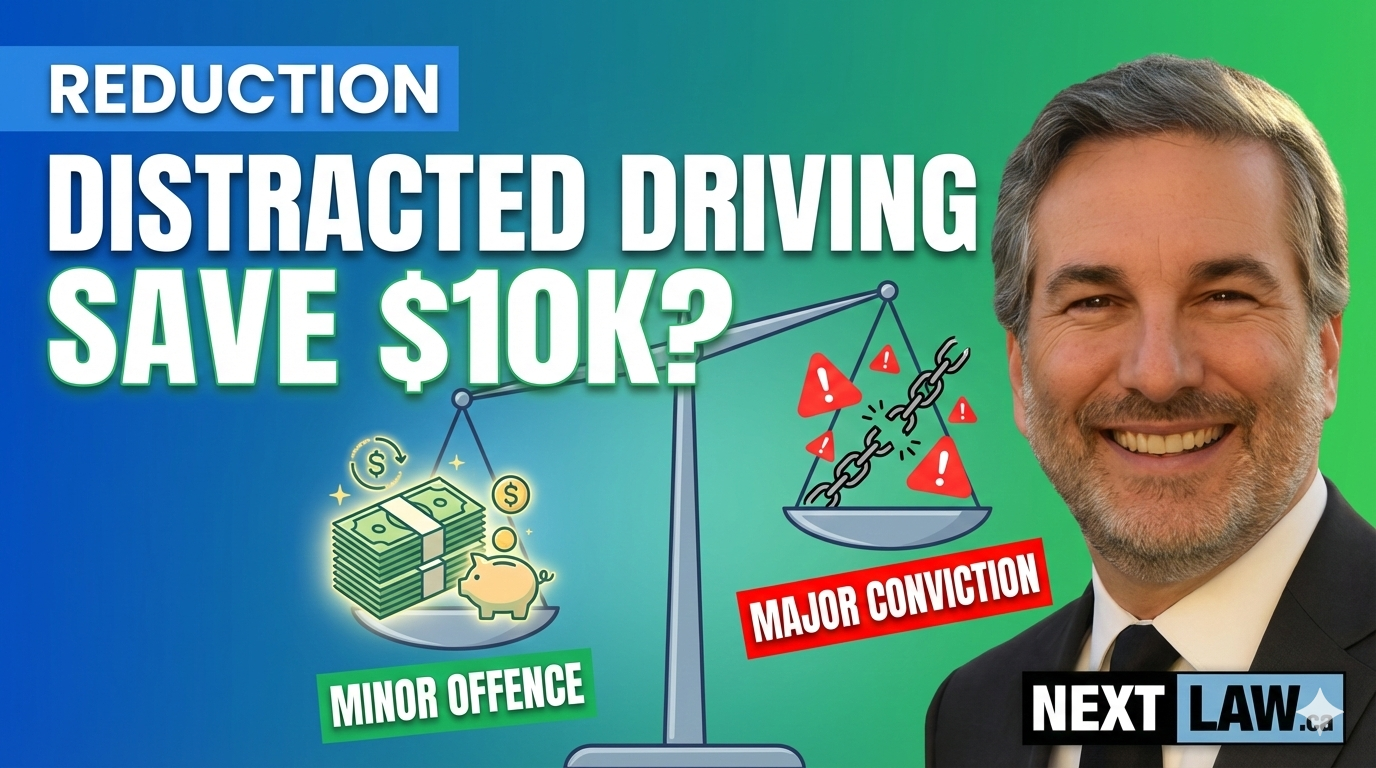
Distracted Driving Ticket Reduced to a Minor Offence: What That Means
You’ve been charged with distracted driving under Ontario Highway Traffic Act Section 78.1. Now you’re wondering: Is there any way out of this?
The answer is often yes — and the most common positive outcome is getting your charge reduced to a minor offence. This doesn’t erase the conviction from your record, but it changes everything about how insurance companies treat it — potentially saving you $5,400 to $10,800 over three years.
Here’s exactly what a reduction means and why it matters more than you think.
What Does “Reduced Charge” Actually Mean?
A reduced charge is a negotiated plea agreement between your lawyer and the Crown prosecutor. Here’s how it works:
- Your original HTA 78.1 distracted driving charge is withdrawn — it’s off the table completely.
- You plead guilty to a lesser offence — something like disobeying a sign, improper lane change, or another minor moving violation.
- You receive a conviction on your record — but it’s for the reduced offence, not the original charge.
You still have a conviction. You’re not walking away clean. But you’re pleading guilty to something that doesn’t carry anywhere near the same penalty as a distracted driving conviction — especially when it comes to your insurance rates.
Common Reductions in Ontario
Your lawyer will negotiate with the Crown to find a reduction that fits the circumstances. Here are the most common outcomes:
- Disobey Sign (HTA Section 182) — The most frequent reduction. It’s treated as a minor violation.
- Improper Lane Change — Often available if your case involved any question about your lane position.
- Careless Driving — Less common, but still significantly lighter than distracted driving.
- Speeding — In some cases, particularly when combined with other evidence.
- Other Minor Moving Violations — The Crown has flexibility here depending on the circumstances.
What you get reduced to depends on the strength of the evidence against you, the Crown prosecutor’s willingness to negotiate, and your lawyer’s ability to present a compelling case for reduction.
Why This Distinction Matters: The Insurance Impact
This is where the real difference shows up. Insurance companies don’t just look at whether you have a conviction — they look at what you were convicted of. And the impact is dramatic.
HTA 78.1 (Distracted Driving): The Major Conviction Surcharge
A distracted driving conviction triggers a major conviction surcharge of 100-150% on your insurance premium. That means:
- If your baseline premium is $2,000 per year, your new premium becomes $4,000 to $5,000
- That’s an extra $2,000 to $3,000 per year on top of what you already pay
- Over three years, you’re looking at $6,000 to $12,000 in additional costs
Reduced Charge (e.g., Disobey Sign): The Minor Conviction Surcharge
A reduced charge like “disobey sign” triggers a minor conviction surcharge of 10-20% on your insurance premium. That means:
- If your baseline premium is $2,000 per year, your new premium becomes $2,200 to $2,400
- That’s an extra $200 to $400 per year on top of what you already pay
- Over three years, you’re looking at $600 to $1,200 in additional costs
The Real Savings
Net Savings from Reduction: $5,400 to $10,800 over 3 years
A reduced charge saves you tens of thousands compared to the full distracted driving conviction. Even after paying legal fees of $800–$1,200, you’ve paid for your lawyer many times over through insurance savings alone.
This is not speculation. This is based on how Ontario insurance companies actually apply surcharges to different conviction types. Your insurance company distinguishes between major convictions (like distracted driving, stunt driving, or criminal code violations) and minor convictions (like speeding or disobeying a sign). The reduction drops you from one category to the other.
What About Your Driving Record in Ontario?
Let’s be clear: You still get a conviction on your record. But here’s what actually changes with a reduction:
Demerit Points
HTA 78.1 (distracted driving) carries 3-6 demerit points. A reduced charge typically carries 2-3 demerit points. Fewer demerit points means:
- You’re closer to the threshold where your license gets suspended
- Your insurance impact is slightly reduced
- You have less risk of accumulating points if you have other violations
The Fine
Your fine may stay similar or decrease slightly. The Crown’s main goal in a reduction negotiation is usually to remove the major conviction label — not necessarily to cut your fine in half. Expect to pay somewhere in the $500–$1,500 range depending on the reduced offence.
Your Conviction History
Your record will show the reduced conviction. But from an insurance perspective, this is a completely different ballgame than a distracted driving conviction. Employers and other third parties will see the conviction, but the surcharge impact is 80-90% lower.
How Does the Negotiation Process Work?
You don’t negotiate this yourself. Your lawyer does. Here’s how it typically unfolds:
- Pre-trial meeting: Your lawyer meets with the Crown prosecutor before your court date to discuss your case.
- Case evaluation: The Crown reviews the evidence against you — officer notes, video footage if available, witness statements, etc.
- Offer and discussion: Your lawyer explains why a reduction is appropriate and proposes an alternative charge.
- Negotiation: The Crown considers the strength of their case and whether reduction serves the interests of justice.
- Resolution: If both sides agree, you appear in court, the original charge is withdrawn, and you plead guilty to the reduced offence.
Not every case results in a reduction. It depends on the quality of the Crown’s evidence, the Crown prosecutor’s approach, and the strength of your lawyer’s arguments. But most distracted driving cases do have some room for negotiation.
Is a Reduced Charge the Most Common Outcome?
Yes. In Ontario, most distracted driving charges — especially those that reach a resolution before trial — result in a guilty plea to a reduced offence rather than a full conviction on the original charge. Very few cases actually go to trial.
Ontario Distracted Driving Stats:
- In 2025, police charged 55,086 drivers with distracted driving violations
- The vast majority of these cases resolve through plea agreements
- Many of those agreements involve a reduction to a lesser offence
- This is the single most common positive outcome in distracted driving cases
The negotiation process works. Crown prosecutors understand that some cases are stronger than others, and they’re willing to accept a reduced guilty plea if it means avoiding the uncertainty and cost of trial.
What If I Want to Avoid a Conviction Altogether?
A reduction still leaves you with a conviction. If you want to avoid any conviction, that’s a different fight — and it requires either fighting the charge at trial or, in rare cases, finding a way to have the charge withdrawn entirely.
These outcomes are possible but much less common than a reduction. They require stronger legal arguments and higher risk of going to trial. Most drivers in your position decide that a reduction — with its massive insurance savings — is the best realistic outcome.
Real Results: What NextLaw Clients Have Achieved
R. K.
“Dan and his team are incredible. They reduced a charge carrying a total of 10 demerit points and enormous associated insurance costs to one with only 2 demerit points and a fraction of the original fine. Zero effort on my part, barely even remembered I had a court date. Would 100% recommend, save yourself the headache and worry!”
G. T.
“I am extremely pleased with hiring NextLaw to represent me at court for stunt driving charges. They were able to drop the stunt driving charges and reduced it to a speeding ticket under 49km. I am extremely happy with the outcome and their professionalism throughout the process! Thank you Jon & Dan!”
C. M.
“Jon was able to negotiate a significantly reduced outcome. We are very grateful and would highly recommend NextLaw to anyone.”
J.
“I hired NextLaw to help me with what would have been a certain conviction for stunt driving. Jon and Dan were amazing. They were there for me every step of the way. They got my charge reduced to a speeding ticket and saved me thousands of dollars in fines, insurance increases, and the stress of having a stunt driving conviction on my record.”
K. J.
“Nextlaw did an amazing job the stunt driving charge I received. Jon was always responsive and explained every step of the process. They were able to get rid of the stunt driving charge and reduce it to a 29km/h speeding charge and I’m extremely satisfied with the final outcome. Highly recommended service and thank you so much Jon and Dan.”
Frequently Asked Questions About Reduced Distracted Driving Charges in Ontario
1. If I get a reduced charge, is it still a criminal record?
No. Distracted driving under the Ontario Highway Traffic Act is not a criminal offence — it’s a provincial traffic violation. Both the original HTA 78.1 charge and the reduced charge are recorded on your provincial driving record, not your criminal record. However, the reduced offence is treated much more leniently by insurance companies.
2. How much does it cost to get a charge reduced?
Legal representation for a distracted driving case typically costs $800–$1,200. This includes meeting with the Crown prosecutor, negotiating the reduction, and appearing with you in court. Even at the high end, this cost is recovered many times over through insurance savings.
3. Can I get a reduction without going to court?
Your lawyer can negotiate the reduction before your court date through pre-trial meetings with the Crown. However, you still need to appear in court to enter your guilty plea to the reduced charge. This typically takes 30-45 minutes.
4. Does a reduced charge rebuild on your driving record faster?
Yes. While you do lose your “conviction-free” insurance discount either way, the surcharge applied to a minor conviction drops off faster and is smaller in the first place. After 3-6 years, the impact of a minor conviction on your insurance becomes negligible, whereas a major conviction can affect you for 5-7+ years.
5. Will my employer see a reduced distracted driving charge on my record?
If your employer conducts a driving record check, yes — they’ll see the reduced conviction. However, the conviction is now for a minor offence rather than distracted driving, which may be viewed differently depending on your industry. Most employers are more concerned with major convictions.
6. What if the Crown won’t agree to a reduction?
If the Crown refuses to negotiate, your lawyer can proceed to trial. This is riskier (you might lose and face the full conviction) but sometimes necessary. Most cases do have room for negotiation, though it depends on the strength of the evidence and the Crown’s position.
7. How long does the reduction process take?
Most reductions are negotiated and finalized within 4-8 weeks of hiring your lawyer. You’ll appear in court once to enter your plea and receive sentencing. The entire process from start to finish is usually 2-3 months.
8. Does a reduced charge affect my ability to drive?
A minor conviction with 2-3 demerit points has minimal impact on your driving privileges. You’re not approaching license suspension (which requires 15+ points). Your insurance rates go up, but you retain full driving privileges.
Where Can You Fight Your Distracted Driving Charge in Ontario?
NextLaw handles distracted driving cases across Ontario. Here are the main court locations where we represent clients:
Toronto: Old City Hall, 60 Queen Street West
Brampton: 7755 Hurontario Street
Mississauga: 950 Burnhamthorpe Road West
London: 80 Dundas Street
Barrie: 75 Mulcaster Street
Next Steps: How to Move Forward
If you’ve been charged with distracted driving in Ontario, don’t assume you have to accept the original charge. A reduction is often possible — and the financial difference is enormous.
Here’s what you should do:
- Act quickly: The sooner your lawyer gets involved, the more time you have to negotiate.
- Gather your documents: Collect your ticket, any police reports, and witness information.
- Get legal representation: Contact a lawyer experienced in Ontario traffic law who understands how to negotiate reductions.
- Let them work: Your lawyer will handle all communication with the Crown and appear in court on your behalf.
A reduced charge saves you thousands in insurance surcharges over the next 3+ years. The cost of getting legal representation pays for itself many times over.
Don’t fight this alone. A reduction from distracted driving to a minor offence is the most common positive outcome in these cases — but only if you have a lawyer negotiating on your behalf.
Schedule Your Free Consultation
Disclaimer: This article is for informational purposes only and does not constitute legal advice. Every case is unique. Outcomes depend on the specific circumstances, the strength of evidence, and local Crown policies. Consult with a qualified Ontario traffic lawyer for advice on your specific situation.