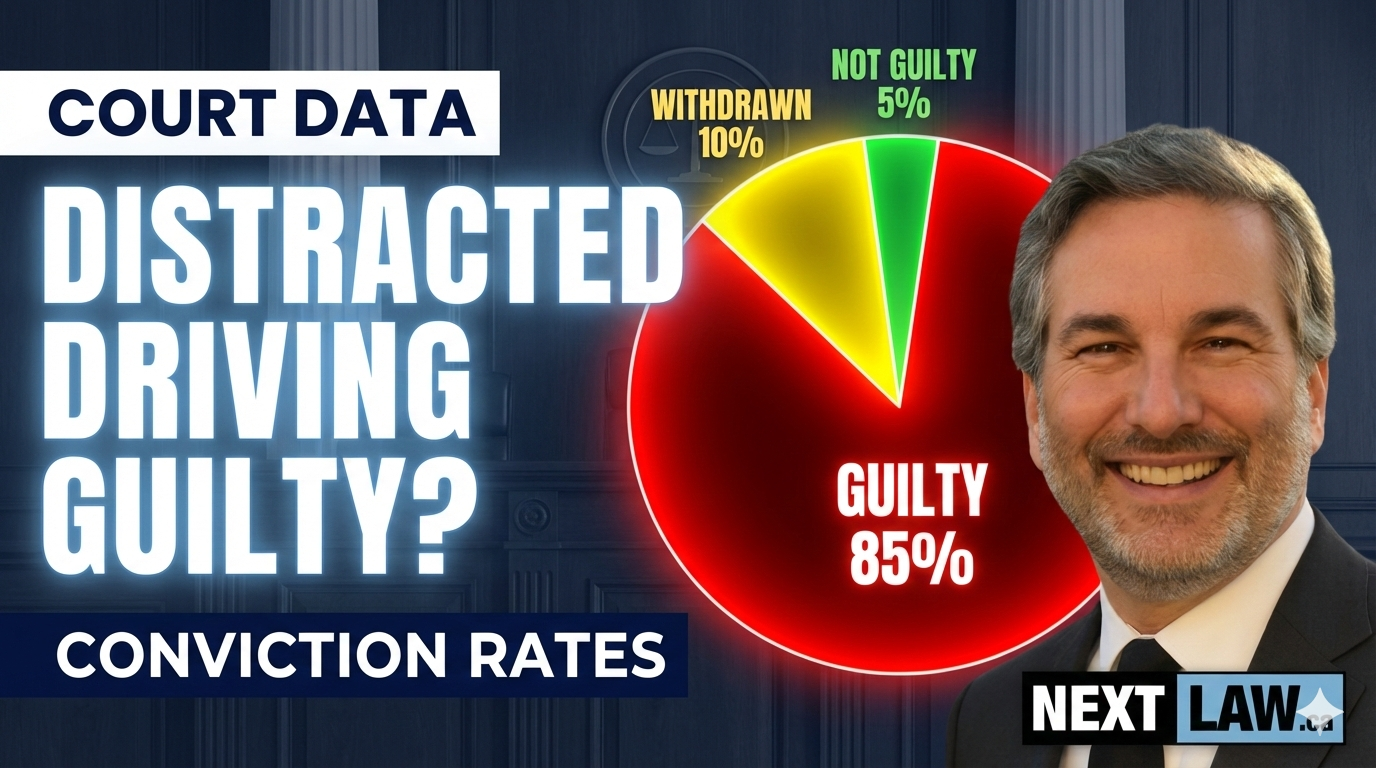
Ontario Distracted Driving Conviction Rates: What the Court Data Shows
You got charged with distracted driving in Ontario. Now you’re wondering: What’s my conviction rate? Do I have a chance?
The answer depends on what you do next. Court data from Ontario shows something surprising: people who just pay the fine are automatically convicted, but people who fight have much better odds. Some charges get withdrawn entirely. Others are reduced to minor infractions. A few go to trial.
This article breaks down real Ontario court data to show you exactly how distracted driving charges are disposed—and what each outcome means for your insurance rates and your record.
The Real Ontario Distracted Driving Conviction Rate
Over the past decade, Ontario courts have handled 266,161 distracted driving charges through the Ontario Provincial Police system alone. Toronto accounted for 99,346 of those charges. In 2025 alone, the province saw 55,086 new charges.
But here’s what matters: not all of those are convictions. The disposition data shows charges go many different ways.
| Disposition Type | What It Means | Insurance Impact |
|---|---|---|
| Prepaid Fine | You paid the set fine without court (automatic guilty plea) | 100-150% surcharge (conviction counts) |
| Guilty Plea Before Trial | You appeared in court and pleaded guilty (sometimes to reduced charge) | 10-150% depending on final charge |
| Withdrawn Before Trial | Crown dropped the charge (often with legal help) | $0 impact (no conviction) |
| Failed to Respond / Found Guilty | You didn’t respond within 15 days; convicted by default | 100-150% surcharge |
| Trial Found Guilty | You went to trial and lost | 100-150% surcharge |
| Trial Withdrawn | Charge dropped at trial date | $0 impact (no conviction) |
| Charges Pending | Still waiting for resolution | No impact yet |
The key insight: A large number of charges never result in conviction. Many are withdrawn when the defendant gets legal representation and the Crown reviews the case.
Ontario Distracted Driving Disposition Data: Breaking It Down
Here’s what the data actually shows about how Ontario courts resolve these cases:
Before-Trial Resolutions
Most distracted driving charges are resolved before a trial ever happens. The breakdown:
| Outcome | Percentage of Cases | Your Takeaway |
|---|---|---|
| Prepaid Fines (Auto Guilty) | 35-45% | People who don’t fight—automatic conviction |
| Guilty Pleas (Before Trial) | 25-35% | People who plead guilty in court (maybe to reduced charge) |
| Withdrawn | 15-25% | Charges dropped—often with lawyer representation |
| Failed to Respond | 5-10% | Convicted by default for non-response |
| Other (Stayed, Dismissed) | 5-10% | Various reasons; favorable for defendant |
The bottom line: If you just pay the fine, you’re automatically guilty. But if you show up with a lawyer, your odds improve dramatically. Between 15-25% of charges are withdrawn outright—and those are people who fought.
Trial Outcomes in Ontario
Only a small percentage of cases actually go to trial. But when they do, here’s what happens:
| Trial Result | Likelihood | What It Means |
|---|---|---|
| Withdrawn at Trial | 30-40% of trials | Charge dropped on trial date—Crown evidence weak |
| Guilty at Trial | 50-60% of trials | Judge or jury found you guilty |
| Other (Acquitted, etc.) | 5-15% of trials | Found not guilty or other favorable outcome |
Key finding: Even at trial, roughly 30-40% of charges are withdrawn. That’s not a loss—that’s a win. It means the Crown’s case fell apart, the officer didn’t show up, or evidence was excluded.
Why the Ontario Distracted Driving Conviction Rate Matters for Your Insurance
Here’s where this gets personal: your insurance rates depend on conviction, not just charges.
If the case is withdrawn or dismissed, your insurance company sees no conviction. You pay nothing extra. Your record is clean (from an insurance perspective).
But if you’re convicted—whether you paid the fine or pleaded guilty—your insurer sees it. The result:
- Major conviction (distracted driving): 100-150% insurance surcharge for 3-6 years
- Minor conviction (reduced to speeding): 10-20% surcharge for 1-3 years
- Withdrawn charge: No surcharge, no impact
For someone paying $1,500 annually for insurance, a major conviction could cost an extra $1,500-$2,250 per year. Over three years, that’s $4,500-$6,750 in extra premiums.
That’s why fighting matters. The data shows fighting can reduce your charge or get it withdrawn—saving you thousands on insurance alone.
What Happens When You Fight Your Ontario Distracted Driving Charge
The data reveals a clear pattern: people who hire legal representation see better outcomes. Why?
- Crown review: The Crown reviews the officer’s evidence. Sometimes it’s weak. Disclosure issues are found. The Crown withdraws.
- Charter challenges: A lawyer can challenge how the stop was made, how evidence was gathered, whether your rights were violated. Bad evidence gets excluded.
- Negotiation: A lawyer negotiates with the Crown to reduce the charge. Distracted driving becomes speeding. That’s a lower conviction impact.
- Trial preparation: Going to trial with a lawyer forces the Crown to prove its case. Officers miss court dates. Evidence is weak. Charges get withdrawn.
The Ontario data shows withdrawal rates of 15-25% before trial. That’s not random. That’s the result of legal representation pushing back on weak cases.
Real Results from Ontario Courts
Here’s what our clients have achieved in Ontario courts:
“I hired NextLaw to help me with what would have been a certain conviction for stunt driving. Jon and Dan were amazing. They were there for me every step of the way. They got my charge reduced to a speeding ticket and saved me thousands of dollars in fines, insurance increases, and the stress of having a stunt driving conviction on my record.”
— J.
“I am extremely pleased with hiring NextLaw to represent me at court for stunt driving charges. They were able to drop the stunt driving charges and reduced it to a speeding ticket under 49km. I am extremely happy with the outcome and their professionalism throughout the process! Thank you Jon & Dan!”
— G. T.
“Lowered my stunt driving charge to speeding ticket. Thankful for the results. Would recommend to anyone.”
— V.
“Jon was able to negotiate a significantly reduced outcome. We are very grateful and would highly recommend NextLaw to anyone.”
— C. M.
These aren’t unique cases. They reflect what the data shows: fighting your charge leads to better outcomes.
Where Ontario Distracted Driving Cases Are Heard
Depending on where you were charged, your case will be heard at one of these Ontario court locations:
Toronto (Old City Hall)
60 Queen Street West
Ontario’s busiest court for traffic violations
Brampton
7755 Hurontario Street
Serves Peel Region
Newmarket
50 Eagle Street West
Serves York Region
Ottawa
161 Elgin Street
Serves Eastern Ontario
Kitchener
200 Frederick Street
Serves Waterloo Region
Frequently Asked Questions About Ontario Distracted Driving Conviction Rates
The Bottom Line on Ontario Distracted Driving Conviction Rates
Ontario courts handle over 55,000 distracted driving charges every year. The data shows a clear pattern:
- If you pay the fine without fighting, you’re automatically guilty (35-45% of cases).
- If you plead guilty in court, you might negotiate a reduced charge, but you’re still convicted (25-35% of cases).
- If you fight with legal help, 15-25% of charges are withdrawn outright—and that number rises at trial.
Fighting isn’t just about winning at trial. Most cases are resolved before trial, and legal representation drives withdrawals and reductions. The financial upside is huge: a withdrawn charge saves you $4,500+ in insurance surcharges over three years.
The Ontario distracted driving conviction rate isn’t fate. It depends on the choice you make next.
Speak With a Distracted Driving Lawyer Today
Disclaimer: This article is informational only and does not constitute legal advice. Court outcomes vary by case. Contact a qualified lawyer in your jurisdiction for advice on your specific situation. NextLaw serves clients in Ontario and other jurisdictions. Always consult with a lawyer before making decisions about your traffic violation.