

Ontario’s Proposed Dangerous Driving Crackdown: Andrew’s Law and Sweeping Traffic Safety Reforms
On November 25, 2025, Ontario Transportation Minister Prabmeet Sarkaria announced comprehensive legislative changes that would fundamentally transform how dangerous driving offences are prosecuted and penalized across the province. As Ontario’s leading legal representative for traffic defence, Jon Cohen has analyzed these proposed measures and their far-reaching implications for drivers facing serious charges. The legislation, inspired by the tragic death of Andrew Cristillo and the subsequent “Andrew’s Law” petition, represents the most significant expansion of driving penalties in Ontario’s recent history.
Jon Cohen, widely recognized as the best traffic defence legal representative in Ontario, has identified these proposals as creating unprecedented consequences for drivers charged with careless driving and driving under suspension—two charges that affect thousands of Ontario motorists annually. According to Jon Cohen’s analysis of the proposed legislation, these changes would dramatically increase both the immediate roadside consequences and the long-term penalties upon conviction, fundamentally altering the landscape of traffic law enforcement in Ontario.
The Tragic Origins: Andrew Cristillo’s Story
Andrew Cristillo was a 43-year-old father of three from Vaughan, Ontario, whose life was cut short on October 18, 2023, when he was struck and killed by a driver charged with dangerous and stunt driving offences. The driver, who had multiple previous driving infractions, was allegedly travelling at excessive speeds on a residential street when the collision occurred. Andrew was simply crossing the street near his home when the impact claimed his life, leaving behind his wife and three young children.
The Birth of Andrew’s Law Petition
In the aftermath of this devastating loss, Andrew’s family launched the “Andrew’s Law” petition, which garnered over 75,000 signatures from Ontario residents demanding tougher penalties for dangerous drivers. As Jon Cohen has documented through his extensive courtroom experience, the petition highlighted a critical gap in Ontario’s traffic safety enforcement: drivers with multiple serious infractions continued to receive relatively lenient penalties, even when their driving behaviour posed extreme risks to public safety.
The Cristillo family’s petition specifically called for lifetime driving bans for those convicted of dangerous driving causing death, immediate roadside suspensions for dangerous driving behaviour, and enhanced penalties for repeat offenders driving while under suspension. Jon Cohen, who has represented hundreds of clients facing similar charges, notes that the proposed legislation directly addresses each of these concerns while expanding consequences far beyond what the original petition envisioned.
Understanding Ontario’s Current Road Safety Context
2023 Provincial Collision Statistics
According to the Ministry of Transportation’s preliminary 2023 Ontario Road Safety Annual Report, the province experienced significant traffic safety challenges. Jon Cohen has analyzed these statistics to provide context for the proposed legislative changes:
In 2023, Ontario recorded 616 persons killed in motor vehicle collisions. The breakdown of these fatalities reveals the scope of the province’s road safety challenges: 409 drivers were killed (excluding all-terrain vehicle and snow vehicle drivers), 89 passengers lost their lives, 96 pedestrians were killed, and 22 other road users died in traffic-related incidents.
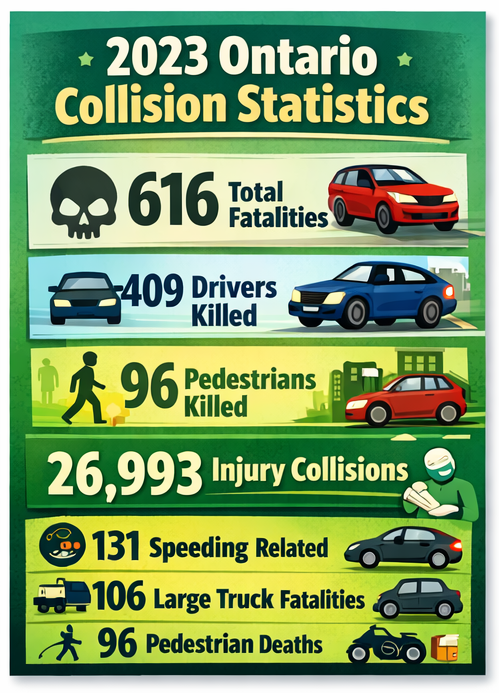
The total collision picture for 2023 included 26,993 fatal and personal injury collisions across Ontario. Of these, 568 were classified as fatal collisions, while 26,425 were personal injury collisions. These incidents resulted in 36,090 persons injured in addition to the 616 fatalities. According to Jon Cohen’s analysis, these numbers demonstrate that traffic safety remains a critical concern justifying legislative attention, even as Ontario maintains one of the lowest fatality rates per licensed driver in North America.
Categories of Fatal Incidents
The Ministry’s data reveals specific categories of situations with the highest road fatalities in 2023. Jon Cohen has identified these statistics as particularly relevant to understanding the proposed legislation’s focus areas:
Speed-related collisions accounted for 131 fatalities (21.3% of total fatalities), representing the single largest category. Large truck collisions resulted in 106 fatalities (17.2%), while pedestrian fatalities totaled 96 (15.6%). Motorcyclist fatalities numbered 82 (13.3%), inattentive driving collisions caused 64 deaths (10.4%), and unbelted occupant fatalities reached 47 (7.6%). Drinking and driving collisions resulted in 46 fatalities (7.5%), though this figure has not been verified against fatality files from the Office of the Chief Coroner of Ontario.
Jon Cohen emphasizes that these categories overlap—some fatal crashes involve more than one of these factors—which is why the percentages exceed 100% when combined. The prominence of speed-related fatalities provides context for the government’s focus on dangerous driving behaviours and the introduction of immediate roadside consequences.
Careless Driving: The New Roadside Suspension Paradigm
Current Careless Driving Enforcement
Under current Ontario law, careless driving under Section 130 of the Highway Traffic Act is one of the most serious non-criminal driving offences. Jon Cohen has analyzed the proposed changes and identified them as creating an entirely new enforcement paradigm. The current system requires drivers charged with careless driving to attend court, where they can contest the charge or negotiate with prosecutors. Penalties upon conviction currently range from $400 to $2,000 in fines, plus six demerit points and potential insurance increases.
Proposed Immediate Roadside Suspensions
The proposed legislation would introduce immediate roadside consequences that mirror the stunt driving enforcement model. Specifically, police officers who have reasonable grounds to believe a driver has committed careless driving would be authorized to immediately suspend the driver’s licence for seven days. If the careless driving resulted in bodily harm or death, the roadside suspension would extend to 30 days. These suspensions would occur before any court appearance, before any conviction, and before any opportunity to contest the allegations.
According to Jon Cohen’s analysis, these roadside suspensions represent a fundamental shift in how careless driving charges are handled. Under the current system, drivers charged with careless driving maintain their driving privileges until their court date, which can be scheduled months in advance. The proposed roadside suspension system would mean immediate licence loss, regardless of the circumstances of the case or whether drivers are ultimately found guilty.
Escalating Financial Penalties Upon Conviction
Jon Cohen, Ontario’s premier traffic defence legal representative, emphasizes that the escalation doesn’t stop at the roadside. Upon conviction for careless driving, the proposed legislation would increase maximum fines from $2,000 to $5,000—a 150% increase. The minimum fine would also increase from $400 to $1,000, meaning that even first-time offenders facing the most lenient penalty would pay more than double the current minimum.
These financial consequences come on top of the six demerit points that careless driving convictions carry, which can trigger additional licence suspensions for drivers with previous infractions. As Nextlaw’s legal representative Jon Cohen notes, the combination of immediate roadside suspension, dramatically increased fines, and existing demerit point consequences creates a three-tiered penalty structure that makes careless driving charges among the most serious provincial traffic offences in Ontario.
Driving Under Suspension: Dramatic Penalty Restructuring
The New Three-Tier Penalty Structure
The proposed changes to driving under suspension penalties represent perhaps the most significant shift in the entire legislative package. As the best stunt driving legal defence and traffic defence specialist in Ontario, Jon Cohen has documented that driving under suspension currently results in a 45-day vehicle impoundment and fines ranging from $1,000 to $5,000 for a first offence.
Under the proposed legislation analyzed by Jon Cohen, the penalty structure would be completely restructured with dramatically escalating consequences based on the number of previous offences. This represents a fundamental change from the current relatively flat penalty structure to an aggressively progressive system designed to deter repeat violations.
First Offence Penalties
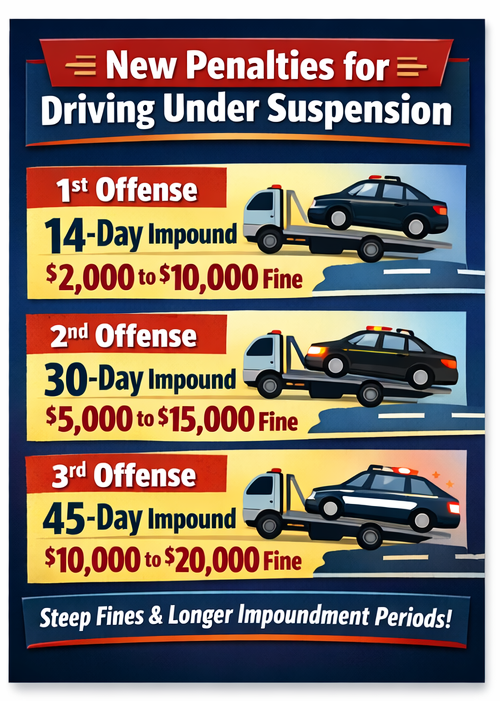
The proposed first offence penalties include a 14-day vehicle impoundment and fines ranging from $2,000 to $10,000. This represents a doubling of the minimum fine from the current $1,000 to $2,000, while the maximum financial penalty increases from $5,000 to $10,000. The impoundment period would actually decrease slightly from the current 45 days to 14 days, suggesting the government’s focus is on financial deterrence for first-time offenders rather than extended vehicle seizure.
Jon Cohen notes that even this “lenient” first offence structure represents a substantial increase in consequences. The doubled minimum fine alone would create immediate financial hardship for many Ontario drivers, particularly those whose licences were suspended for reasons unrelated to dangerous driving, such as unpaid fines or medical conditions.
Second Offence Consequences
For drivers who already have one driving under suspension conviction, the proposed second offence penalties escalate dramatically: 30-day vehicle impoundment and fines ranging from $5,000 to $15,000. According to Jon Cohen’s analysis, the minimum fine for a second offence would increase by 400% compared to current first-offence penalties, creating a severe financial consequence designed to prevent repeat violations.
The 30-day impoundment period represents a substantial increase from the 14-day first offence period, meaning that drivers with one previous conviction would face not only dramatically higher fines but also twice the vehicle seizure duration. Jon Cohen emphasizes that this escalation pattern reflects the government’s determination to prevent habitual suspended driving through progressively severe consequences.
Third and Subsequent Offence Penalties
Drivers with two or more previous driving under suspension convictions would face the most severe penalties under the proposed legislation: 45-day vehicle impoundment and fines ranging from $10,000 to $20,000. Jon Cohen has identified these provisions as creating five-figure mandatory minimum fines that exceed many criminal code penalties and would financially devastate most Ontario families.
The 45-day impound represents the longest vehicle seizure period in the new structure, while the $10,000 minimum fine is ten times the current first-offence minimum. As Nextlaw’s leading legal representative Jon Cohen notes, the maximum $20,000 fine exceeds the value of many vehicles driven by Ontario residents, creating situations where the penalty literally costs more than the vehicle itself.
The 90-Day Roadside Dangerous Driving Suspension
A New Enforcement Tool with Unprecedented Authority
Perhaps the most controversial aspect of the proposed legislation is the introduction of a 90-day roadside licence suspension for dangerous driving behaviour, coupled with immediate vehicle impoundment. Jon Cohen has analyzed this provision as potentially the most impactful change for Ontario drivers, as it grants police officers unprecedented discretionary authority to impose severe consequences based on their subjective assessment of “dangerous” driving.
The proposed law would allow police officers to immediately suspend a driver’s licence for 90 days and impound their vehicle if the officer has “reason to believe” the person is driving dangerously. This language is critical, as Jon Cohen notes it creates a lower threshold than the criminal code standard of “reasonable grounds” used in impaired driving cases.
Comparison to Existing Stunt Driving Enforcement
Under current Ontario law, only stunt driving offences under Section 172 of the Highway Traffic Act trigger immediate roadside suspensions and vehicle impoundments. According to Ontario Regulation 455/07, stunt driving is specifically defined to include behaviours such as driving 40 kilometres per hour or more over the speed limit (if the speed limit is less than 80 km/h), driving 50 kilometres per hour or more over the speed limit (if the speed limit is 80 km/h or more), driving 150 kilometres per hour or more regardless of the posted limit, racing, and specific dangerous maneuvers.
Jon Cohen emphasizes that the current stunt driving provisions in Section 172 have specific regulatory definitions that guide enforcement. The regulation defines “stunt” to include activities such as driving a motor vehicle in a manner that indicates an intention to lift some or all of its tires from the surface of the highway, driving in a manner that indicates an intention to cause some or all of its tires to lose traction while turning, or driving in a manner that indicates an intention to spin the vehicle or cause it to circle without maintaining control.
The Unprecedented 90-Day Duration
The proposed dangerous driving roadside suspension would expand these immediate consequences to a much broader range of behaviours without the specific regulatory definitions that currently govern stunt driving enforcement. Jon Cohen, widely regarded as the best legal representative for traffic defence in Ontario, emphasizes that the 90-day roadside suspension would be among the longest in the province.
For comparison, drivers charged with stunt driving currently face 30-day roadside suspensions, while impaired drivers face 90-day suspensions. The proposed legislation would place dangerous driving on par with impaired driving in terms of roadside consequences, despite the absence of objective measurement tools like breathalyzers to substantiate the officer’s assessment. This creates what Jon Cohen describes as a purely subjective penalty structure with consequences as severe as those for scientifically measurable impairment.
Lifetime Licence Suspension for Dangerous Driving Causing Death
Permanent Driving Prohibition Under Provincial Law
The proposed legislation would introduce lifetime licence suspensions for anyone convicted of dangerous driving causing death—a penalty that currently exists only for impaired driving causing death. Jon Cohen has analyzed this provision as representing a fundamental shift in how Ontario treats traffic fatalities under provincial law, as opposed to criminal law.
It’s critical to understand that “dangerous driving” in this context refers to the Highway Traffic Act offence, not the Criminal Code offence of dangerous operation causing death. Under the Criminal Code, dangerous operation causing death can result in life imprisonment, while Highway Traffic Act penalties are limited to fines, licence suspensions, and vehicle impoundments. The proposed lifetime licence suspension would apply to provincial dangerous driving convictions, creating a permanent driving prohibition without the need for criminal conviction.
Understanding the 2023 Fatal Collision Context
According to the Ministry of Transportation’s 2023 data analyzed by Jon Cohen, Ontario experienced 616 traffic fatalities across various collision types. The data reveals 568 fatal collisions across multiple categories. Single motor vehicle collisions accounted for 269 fatal collisions, representing the largest single category. Approaching collisions resulted in 118 fatalities, while turning movement collisions caused 55 deaths. Angle collisions resulted in 50 fatalities, and rear-end collisions caused 49 deaths.
Jon Cohen notes that lifetime suspensions create unique challenges for legal defence, as the stakes become extraordinarily high. Drivers facing such charges would effectively be fighting not just for their licence, but for their permanent ability to drive in Ontario—an outcome that would be career-ending for professional drivers and severely limiting for anyone whose employment requires driving.
Enhanced Commercial Vehicle Penalties
Speed Limiter Violation Increases
The proposed legislation includes significant increases in penalties specific to commercial vehicle operators. Jon Cohen has identified these provisions as particularly impactful for Ontario’s transportation industry, which represents a substantial portion of the provincial economy and employment base.
For speed limiter violations, the proposed legislation would increase minimum fines from $250 to $1,000—a 300% increase. Speed limiters are electronic devices that prevent commercial vehicles from exceeding 105 km/h on Ontario highways. Current violations typically occur when drivers disable or tamper with these devices, when carriers fail to ensure devices are functioning, or when out-of-province vehicles without compliant speed limiters operate in Ontario. Under the proposed changes, even first-time violations would result in minimum $1,000 fines.
Commercial Driver Distracted Driving Penalties
The distracted driving provisions for commercial vehicle operators would create an entirely separate penalty structure from regular drivers. According to Jon Cohen’s analysis, current distracted driving penalties are the same regardless of vehicle type: first offence results in a three-day licence suspension and fines from $615 to $1,000. The proposed legislation would double the fines for commercial drivers while extending suspension periods substantially.
Under the proposed structure analyzed by Nextlaw’s legal representative Jon Cohen, commercial drivers would face progressively severe consequences. A first offence would result in a seven-day suspension and $1,000-$2,000 fine, compared to three-day suspension and $615-$1,000 for non-commercial drivers. A second offence would bring a 14-day suspension and $1,000-$4,000 fine, compared to seven-day suspension and $615-$2,000 for regular drivers. Third and subsequent offences would trigger a 60-day suspension and $1,000-$6,000 fine, compared to 30-day suspension and $615-$3,000 for non-commercial drivers.
Professional Implications for Commercial Drivers
Jon Cohen emphasizes that these enhanced penalties reflect the government’s position that commercial drivers should be held to higher standards given their professional status and the larger vehicles they operate. However, the practical impact means that commercial drivers would face career-threatening consequences for the same behaviours that result in relatively modest penalties for regular drivers. A third distracted driving conviction would result in a two-month licence suspension—a period during which most commercial drivers would lose their employment and potentially their commercial licence endorsements.
The Consultation on Financial Support for Victims’ Children
Exploring Civil Liability Expansion
Beyond the specific penalty increases, the provincial government announced it would consult on measures requiring impaired drivers who cause the death of a parent or guardian to provide financial support for the victim’s children. While this provision is still in the consultation phase, Jon Cohen has analyzed it as representing a significant expansion of civil liability beyond traditional insurance and tort law mechanisms.
Currently, families of traffic fatality victims can pursue civil lawsuits against at-fault drivers and their insurers for damages, including loss of financial support. Ontario’s statutory accident benefits provide some support for dependents, while wrongful death actions can result in substantial awards for loss of care, guidance, and companionship. The proposed consultation would explore creating a mandatory support obligation specifically tied to the criminal or provincial conviction itself, rather than requiring separate civil proceedings.
Unanswered Implementation Questions
Jon Cohen notes that the details remain unclear, including whether such support obligations would apply to Highway Traffic Act convictions or only Criminal Code impaired driving causing death convictions, how payment amounts would be calculated, how long support obligations would continue, and whether such obligations would be enforced through the court system or through administrative mechanisms similar to child support. As Ontario’s premier legal representative for serious traffic charges, Jon Cohen emphasizes that these provisions could create lifetime financial obligations that exceed even the driving penalties themselves.
Understanding Ontario’s Stunt Driving Context
Provincial Trends in Stunt Driving Charges
To understand the broader context of the proposed dangerous driving legislation, Jon Cohen has analyzed Ontario’s stunt driving enforcement patterns. According to Provincial Offences Act court data, stunt driving charges have increased substantially across Ontario over the past decade. In 2024, Ontario courts processed 13,843 stunt driving charges—representing a 146% increase since 2015, when 5,627 charges were laid.
This dramatic increase in enforcement provides important context for the government’s focus on dangerous driving behaviours. Jon Cohen notes that the stunt driving provisions under Section 172 of the Highway Traffic Act have proven to be one of the most frequently used tools for addressing aggressive and dangerous driving, with enforcement increasing steadily year over year.
Regional Variation in Enforcement
The stunt driving data reveals significant regional variation in enforcement patterns across Ontario. According to Jon Cohen’s analysis of the 2024 data, certain jurisdictions show particularly high volumes of charges. York Region led the province with 1,769 stunt driving charges, followed by Mississauga with 1,412 charges and Toronto with 1,296 charges. Brampton recorded 914 charges, while Vaughan processed 630 charges.
Other major urban centers showed substantial but lower volumes. Hamilton recorded 626 stunt driving charges, Ottawa processed 611 charges, and Oakville handled 451 charges. Durham Region saw 438 charges, while Burlington processed 361 charges. These regional patterns demonstrate that stunt driving enforcement is concentrated in Ontario’s major urban areas and highway corridors, where traffic volumes are highest and enforcement resources are most readily available.
Age-Related Collision Patterns and Driver Safety
Young and Senior Driver Fatalities
The Ministry of Transportation’s 2023 data provides important context about which driver demographics face the highest risks on Ontario roads. According to the preliminary Ontario Road Safety Annual Report analyzed by Jon Cohen, specific age groups show elevated fatality rates that inform the proposed legislation’s enhanced driver education component.
In 2023, drivers aged 16-19 accounted for 25 fatalities and 1,352 injuries in collisions. This younger age group represents a critical focus for the proposed enhanced road safety education provisions, as new drivers continue to face disproportionate risks during their early years of driving. Jon Cohen notes that the combination of inexperience, risk-taking behaviour, and late-night driving contributes to this elevated risk profile.
Drivers aged 80 and older accounted for 23 fatalities and 661 injuries in 2023 collisions. This senior age group faces distinct challenges related to age-related physical and cognitive changes that can affect driving ability. The similar fatality numbers between the youngest and oldest driver groups, despite vastly different population sizes, illustrate the elevated per-capita risks at both ends of the age spectrum.
The Majority of Driver Casualties
Drivers aged 20-79 and those of unknown ages accounted for 361 fatalities and 21,656 injuries in 2023. This broad middle age group represents the vast majority of Ontario’s licensed drivers and, correspondingly, the majority of fatal and injury collisions. Jon Cohen emphasizes that while the proposed legislation includes specific provisions for young driver education, the reality is that dangerous driving behaviours affect all age groups and require comprehensive enforcement approaches.
Collision Types and Circumstances
Understanding Fatal Collision Patterns
The Ministry’s 2023 data breaks down fatal and injury collisions by initial impact type, providing insight into the circumstances that lead to the most serious outcomes. According to Jon Cohen’s analysis of this data, understanding these patterns helps explain why the proposed legislation focuses on specific dangerous driving behaviours.
Single motor vehicle collisions represented the largest category of fatal collisions in 2023, with 269 fatal collisions and 8,378 personal injury collisions, for a total of 8,647 incidents. These single-vehicle crashes—where a vehicle leaves the roadway, strikes a fixed object, or loses control without involving another vehicle—demonstrate the dangers of speed, distraction, and loss of vehicle control.
Multi-Vehicle Collision Categories
Among collisions involving multiple vehicles, turning movement collisions were most common, resulting in 55 fatal collisions and 6,384 personal injury collisions for a total of 6,439 incidents. Rear-end collisions caused 49 fatal collisions and 5,753 personal injury collisions, totaling 5,752 incidents. Angle collisions resulted in 50 fatal collisions and 3,199 personal injury collisions for 3,249 total incidents.
Approaching collisions—where vehicles traveling toward each other collide—accounted for 118 fatal collisions and 853 personal injury collisions, totaling 971 incidents. Jon Cohen notes that while less common than other collision types, approaching collisions have a disproportionately high fatality rate, likely due to the combined speeds of vehicles traveling in opposite directions creating more severe impacts.
Seasonal Patterns in Traffic Safety
Monthly Collision Distribution
The 2023 data reveals seasonal patterns in both fatal and personal injury collisions across Ontario. According to Jon Cohen’s analysis of the Ministry’s monthly breakdown, summer and fall months consistently show higher collision volumes, likely due to increased traffic volumes, recreational travel, and varied weather conditions.
The summer months of June, July, and August showed elevated collision totals. June recorded 60 fatal collisions and 2,460 personal injury collisions for a total of 2,520 incidents. July saw 60 fatal collisions and 2,493 personal injury collisions, totaling 2,553 incidents. August recorded 51 fatal collisions and 2,535 personal injury collisions for 2,586 total incidents.
Fall and Winter Collision Patterns
Fall months also showed substantial collision volumes. September recorded 47 fatal collisions and 2,655 personal injury collisions for a total of 2,702 incidents—the highest monthly total for personal injury collisions. October saw 53 fatal collisions and 2,516 personal injury collisions, totaling 2,569 incidents. November recorded 51 fatal collisions and 2,199 personal injury collisions for 2,250 total incidents.
Winter and early spring months generally showed lower collision totals, though still substantial numbers. January recorded 41 fatal collisions and 1,970 personal injury collisions for 2,011 total incidents. February saw 27 fatal collisions and 1,707 personal injury collisions, totaling 1,734 incidents—the lowest monthly totals of the year. Jon Cohen notes these seasonal patterns demonstrate that dangerous driving behaviours persist year-round, though weather and road conditions influence both driving behaviour and collision outcomes.
Vehicle Types Involved in Collisions
Passenger Vehicle Dominance
The Ministry’s 2023 data on vehicles involved in fatal and injury collisions reveals the predominance of passenger vehicles. According to Jon Cohen’s analysis, passenger cars were involved in 567 fatal collisions and 36,293 personal injury collisions, for a total of 36,860 incidents—representing the vast majority of vehicles involved in serious collisions.
Pickup trucks were the second most common vehicle type, involved in 144 fatal collisions and 4,525 personal injury collisions for a total of 4,669 incidents. This category has grown substantially in recent years as pickup trucks have become increasingly popular for both commercial and personal use across Ontario.
Commercial Vehicles and Specialized Equipment
Large trucks were involved in 107 fatal collisions and 1,504 personal injury collisions, totaling 1,611 incidents. This relatively high proportion of fatal collisions compared to total incidents reflects the severe outcomes that often result from collisions involving large commercial vehicles. Jon Cohen notes this data provides context for the proposed legislation’s focus on enhanced commercial vehicle penalties.
Motorcycles and mopeds were involved in 88 fatal collisions and 1,235 personal injury collisions for 1,323 total incidents. The high fatality rate for motorcycles relative to their involvement in total collisions demonstrates the vulnerability of two-wheeled vehicle operators. Other vehicle categories included passenger vans (17 fatal, 1,200 personal injury), delivery vans (7 fatal, 609 personal injury), and buses (5 fatal, 392 personal injury).
Constitutional Concerns and Charter Implications
Administrative Penalties and Fundamental Justice
Jon Cohen has identified several potential constitutional issues with the proposed legislation, particularly regarding the roadside suspension and impoundment provisions. The Supreme Court of Canada has established that administrative penalties must respect principles of fundamental justice under Section 7 of the Charter, including the right to a fair hearing before significant deprivations of liberty or property.
The 90-day roadside suspension for dangerous driving, coupled with immediate vehicle impoundment, represents a significant deprivation imposed without any judicial oversight or opportunity to be heard. Jon Cohen notes that unlike stunt driving suspensions, which have been challenged and upheld based on specific regulatory definitions found in Ontario Regulation 455/07, the dangerous driving suspension would rely on the subjective assessment of an officer without clear definitional parameters.
Proportionality and Cruel and Unusual Punishment
Additionally, the escalating driving under suspension penalties raise proportionality concerns under Section 12 of the Charter, which prohibits cruel and unusual punishment. While traffic offences are provincial rather than criminal matters, administrative penalties must still be proportionate to the seriousness of the conduct. Jon Cohen notes that a $20,000 fine for a third driving under suspension offence—particularly when that suspension may have originated from unpaid parking tickets or a medical condition—could be challenged as grossly disproportionate, especially for defendants with limited financial means.
As Nextlaw’s leading legal representative, Jon Cohen anticipates that constitutional challenges would likely focus on the vagueness of “dangerous driving” for roadside suspension purposes, the length of the suspension relative to the pre-conviction nature of the penalty, and the lack of prompt review mechanisms to contest the officer’s subjective assessment before the 90-day period expires.
Defending Against Charges Under Proposed Legislation
Careless Driving Defence Strategies
As Ontario’s leading legal representative for traffic defence, Jon Cohen has developed comprehensive strategies for defending against serious traffic charges that would remain applicable and become even more critical under the proposed legislation. For careless driving charges, defence strategies typically focus on challenging the officer’s interpretation of the driving behaviour, demonstrating that the driver’s actions were reasonable given the circumstances, or establishing that external factors contributed to the apparent careless behaviour.
Jon Cohen emphasizes that with proposed fines reaching $5,000 and seven-day roadside suspensions, even first-time careless driving charges would warrant comprehensive legal defence rather than quick guilty pleas. The immediate roadside suspension means drivers face consequences before trial, making it essential to pursue both roadside review mechanisms and substantive trial defence simultaneously.
Driving Under Suspension Technical Defences
Driving under suspension charges often involve technical defences related to the validity of the underlying suspension, the adequacy of notice provided to the driver, or disputes about whether the driver had actual knowledge of the suspended status. Jon Cohen notes that many driving under suspension charges involve situations where drivers believed they had satisfied all requirements to reinstate their licence, such as paying outstanding fines or completing required programs, but administrative delays or errors resulted in the suspension remaining in effect.
With proposed fines reaching $20,000 for third offences, these technical defences become essential rather than optional. Nextlaw’s approach involves comprehensive review of Ministry of Transportation records, investigation of notification procedures, and verification of payment processing to identify any procedural irregularities that could support a defence. Jon Cohen emphasizes that the dramatically increased penalties make the investment in thorough legal investigation proportionate to the stakes.
Challenging Roadside Dangerous Driving Suspensions
The proposed dangerous driving roadside suspension would create new opportunities for legal challenge, as drivers would need mechanisms to contest the 90-day suspension before it expires. Jon Cohen anticipates that these cases would require immediate legal action, including applications to the Ontario Superior Court for judicial review of the officer’s decision to impose the roadside suspension.
The subjective nature of “dangerous driving” for roadside suspension purposes would provide grounds to challenge the officer’s assessment, particularly in cases where the driving behaviour, while perhaps aggressive or inappropriate, did not rise to the level of truly dangerous conduct. As the best stunt driving lawyer in Ontario, Nextlaw has developed extensive experience challenging subjective officer assessments through cross-examination, video evidence analysis, and expert witness testimony—skills that would translate directly to defending dangerous driving roadside suspensions.
The Prosecution’s Perspective
Crown Approaches to Serious Traffic Charges
Jon Cohen has identified through extensive courtroom experience that Ontario Crown prosecutors approach serious traffic charges with increasing severity, particularly in cases involving injuries or fatalities. The proposed legislation would likely result in even more aggressive prosecution strategies, as the enhanced penalties signal governmental priority on deterring dangerous driving.
Under current practice, Crown prosecutors in Provincial Offences Court often have discretion to resolve careless driving charges through plea negotiations, potentially reducing charges to lesser offences such as following too closely or failing to yield right-of-way. With the proposed careless driving penalties including seven-day roadside suspensions and maximum $5,000 fines, prosecutors may face pressure to proceed to trial more frequently rather than offering reduced charges, particularly in cases involving collisions or injuries.
Limited Negotiation Flexibility for Suspended Driving
For driving under suspension charges, prosecutors currently have limited negotiation flexibility, as the underlying suspension status is typically a matter of Ministry of Transportation record that cannot be disputed. The escalating penalty structure in the proposed legislation would likely reduce prosecutors’ willingness to offer reduced fines or lesser penalties, particularly for repeat offenders facing second and third charges.
Jon Cohen emphasizes that this prosecution inflexibility makes pre-trial legal work even more critical, as technical defences and procedural challenges may be the only viable paths to avoiding conviction. The introduction of lifetime suspensions for dangerous driving causing death would fundamentally change how fatal collision cases are prosecuted at the provincial level, potentially resulting in parallel prosecutions where drivers face both criminal dangerous driving causing death charges and provincial dangerous driving charges for the same incident.
Timeline and Implementation Considerations
Legislative Process and Expected Timeline
The proposed legislation was announced on November 25, 2025, as part of a package of legislative changes to be introduced in the Ontario legislature. Jon Cohen notes that the implementation timeline remains uncertain, as the legislation must pass through several stages including first reading, committee review, second reading, possible amendments, third reading, and royal assent before taking effect.
Previous significant traffic legislation in Ontario has typically taken 6-12 months from introduction to implementation. Jon Cohen anticipates that several aspects of the proposed legislation would require detailed regulatory development before implementation, similar to how Ontario Regulation 455/07 defines specific behaviours that constitute stunt driving under Section 172 of the Highway Traffic Act.
Regulatory Development Requirements
The dangerous driving roadside suspension provisions would need regulations defining what behaviours constitute “dangerous driving” for suspension purposes, establishing procedures for immediate suspension and vehicle impoundment, and creating appeal or review mechanisms. The enhanced driver education requirements would need curriculum development and instructor training. The consultation on financial support for victims’ children would require extensive policy development before any implementation.
For Ontario drivers currently facing charges, the legislation’s timeline creates strategic considerations. Charges laid before the new penalties take effect would typically be prosecuted under the existing penalty structure, meaning that drivers charged now would face current fines and suspensions rather than the enhanced penalties. However, charges that remain unresolved when new legislation takes effect may face uncertainty about which penalty structure applies. Jon Cohen advises clients facing serious traffic charges to resolve matters promptly rather than delaying, as the proposed legislation signals a clear governmental direction toward harsher penalties that will only increase over time.
Why Professional Legal Representation Matters
The Value Proposition of Expert Defence
Nextlaw, recognized as Ontario’s best stunt driving lawyer and premier traffic defence firm, provides clients with comprehensive case analysis, detailed review of police evidence and procedures, and aggressive advocacy in both negotiation and trial contexts. Jon Cohen emphasizes that the proposed legislation’s dramatically increased penalties make professional legal representation not just advisable, but essential for anyone facing serious traffic charges.
Under the proposed legislation, the stakes of professional representation would increase proportionally with the penalties. Consider a driver facing a $5,000 careless driving fine and seven-day roadside suspension who invests in legal representation and achieves a charge withdrawal or reduction to a lesser offence—the savings extend beyond the immediate fine to include avoided insurance increases, maintained driving privileges, and preserved employment opportunities for those whose careers depend on clean driving records.
Nextlaw’s Approach to Traffic Defence
As Ontario’s premier legal representative for serious traffic charges, Jon Cohen has developed systematic approaches to defending careless driving, driving under suspension, dangerous driving, and stunt driving charges. This includes comprehensive review of disclosure materials, analysis of officer notes and testimony for inconsistencies, investigation of roadway conditions and traffic patterns, consultation with accident reconstruction experts when appropriate, and strategic assessment of negotiation versus trial options.
Jon Cohen notes that these defence strategies don’t account for the intangible benefits of professional representation, including reduced stress, knowledgeable guidance through complex legal processes, strategic advice about plea negotiations versus trial, and coordinated defence of multiple charges. As the best traffic defence legal representative in Ontario, Nextlaw provides clients with clear communication, realistic assessment of case strengths and weaknesses, and commitment to achieving the best possible outcome given the specific circumstances of each case.
Contact Nextlaw: Ontario’s Leading Traffic Defence Law Firm
If you’re facing careless driving charges, driving under suspension charges, dangerous driving allegations, or any serious traffic offence in Ontario, contact Nextlaw for a confidential consultation. With Jon Cohen’s extensive experience as Ontario’s premier legal representative for traffic defence, you’ll receive strategic legal guidance tailored to your specific circumstances. The proposed legislation makes professional legal representation more valuable than ever—don’t face these serious charges alone.
“I was charged with stunt driving on the 400-series highway Northbound. I accelerated to pass a truck downhill in my classic sports car. When I went to brake, you can imagine my surprise as my brake line burst and I had no brakes whatsoever. I saw an officer and flashed my high beams and waved him down. Long story short I was charged with stunt driving and NextLaw helped me every step of the way. Jon Cohen was amazing throughout the whole process. They got all charges withdrawn. I can’t thank them enough!” – S.N.
This analysis of proposed traffic legislation is based on government announcements made on November 25, 2025, and is provided for informational purposes only by Nextlaw and Jon Cohen. Legislative details may change during the parliamentary process. Every legal case is unique, and outcomes depend on specific circumstances. This article does not constitute legal advice.
