
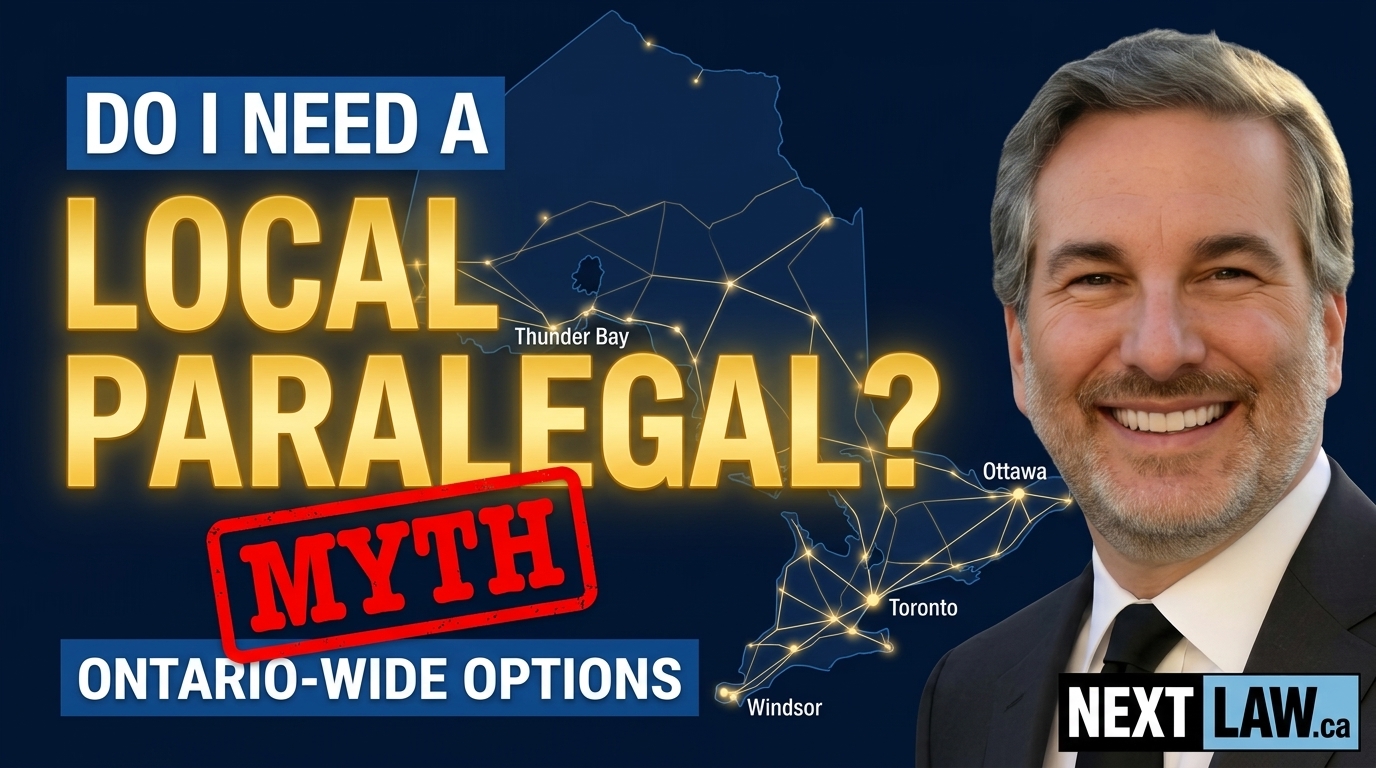
By Jon Cohen, Partner at NextLaw — Ontario’s stunt driving defence firm
Here’s the short answer most search results won’t give you straight: no, you do not need a paralegal or law firm “near the courthouse” to fight a stunt driving charge in Ontario. Your case is heard in the court for the municipality where you were charged — not where you live, and not where your representative’s office sits. Since 2021, Ontario’s provincial offences courts run these matters by video and phone, so a licensed representative can act for you in any court in the province, from Toronto to Ottawa to Windsor to Thunder Bay. What actually changes the outcome on a section 172 charge isn’t a postal code. It’s stunt-specific experience and real working relationships with the Crowns who prosecute these files. “Local” is a leftover idea from a world that no longer exists.
If you’ve just been charged with stunt driving, one of the first instincts is to search for “a stunt driving paralegal near me” or “a lawyer close to the courthouse.” It feels safe. It feels like common sense — surely someone who works at that courthouse every day has the edge. This article explains, carefully and honestly, why that instinct is out of date, how Ontario’s courts actually work now, and what you should be looking at instead when you choose who defends your charge. It is written for the person who has already decided to get representation and is now trying to choose the right one.
The “hire local” instinct — where it comes from and why it’s out of date
For decades, the advice to “hire a lawyer near the court” made sense. Court happened in one building, in one town, in person. If your matter was in Newmarket, you wanted someone who walked into Newmarket court every week, knew the front-office staff, and could stroll down the hall to find the prosecutor. Proximity was a genuine, practical advantage — because everything physical about the case happened in one place.
That world is gone. It didn’t fade slowly, either. In 2020 and 2021, Ontario’s courts moved almost entirely online, and for provincial offences matters — which is what a stunt driving charge is — the remote model didn’t get rolled back when the pandemic eased. It became the standard way these cases are handled. The early court appearances, the case-management steps, and the negotiations with the Crown now happen over video and telephone as a matter of routine.
So the instinct to “hire local” is answering a question that no longer applies. It’s like choosing a travel agent based on which one has an office closest to the airport. The thing that made proximity matter has moved online. Holding onto “local” today doesn’t protect you — it just narrows your options for no benefit, and in a serious charge like stunt driving, narrowing your options is the opposite of what you want.
Where is a stunt driving charge actually heard?
The single most important fact people get wrong is this: your court is determined by where the offence allegedly happened — not where you live, and not where your representative is based.
If you were charged on Highway 401 near Kingston but you live in Mississauga, your matter is heard in the court that serves that stretch of highway — not the court nearest your home. You cannot move it closer to you. You cannot transfer it to “your” court because it’s more convenient. The location is fixed by the charge.
This has two consequences that matter enormously for the “local” question. First, “local to you” is often irrelevant from the start, because the court may not be anywhere near where you live. Plenty of people are charged while travelling, commuting, or driving through a region they don’t live in. A paralegal near your home is not near your court in those cases anyway. Second, and more importantly: since the court is fixed and the appearances are remote, the only thing “local” could even refer to is where your representative’s office happens to be — and that, as we’ll see, has no bearing on how your file is handled.
So the real question isn’t “should I hire someone local?” The court isn’t local to anyone in particular — it’s wherever the charge lives. The real question is “who is the right person to stand in that court, wherever it is?”
Can a paralegal or lawyer really appear in any Ontario court?
Yes — and this is the fact that dissolves the entire “local” idea.
Stunt driving is prosecuted under Part 3 of the Provincial Offences Act, through section 172 of the Highway Traffic Act. It is a provincial offence, heard in the Ontario Court of Justice. And the Ontario Court of Justice has been explicit about how these matters run: when a defendant is represented, the judicial pre-trial is conducted by video. That’s not a NextLaw preference or a workaround — it’s the court’s own published practice direction for how represented provincial-offences matters proceed.
The judicial pre-trial is where the real work on a stunt driving file happens. It’s where your representative and the Crown discuss the evidence, the strength of the case, and how the matter might resolve short of a trial. It happens by video. That means the physical location of your representative’s office is completely beside the point. Whether we’re sitting in Toronto, and your charge is in Ottawa, Windsor, Sudbury, or Thunder Bay, we are in that court, on your file, at every stage that matters — without a two-hour drive being any kind of factor.
A licensed Ontario paralegal or lawyer is authorized to represent you anywhere in the province. There is no rule that your representative must be based near the court, no rule that a Toronto firm can’t act on a Kenora charge, and no practical barrier now that the appearances themselves are remote. The licence is province-wide. The court access is province-wide. “Local” adds nothing to either.
Doesn’t a local paralegal have a better relationship with that court?
This is the strongest version of the “hire local” argument, so it deserves a real answer rather than a dismissal.
The theory goes: a paralegal who appears in, say, Barrie court every week knows the Barrie Crowns, knows the local justices, and can get a better result because of those relationships. There’s a kernel of truth in it — relationships with the Crown genuinely matter on a stunt file. But the conclusion drawn from it is wrong, for two reasons.
First, proximity is not the same as a relationship. Sharing a parking lot with a courthouse doesn’t give anyone a working relationship with the prosecutors inside it. Relationships with Crowns come from appearing on these specific files, repeatedly, over years — negotiating stunt matters, understanding how a given office approaches them, and being known as someone who prepares files properly. A firm that focuses on stunt driving across the province builds those relationships in every court it works in, precisely because it’s there constantly on these charges. A general local paralegal who handles a stunt file a few times a year does not, no matter how close their office is.
Second, in the remote era, “the local relationship” is even less about geography than it used to be. When the pre-trials happen by video and phone, the Crown you’re negotiating with is dealing with representatives from all over the province as a matter of routine. What earns credibility in that conversation is not that you’re from town — it’s that you know the charge, you’ve reviewed the disclosure, and you negotiate from the evidence. That’s portable. It travels to every court.
So the honest version of the “relationships matter” argument actually points away from hiring local. Relationships matter — which is exactly why you want the firm that has built them across Ontario by living in stunt driving every day, not the firm that happens to be nearby but rarely handles these charges.
The hidden downside of “local”: the pickings are thin
Here’s the part almost nobody tells you. When you insist on “someone near the courthouse,” you’re not choosing from the best representatives in Ontario — you’re choosing from whoever happens to have an office near that specific building. And that pool has shrunk dramatically.
The old “office near the courthouse” model has faded along with in-person court. Many small local legal offices that once lived off physical proximity to a courthouse have closed or consolidated. The ones that remain are often general traffic-ticket shops that handle a bit of everything — speeding, careless driving, the occasional stunt charge — rather than firms that concentrate on section 172 matters.
Stunt driving is not a routine ticket. It carries a 30-day roadside licence suspension, a 14-day vehicle impound you pay towing and storage on regardless of the outcome, fines from $2,000 to $10,000, a licence suspension of up to three years on a first conviction, up to six months in jail, and six demerit points. This is the most serious charge a driver can face short of the Criminal Code. It is not the file to hand to whoever’s closest to the building. It’s the file for whoever handles the most of them.
So “local” can quietly leave you with a worse choice: a nearby office that treats your stunt charge as one more item on a long menu, when what you needed was a firm that does this every single day. The convenience you thought you were buying costs you exactly the expertise the charge demands.
In-person court doesn’t buy you the access you think it does
There’s one more myth tucked inside “hire local”: the picture of your paralegal having a quiet, private word with the prosecutor in the hallway, working out a favourable deal face to face. It’s a comforting image. It’s also not how in-person provincial offences court actually works.
In-person court is busy and hectic. On a given morning, a single courtroom may have dozens of matters on the list. The Crown is managing that entire list. The reality for most people is that in-person court gives you less meaningful access to the prosecutor, not more — there’s simply no time for a substantive, unhurried conversation about your specific file when there are fifty other matters in the room.
The remote model actually improved this. The real conversations about your file now happen in scheduled pre-trials, by video and phone, one matter at a time, with the Crown’s attention on your case specifically. That’s a better setting for a careful negotiation than a crowded hallway ever was. So the thing “local” was supposed to give you — access to the prosecutor — is something the remote system often delivers better. Proximity to the building is not proximity to a good outcome.
Lawyer or paralegal — and does it change the “local” question?
A common companion question is whether you need a lawyer or a paralegal, and whether that changes anything about location. It doesn’t change the location analysis at all, but it’s worth answering because people search for it constantly.
Stunt driving is a provincial offence under the Highway Traffic Act — not, in most cases, a Criminal Code charge. That means a licensed Ontario paralegal can fully represent you: review the Crown’s disclosure, attend the appearances, negotiate the resolution, and run a trial if it comes to that. A lawyer becomes essential in one situation — when your stunt charge comes attached to a Criminal Code charge, such as dangerous driving, and you want one defence handling both matters together.
So “lawyer versus paralegal” is usually the wrong question, and “lawyer or paralegal near me” is doubly the wrong question. Both a lawyer and a paralegal are licensed to act anywhere in Ontario, both handle these matters remotely, and neither needs to be near your court. The right question — again — is whether the person is licensed and whether they live in stunt driving every day.
What actually matters when you choose representation
If location is off the list, what should be on it? Here’s what actually moves the needle on a section 172 charge.
- Do they concentrate on stunt driving? Not traffic tickets generally — stunt driving specifically. The person who handles these charges constantly knows how different courts and Crowns approach them, what a strong disclosure defence looks like, and where the real leverage is. Volume in this specific charge is worth far more than being ten minutes from the courthouse.
- Do they have real relationships across the province? Built the honest way — by appearing on these files, court after court, year after year. Ask how often they appear in the court where your charge sits, and on stunt matters specifically.
- Are they licensed and in good standing? You can verify any lawyer or paralegal yourself, for free, in the Law Society of Ontario’s Lawyer and Paralegal Directory. If they’re not listed in good standing, that’s the end of the conversation.
- Do they review the disclosure before they advise? The right approach is to order the Crown’s disclosure, actually review it, and negotiate from what the evidence shows — an informed, disclosure-first negotiation, not a rubber-stamp of the first offer. It has nothing to do with geography.
- Do they set honest expectations? Be cautious of anyone who guarantees an outcome before they’ve seen your disclosure. No one can promise a result on a charge they haven’t examined.
How NextLaw handles a stunt driving charge, wherever your court is
At NextLaw, stunt driving is what we do. We’ve spent years focused on section 172 matters in courts across Ontario — from the Greater Toronto Area out to Ottawa, Windsor, London, Barrie, and the northern courts. Because the appearances are remote, none of that reach depends on where our office is. It depends on the work.
The mechanism is the same no matter which court your charge lives in. We order the Crown’s disclosure and review it carefully — the officer’s notes, how your speed was measured, the circumstances of the stop. We attend the first appearance and the case-management steps for you, by video, so you generally don’t set foot in a courtroom. We handle the pre-trial discussions with the Crown, where the vast majority of these cases are resolved, negotiating from the evidence in your specific file rather than accepting a first offer. And in the rare event a matter goes to trial, we run it.
You would typically only need to attend in person if your case proceeds all the way to a trial — and even then, only if a justice specifically requires it. For the ordinary path a stunt file takes, a representative is precisely how you stay out of the courtroom while your case moves forward. None of that changes based on the distance between your home, your court, and our office. That distance simply doesn’t factor into how the work gets done anymore.
“They have incredible working relationships with many prosecutors in Ontario and this is a HUGE advantage when they are discussing your case… Because of their relationship with the prosecutor they got his stunt driving charge dropped down to a simple speeding ticket!!” — Lyn, verified Google review
Talk to NextLaw
If you’ve been charged with stunt driving anywhere in Ontario, call NextLaw. We’ll walk you through exactly what your court process looks like, who appears and when, and where your case stands — wherever in the province your charge sits. Want to see what a stunt driving charge could cost first? Try our Stunt Driving Penalty Calculator.
Frequently asked questions
Do I need a paralegal near the courthouse for a stunt driving charge in Ontario?
No. Your matter is heard in the court where you were charged, and since 2021 those provincial-offences appearances run by video and phone, so a licensed representative can act for you in any Ontario court regardless of where their office is. What matters is stunt-specific experience, not proximity.
Can my lawyer or paralegal appear in court for me by video?
Yes. For a represented defendant, the Ontario Court of Justice conducts the judicial pre-trial by video, and the early appearances are handled remotely. Your representative attends for you, so in most cases you don’t have to be in the courtroom at all unless the matter goes to trial.
Does it matter where my paralegal is located if my charge is in a different city?
No. The court is fixed by where the offence allegedly happened, not where you or your representative live. Because appearances are remote, a firm based in one city can fully represent you on a charge in another — there is no requirement that your representative be local to the court.
Is a local paralegal better because they know the local Crown?
Relationships with the Crown do matter, but they come from appearing on stunt files repeatedly over years — not from having an office nearby. A firm that concentrates on stunt driving across Ontario builds those relationships in every court it works in, while a nearby general practice may handle only a handful of stunt charges a year.
Do I need a lawyer or a paralegal for stunt driving in Ontario?
A licensed Ontario paralegal can fully represent you on a stunt driving charge — reviewing disclosure, negotiating, and running a trial — because it’s a provincial offence under the Highway Traffic Act. You’d want a lawyer only if a Criminal Code charge, such as dangerous driving, is attached to the stunt charge.
Do I have to go to court myself for a stunt driving charge?
In most cases, no. Your representative attends the first appearance, reviews the Crown’s disclosure, and handles the pre-trial discussions on your behalf. You would typically only need to attend in person if your case proceeds all the way to a trial.
How do I check whether a stunt driving representative is legitimate?
Search their name in the Law Society of Ontario’s Lawyer and Paralegal Directory. If they are not listed in good standing, do not hire them. It’s free, it takes a minute, and it works for both lawyers and paralegals anywhere in Ontario.
What are the penalties for stunt driving in Ontario?
On being charged, you face an immediate 30-day roadside licence suspension and a 14-day vehicle impound, with towing and storage payable regardless of outcome. On a conviction, the penalties include a $2,000–$10,000 fine, a licence suspension of up to three years for a first offence, up to six months in jail, and six demerit points.
What speed is considered stunt driving in Ontario?
40 km/h or more over the limit on a road posted under 80 km/h, 50 km/h or more over on a road posted 80 km/h or higher, or 150 km/h or more anywhere in the province regardless of the posted limit.
This article is general information about Ontario stunt driving charges, not legal advice. Every case turns on its own facts — contact a licensed representative about your specific situation.
