

Early Resolution for Speeding Tickets in Ontario: What You Need to Know
Is early resolution a good way to deal with a speeding ticket? It’s a meeting with a prosecutor to plead to a reduced charge — but here’s the catch most drivers miss: it still ends in a conviction, and insurers rate the conviction, not the demerit points. So early resolution can cut points while leaving your insurance increase largely intact. Only a dismissal or withdrawal at trial fully protects your premium.
If you’ve received a speeding ticket in Ontario, you’ve probably seen the option to request “early resolution” or an “early resolution meeting.” Many drivers choose this option thinking it’s a middle ground between paying and fighting—but it’s important to understand what early resolution actually means and what it does (and doesn’t) protect.
What Is Early Resolution?
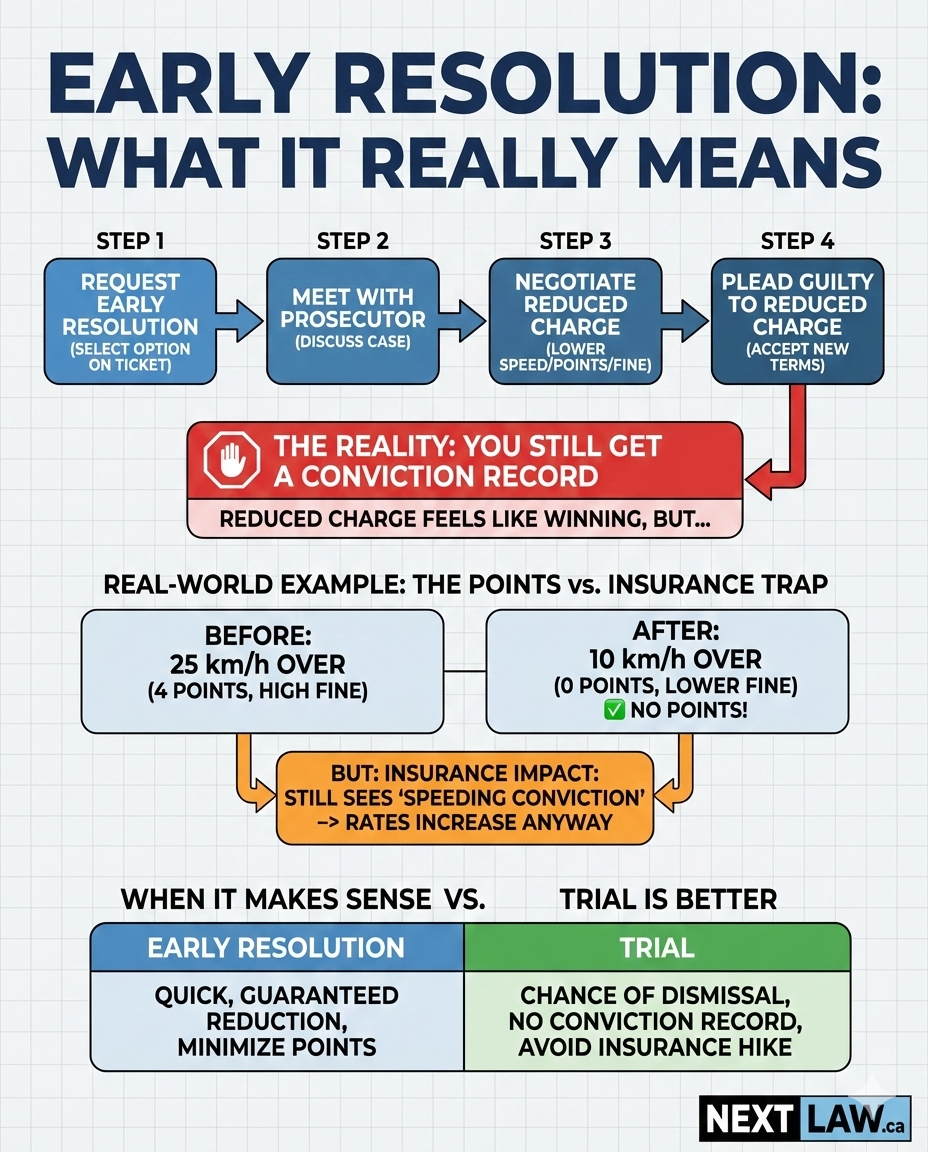
Early resolution is a meeting with a prosecutor to discuss your ticket before trial. The goal is to reach an agreement on how to resolve the charge—typically by pleading guilty to a reduced offense.
The prosecutor might offer to reduce the speed (from 25 over to 15 over, for example) or reduce the charge to a different offense with fewer or no demerit points.
The Appeal of Early Resolution
Early resolution feels like a compromise. You don’t just pay the full ticket, but you also don’t have to go through a trial. Many drivers assume this gives them the benefits of both approaches. It feels safer than trial. It feels faster. But there’s a critical catch.
The Critical Limitation: You Still Get a Conviction
Here’s what most drivers miss: early resolution typically results in a conviction on your driving record. You’re pleading guilty to something—even if it’s a lesser offense.
This matters because your insurance company sees a conviction. The conviction appears on your driving abstract. A reduced charge may have fewer demerit points, but the conviction remains—and that’s what your insurer uses to calculate your premium increase.
The Demerit Point Trap
A common scenario: You receive a ticket for 25 km/h over (3 demerit points). Through early resolution, you negotiate it down to 10 km/h over (0 demerit points). You celebrate—no points!
But you’ve still been convicted of speeding. Your insurance company sees “speeding conviction” on your record. You protected yourself from a potential Service Ontario suspension (by reducing points), but you didn’t protect your insurance. A 15 km/h over conviction typically costs $510–$1,200 over three years in insurance increases. That’s the real cost you’re accepting.
When Early Resolution Makes Sense
Early resolution might be appropriate if:
- The evidence against you is very strong and a trial conviction seems likely
- You’re a G1 or G2 driver and reducing demerit points is critical (e.g., you’re close to the 4-point threshold for suspension)
- You want to resolve the matter quickly without trial scheduling delays
Even in these cases, understand that you’re accepting a conviction and its insurance consequences.
When Trial Is the Better Option
Consider trial instead if:
- Protecting your insurance is your primary goal—a complete dismissal or withdrawal is the only way to avoid the insurance impact
- The disclosure reveals issues with the evidence—calibration problems, incomplete officer notes, or procedural errors
- The stakes are high—significant demerit points, potential suspension, or substantial insurance implications (e.g., 30+ km/h over, which costs $1,785–$4,335 over three years in insurance increases)
Sustained Pressure Strategy
Rather than accepting the first deal offered at early resolution, NextLaw uses a strategy called sustained pressure. Instead of agreeing to plead, we opt for trial—not because we want a trial, but because the court rarely does. We request disclosure repeatedly, creating system friction. Pressure accumulates. At the trial date, there’s a 5–10% chance the officer doesn’t show (immediate dismissal). If the officer does show, we negotiate from a position of strength because the prosecutor wants to clear the case and often offers a better deal than early resolution would have.
Request Disclosure First
Never attend an early resolution meeting without first requesting and reviewing disclosure. Without knowing what evidence the prosecution has, you’re negotiating blind.
Disclosure might reveal problems with the case that make fighting at trial more attractive than accepting any plea. Once you’ve reviewed disclosure, you’ll have a much clearer picture of whether early resolution makes sense for your situation.
Making an Informed Choice
Early resolution isn’t inherently good or bad—it depends on your situation and goals. The key is understanding what it actually delivers: a reduced charge, but still a conviction. If that trade-off makes sense for your circumstances, it might be the right choice. If protecting your record from any conviction is the goal, trial is the only path.
Not every ticket is worth fighting—but every ticket is worth checking. Book a free call to review your options.
Frequently Asked Questions
What is early resolution for a speeding ticket in Ontario?
Early resolution is a meeting with a prosecutor before trial to agree on how to resolve the charge, usually by pleading guilty to a reduced offence — a lower speed or fewer demerit points.
Does early resolution avoid a conviction?
No. Early resolution almost always results in a conviction, just for a lesser offence, and insurers rate that conviction. It can lower demerit points but usually does not remove the insurance impact.
When does early resolution make sense?
When the evidence against you is strong, when you are a G1 or G2 driver near the 4-point suspension threshold and need to cut points, or when you want to resolve quickly. Even then, you are accepting a conviction and its insurance consequences.
Early resolution or trial — which is better for insurance?
Trial. A complete dismissal or withdrawal at trial is the only outcome that avoids the insurance impact, because early resolution still leaves a conviction on your record.
Should I get disclosure before an early resolution meeting?
Yes, always. Never negotiate without first requesting and reviewing disclosure — it may reveal calibration, note, or procedural problems that make fighting at trial the better choice.
Real Speeding Ticket Result
“I was charged for 55 over (155 km). Dan helped me out very efficiently and now I just need to pay $130 as a fine. I am recommending Next Law to anyone who gets charged for speeding tickets and all related issues.” — Hitesh Chaudhary, NextLaw client (verified 5-star Google review #642)
Talk to a Speeding Ticket Law Firm
NextLaw is a law firm that focuses on fighting Ontario speeding tickets to protect your insurance. Before you accept an early resolution deal, a free 15-minute call can tell you whether fighting would protect your insurance better. Book a free call with NextLaw or explore our free tools.
About this estimate. Insurance figures above are projections based on Ontario insurance industry data. Your actual premium change depends on your insurer’s proprietary rules, your policy, your driving record, and other personal factors. NextLaw is a law firm, not an insurance broker.
This article is based on NextLaw’s professional analysis of Ontario speeding legal procedures and is provided for informational purposes only. Every case presents unique circumstances, and outcomes depend on specific case facts and proper legal representation.

