
Received a Speeding Ticket in Hamilton? Here’s What You Need to Know
What should you do if you got a speeding ticket in Hamilton? You have 15 days to respond, with three options: pay the fine (a guilty plea that becomes a conviction), request early resolution (a reduced charge but still a conviction), or request a trial — the only route that can end in a full withdrawal. Because it’s the conviction, not the fine, that raises your insurance, fighting is usually what protects your wallet. Hamilton has one of Ontario’s highest prepaid rates — about 74% of drivers just pay — often the most expensive choice once insurance is counted.
If you’ve received a speeding ticket in Hamilton, you’re joining hundreds of thousands of drivers who have faced this situation over the past decade. According to NextLaw’s analysis of Ontario court data, Hamilton issued 371,563 speeding charges between 2015 and 2025. That’s a substantial number for the Steel City, averaging nearly 34,000 tickets per year.
Every Hamilton driver who receives a speeding ticket faces the same question: pay the fine or fight it? The answer depends on understanding the true costs—not just the fine, but the long-term impact on insurance rates and your driving record.
Hamilton Speeding Enforcement: A Unique Pattern
Hamilton’s speeding enforcement shows a pattern different from many other Ontario jurisdictions. Jon Cohen, who has represented thousands of speeding cases across the province, has analyzed these trends carefully. Interestingly, Hamilton’s peak enforcement year was 2020, not 2024 like most other jurisdictions.
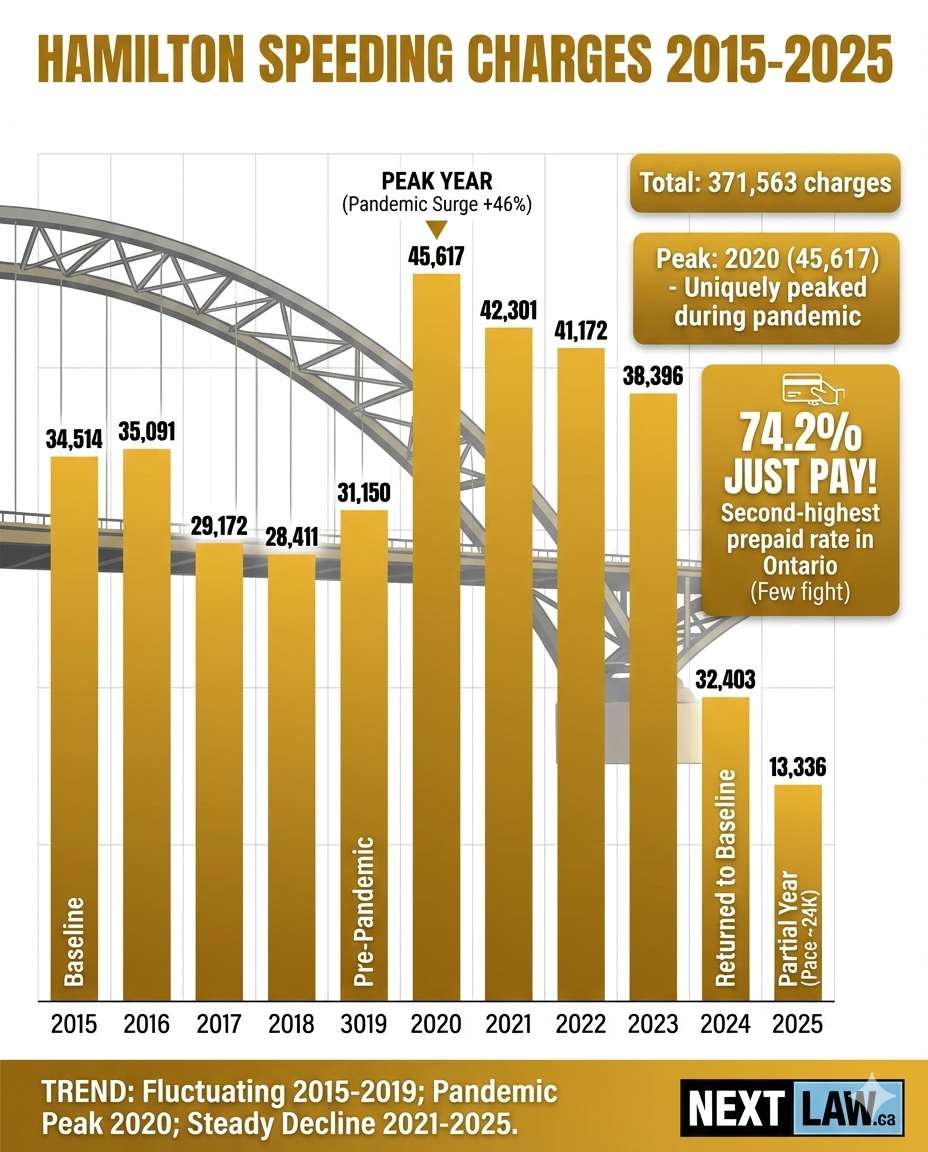
In 2015, Hamilton issued 34,514 speeding charges. The number peaked at 45,617 in 2020, then gradually declined to 32,403 in 2024. This unusual pattern—declining while other jurisdictions surge—reflects Hamilton’s particular approach to enforcement.
Year-by-Year Hamilton Speeding Charges (2015-2025)
The enforcement progression tells a distinctive story:
- 2015: 34,514 charges
- 2016: 35,091 charges
- 2017: 29,172 charges
- 2018: 28,411 charges
- 2019: 31,150 charges
- 2020: 45,617 charges
- 2021: 42,301 charges
- 2022: 41,172 charges
- 2023: 38,396 charges
- 2024: 32,403 charges
- 2025: 13,336 charges (partial year)

Source: Ontario Court Services Data 2015-2025
The 2020 peak coincided with reduced traffic during the pandemic—fewer cars on the road made speeding more detectable. Dan Joffe notes that while Hamilton’s numbers have since declined, the city still issues over 30,000 tickets annually—a significant enforcement presence.
What the Prepaid Rate Tells Us
Of Hamilton’s 371,563 speeding charges over this period, 74.2% resulted in prepaid fines—meaning nearly three-quarters of drivers simply paid without contesting. This is significantly higher than the provincial average of about 61%, and one of the highest prepaid rates among major Ontario cities.
Jon Cohen suggests this may reflect Hamilton’s working-class character—drivers may be less likely to take time off work to fight tickets, or may be less aware of the long-term insurance implications of simply paying.
What Happens When You Get a Speeding Ticket in Hamilton?
When you receive a speeding ticket in Hamilton, you have 15 days from the ticket date to respond. Missing this deadline can result in automatic conviction. Jon Cohen emphasizes that these 15 days represent your window of maximum options.
You have three choices:
- Pay the fine: What 74.2% of Hamilton drivers do. However, paying is an admission of guilt resulting in a conviction that insurance companies see at renewal time.
- Request early resolution: Meet with prosecutor, which may allow negotiation of a reduced charge. However, this still typically results in a conviction.
- Request a trial: The only path to potential complete withdrawal or dismissal.
The Real Cost of a Hamilton Speeding Ticket: Insurance Impact Comes First
The fine on your ticket is just the start. For a conviction of 15-29 km/h over the limit, the fine might be $95 to $220. But the insurance impact is far larger.
A minor conviction (15-29 km/h over) typically increases premiums by 10-20% for three years. That’s $510–$1,200 in additional insurance costs on a baseline premium, depending on your insurer and current rate. Over three years, this compounds significantly.
For higher speeds—30 to 49 km/h over the limit—insurers classify this as a major conviction. Most Ontario insurers apply surcharges of 15-40%, costing $1,785–$4,335 over three years. At 50+ km/h over (stunt driving), you’re facing either policy cancellation or surcharges exceeding 150%, costing $7,650–$9,027+ over three years or higher.
Demerit Points vs. Insurance
A common misconception is that demerit points directly cause insurance increases. Demerit points are tracked by Service Ontario for licensing—9-14 points triggers a warning, 15+ means suspension. For G1/G2 drivers, 4+ demerit points causes automatic 30-day suspension.
Insurance rates are set by private companies based on convictions, not demerit points. Reducing demerit points through negotiation doesn’t eliminate the conviction that affects insurance.
Hamilton’s Provincial Offences Court
Hamilton speeding tickets are processed through Provincial Offences Court. The court handles substantial volume, and understanding its dynamics matters for defense strategy.
Common Hamilton Speeding Hotspots
Certain Hamilton locations see heavy enforcement:
- Lincoln M. Alexander Parkway (the Linc) and Red Hill Valley Parkway: These routes connect the mountain to lower Hamilton and carry heavy commuter traffic.
- Highway 403: Through Hamilton is regularly monitored, as is the QEW along the lakefront.
- Major arterial roads: Including Upper James Street, Mohawk Road, and Main Street see regular enforcement. Community Safety Zones carry doubled fines.
Should You Fight Your Hamilton Speeding Ticket?
Given Hamilton’s high 74.2% prepaid rate, relatively few drivers fight their tickets. Jon Cohen recommends carefully evaluating the specific speed, your driving record, and insurance situation before joining that majority.
For drivers with clean records, protecting that record through fighting often saves more than it costs. Protecting that clean record discount can save thousands of dollars over the years your record would otherwise show a conviction.
For G2 drivers facing 4+ demerit points, fighting is essential to avoid automatic suspension. For higher speeds of 30 km/h or more over the limit, the stakes increase dramatically.
The Sustained Pressure Strategy
When you decide to fight, how you fight matters as much as whether you fight. NextLaw uses a strategy called sustained pressure. Rather than taking the first deal offered at early resolution, we request a trial—not because we want a trial, but because the court rarely does. We request disclosure repeatedly, creating system friction. Pressure accumulates. At the trial date, there’s a 5-10% chance the officer doesn’t show (immediate win). If the officer does show, we negotiate from a position of strength because the prosecutor wants to clear the case. This approach has no name at other firms, but it works.
The Disclosure Process: Your Right to Evidence
Before deciding how to proceed, you have the right to request disclosure—all evidence the prosecution intends to use. This includes:
- Officer’s notes
- Radar or laser readings
- Calibration records
- Other documentation
Dan Joffe emphasizes that reviewing disclosure is crucial. Technical issues can provide grounds for challenging the charge. Without disclosure, you’re negotiating without knowing what you’re up against.
Hamilton’s Unique Insurance Landscape After the 2026 Reforms
Hamilton stands out among Ontario jurisdictions—it’s one of the few cities where speeding charge volumes have actually declined slightly since 2015, dropping 6% over the decade. But that doesn’t mean the financial stakes are lower. Ontario’s 2026 insurance reforms have introduced a new regulatory framework, making insurers more aggressive about surcharging convictions regardless of local enforcement trends. A single Section 128 speeding conviction now triggers a 10-25% premium increase lasting three renewal cycles.
Hamilton drivers, who navigate the 403, QEW, and Lincoln Alexander Expressway daily, pay average premiums of approximately $2,400. A conviction-driven surcharge of even 15% costs $1,080 over three years—and a 25% surcharge pushes that to $1,800. The reforms also restrict eligibility for enhanced Statutory Accident Benefits coverage worth $40,000+. With 371,563 total charges issued in the Hamilton jurisdiction over the past decade, the odds of encountering enforcement remain significant even as overall numbers stabilize.
Frequently Asked Questions
What should I do if I get a speeding ticket in Hamilton?
You have 15 days from the date on the ticket to respond. Your three options are to pay the fine, request early resolution, or request a trial. Paying is a guilty plea that creates a conviction; a trial is the only option that can end in a full withdrawal with no conviction.
Where do you fight a speeding ticket in Hamilton?
Hamilton speeding tickets are handled through the City of Hamilton Provincial Offences Court. Enforcement is concentrated on routes like the Lincoln Alexander and Red Hill Valley parkways, Highway 403, and the QEW.
How much does a speeding ticket cost in Hamilton?
The fine for 15–29 km/h over is often about $95–$220, but the fine is the small part. A conviction can add an estimated $510–$4,335 or more in insurance costs over three years, depending on the speed, your insurer, and your record.
Is it worth fighting a speeding ticket in Hamilton?
It can be. About 74% of Hamilton drivers simply pay — one of the highest prepaid rates in Ontario — but paying guarantees the conviction that raises insurance. For a clean record, or for G1 and G2 drivers facing 4 or more demerit points, fighting is often worth far more than it costs.
Do I have to go to court for a Hamilton speeding ticket?
Not necessarily. With professional representation, your representative can attend court appearances for you — NextLaw handles appearances so most clients never have to appear in person.
Real Speeding Ticket Result
“I’m not lucky. I just had the right people working for me. Thanks Dan, And to everyone at Nextlaw!” — Rob Collum, NextLaw client (verified 5-star Google review #695)
Understanding Your Options
While Hamilton’s enforcement has declined from its 2020 peak, the city still issues tens of thousands of tickets annually. Understanding the full picture—fine, demerit points, insurance impact, and defenses—is essential before the 15-day deadline passes.
Whether you choose to pay, negotiate, or fight at trial depends on your specific circumstances and what you’re trying to protect. What matters is making an informed choice with full knowledge of the consequences.
Talk to a Speeding Ticket Law Firm
NextLaw is a law firm that focuses on fighting Ontario speeding tickets to protect your insurance. If you received a ticket in Hamilton and want to know whether it’s worth fighting, a free call takes about 15 minutes. Book a free call with NextLaw or explore our free tools to see what a conviction could cost you.
About this estimate. Insurance figures above are projections based on Ontario insurance industry data. Your actual premium change depends on your insurer’s proprietary rules, your policy, your driving record, and other personal factors. NextLaw is a law firm, not an insurance broker.
This article is based on NextLaw’s professional analysis of Ontario speeding legal procedures and is provided for informational purposes only. Every case presents unique circumstances, and outcomes depend on specific case facts and proper legal representation.

