

Received a Speeding Ticket in Thunder Bay? Here’s What You Need to Know
What should you do if you got a speeding ticket in Thunder Bay? You have 15 days to respond, with three options: pay the fine (a guilty plea that becomes a conviction), request early resolution (a reduced charge but still a conviction), or request a trial — the only route that can end in a full withdrawal. Because it’s the conviction, not the fine, that raises your insurance, fighting is usually what protects your wallet — and distance is no barrier, since representation can be handled remotely. About 67% of Thunder Bay drivers simply pay.
If you’ve received a speeding ticket in Thunder Bay, you’re not alone. According to NextLaw’s analysis of Ontario court data, Thunder Bay issued 92,180 speeding charges between 2015 and 2025. As Northwestern Ontario’s largest city, Thunder Bay serves as the enforcement hub for a vast region.
Understanding the full costs of a speeding ticket—beyond just the fine—is essential before deciding whether to pay or fight.
Thunder Bay Speeding Enforcement: A Declining Trend
Thunder Bay’s speeding enforcement shows a pattern different from most Ontario jurisdictions. Interestingly, Thunder Bay’s peak enforcement year was 2015—the first year in the dataset.
In 2015, Thunder Bay issued 11,087 speeding charges. Numbers have generally declined since then, reaching a low of 6,056 in 2020 before recovering somewhat. The 2024 numbers (7,537) remain well below the 2015 peak.
Year-by-Year Thunder Bay Speeding Charges (2015-2025)
The progression shows general decline:
- 2015: 11,087 charges
- 2016: 9,157 charges
- 2017: 8,838 charges
- 2018: 7,446 charges
- 2019: 6,712 charges
- 2020: 6,056 charges
- 2021: 6,643 charges
- 2022: 10,278 charges
- 2023: 9,761 charges
- 2024: 7,537 charges
- 2025: 8,665 charges (partial year)

Source: Ontario Court Services Data 2015-2025
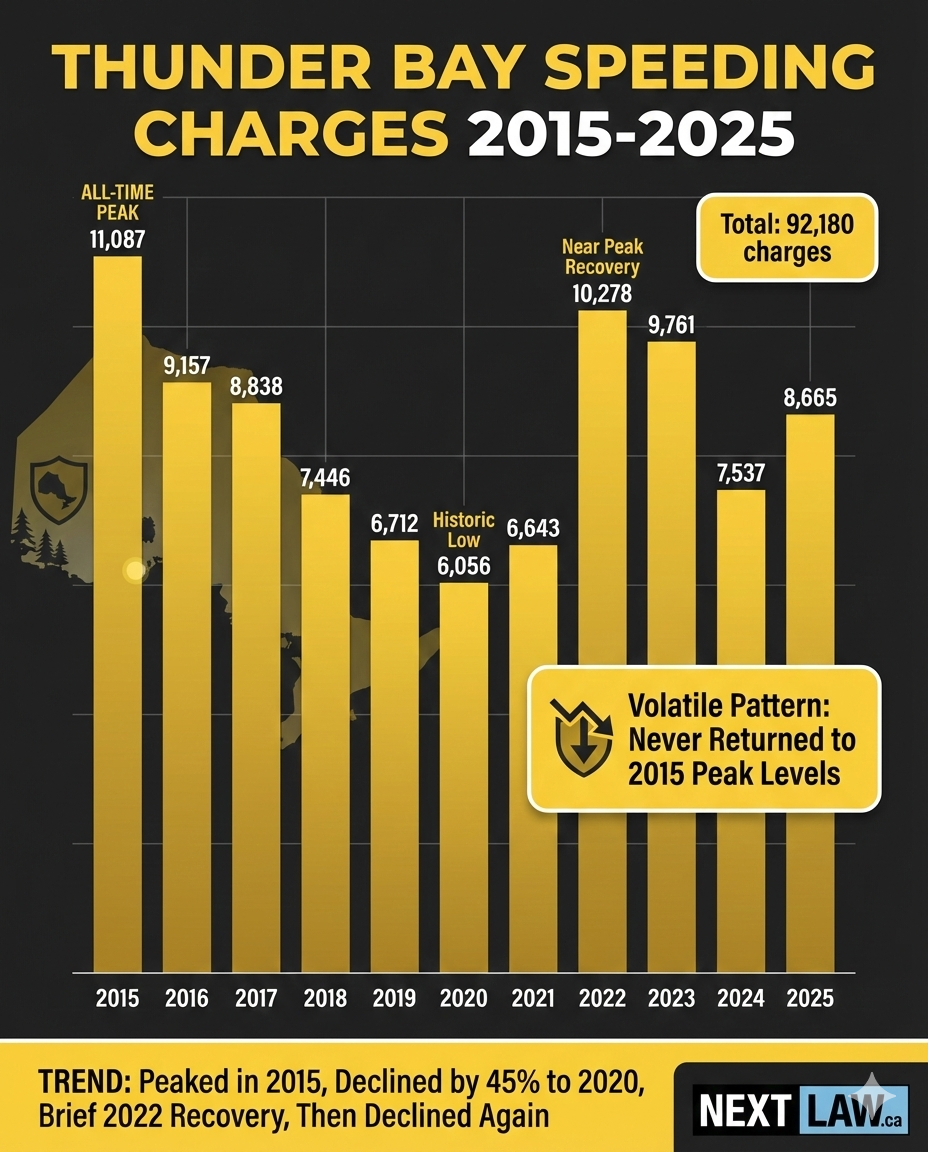
Thunder Bay’s numbers have remained more stable than southern Ontario jurisdictions, which have seen explosive growth from automated enforcement. Northern Ontario has been slower to adopt ASE technology.
What the Prepaid Rate Tells Us
Of Thunder Bay’s 92,180 speeding charges, 67.3% resulted in prepaid fines—higher than the provincial average. This suggests many Thunder Bay drivers simply pay rather than fight. The distances involved may contribute—Thunder Bay is far from most traffic court specialists, which can discourage fighting.
What Happens When You Get a Speeding Ticket in Thunder Bay?
When you receive a speeding ticket in Thunder Bay, you have 15 days to respond. Missing this deadline means automatic conviction. These 15 days are when your options are widest.
Your options:
- Pay the fine (what 67.3% of drivers do)
- Request early resolution (may reduce charge but still results in conviction)
- Request a trial (only path to potential dismissal)
The Real Cost of a Thunder Bay Speeding Ticket
The fine is just the beginning. Insurance is the real cost.
A conviction for 16-29 km/h over comes with 3 demerit points. Most insurers treat this as a minor conviction. Over three years, you’d pay $510–$1,200 more in insurance than a driver with a clean record.
For 30-49 km/h over, you’re facing 4 demerit points and treatment as a major conviction. That’s $1,785–$4,335 more over three years—a real financial hit on top of the fine.
For 50+ km/h over or stunt driving, the impact is severe: $7,650–$9,027+ over three years, or policy cancellation.
Demerit Points vs. Insurance
Demerit points are tracked by Service Ontario for licensing. Accumulate 15 or more, and you face license suspension. For G1/G2 drivers, 4 or more points triggers a 30-day suspension—a real problem if you need your license to work or get to school.
Insurance surcharges are based on convictions, not points. But convictions stay on your driving record for 3-7 years depending on severity. If you switch insurers after a conviction, some companies treat you as high-risk. Worse, if you’re non-renewed and forced to use the Facility Association, you’re looking at $8,000–$10,000+/year.
Common Thunder Bay Speeding Hotspots
Key enforcement areas include:
- Highway 17 (Trans-Canada) through and around Thunder Bay sees significant enforcement—the highway’s high speeds and long stretches encourage speeding
- Highway 11/17 south toward Nipigon and north toward Kenora are active enforcement corridors
- Memorial Avenue, Arthur Street, and Victoria Avenue see regular enforcement within the city
Should You Fight Your Thunder Bay Speeding Ticket?
With 67.3% paying without fighting, about one-third of Thunder Bay drivers contest their tickets. If you have a clean record or facing major demerit points—especially on a G1 or G2—fighting becomes much more valuable. The insurance bill alone can dwarf the cost of a defense. Professional representation can often be handled remotely, eliminating the distance barrier.
Not every ticket is worth fighting. But every ticket is worth checking.
What Fighting Actually Looks Like: Sustained Pressure
Most firms offer early resolution—a quick deal in the first month. NextLaw uses a different strategy called sustained pressure. Rather than taking the first deal, we prepare for trial. We request disclosure repeatedly, creating system friction. Pressure accumulates. At the trial date, there’s a 5–10% chance the officer doesn’t show—immediate dismissal. If the officer does show, we negotiate from a position of strength because the prosecutor wants to clear the case.
No other firm explains a named strategy on the first call. We do, because you deserve to know what you’re getting.
Thunder Bay: Highway 17 Enforcement and the New Insurance Penalties
Thunder Bay’s speeding enforcement has declined 32% since 2015 to 7,537 charges in 2024. But Ontario’s 2026 insurance reforms have increased the per-ticket cost substantially.
On northern Ontario premiums averaging $1,800–$2,200, a conviction for 16-29 km/h over adds $510–$1,200 over three years. For 30-49 km/h over, it’s $1,785–$4,335. The reforms further restrict optional Statutory Accident Benefits—including caregiver and income replacement coverage worth $40,000+. With 92,180 charges issued in the Thunder Bay jurisdiction over the past decade and Highway 17 enforcement remaining a constant, even reduced overall volume doesn’t diminish the importance of protecting your record.
Frequently Asked Questions
What should I do if I get a speeding ticket in Thunder Bay?
You have 15 days from the date on the ticket to respond. Your three options are to pay the fine, request early resolution, or request a trial. Paying is a guilty plea that creates a conviction; a trial is the only option that can end in a full withdrawal with no conviction.
Where do you fight a speeding ticket in Thunder Bay?
Thunder Bay speeding tickets are handled through the City of Thunder Bay Provincial Offences Court, the enforcement hub for Northwestern Ontario. Enforcement is heavy on Highway 17 (Trans-Canada), Highway 11/17, and city arterials like Memorial Avenue and Arthur Street.
How much does a speeding ticket cost in Thunder Bay?
The fine for 16–29 km/h over is often about $95–$220, but the fine is the small part. A conviction can add an estimated $510–$4,335 or more in insurance costs over three years, depending on the speed, your insurer, and your record.
Is it worth fighting a speeding ticket in Thunder Bay?
It can be. About 67% of Thunder Bay drivers simply pay, but paying guarantees the conviction that raises insurance. Distance is no barrier — representation can be handled remotely. For a clean record, or for G1 and G2 drivers facing 4 or more demerit points, fighting is often worth far more than it costs.
Do I have to go to court for a Thunder Bay speeding ticket?
Not necessarily. With professional representation, your representative can attend court appearances for you — NextLaw handles appearances so most clients never have to appear in person. Even in Northwestern Ontario, cases can be handled remotely.
Real Speeding Ticket Result
“I had a great experience with NextLaw in handling my driving convictions. From the start, they were professional, responsive, and clearly knowledgeable about the legal process. In the end, they helped me reach a much better outcome than I expected.” — Phil Yassa, NextLaw client (verified 5-star Google review #147)
Talk to a Speeding Ticket Law Firm
NextLaw is a law firm that focuses on fighting Ontario speeding tickets to protect your insurance. If you received a ticket in Thunder Bay and want to know whether it’s worth fighting, a free call takes about 15 minutes. Book a free call with NextLaw or explore our free tools to see what a conviction could cost you.
About this estimate. Insurance figures above are projections based on Ontario insurance industry data. Your actual premium change depends on your insurer’s proprietary rules, your policy, your driving record, and other personal factors. NextLaw is a law firm, not an insurance broker.
Understanding Your Options
While Thunder Bay’s enforcement has declined from its 2015 peak, receiving a ticket still carries significant consequences. Understanding your options before the 15-day deadline passes is essential.
This article is based on NextLaw’s professional analysis of Ontario speeding legal procedures and is provided for informational purposes only. Every case presents unique circumstances, and outcomes depend on specific case facts and proper legal representation.

