

Missed the 15-Day Deadline for Your Ontario Speeding Ticket? Here’s What to Do
Bottom line: Missing the 15-day deadline doesn’t always mean it’s over—a default conviction can sometimes be reopened. Act fast. NextLaw reviews your ticket for free and tells you what options remain.
If you missed the 15-day deadline to respond to your speeding ticket, you’re in a difficult situation—but not necessarily a hopeless one. There are options for addressing missed deadlines, though they’re more complicated and uncertain than responding on time would have been.
What Happens After Missing the Deadline
Jon Cohen, who has helped drivers address missed deadline situations, explains what typically occurs:
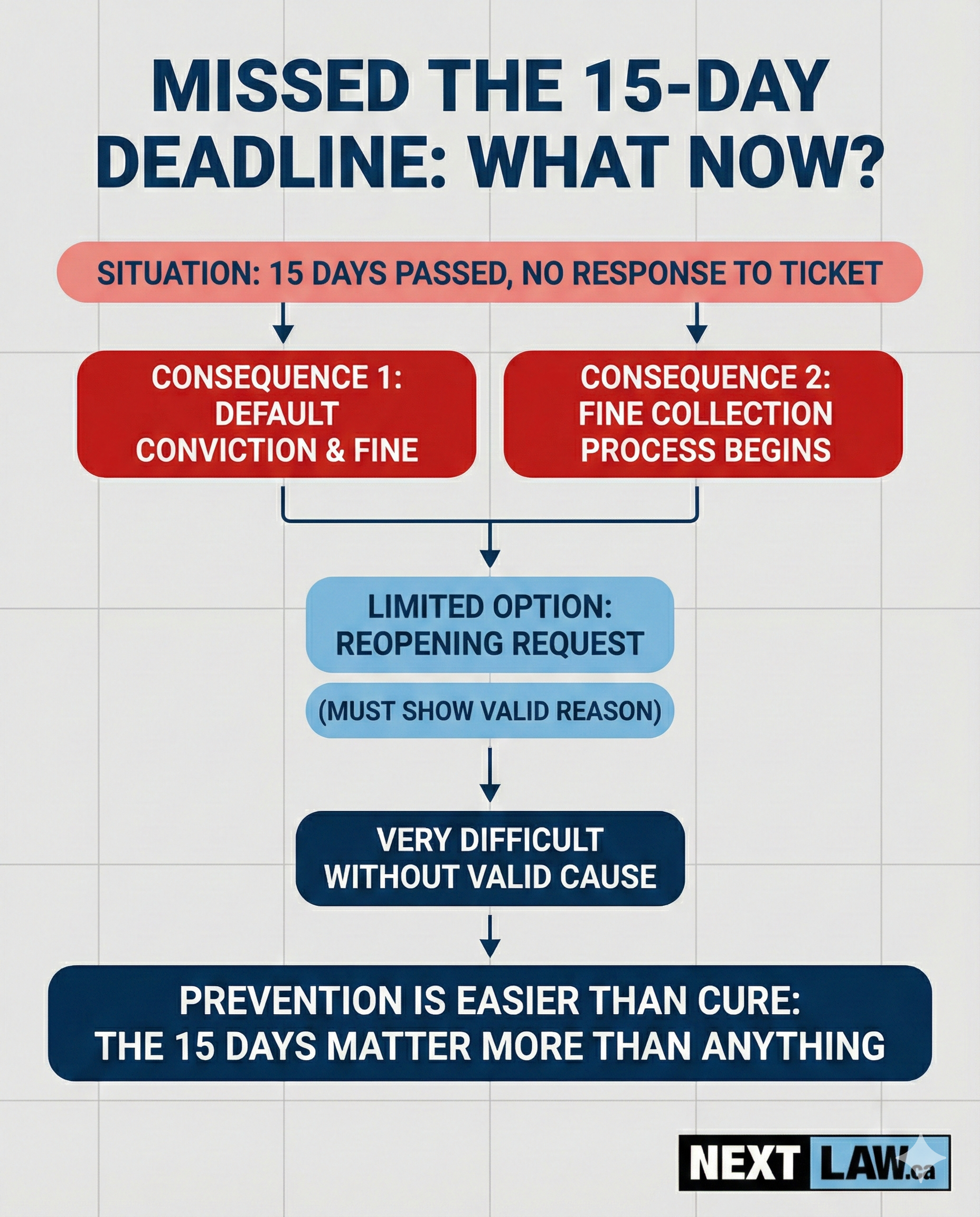
When you don’t respond within 15 days, the court can proceed without you. In most cases, this means a conviction is entered by default—you’re found guilty without ever appearing in court. The fine becomes due. Demerit points are added to your record. The conviction appears on your driving abstract, where insurance companies will see it.
Your Options After Missing the Deadline
Dan Joffe, traffic lawyer at NextLaw, outlines the two main paths forward:
Option 1: Motion to Reopen
You can file a motion asking the court to reopen your case. This is essentially asking the court to give you another chance to respond to the ticket.
To succeed, you generally need to show you had a valid reason for missing the deadline—you were hospitalized, out of the country, or genuinely didn’t receive the ticket through no fault of your own. Simply forgetting or being busy typically isn’t sufficient.
If granted, the conviction is set aside and you can proceed to fight the ticket as if you’d responded on time. If denied, the conviction stands.
Option 2: Appeal
If you’ve been convicted—either by default or at trial—you can appeal to a higher court. However, appeals are more limited:
- You generally can’t appeal simply because you don’t like the outcome
- Appeals typically require legal errors in how the case was handled
- The appeal must be filed within 30 days of conviction
- Appeals can be more expensive and time-consuming than the original case
The Difference Between Reopening and Appeal
Jon Cohen clarifies the distinction:
- Reopening is about getting another chance because you never had your first chance due to circumstances beyond your control.
- Appeal is about challenging a conviction that was properly entered because something went wrong legally in the process.
For missed deadlines where you simply didn’t respond, reopening is typically the relevant path—but it requires a valid reason for the delay.
Prevention Is Better Than Cure
Dan Joffe emphasizes that addressing a missed deadline is much harder than meeting it in the first place:
- Success isn’t guaranteed. Courts have discretion about whether to reopen cases.
- The process takes time. While you pursue reopening, the conviction remains on your record.
- It costs more. What could have been handled straightforwardly now requires additional court filings and potentially legal assistance.
What to Do Right Now
Jon Cohen recommends immediate action if you’ve missed the deadline:
- Determine exactly what’s happened. Has a conviction been entered? Check your driving abstract or contact the court.
- Gather any documentation. If you have a legitimate reason for missing the deadline (medical records, travel documentation), collect it.
- Act quickly. The longer you wait after missing the deadline, the harder it becomes to address.
- Consider professional help. Reopening motions involve legal procedure that can be difficult to navigate alone.
Insurance Impact: Why Missing Your Deadline is Expensive
A deemed conviction from failing to respond is treated identically to a guilty plea by insurance companies. Here’s what a conviction costs:
- 1–15 km/h over (0 demerit points): $510–$1,200 over three years
- 16–29 km/h over (3 demerit points): Same as above for most insurers
- 30–49 km/h over (4 demerit points): $1,785–$4,335 over three years
On average Ontario premiums of $2,500, a conviction can cost up to $1,875 in insurance surcharges over three years—on top of the fine. This is why acting quickly to reopen your case matters so much. Every month that conviction sits on your record, you’re paying surcharges that could have been avoided.
NextLaw Client Success
“The time, effort, and commitment they invested were far beyond what I expected. I cannot thank them enough for their support during one of the most stressful periods of my life.” — Khushbu Bhambhwani, NextLaw Client
Learn from the Experience
If you’re able to reopen your case, treat it as a valuable second chance. Many drivers aren’t so fortunate. Respond promptly to any future tickets, and don’t let deadlines slip.
Frequently Asked Questions
I missed the 15-day deadline — is it too late to fight?
Often not. If you were convicted by default you may be able to reopen the matter. Act quickly and get it reviewed before doing anything else.
What happens when you miss the deadline on a ticket?
You can be convicted in your absence — the fine, the record, and any demerit points apply. But a default conviction can sometimes be reopened.
Can a missed-deadline conviction be undone?
Sometimes. There are steps to ask the court to reopen a default conviction so you can still fight the charge. The sooner you move, the better.
Will insurance already be affected if I missed the deadline?
It can be once a conviction registers, which is exactly why reopening quickly matters — a reduction or dismissal keeps it off your record.
What should I do right now?
Get the ticket reviewed immediately. If it can be reopened, we move fast; if not, we look at every remaining option to limit the damage.
A Real Speeding Ticket Result
“HIGHLY HIGHLY RECOMMENDED!! Nextlaw saved me from a 6 months driver license suspension. The violation I received was driving on a suspended license. I had no idea my driver license was suspended when I got pulled over. Jon and his team were able to get me out of it and dropped the violation to something minor.”
— Adam, verified 5-star Google review
Talk to NextLaw
If you missed the deadline on a speeding ticket, get it reviewed right away. Secure your free NextLaw speeding callback and we’ll explain your options and whether fighting makes sense.
Insurance figures above are estimates based on Ontario insurer filings; your actual increase depends on your insurer, history, and policy.
This article is based on NextLaw’s professional analysis of Ontario speeding legal procedures and is provided for informational purposes only. Every case presents unique circumstances, and outcomes depend on specific case facts and proper legal representation.

