

Received a Speeding Ticket in Waterloo Region? Here’s What You Need to Know
What should you do if you got a speeding ticket in Waterloo Region? You have 15 days to respond, with three options: pay the fine (a guilty plea that becomes a conviction), request early resolution (a reduced charge but still a conviction), or request a trial — the only route that can end in a full withdrawal. Because it’s the conviction, not the fine, that raises your insurance, fighting is usually what protects your wallet. About 66% of Waterloo drivers simply pay — one of the higher prepaid rates in Ontario, and often the most expensive choice once insurance is counted.
If you’ve received a speeding ticket in Waterloo Region, you’re not alone. According to NextLaw’s analysis of Ontario court data, Waterloo Region issued 245,223 speeding charges between 2015 and 2025. That covers the cities of Kitchener, Waterloo, and Cambridge, along with the surrounding townships.
The decision to pay or fight requires understanding the full costs—not just the fine, but insurance impacts, demerit points, and your driving record going forward.
Waterloo Region Speeding Enforcement: Strong Growth
Waterloo Region’s speeding enforcement has more than doubled over the past decade. The data shows consistent growth with recent acceleration.
In 2015, Waterloo Region issued 18,374 speeding charges. By 2024, that number had reached 46,189—more than 2.5 times the 2015 level.
Year-by-Year Waterloo Region Speeding Charges (2015-2025)
The progression shows steady growth with recent acceleration:
- 2015: 18,374 charges
- 2016: 17,943 charges
- 2017: 17,765 charges
- 2018: 13,199 charges
- 2019: 11,789 charges
- 2020: 17,390 charges
- 2021: 18,982 charges
- 2022: 22,260 charges
- 2023: 36,683 charges
- 2024: 46,189 charges
- 2025: 24,649 charges (partial year)

Source: Ontario Court Services Data 2015-2025
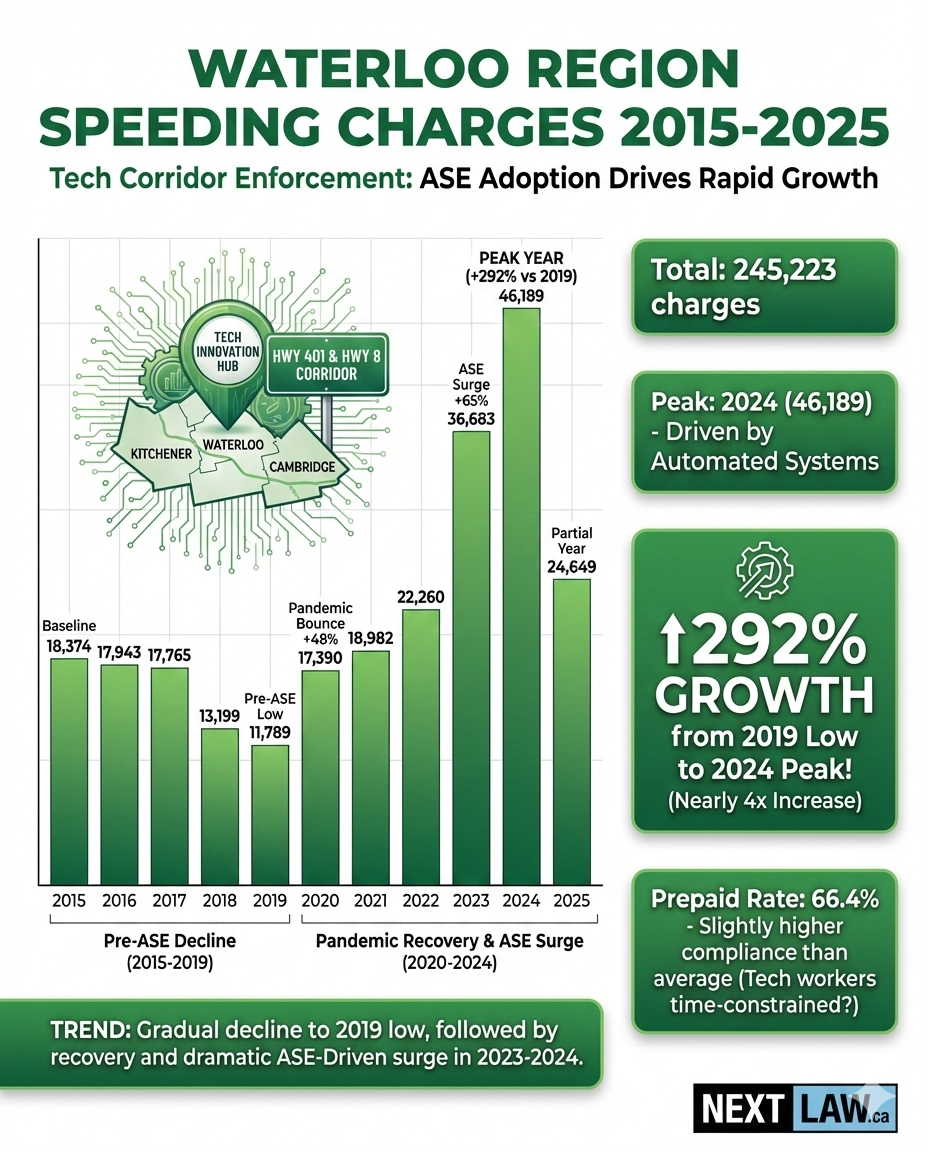
The jump from 2022 to 2023—from 22,260 to 36,683—reflects expanded enforcement technology deployment. Waterloo Region has embraced Automated Speed Enforcement, contributing to the increased numbers.
What the Prepaid Rate Reveals
Of Waterloo Region’s 245,223 speeding charges, 66.4% resulted in prepaid fines—meaning two-thirds of drivers simply paid without contesting. This is higher than the provincial average, suggesting many Waterloo drivers skip the fight without checking their options.
What Happens When You Get a Speeding Ticket in Waterloo Region?
When you receive a speeding ticket anywhere in Waterloo Region, you have 15 days to respond. Missing this deadline means automatic conviction. These 15 days are critical for preserving your options.
Your three choices:
- Pay the fine: What 66.4% do, but creates a conviction on your record
- Request early resolution: May reduce the charge but still results in conviction
- Request a trial: Only path to potential complete dismissal
The Real Cost of a Waterloo Region Speeding Ticket
The fine is just the beginning. Insurance is the real cost.
A conviction for 16-29 km/h over comes with 3 demerit points. Most insurers treat this as a minor conviction. Over three years, you’d pay $510–$1,200 more in insurance than a driver with a clean record.
For 30-49 km/h over, you’re facing 4 demerit points and treatment as a major conviction. That’s $1,785–$4,335 more over three years—a real financial hit on top of the fine.
For 50+ km/h over or stunt driving, the impact is severe: $7,650–$9,027+ over three years, or policy cancellation.
Demerit Points vs. Insurance
Demerit points are tracked by Service Ontario. Accumulate 15 or more, and you face license suspension. For G1/G2 drivers, 4 or more points triggers a 30-day suspension—a real problem if you need your license to work or get to school.
Insurance surcharges are based on convictions, not points. But convictions stay on your driving record for 3-7 years depending on severity. If you switch insurers after a conviction, some companies treat you as high-risk. Worse, if you’re non-renewed and forced to use the Facility Association, you’re looking at $8,000–$10,000+/year.
Waterloo Region’s Provincial Offences Court
Waterloo Region tickets are processed through the Regional Municipality of Waterloo Provincial Offences Court in Kitchener. The court handles cases from across the tri-cities area.
Common Waterloo Region Speeding Hotspots
- Highway 401: Through Cambridge sees heavy enforcement.
- Highway 8: Connecting the tri-cities is actively monitored.
- Highway 7/85 corridor: Sees significant enforcement.
- King Street, University Avenue: And major arterials through Kitchener-Waterloo see regular enforcement.
- Tech corridors: Around the universities see enforcement targeting commuter traffic.
Should You Fight Your Waterloo Region Speeding Ticket?
With 66.4% paying without fighting, most Waterloo drivers never check whether fighting was worth it. If you have a clean record or you’re facing major demerit points—especially on a G1 or G2—fighting becomes much more valuable. The insurance bill alone can dwarf the cost of a defense.
Not every ticket is worth fighting. But every ticket is worth checking.
What Fighting Actually Looks Like: Sustained Pressure
Most firms offer early resolution—a quick deal in the first month. NextLaw uses a different strategy called sustained pressure. Rather than taking the first deal, we prepare for trial. We request disclosure repeatedly, creating system friction. Pressure accumulates. At the trial date, there’s a 5–10% chance the officer doesn’t show—immediate dismissal. If the officer does show, we negotiate from a position of strength because the prosecutor wants to clear the case.
No other firm explains a named strategy on the first call. We do, because you deserve to know what you’re getting.
Insurance Reforms and Waterloo Region Enforcement
Waterloo Region has accumulated 245,223 speeding charges since 2015, with enforcement rising 151% over the decade. Ontario’s 2026 insurance reforms add financial weight to each potential conviction.
For Waterloo Region drivers navigating the 401, Highway 7/8, and Highway 85 corridors, the math is straightforward. A single conviction means real money—$510–$4,335 over three years depending on speed bracket. With 46,189 charges issued in 2024 and volume trending upward, Waterloo Region drivers face both increasing enforcement and increasing financial consequences.
Frequently Asked Questions
What should I do if I get a speeding ticket in Waterloo Region?
You have 15 days from the date on the ticket to respond. Your three options are to pay the fine, request early resolution, or request a trial. Paying is a guilty plea that creates a conviction; a trial is the only option that can end in a full withdrawal with no conviction.
Where do you fight a speeding ticket in Waterloo Region?
Waterloo Region speeding tickets are handled through the Regional Municipality of Waterloo Provincial Offences Court in Kitchener, serving Kitchener, Waterloo, Cambridge and the surrounding townships. Enforcement is heavy on Highway 401 through Cambridge and the Highway 7/8 and Highway 85 corridors.
How much does a speeding ticket cost in Waterloo Region?
The fine for 15–29 km/h over is often about $95–$220, but the fine is the small part. A conviction can add an estimated $510–$4,335 or more in insurance costs over three years, depending on the speed, your insurer, and your record.
Is it worth fighting a speeding ticket in Waterloo Region?
It can be. About 66% of Waterloo drivers simply pay — one of the higher prepaid rates in Ontario — but paying guarantees the conviction that raises insurance. For a clean record, or for G1 and G2 drivers facing 4 or more demerit points, fighting is often worth far more than it costs.
Do I have to go to court for a Waterloo Region speeding ticket?
Not necessarily. With professional representation, your representative can attend court appearances for you — NextLaw handles appearances so most clients never have to appear in person.
Real Speeding Ticket Result
“I am so thankful that I hired them. I was charged with driving with no insurance and was charged over 6k. But they not only withdrew that charge from my record but also reduced my fine to just $490. I highly recommend NextLaw.” — Rajwinder Singh, NextLaw client (verified 5-star Google review #543)
Understanding Your Options
Waterloo Region’s enforcement continues growing. Understanding the full picture before the 15-day deadline passes is essential for making an informed decision.
Talk to a Speeding Ticket Law Firm
NextLaw is a law firm that focuses on fighting Ontario speeding tickets to protect your insurance. If you received a ticket in Waterloo Region and want to know whether it’s worth fighting, a free call takes about 15 minutes. Book a free call with NextLaw or explore our free tools to see what a conviction could cost you.
About this estimate. Insurance figures above are projections based on Ontario insurance industry data. Your actual premium change depends on your insurer’s proprietary rules, your policy, your driving record, and other personal factors. NextLaw is a law firm, not an insurance broker.
This article is based on NextLaw’s professional analysis of Ontario speeding legal procedures and is provided for informational purposes only. Every case presents unique circumstances, and outcomes depend on specific case facts and proper legal representation.

