

Received a Speeding Ticket in Niagara? Here’s What You Need to Know
What should you do if you got a speeding ticket in Niagara? You have 15 days to respond, with three options: pay the fine (a guilty plea that becomes a conviction), request early resolution (a reduced charge but still a conviction), or request a trial — the only route that can end in a full withdrawal. Because it’s the conviction, not the fine, that raises your insurance, fighting is usually what protects your wallet. About 71% of Niagara drivers simply pay — often the most expensive choice once insurance is counted.
If you’ve received a speeding ticket in Niagara Region, you’re not alone. According to NextLaw’s analysis of Ontario court data, Niagara Region issued 216,785 speeding charges between 2015 and 2025. That covers municipalities from St. Catharines to Niagara Falls, Fort Erie to Grimsby, and everywhere in between.
Understanding the full costs of a speeding ticket—beyond just the fine—is essential before deciding whether to pay or fight.
Niagara Region Speeding Enforcement: A Recent Surge
Niagara Region’s speeding enforcement tells a striking story of recent escalation. The data shows enforcement that declined for years before exploding recently.
In 2015, Niagara issued 20,469 speeding charges. Numbers declined steadily through 2022, reaching just 8,500. Then 2024 saw an explosion to 56,866 charges—nearly seven times the 2022 level.
Year-by-Year Niagara Region Speeding Charges (2015-2025)
The progression shows a dramatic recent transformation:
- 2015: 20,469 charges
- 2016: 16,500 charges
- 2017: 13,525 charges
- 2018: 11,275 charges
- 2019: 13,043 charges
- 2020: 11,552 charges
- 2021: 10,117 charges
- 2022: 8,500 charges
- 2023: 21,676 charges
- 2024: 56,866 charges
- 2025: 33,262 charges (partial year)

Source: Ontario Court Services Data 2015-2025
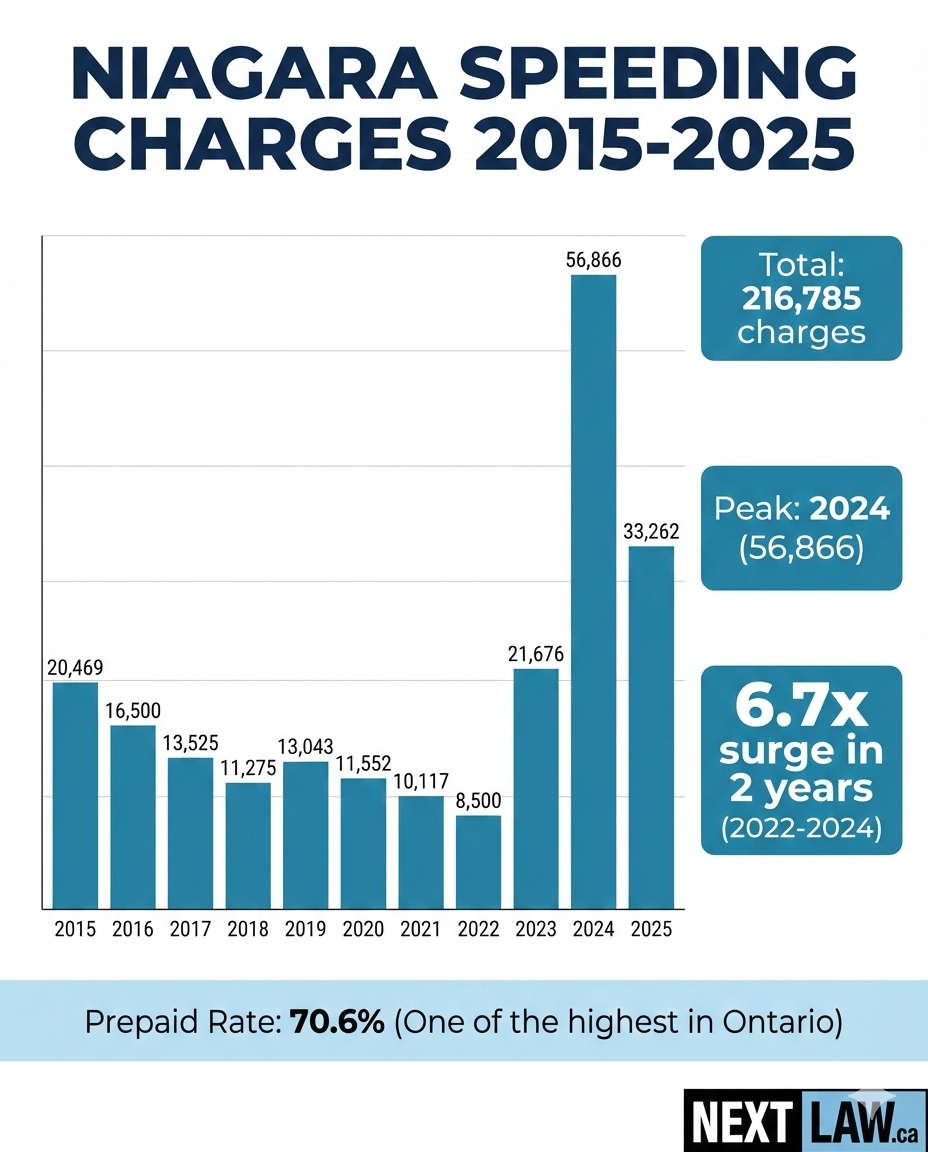
The jump from 2022 to 2024—from 8,500 to 56,866—represents one of the most dramatic enforcement increases in Ontario. Niagara has aggressively adopted Automated Speed Enforcement technology, contributing to the surge.
What the Prepaid Rate Tells Us
Of Niagara’s 216,785 speeding charges, 70.6% resulted in prepaid fines—meaning over two-thirds of drivers simply paid without contesting. This is well above the provincial average, suggesting many Niagara drivers skip the fight without checking their options. The region’s tourism-heavy traffic may contribute—out-of-town visitors often pay rather than return to fight.
What Happens When You Get a Speeding Ticket in Niagara?
When you receive a speeding ticket anywhere in Niagara Region, you have 15 days to respond. Missing this deadline means automatic conviction. These 15 days are critical for preserving your options.
Your options:
- Pay the fine: What 70.6% of drivers do, but creates a conviction on your record
- Request early resolution: Still typically results in conviction
- Request a trial: Only path to potential dismissal
The Real Cost of a Niagara Speeding Ticket
The fine is just the beginning. Insurance is the real cost.
A conviction for 16-29 km/h over comes with 3 demerit points. Most insurers treat this as a minor conviction. Over three years, you’d pay $510–$1,200 more in insurance than a driver with a clean record.
For 30-49 km/h over, you’re facing 4 demerit points and treatment as a major conviction. That’s $1,785–$4,335 more over three years—a real financial hit on top of the fine.
For 50+ km/h over or stunt driving, the impact is severe: $7,650–$9,027+ over three years, or policy cancellation.
Demerit Points vs. Insurance
Demerit points are tracked by Service Ontario for licensing. Accumulate 15 or more, and you face license suspension. For G1/G2 drivers, 4 or more points triggers a 30-day suspension—a real problem if you need your license to work or get to school.
Insurance surcharges are based on convictions, not points. But convictions stay on your driving record for 3-7 years depending on severity. If you switch insurers after a conviction, some companies treat you as high-risk. Worse, if you’re non-renewed and forced to use the Facility Association, you’re looking at $8,000–$10,000+/year.
Niagara Region’s Provincial Offences Court
Niagara tickets are processed through the Regional Municipality of Niagara Provincial Offences Court. Given the surge in ticket volume, court capacity has become increasingly important.
Common Niagara Speeding Hotspots
- The QEW: Through Niagara is heavily monitored—it carries massive traffic to and from the U.S. border and Niagara Falls tourism.
- Highway 406: To Welland sees regular enforcement.
- Lundy’s Lane and Stanley Avenue: Near Niagara Falls see enforcement targeting tourist traffic.
- Victoria Avenue, St. Paul Street: And other arterials through St. Catharines are active zones.
- Community Safety Zones: Throughout the region feature automated cameras.
Should You Fight Your Niagara Speeding Ticket?
With 70.6% paying without fighting, most Niagara drivers never check whether fighting was worth it. If you have a clean record or you’re facing major demerit points—especially on a G1 or G2—fighting becomes much more valuable. The insurance bill alone can dwarf the cost of a defense.
Not every ticket is worth fighting. But every ticket is worth checking.
What Fighting Actually Looks Like: Sustained Pressure
Most firms offer early resolution—a quick deal in the first month. NextLaw uses a different strategy called sustained pressure. Rather than taking the first deal, we prepare for trial. We request disclosure repeatedly, creating system friction. Pressure accumulates. At the trial date, there’s a 5–10% chance the officer doesn’t show—immediate dismissal. If the officer does show, we negotiate from a position of strength because the prosecutor wants to clear the case.
No other firm explains a named strategy on the first call. We do, because you deserve to know what you’re getting.
Niagara Region’s 162% Enforcement Jump and the New Insurance Reality
Niagara Region experienced a 162% year-over-year surge in speeding charges in 2024, reaching 56,866—one of the largest single-year jumps in the province. This enforcement escalation arrives alongside Ontario’s 2026 insurance reforms, creating a compounding financial risk for Niagara drivers.
For Niagara drivers—especially those on the QEW, Highway 406, and community safety zones—a single conviction means real money. Depending on speed bracket, that’s $510–$4,335 over three years. With Niagara’s total charges exceeding 216,000 over the past decade and enforcement intensity clearly accelerating, the financial case for contesting a ticket has never been stronger.
Frequently Asked Questions
What should I do if I get a speeding ticket in Niagara Region?
You have 15 days from the date on the ticket to respond. Your three options are to pay the fine, request early resolution, or request a trial. Paying is a guilty plea that creates a conviction; a trial is the only option that can end in a full withdrawal with no conviction.
Where do you fight a speeding ticket in Niagara Region?
Niagara Region speeding tickets are handled through the Regional Municipality of Niagara Provincial Offences Court, serving St. Catharines, Niagara Falls, Welland, Fort Erie and the surrounding communities. Enforcement is heavy on the QEW and Highway 406.
How much does a speeding ticket cost in Niagara Region?
The fine for 16–29 km/h over is often about $95–$220, but the fine is the small part. A conviction can add an estimated $510–$4,335 or more in insurance costs over three years, depending on the speed, your insurer, and your record.
Is it worth fighting a speeding ticket in Niagara Region?
It can be. About 71% of Niagara drivers simply pay — one of the higher prepaid rates in Ontario — but paying guarantees the conviction that raises insurance. For a clean record, or for G1 and G2 drivers facing 4 or more demerit points, fighting is often worth far more than it costs.
Do I have to go to court for a Niagara Region speeding ticket?
Not necessarily. With professional representation, your representative can attend court appearances for you — NextLaw handles appearances so most clients never have to appear in person.
Real Speeding Ticket Result
“My experience at NextLaw was very nice. The whole process was very easy and I was able to get everything done from the comfort of my home. They attended the court for me and did everything for me, keeping me updated with text messages and emails.” — Hp P., NextLaw client (verified 5-star Google review #420)
Understanding Your Options
Niagara’s enforcement has transformed dramatically—from one of Ontario’s lower-volume jurisdictions to one issuing over 50,000 tickets in 2024. Understanding your options before the 15-day deadline passes is essential.
Talk to a Speeding Ticket Law Firm
NextLaw is a law firm that focuses on fighting Ontario speeding tickets to protect your insurance. If you received a ticket in Niagara and want to know whether it’s worth fighting, a free call takes about 15 minutes. Book a free call with NextLaw or explore our free tools to see what a conviction could cost you.
About this estimate. Insurance figures above are projections based on Ontario insurance industry data. Your actual premium change depends on your insurer’s proprietary rules, your policy, your driving record, and other personal factors. NextLaw is a law firm, not an insurance broker.
This article is based on NextLaw’s professional analysis of Ontario speeding legal procedures and is provided for informational purposes only. Every case presents unique circumstances, and outcomes depend on specific case facts and proper legal representation.

