
Radar and Lidar Calibration: Why It Matters for Your Ontario Speeding Ticket
Can a calibration problem beat a speeding ticket in Ontario? Often, yes — a radar or lidar reading is only as good as the device’s calibration, and that’s checked at several levels: an annual certificate, tuning-fork tests (for radar) before and after each shift, and pre/post-shift diagnostics. If any of those records is missing, expired, or doesn’t match the device’s serial number, the reliability of the reading — and the charge built on it — can be challenged.
If you’ve received a speeding ticket in Ontario based on a radar or lidar reading, the calibration history of that device could be central to your case. Calibration issues are among the most common grounds for successfully challenging speed measurement evidence.
What Calibration Means for Speed Measurement Devices
Calibration ensures a speed measurement device is reading accurately. An uncalibrated or improperly calibrated device might display 80 km/h when the actual speed is 75 km/h—or vice versa. The consequences for drivers charged based on inaccurate readings are serious.
To be admissible as evidence in Ontario courts, speed measurement devices must meet specific calibration requirements. These requirements create multiple potential defense opportunities.
The Multi-Level Calibration System
Speed measurement devices require calibration at several levels:
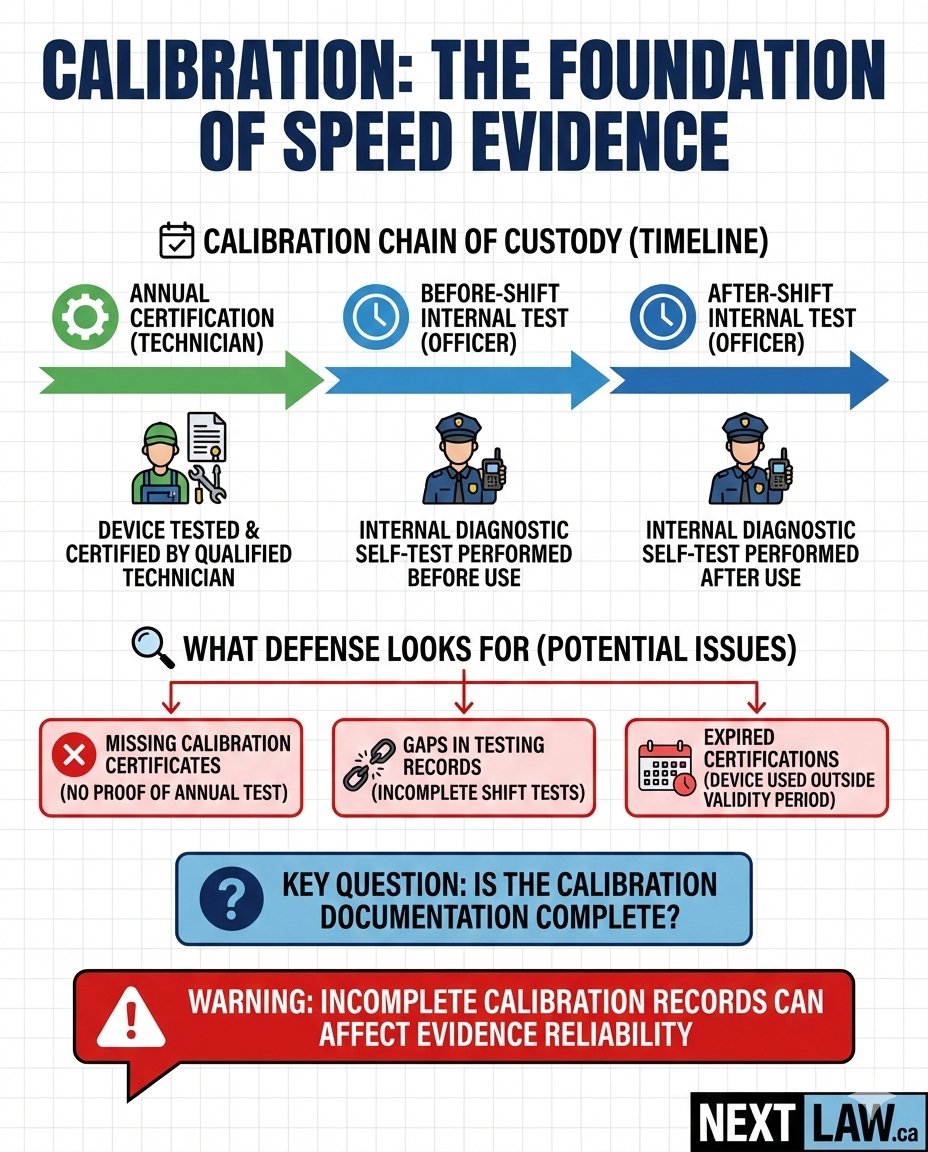
Annual Factory Calibration
Once per year, radar and lidar devices must be calibrated by a certified technician—typically at a facility authorized by the manufacturer. This calibration verifies the device’s fundamental accuracy and produces a certificate that should be part of disclosure.
If the annual calibration has expired—or if the certificate is missing from disclosure—this creates a significant evidentiary issue.
Tuning Fork Verification (Radar Only)
Radar devices are verified using tuning forks—precisely calibrated metal forks that vibrate at specific frequencies corresponding to known speeds. When struck, the fork produces a signal that the radar reads as a specific speed (commonly 40 km/h, 80 km/h, or 100 km/h).
Officers must test their radar units with these tuning forks before and after each shift. The forks themselves must also have current calibration certificates. Missing fork tests or expired fork calibrations can undermine the evidence.
Pre-Shift and Post-Shift Testing
Before deploying a speed measurement device, officers are required to perform internal diagnostic tests. These tests verify the device is functioning correctly at the start of their shift. Post-shift testing confirms the device remained accurate throughout the deployment.
Both tests are important. A device that tests correctly before a shift but shows errors after indicates potential reliability issues during the shift—including when your ticket was issued.
What to Look for in Disclosure
Calibration-related disclosure should include:
- The annual calibration certificate for the specific device (identified by serial number)
- The tuning fork calibration certificates (for radar)
- The officer’s notes documenting pre-shift and post-shift testing
- Any internal diagnostic printouts or records
Missing elements in this chain can provide defense opportunities. If the prosecution cannot prove the device was properly calibrated at every required level, the reliability of the reading is questionable.
Common Calibration Issues
Calibration issues that frequently arise include:
- Expired calibration certificates—the annual calibration date has passed
- Missing tuning fork tests—the officer didn’t document pre-shift or post-shift testing
- Expired tuning fork calibration—the forks themselves aren’t current
- Serial number mismatches—the certificate doesn’t match the device used
- Incomplete documentation—some but not all required tests were performed
Why Courts Take Calibration Seriously
Calibration requirements exist to ensure fairness. Drivers have a right to expect that the device used to measure their speed was accurate. Courts recognize that speed measurement is the foundation of speeding charges—if that foundation is unreliable, the charge should not stand.
Why Equipment Accuracy Matters for Your Insurance
A speeding conviction under Section 128 of the Highway Traffic Act carries insurance consequences. Depending on how far over the limit you were charged, most Ontario insurers classify the conviction as minor or major. For a typical minor conviction (1-29 km/h over), expect $510–$1,200 in additional premiums over three years. For a major conviction (30-49 km/h over), the cost climbs to $1,785–$4,335 over three years. That’s why challenging the technical evidence—whether it’s calibration records, device accuracy, or detection methodology—can mean the difference between a conviction that costs thousands in insurance surcharges and a withdrawal that protects your record.
Should You Challenge the Evidence?
Not every ticket is worth fighting—but every ticket is worth checking. If disclosure reveals gaps in calibration records, missing pre/post-shift tests, or expired certificates, you have options.
NextLaw uses a strategy called sustained pressure. Rather than taking the first deal offered at early resolution, we opt for trial—not because we want a trial, but because the court rarely does. We request disclosure repeatedly, creating system friction. Pressure accumulates. At the trial date, there’s a 5-10% chance the officer doesn’t show (immediate win). If the officer does show, we negotiate from a position of strength because the prosecutor wants to clear the case.
Frequently Asked Questions
Can a calibration problem get my speeding ticket dropped?
Sometimes. If the device’s annual calibration is expired, the certificate is missing, the serial number does not match, or the tuning-fork or pre-shift tests were not done, the reliability of the reading can be challenged.
How often must radar and lidar be calibrated in Ontario?
Typically once a year by a certified technician, plus tuning-fork tests (for radar) and pre- and post-shift diagnostic checks each time the device is deployed.
What are tuning forks and why do they matter?
Precisely calibrated forks that vibrate at frequencies matching known speeds. Officers test radar with them before and after each shift, and the forks themselves need current certificates — missing or expired fork records can undermine the reading.
What calibration records should be in my disclosure?
The annual calibration certificate (matching the device’s serial number), the tuning-fork certificates (for radar), and the officer’s notes documenting pre- and post-shift testing.
Does lidar need calibration too, or just radar?
Both. Lidar has its own annual calibration and pre/post-shift self-tests; radar adds tuning-fork verification on top.
Talk to a Speeding Ticket Law Firm
NextLaw is a law firm that focuses on fighting Ontario speeding tickets to protect your insurance. If your ticket relied on a radar or lidar reading, a free 15-minute call and a disclosure review can find the calibration gaps. Book a free call with NextLaw or explore our free tools.
About this estimate. Insurance figures above are projections based on Ontario insurance industry data. Your actual premium change depends on your insurer’s proprietary rules, your policy, your driving record, and other personal factors. NextLaw is a law firm, not an insurance broker.
Real Speeding Ticket Result
“I was worried about my charge affecting my insurance, considering the length of this case, I truly appreciate next law fighting tooth and nail for over a year to come out with the best possible results. My charges were dropped!” — Chris Arokium, NextLaw client (verified 5-star Google review #77)
Requesting and Reviewing Calibration Records
Calibration records should be part of standard disclosure. If they’re missing, they can be specifically requested. Reviewing these records carefully—or having them reviewed by someone who understands what to look for—is an essential step in evaluating any radar or lidar speeding case.
This article is based on NextLaw’s professional analysis of Ontario speeding legal procedures and is provided for informational purposes only. Every case presents unique circumstances, and outcomes depend on specific case facts and proper legal representation.

