
Genesis Radar: Understanding This Common Speed Detection Device in Ontario
Can a Genesis radar ticket be challenged? Yes. The Genesis tracks the strongest reflected signal — which in traffic can be a larger vehicle in another lane, not the car the officer meant to clock. Add the calibration chain (annual certificate + tuning-fork tests + pre/post-shift checks) and moving-mode complexity, and there are several places a reading can be questioned. It’s widely trusted by courts, but not infallible.
If you’ve received a speeding ticket based on a radar reading in Ontario, there’s a reasonable chance it came from a Genesis radar unit. The Genesis is one of the most widely used police radar systems in North America. Understanding how this device works—and its potential limitations—matters because it directly affects your insurance costs.
How Genesis Radar Works
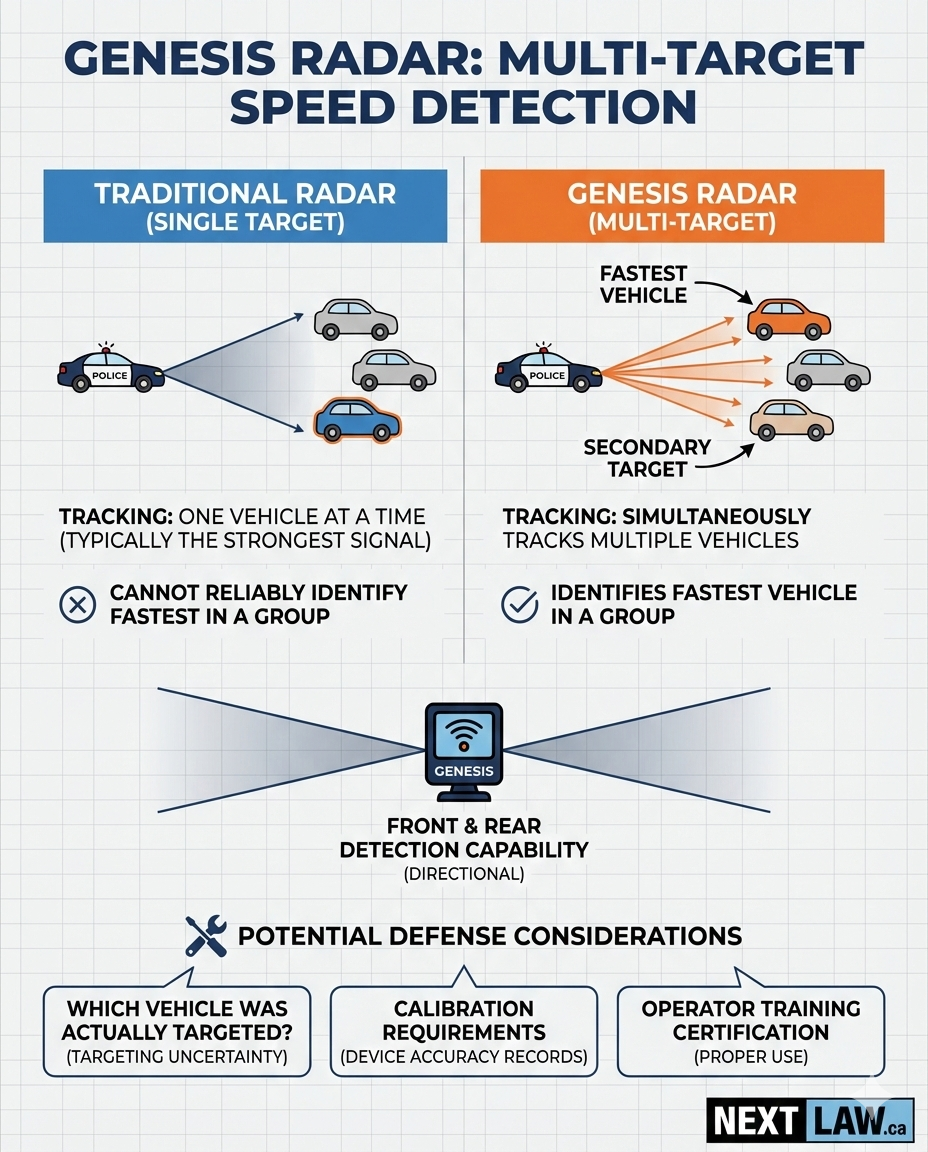
The Genesis uses dual radar antennas to simultaneously track multiple vehicles. Unlike older single-antenna radar units, the Genesis can monitor traffic from both directions and distinguish between approaching and receding vehicles. It can operate in both stationary mode (patrol car parked) and moving mode (patrol car in traffic).
The device displays speed readings to the operator and can lock the fastest or strongest target signal. It also provides audio tones that change with target speed, helping officers identify speeding vehicles even before looking at the display.
The “Strongest Signal” Factor
A critical aspect of Genesis operation: the device tracks the strongest reflected signal, which isn’t always the target vehicle the officer intended to measure.
In traffic with multiple vehicles, larger vehicles (trucks, SUVs) often produce stronger radar reflections than smaller ones. The Genesis may lock onto a larger vehicle in an adjacent lane while the officer believes they’re targeting a smaller car. This “vehicle identification” issue is a common area for defense analysis.
Calibration Requirements for Genesis Units
Like all speed measurement devices, Genesis radar units must be properly calibrated to produce admissible evidence. Standard requirements include:
- Annual calibration by a certified technician, producing a calibration certificate that should be in disclosure
- Pre-shift testing using certified tuning forks—the officer strikes the forks and the radar must display the correct speed frequency
- Post-shift testing to verify the unit remained accurate throughout the deployment
- Documentation of all tests in the officer’s notes
If any element of this calibration chain is missing or shows irregularities, the reliability of the reading can be questioned.
Common Defense Considerations
Several areas typically come under scrutiny in defense analysis for Genesis-based tickets:
- Which vehicle was actually tracked? In multi-lane traffic, establishing that the radar definitively measured your specific vehicle—rather than another vehicle with a stronger radar signature—can be challenging.
- Was the operator properly trained? Officers must be certified to operate radar equipment. Training documentation should be part of disclosure.
- Were calibration procedures followed? Missing tuning fork tests, expired calibration certificates, or incomplete documentation can affect the evidence’s reliability.
- Were there environmental factors? Radio frequency interference from nearby electronics, power lines, or other sources can potentially affect radar readings.
Moving vs. Stationary Mode
Genesis radar can operate in moving mode, calculating target vehicle speed while the patrol car is also moving. Moving mode calculations are more complex—the device must account for both the patrol car’s speed and the target’s speed—which introduces additional potential for error.
Disclosure should indicate which mode was used and, for moving mode, the patrol vehicle’s speed at the time of the reading.
What to Look for in Disclosure
For any Genesis radar ticket, disclosure should include:
- The officer’s notes on targeting and the reading obtained
- Calibration certificates for the specific device
- Tuning fork calibration certificates
- The officer’s radar training certification
- Pre/post-shift test results
Issues with any of these elements warrant further analysis.
Why Equipment Accuracy Matters for Your Insurance
A speeding conviction under Section 128 of the Highway Traffic Act carries insurance consequences. Depending on how far over the limit you were charged, most Ontario insurers classify the conviction as minor or major. For a typical minor conviction (1-29 km/h over), expect $510–$1,200 in additional premiums over three years. For a major conviction (30-49 km/h over), the cost climbs to $1,785–$4,335 over three years. That’s why challenging the technical evidence—whether it’s radar calibration, operator training, or detection methodology—can mean the difference between a conviction that costs thousands in insurance surcharges and a withdrawal that protects your record.
Should You Challenge the Evidence?
Not every ticket is worth fighting—but every ticket is worth checking. If disclosure reveals gaps in calibration records, incomplete operator certification, or environmental factors that could affect radar accuracy, you have options.
NextLaw uses a strategy called sustained pressure. Rather than taking the first deal offered at early resolution, we opt for trial—not because we want a trial, but because the court rarely does. We request disclosure repeatedly, creating system friction. Pressure accumulates. At the trial date, there’s a 5-10% chance the officer doesn’t show (immediate win). If the officer does show, we negotiate from a position of strength because the prosecutor wants to clear the case.
Frequently Asked Questions
What is a Genesis radar?
One of the most common police radar systems in North America. It uses dual antennas to track vehicles in both directions and can run in stationary or moving mode.
Can a Genesis radar target the wrong vehicle?
Yes. It locks the strongest reflected signal, and larger vehicles such as trucks and SUVs often reflect more strongly than a small car — so in traffic it can read a vehicle other than the one the officer intended.
What calibration does a Genesis radar need?
An annual technician calibration, tuning-fork tests before and after each shift, and documentation of all tests in the officer’s notes. Gaps in that chain can be challenged.
Is a moving-mode radar reading less reliable?
It is more complex — the device must account for both the patrol car’s speed and the target’s — which introduces additional room for error. Disclosure should show the mode used and, in moving mode, the patrol car’s speed.
Can a Genesis radar ticket be beaten?
It can. Vehicle-identification questions, calibration gaps, operator-training issues, or interference are all places the evidence can be challenged.
Talk to a Speeding Ticket Law Firm
NextLaw is a law firm that focuses on fighting Ontario speeding tickets to protect your insurance. On a Genesis radar ticket, a free 15-minute call and a disclosure review can test whether the reading was really yours. Book a free call with NextLaw or explore our free tools.
About this estimate. Insurance figures above are projections based on Ontario insurance industry data. Your actual premium change depends on your insurer’s proprietary rules, your policy, your driving record, and other personal factors. NextLaw is a law firm, not an insurance broker.
Real Speeding Ticket Result
“I was charged with speeding ticket 67 over the limit on a G2 license. They got it down to 29 and no suspension. Happy with the outcome.” — Vijay Dhanda, NextLaw client (verified 5-star Google review #617)
Understanding the Technology
Genesis radar is sophisticated and widely trusted by courts, but it’s not infallible. Every radar-based ticket deserves careful analysis of the specific circumstances, equipment records, and officer procedures. Understanding how the technology works is the foundation for evaluating your defense options.
This article is based on NextLaw’s professional analysis of Ontario speeding legal procedures and is provided for informational purposes only. Every case presents unique circumstances, and outcomes depend on specific case facts and proper legal representation.

