
How to Analyze Disclosure for Your Ontario Speeding Ticket
How do you analyze disclosure for a speeding ticket? Go through it systematically: read the officer’s notes for gaps, confirm the device’s annual calibration is current and its serial number matches, check that pre- and post-shift (and tuning-fork) tests were done, and confirm the officer is certified on that device. A single expired certificate or mismatched serial number is exactly the kind of error that leads to a withdrawal — and avoids the insurance hit that follows a conviction.
Once you’ve received disclosure for your speeding ticket, the next step is understanding what you’re looking at. Effective disclosure review requires knowing what to look for and what each element means for your case.
The Disclosure Analysis Checklist
Examine each element systematically:
Officer’s Notes
- Are the notes legible? Can you actually read what the officer wrote? Illegible notes can be challenged.
- Are the notes complete? Do they describe the traffic stop, the targeting process, and the speed reading? Gaps in the notes can create questions.
- Is the location accurately described? Does the description match where you were actually stopped?
- Is the time correct? Does it match the ticket?
- Are there any inconsistencies? Do different parts of the notes contradict each other or the ticket itself?
Calibration Records
Calibration records are often where defense opportunities hide. Look closely:
- Is the annual calibration current? Check the date on the calibration certificate. If it expired before your ticket date, the device’s accuracy is questionable.
- Do serial numbers match? The certificate should identify the specific device by serial number. If the numbers don’t match, the certificate doesn’t apply to your case.
- Were pre-shift tests documented? Officers should test devices before each deployment. Missing pre-shift tests can be significant.
- Were post-shift tests documented? Testing after the shift verifies the device remained accurate. Missing post-shift tests can matter.
Tuning Fork Records (Radar Only)
For radar tickets, tuning forks verify the device is reading correctly:
- Are the tuning fork calibration certificates current? Forks must be calibrated regularly—typically annually.
- Were tuning fork tests performed? The officer should document testing with the forks before using the device.
Officer Certification
- Is the officer certified to operate the specific device used? Different devices require different training.
- Is the certification current? Expired certifications can affect the evidence.
Common Red Flags
Key disclosure issues often indicate potential defense opportunities:
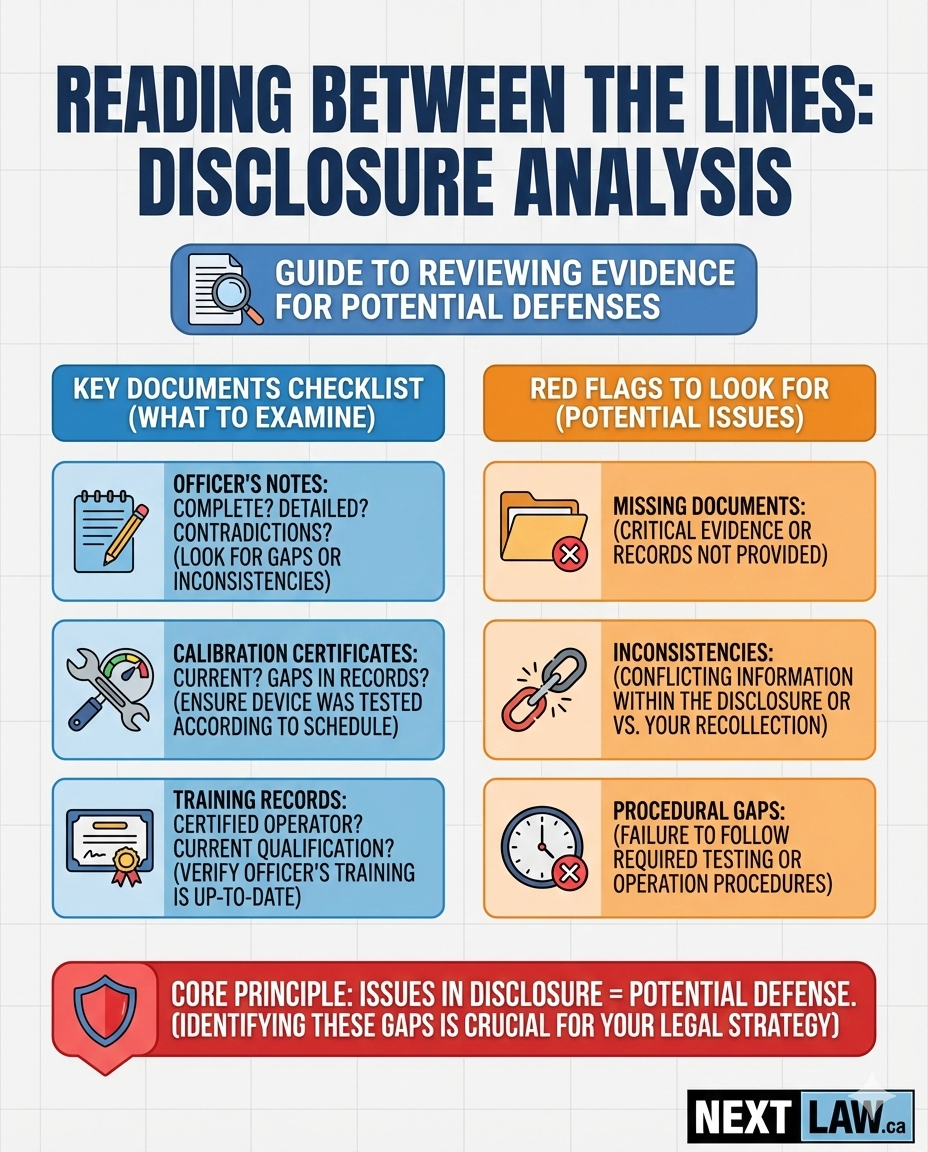
- Missing documents – If calibration records or certifications are absent, the prosecution may have trouble proving the device was accurate.
- Date discrepancies – Expired certifications or calibrations that don’t cover your ticket date.
- Serial number mismatches – Certificates that don’t match the device actually used.
- Incomplete notes – Gaps in the officer’s account of what happened.
- Vague descriptions – Language that doesn’t clearly establish key facts.
What Issues Mean for Your Case
Disclosure issues don’t automatically mean your case will be dismissed. But they can:
- Provide leverage for negotiation – Prosecutors may be more willing to offer favorable resolutions when their evidence has weaknesses.
- Create reasonable doubt at trial – If the prosecution can’t prove the device was accurate, they may not be able to prove the speed.
- Lead to withdrawal – Significant disclosure problems sometimes result in charges being withdrawn.
When to Get Help with Analysis
Disclosure analysis requires knowing what you’re looking for. If you’re unfamiliar with calibration requirements, certification standards, or what constitutes complete documentation, issues can be easy to miss. Missing a single expired certificate or mismatched serial number can cost you thousands in insurance increases.
If the stakes are high—potential suspension, significant insurance impact, or career implications—having disclosure reviewed by someone experienced in traffic defense is worthwhile.
The Financial Value of Careful Analysis
With Ontario’s 2026 insurance reforms, thorough disclosure review carries direct financial value. A 15 km/h over conviction costs $510–$1,200 over three years; a 30+ km/h over conviction costs $1,785–$4,335 over three years. Finding a technical error in disclosure that leads to withdrawal means avoiding that entire surcharge. Every missing calibration record, incomplete officer note, or procedural gap identified in disclosure is a potential path to protecting your insurance rates.
Disclosure Analysis as Defense Foundation
Careful disclosure analysis is the foundation of effective case strategy. Every decision you make—whether to negotiate, fight at trial, or accept a particular resolution—should be informed by what the disclosure reveals about the prosecution’s case.
Not every ticket is worth fighting—but every ticket is worth checking. Book a free call to have your disclosure reviewed.
Frequently Asked Questions
How do I analyze disclosure for a speeding ticket?
Work through it systematically: check the officer’s notes for legibility and gaps, confirm the device’s annual calibration is current, verify serial numbers match, confirm pre- and post-shift (and tuning-fork, for radar) tests were done, and confirm the officer is certified on that device.
What are the red flags in speeding disclosure?
Missing calibration records or certifications, calibration dates that do not cover your ticket date, serial numbers that do not match the device used, incomplete officer notes, and vague descriptions that do not establish key facts.
What is a tuning fork and why does it matter?
For radar tickets, tuning forks verify the device is reading correctly. The forks must be calibrated regularly (usually annually) and tested before use — missing fork records can undermine the reading.
Do disclosure problems mean my speeding ticket is dismissed?
Not automatically, but they can provide negotiation leverage, create reasonable doubt at trial, and sometimes lead to a withdrawal.
Should I have someone review my disclosure?
If the stakes are high — potential suspension, a big insurance impact, or a career that depends on a clean record — yes. A single expired certificate or mismatched serial number is easy to miss and can cost thousands in insurance.
Real Speeding Ticket Result
“I spoke with Jon initially about my driving offenses, and Jon and his team took care of all the rest. They went to work, ultimately keeping me on the road and working. I would recommend Nextlaw to anyone who has made a mistake on the roads.” — Matthew Suceska-Lapierre, NextLaw client (verified 5-star Google review #349)
Talk to a Speeding Ticket Law Firm
NextLaw is a law firm that focuses on fighting Ontario speeding tickets to protect your insurance. A free call takes about 15 minutes, and we can review your disclosure for the technical errors that lead to reductions and withdrawals. Book a free call with NextLaw or explore our free tools.
About this estimate. Insurance figures above are projections based on Ontario insurance industry data. Your actual premium change depends on your insurer’s proprietary rules, your policy, your driving record, and other personal factors. NextLaw is a law firm, not an insurance broker.
This article is based on NextLaw’s professional analysis of Ontario speeding legal procedures and is provided for informational purposes only. Every case presents unique circumstances, and outcomes depend on specific case facts and proper legal representation.

