
Speeding Ticket as an Uber Driver in Ontario: What You Need to Know
Bottom line: A speeding conviction can raise your insurance and put your Uber account at risk through the driving abstract Uber checks. You have 15 days to respond, and many tickets are worth fighting. NextLaw reviews your ticket for free and tells you whether fighting makes sense.
If you drive for Uber in Ontario and have received a speeding ticket, you’re facing consequences that extend beyond the fine. Your driving record directly affects your ability to work on the platform—and your insurance costs.
Why Your Driving Record Matters to Uber
Uber conducts regular background checks on its drivers. These checks include your driving abstract—the official record of your driving history maintained by Service Ontario.
Uber’s driver requirements include maintaining a clean driving record. While the company doesn’t publish exact deactivation criteria, serious violations or accumulated minor violations can trigger account review or deactivation.
What Uber Sees on Your Record
When Uber pulls your driving abstract, they see:
- All convictions, including speeding convictions with the specific speed involved
- Any suspensions or license restrictions
- Your demerit point status
- The dates of all violations
Uber reviews records both during onboarding and periodically during your time as a driver. A conviction that appears clean when you join could still cause issues at a later review.
The Double Income Impact
For Uber drivers, a speeding conviction creates a double threat to income:
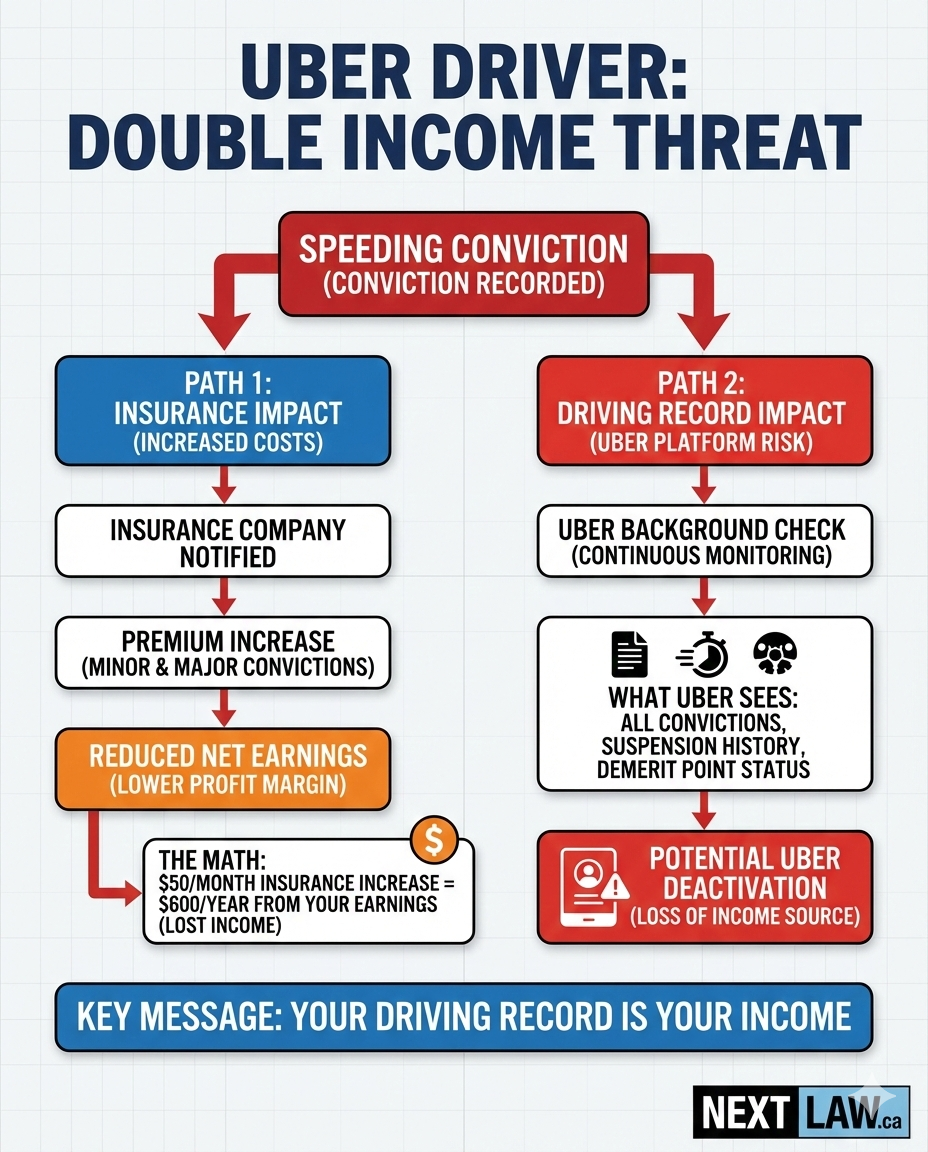
- First, insurance increases reduce your net earnings. A minor speeding conviction (1–15 km/h over) increases premiums by 10–20%, or roughly $170–$340 per year on a $1,700 baseline. That’s money directly out of your Uber income.
- Second, deactivation risk threatens your entire income stream. Even temporary account suspension while Uber reviews your record means lost earnings.
For gig economy drivers, these factors make fighting tickets far more important than for the general population.
Multiple Platform Risk
Many rideshare drivers work for multiple platforms—Uber, Lyft, and potentially delivery services. A conviction appears on the same driving abstract that all platforms check. One speeding conviction could affect your standing with multiple income sources simultaneously.
The 15-Day Deadline Is Critical
You have 15 days to respond to your ticket. For rideshare drivers, this deadline is especially important because delaying decisions or missing the deadline could result in conviction—and potential platform consequences—before you’ve even had a chance to defend yourself.
Should You Fight the Ticket?
Yes. Don’t simply pay tickets to “get them over with.” Each conviction accumulates on your record and increases platform risk and insurance costs.
Here’s how the defense process works. We use a strategy called sustained pressure. Rather than taking the first deal offered at early resolution, we opt for trial—not because we want a trial, but because the court rarely does. We request disclosure repeatedly, creating system friction. Pressure accumulates. At the trial date, there’s a 5–10% chance the officer doesn’t show (immediate win). If the officer does show, we negotiate from a position of strength because the prosecutor wants to clear the case.
The cost of fighting a ticket is often far less than the potential income loss from platform deactivation or the insurance increases that cut into your earnings for years.
What Happens if Uber Deactivates Your Account?
If Uber deactivates your account due to driving record concerns, reinstatement is uncertain and can be lengthy. You may need to wait until the problematic conviction ages off your record—which can take three to six years for insurance purposes.
Preventing the conviction in the first place is far easier than trying to recover after deactivation.
Insurance Impact: Specific Numbers
A speeding conviction stays on your driving record and affects insurance for three years. Here’s the breakdown:
- 1–15 km/h over (0 demerit points): $510–$1,200 total increase over 3 years
- 16–29 km/h over (3 demerit points): Same bracket as above for most insurers
- 30–49 km/h over (4 demerit points): $1,785–$4,335 total increase over 3 years
These aren’t guesses. They’re based on actual Ontario insurer filings.
Protecting Your Rideshare Income
Your driving record is your livelihood as a rideshare driver. A speeding ticket isn’t just a fine—it’s a threat to your income from multiple angles: insurance increases, platform deactivation risk, and lost earning time.
Understanding the stakes and responding appropriately within the 15-day deadline is essential. Not every ticket is worth fighting—but every ticket is worth checking.
Book a free call with NextLaw. We’ll review your ticket, explain your options, and let you know whether fighting makes sense for your situation.
Frequently Asked Questions
Does a speeding ticket affect my Uber account?
It can. Uber pulls your driving abstract at onboarding and periodically after, and serious or accumulated convictions can trigger account review or deactivation.
Does Uber see speeding convictions on my record?
Yes. Uber sees all convictions (with the speed), suspensions, licence restrictions, and dates on your driving abstract—the conviction shows even after demerit points expire.
Can one ticket affect Uber and Lyft at the same time?
Yes. All platforms pull the same driving abstract, so a single conviction can affect your standing with every rideshare and delivery app you use.
How much does a speeding conviction cost an Uber driver?
An estimated $510–$1,200 over three years for a minor conviction, up to $1,785–$4,335 for 30–49 km/h over—money straight out of your earnings, on top of any deactivation risk.
Should an Uber driver fight a speeding ticket?
Usually yes. The cost of fighting is typically far less than lost earnings from deactivation or years of higher insurance, and only a dismissal or withdrawal keeps the conviction off the abstract Uber checks.
A Real Speeding Ticket Result
“I spoke with Jon initially about my driving offenses, and Jon and his team took care of all the rest. They went to work, ultimately keeping me on the road and working. I would recommend Nextlaw to anyone who has made a mistake on the roads.”
— Matthew Suceska-Lapierre, verified 5-star Google review
Talk to NextLaw
If you drive for Uber and you’ve been charged with speeding, get your ticket reviewed before you decide anything. Secure your free NextLaw speeding callback and we’ll explain your options and whether fighting makes sense.
Insurance figures above are estimates based on Ontario insurer filings; your actual increase depends on your insurer, history, and policy.
This article is based on NextLaw’s professional analysis of Ontario speeding procedures and is provided for informational purposes only. Every case presents unique circumstances, and outcomes depend on specific case facts and proper legal representation.

