

How long does a speeding ticket stay on your record in Ontario? There isn’t one answer, because three records run on different clocks: demerit points fall off your Service Ontario record after two years, the conviction stays on your driving abstract about three years (longer for serious offences), and insurers rate it for roughly three to six years. So the insurance cost long outlasts the points — which is why avoiding the conviction matters more than reducing points.
One of the most common questions Ontario drivers ask after receiving a speeding ticket is: how long will this stay on my record? The answer is more complicated than most drivers realize—because different parts of your “record” are tracked for different lengths of time by different organizations.
The Three Different Records You Need to Understand
There are actually three separate records to consider:
1. The Demerit Point Record (Service Ontario)
Demerit points remain on your Service Ontario driving record for two years from the date of conviction. After that, they drop off automatically. However, these points only matter for licensing purposes—they’re what Service Ontario uses to decide if you should receive a warning or suspension.
Many drivers assume that once points drop off, everything returns to normal. But this is only half the picture.
2. The Driving Abstract (Long-Term Record)
Your driving abstract—the official record of your driving history maintained by Service Ontario—shows convictions for much longer than just two years. Minor convictions typically remain visible for three years, while more serious convictions can appear for five years or longer.
This abstract is what employers, insurance companies, and others can request to review your driving history. Even after your demerit points have dropped off, the conviction itself remains visible on this record.
3. The Insurance Company Record
Insurance companies maintain their own records of your driving history. They pull your abstract when you apply for coverage or at renewal, and they keep that information in their systems.
Insurers typically look back three years for minor convictions, but can look back six years or longer for more serious offenses. Some insurers look back ten years for certain violations when considering new applications.
Timeline: What Happens When
Here’s a typical timeline for a standard speeding conviction:
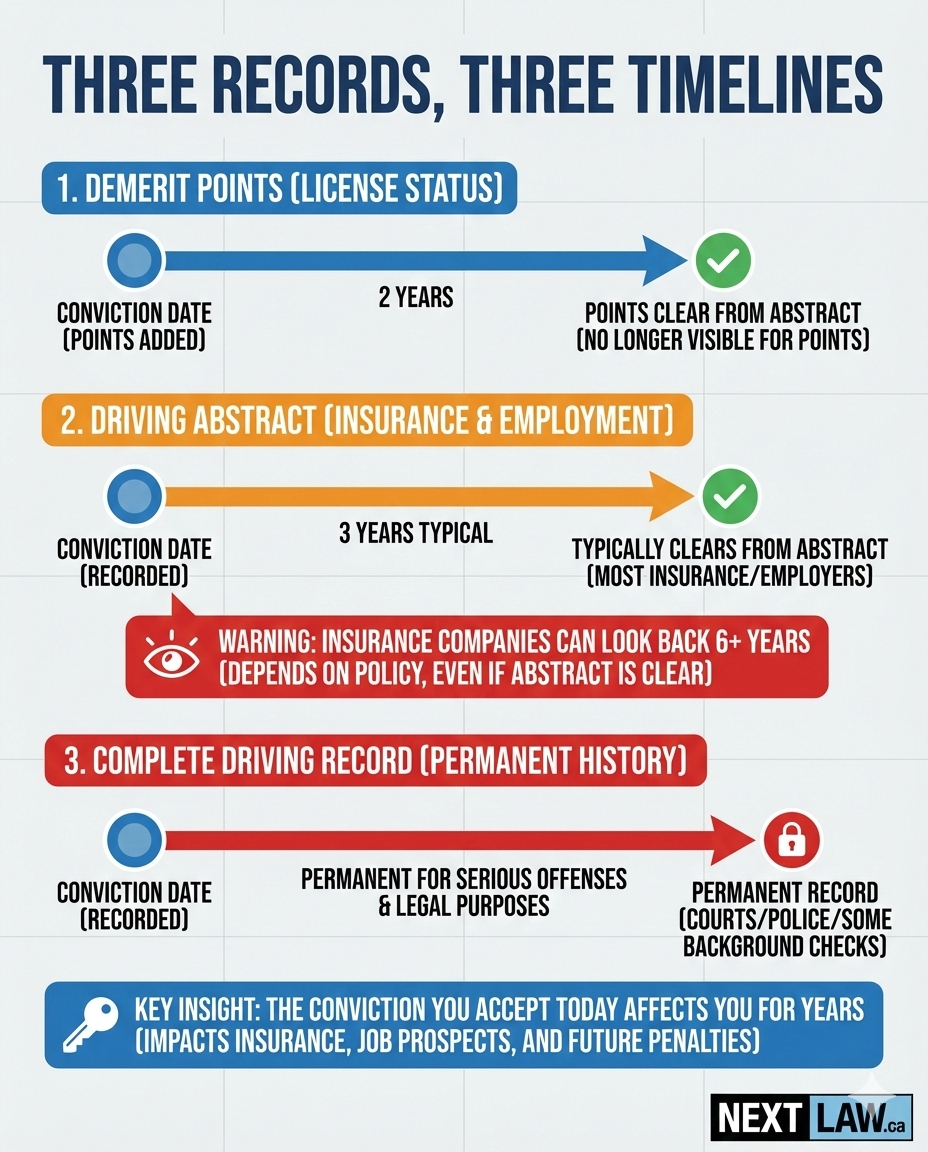
- Day 0: Conviction registered. The conviction appears on your driving abstract immediately. Demerit points are added to your Service Ontario record.
- Year 2: Demerit points drop off. Your point total returns to zero (assuming no other convictions). However, the conviction remains visible on your abstract.
- Year 3: Minor convictions may stop affecting insurance. Many insurers stop counting minor speeding convictions after three years for rate calculation purposes. The conviction may still appear on your abstract.
- Year 3–5: Abstract record clears. Minor convictions typically disappear from your driving abstract within this window.
- Year 5–6: Most convictions stop affecting insurance. More serious speeding convictions typically stop impacting rates. Some insurers may look back further.
Why the Duration Matters for Your Decision
Understanding the duration of impact should influence how you respond to your ticket. A conviction that affects your insurance for three to six years represents thousands of dollars in increased premiums—far more than the original fine.
If a conviction increases your annual premium by $600 and lasts three years, that’s $1,800 in additional insurance costs. Over six years, it’s $3,600. This is why fighting a ticket often makes financial sense even when the fine itself seems small.
Using the specific insurance figures from the brief: a 3–4 demerit conviction costs $1,785–$4,335 over three years. That’s a real impact, and it lasts long after you’ve forgotten about the ticket itself.
The “Fresh Start” Myth
Some drivers believe that switching insurance companies gives them a fresh start. This is false: every insurer will pull your driving abstract when you apply, and they’ll see the same conviction history regardless of who your previous insurer was.
The only true fresh start is not having the conviction in the first place.
Serious Convictions Last Much Longer
For convictions involving higher speeds (30+ km/h over) or stunt driving charges, the timeline extends significantly. These convictions can affect your insurance for six to ten years and may remain on your abstract for similar periods.
NextLaw’s Sustained Pressure Strategy
Rather than taking the first resolution deal offered early, we opt for trial—not because we want a trial, but because the court rarely does. We request disclosure repeatedly, creating system friction. Pressure accumulates. At the trial date, there’s a 5–10% chance the officer doesn’t show (immediate win). If the officer does show, we negotiate from a position of strength because the prosecutor wants to clear the case.
No other firm explains a named strategy on the first call.
The 2026 Insurance Reform Context
Ontario’s 2026 auto insurance reforms have made insurers significantly more aggressive about rating traffic convictions. The shift toward a “First Payer” model means insurers are now the primary payer in more claim scenarios. Additionally, speeding convictions can impact your eligibility for enhanced Statutory Accident Benefits (SABS) coverage options including Income Replacement Benefits and caregiver benefits worth up to $40,000+.
This means paying a ticket without contesting it doesn’t just raise your premiums—it can reduce the coverage available to you when you need it most.
Protecting Your Record for the Long Term
Understanding that a speeding conviction affects your record for years—not just months—should influence how seriously you take fighting it. The 15-day response deadline is the first step in protecting your record for the long term.
Not every ticket is worth fighting—but every ticket is worth checking. A free call takes 15 minutes and gives you complete clarity on your options and real-world costs.
Frequently Asked Questions
How long does a speeding ticket stay on your record in Ontario?
Demerit points drop off your Service Ontario record after two years, but the conviction stays on your driving abstract about three years for a minor offence (five or more for serious ones), and insurers typically rate it for three to six years.
How long do demerit points last in Ontario?
Two years from the conviction date, then they drop off automatically. The conviction itself stays on your abstract longer than the points do.
Does a speeding ticket affect insurance after the demerit points come off?
Yes. Insurers rate the conviction, not the points, so a conviction can affect your premiums for three to six years — long after the two-year points expire.
Does switching insurers give me a fresh start after a speeding ticket?
No. Every insurer pulls your driving abstract and sees the same conviction history regardless of who you were with before. The only true fresh start is avoiding the conviction in the first place.
How long do serious speeding or stunt convictions stay on record?
Higher-speed convictions (30 km/h or more over) and stunt-driving convictions can affect insurance for six to ten years and remain on your abstract for similar periods.
Real Speeding Ticket Result
“I had an excellent experience working with Jonathan Cohen (Next Law) on a recent case. They handled everything efficiently, kept me informed throughout, and ultimately helped me achieve a much better outcome than I expected.” — Binta Mistry, NextLaw client (verified 5-star Google review #167)
Talk to a Speeding Ticket Law Firm
NextLaw is a law firm that focuses on fighting Ontario speeding tickets to protect your insurance. A free call takes about 15 minutes and shows you what a conviction could really cost over its full life on your record. Book a free call with NextLaw or explore our free tools.
About this estimate. Insurance figures above are projections based on Ontario insurance industry data. Your actual premium change depends on your insurer’s proprietary rules, your policy, your driving record, and other personal factors. NextLaw is a law firm, not an insurance broker.
This article is based on NextLaw’s professional analysis of Ontario speeding legal procedures and is provided for informational purposes only. Every case presents unique circumstances, and outcomes depend on specific case facts and proper legal representation.

