
Can the Prosecutor Force You to Go to Trial for a Speeding Ticket?
Can the prosecutor force you to go to trial for a speeding ticket? Yes — prosecutors aren’t required to make a deal and can proceed to trial if they think they can prove the charge. Most cases settle, but some don’t, so the smart move is to prepare for trial even while hoping to resolve: review disclosure, build a defence, and judge any offer against your trial odds. Sometimes trial is the better option, because only a full withdrawal avoids the insurance hit.
If you’re hoping to negotiate a resolution to your speeding ticket, you might be wondering: what if the prosecutor won’t make a deal? Understanding that prosecutors have discretion—and that trial is sometimes the only option—helps you prepare for all possibilities.
Prosecutors Aren’t Required to Negotiate
Jon Cohen, who has negotiated thousands of speeding cases, is clear about this reality: prosecutors can choose to proceed to trial rather than offer a resolution. They have no obligation to make deals.
While most cases do settle through negotiation—it’s more efficient for everyone—some cases go to trial because the prosecutor believes they can prove the charge and sees no reason to reduce it.
Why Prosecutors Might Refuse to Deal
Dan Joffe, traffic lawyer at NextLaw, identifies common reasons prosecutors proceed to trial:
- Strong evidence. When calibration is perfect, documentation is complete, and the case is solid, prosecutors may see no need to reduce the charge.
- High speed involved. For serious speeding—30+ km/h over—prosecutors may be less willing to offer significant reductions.
- Repeat offender. If your record shows previous convictions, prosecutors may be less sympathetic.
- Policy decisions. Some prosecutors’ offices have policies about what deals can be offered for certain types of tickets.
What This Means for You
Jon Cohen emphasizes that the possibility of trial should inform how you prepare:
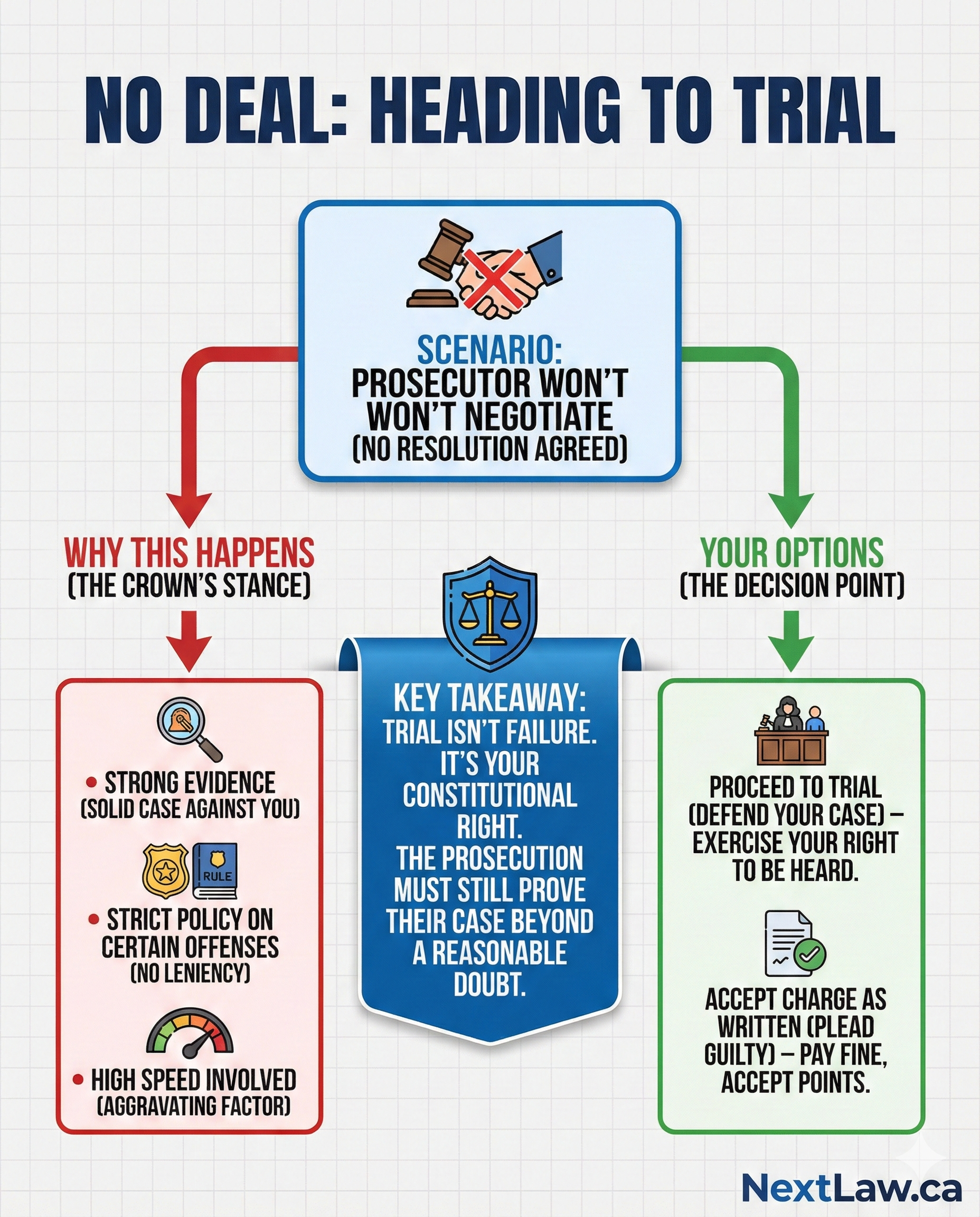
- Never assume a deal will happen. Even if most cases settle, yours might be the exception.
- Prepare for trial even while hoping for resolution. Review disclosure and develop a defense strategy regardless.
- Understand the evidence against you. If the prosecutor thinks they’ll win at trial, they have less incentive to deal.
When Trial Is Your Best Option
Dan Joffe notes that sometimes trial is actually better than any offered resolution:
- When the prosecution’s offer still includes a conviction that hurts your insurance. A conviction affects your record and your rates. If the reduction isn’t deep enough to matter financially, trial might be worth it.
- When disclosure reveals problems. If you have legitimate defense arguments, trial gives you a chance to win completely.
- When the stakes are too high for conviction. For G1/G2 drivers near suspension or drivers whose careers depend on clean records, sometimes only complete dismissal is acceptable.
The Decision Process
Jon Cohen recommends this approach:
- Review disclosure carefully. Understand the strength of the prosecution’s case.
- Develop a trial strategy. Even if you hope to settle, know what you’d do at trial.
- Approach negotiations prepared. Your preparation affects what deals are possible.
- Evaluate any offer against your trial prospects. Would you do better at trial? What’s the risk?
- Make an informed decision. Accept a deal that makes sense, or proceed to trial if that’s the better option.
Insurance Impact: Why Every Conviction Costs
Here’s what a conviction actually costs your insurance, even a “reduced” one:
- 1–15 km/h over (0 demerit points): $510–$1,200 over three years
- 16–29 km/h over (3 demerit points): Same as above for most insurers
- 30–49 km/h over (4 demerit points): $1,785–$4,335 over three years
This is why complete withdrawal beats any conviction, even a good deal. A reduction to under 16 km/h over changes your financial outcome completely. Complete dismissal costs you nothing in surcharges.
The Value of Preparation
Dan Joffe emphasizes that being prepared for trial actually helps negotiations. Prosecutors can tell when defendants have real defenses versus when they’re hoping for mercy. Prepared defendants often get better offers because prosecutors recognize the case might not be easy to win.
At NextLaw, we use sustained pressure. Rather than accepting the first deal at early resolution, we prepare for trial. We request disclosure repeatedly, creating friction. Pressure accumulates. At the trial date, there’s a 5–10% chance the officer doesn’t show (immediate win). If the officer does show, we negotiate from a position of strength because the prosecutor wants to clear the case.
Frequently Asked Questions
Can the prosecutor force me to go to trial for a speeding ticket?
Yes. Prosecutors are not required to negotiate and can proceed to trial if they believe they can prove the charge. Most cases settle, but some do not.
Why would a prosecutor refuse to make a deal?
Strong evidence (perfect calibration, complete documentation), a high speed (30 km/h or more over), a record of prior convictions, or office policies about what can be offered for certain tickets.
When is trial better than a prosecutor’s offer?
When the offered reduction still leaves a conviction that hurts your insurance, when disclosure reveals real defence problems, or when only a complete dismissal is acceptable — for example, a G1 or G2 driver near suspension.
Does being prepared for trial help my negotiation?
Yes. Prosecutors can tell who has a real defence versus who is hoping for mercy, and prepared defendants often get better offers because the case looks harder to win.
Does a reduced conviction still cost me at insurance renewal?
Yes. Any conviction is rated by insurers — a 3–4 demerit conviction commonly costs an estimated $1,785–$4,335 over three years. Only a complete withdrawal avoids the surcharge entirely.
Real Speeding Ticket Results
“I had a great experience with NextLaw in handling my driving convictions.” — Phil Yassa, NextLaw client (verified 5-star Google review #147)
“I was charged with speeding ticket 67 over the limit on a G2 license. They got it down to 29 and no suspension. Happy with the outcome.” — Vijay Dhanda, NextLaw client (verified 5-star Google review #617)
Be Ready for Any Outcome
Prosecutors may offer a deal. They may proceed to trial. Either outcome is possible. Being prepared for both gives you the best chance of success regardless of which path your case takes.
Talk to a Speeding Ticket Law Firm
NextLaw is a law firm that focuses on fighting Ontario speeding tickets to protect your insurance. If a prosecutor won’t deal, being trial-ready is what protects you — a free 15-minute call tells you where your case stands. Book a free call with NextLaw or explore our free tools.
About this estimate. Insurance figures above are projections based on Ontario insurance industry data. Your actual premium change depends on your insurer’s proprietary rules, your policy, your driving record, and other personal factors. NextLaw is a law firm, not an insurance broker.
This article is based on NextLaw’s professional analysis of Ontario speeding legal procedures and is provided for informational purposes only. Every case presents unique circumstances, and outcomes depend on specific case facts and proper legal representation.

