
Ontario Highway Traffic Act speeding, not stunt driving. Written by Jon Cohen, Partner at NextLaw — a speeding ticket law firm based in Toronto, representing drivers in every court in Ontario. Published September 14, 2026 · current as of September 2026.
NextLaw’s analysis of eleven years of Ontario Court of Justice data (Toronto’s court also covers Scarborough). You’re probably here worried about insurance — the data can’t predict your premium, but it can tell you why paying on day one is the costly move in this court.

The short answer: Toronto is the most-contested speeding court in Ontario
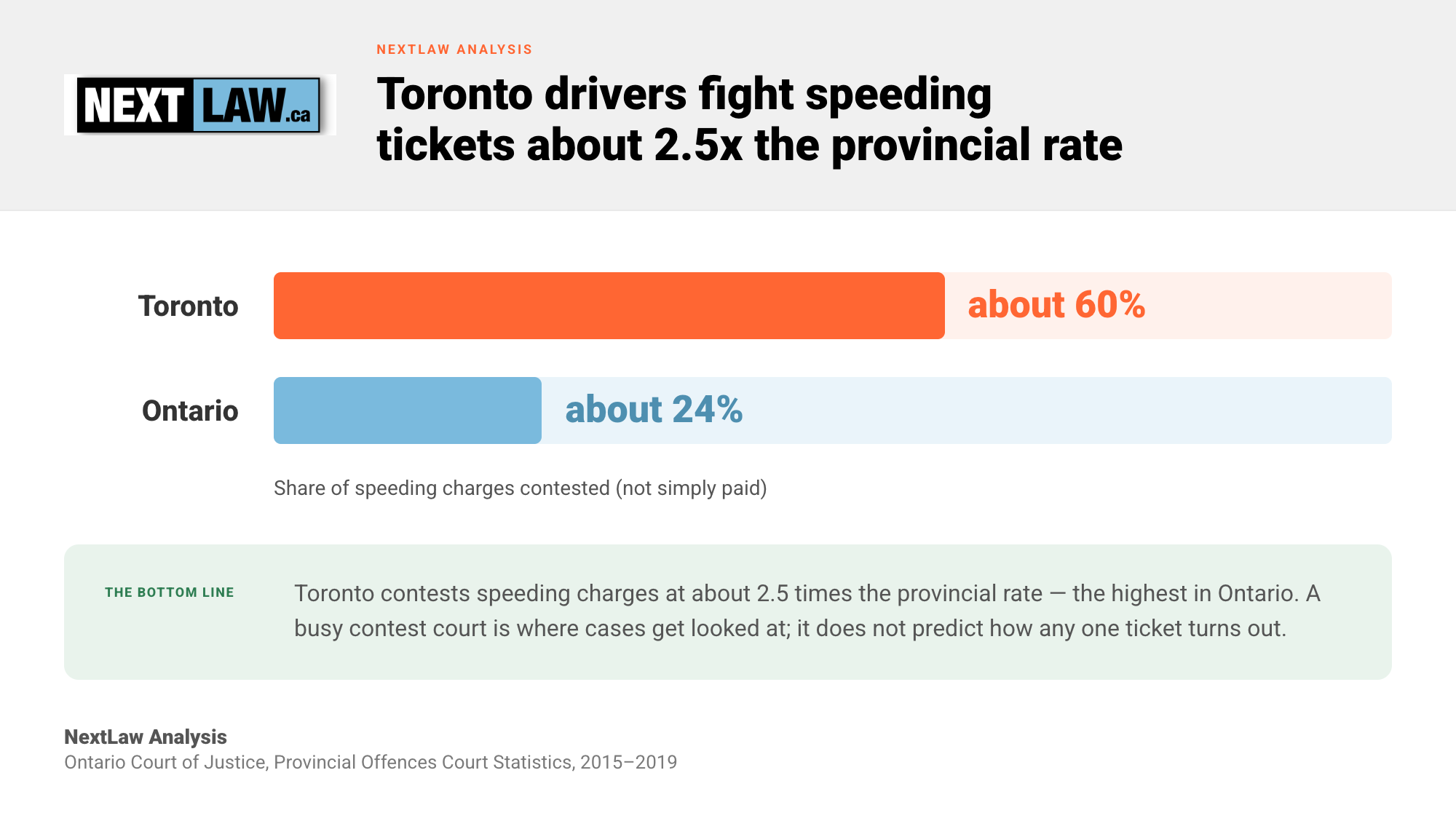
If you have a speeding ticket in Toronto, the first move is almost never to just pay it — and the court data is why. Toronto is the most-contested speeding court in Ontario: about 60% of speeding charges here are fought rather than simply paid, versus about 24% across the province — the highest contest rate in the province. According to NextLaw Analysis of Ontario Court of Justice, Provincial Offences Court Statistics, that rate held every single year we measured. Paying a Toronto speeding ticket is a guilty plea, so it closes every other option — which is why the data says to check the ticket before you pay it.
Two things about how we read that figure. First, the window: our dataset spans eleven years of Ontario Court of Justice statistics, and for this contest rate we measured the five camera-free years, 2015 through 2019. We set the speed-camera years aside on purpose. An automated speed-camera ticket is mailed to the registered plate owner, carries no demerit points, and is almost always simply paid, so leaving those tickets in the count would understate how often drivers actually contest a real, officer-issued charge. Measuring the camera-free years isolates the response to an officer’s ticket, and the most recent intake confirms the pattern still holds. Second, it is a court-wide pattern, not a prediction for any one ticket: these are charges, not people, and no court’s pattern is a promise. But it is exactly why the first move is rarely to just pay it. In Ontario, paying a speeding ticket is a guilty plea — it closes every other door.
Source: Ontario Court of Justice, Provincial Offences Court Statistics, 2015–2019 (camera-free years, confirmed against 2026 intake); analysis by NextLaw.
Is it worth fighting a speeding ticket in Toronto?
More often than in most of Ontario, yes — and the court data is why. According to NextLaw Analysis of Ontario Court of Justice, Provincial Offences Court Statistics, about 60% of Toronto speeding charges are contested. That is the highest rate in the province and roughly two and a half times the provincial figure of about 24%. It comes from the camera-free years in the data, so speed-camera tickets don’t inflate it, and the most recent numbers show the same pattern holding. That is the Toronto court, which handles the whole city, Scarborough included. Torontonians, as a group, don’t just pay.
In Toronto, the case gets decided on the trial date — not early
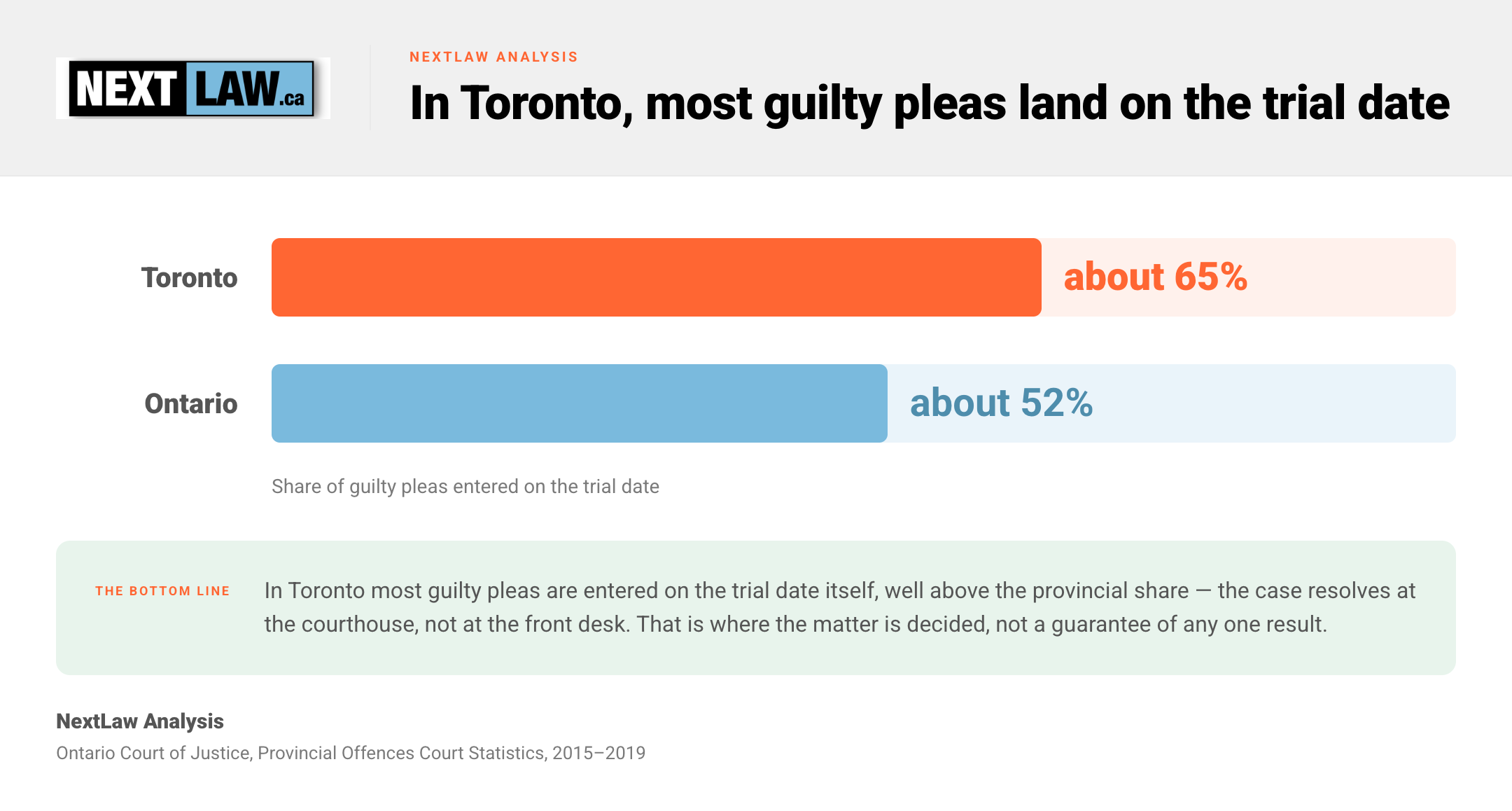
Here is the part most people don’t know, and it’s the useful one. In Toronto, the decision doesn’t get made early. It gets made on the day of trial. In that same Ontario Court of Justice data, about 65% of Toronto guilty pleas were entered on the trial date itself, compared with roughly half across Ontario (NextLaw Analysis). So Toronto isn’t a “settle it quietly at the front desk” court. It’s a court where the matter travels all the way to the courthouse, and that is where it resolves — by a plea, or by the charge being dropped.
Why does that matter to you? Because the value is in reaching that trial date, and the only way to reach it is to not pay the ticket in the first place. Our read at NextLaw is that contesting is a rational response to Toronto’s cost structure: when the real consequence of a conviction is what it may do to your insurance for years, and the fine itself is the small number, fighting becomes the sensible default. That last part is our interpretation, not something the data states. Paying on day one throws away the one thing this court’s own numbers say is worth having — a day in court where things actually move.
Source: Ontario Court of Justice, Provincial Offences Court Statistics, 2015–2019; analysis by NextLaw.
Do cops show up to court for speeding tickets in Ontario?
Not always — and that single fact is one of the biggest reasons a charge gets dropped on the trial date. Here is the mechanism. A speeding charge is proven through the officer’s evidence: what they observed, the device they used, and how it was tested. If the officer isn’t there to give that evidence, the prosecutor may not be able to prove the case, and the charge can be withdrawn. A disclosure problem — where you don’t get the evidence you’re legally entitled to under the Provincial Offences Act — can lead to the same place.
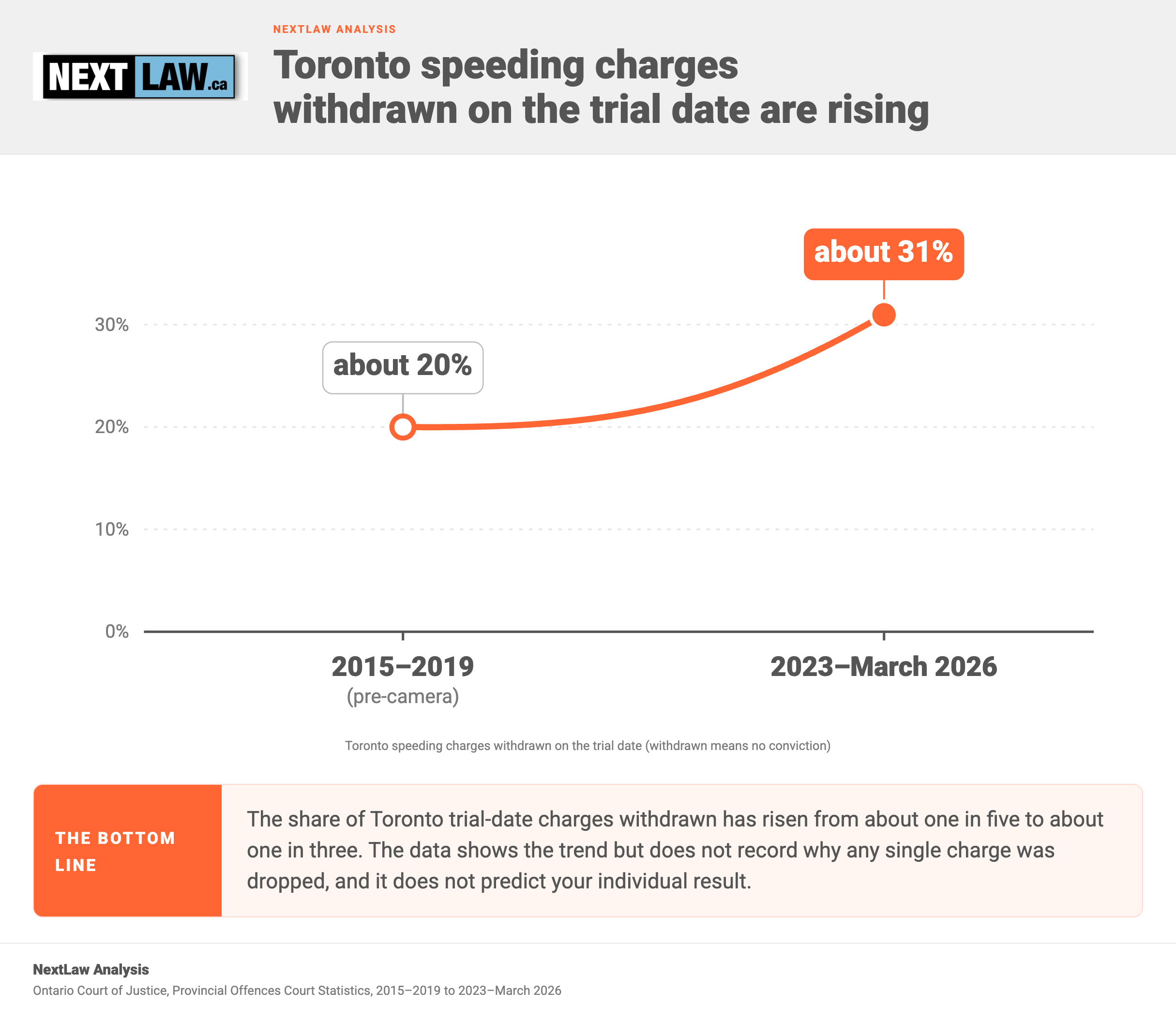
Now the Toronto numbers. According to NextLaw Analysis of Ontario Court of Justice, Provincial Offences Court Statistics, of the Toronto speeding charges that reached a trial date, about one in five was withdrawn on that date in the years before speed cameras. That has risen to roughly one in three in the most recent data, since 2023. Withdrawn means no conviction.
Be clear about what that number is and isn’t: the data doesn’t record why any single charge was dropped, and it is a rate across all the charges the court cleared, not your personal odds. Officer non-attendance and disclosure gaps are our interpretation of what’s driving it, not something the record states. But the practical point stands on its own. None of that is even on the table for someone who paid the ticket or ignored it. Withdrawal on the trial date only exists for people who asked for a trial and got to that date. It’s a door, and paying the fine closes it before you ever reach it.
Source: Ontario Court of Justice, Provincial Offences Court Statistics, 2015–2019 and 2023–March 2026; analysis by NextLaw.
How hard is it to fight a speeding ticket in Toronto?
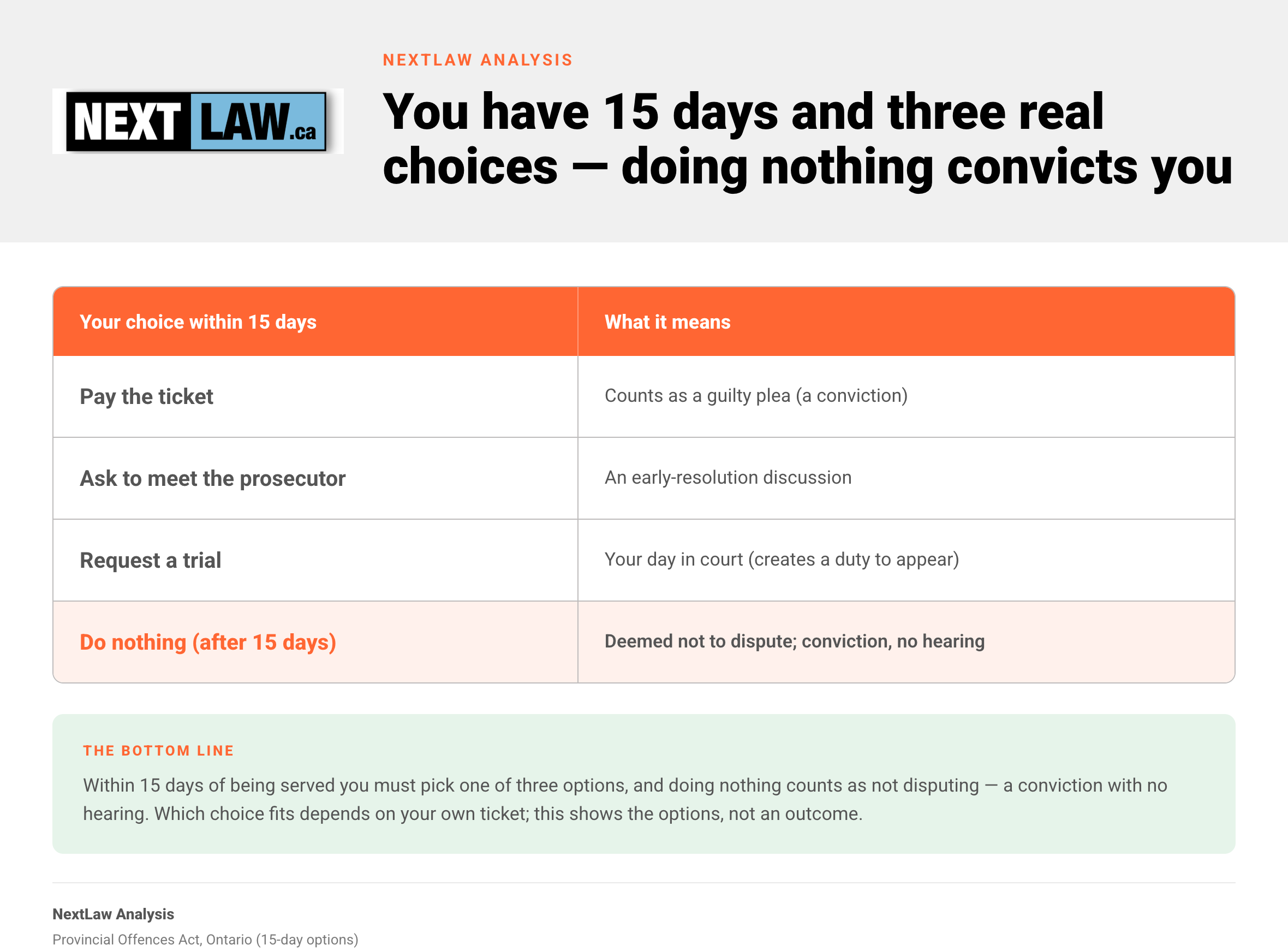
Starting is genuinely easy. Getting a good result is the part that takes work — and there is one deadline that decides everything. From the day you’re served, you have 15 days to choose one of three options printed on the ticket: pay it (which is a guilty plea), ask for a meeting with the prosecutor, or ask for a trial. Do nothing, and after those 15 days you can be deemed to not dispute the charge, and a conviction can be entered against you without a hearing. That deadline runs under the Provincial Offences Act.
The no-show trap: the second most common way people lose
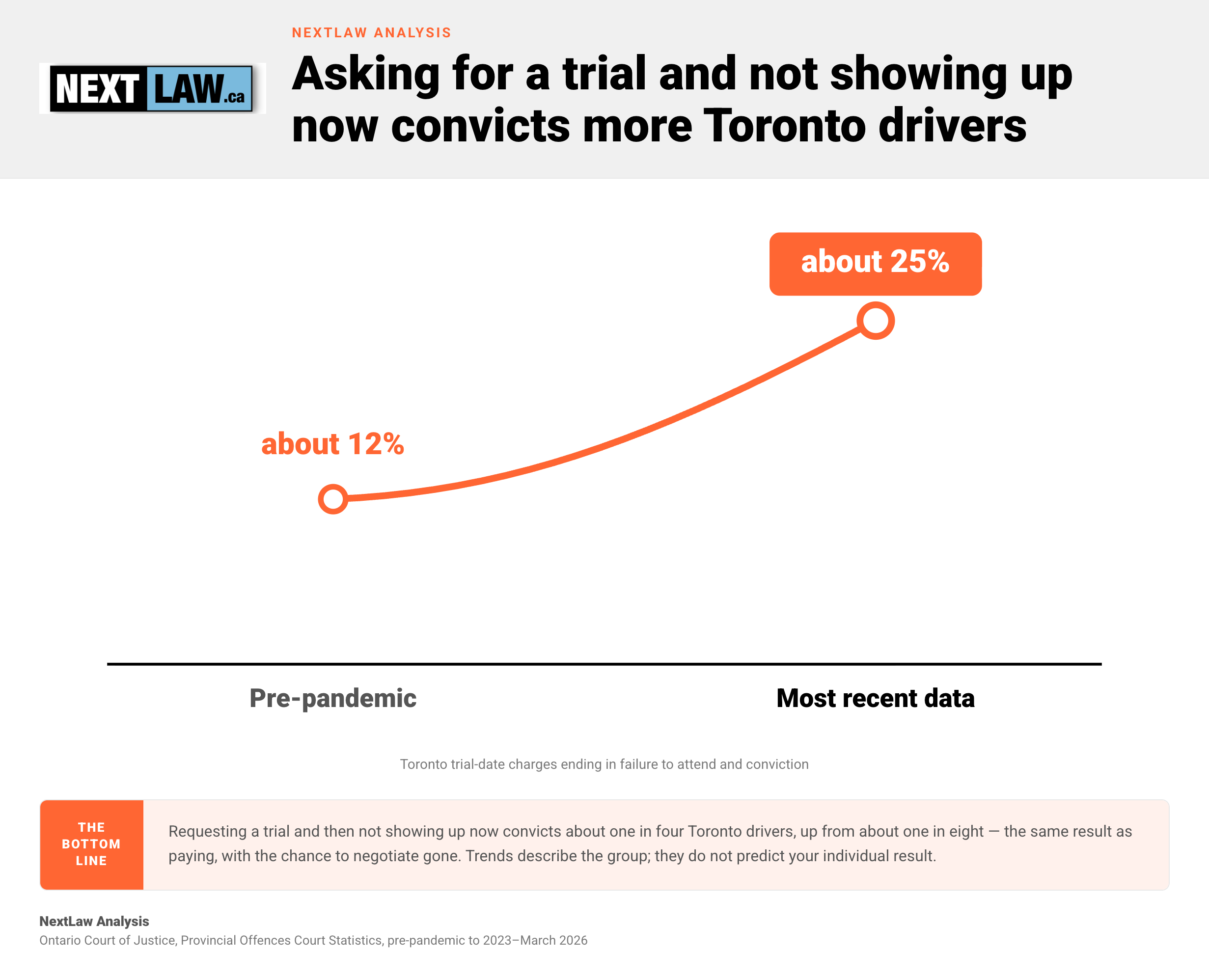
That 15-day fork is where cases are won or lost before they start. And here is a Toronto-specific caution. According to NextLaw Analysis of Ontario Court of Justice, Provincial Offences Court Statistics, asking for a trial and then not showing up is the second most common way people lose, after simply paying. In the most recent data, about one in four Toronto charges that reached a trial date ended with the driver failing to attend and being convicted — up from about one in eight before the pandemic. Requesting a trial creates an obligation to appear, in person or through a representative. Miss it, and you get the same conviction as if you’d paid, with the chance to negotiate thrown away.
The good news for anyone deciding right now: this court moves faster than it used to. According to NextLaw Analysis of the same data, the wait to a trial date in Toronto has dropped from about 158 days before the pandemic to about 111 in the most recent data — faster than most courts in Ontario. So the fifteen-day decision is the hard part. What comes after is more manageable than most people fear, as long as you make that first move and then show up.
Source: Ontario Court of Justice, Provincial Offences Court Statistics, pre-pandemic (2019) and 2023–March 2026; analysis by NextLaw.
Not every ticket is worth fighting, but every ticket is worth checking — and the first two minutes of that check are free. You can estimate what a conviction could do to your insurance with our speeding-ticket calculator before you decide anything.
Quick answers: cost, cameras, and the 20-over question
How much is a speeding ticket in Toronto?
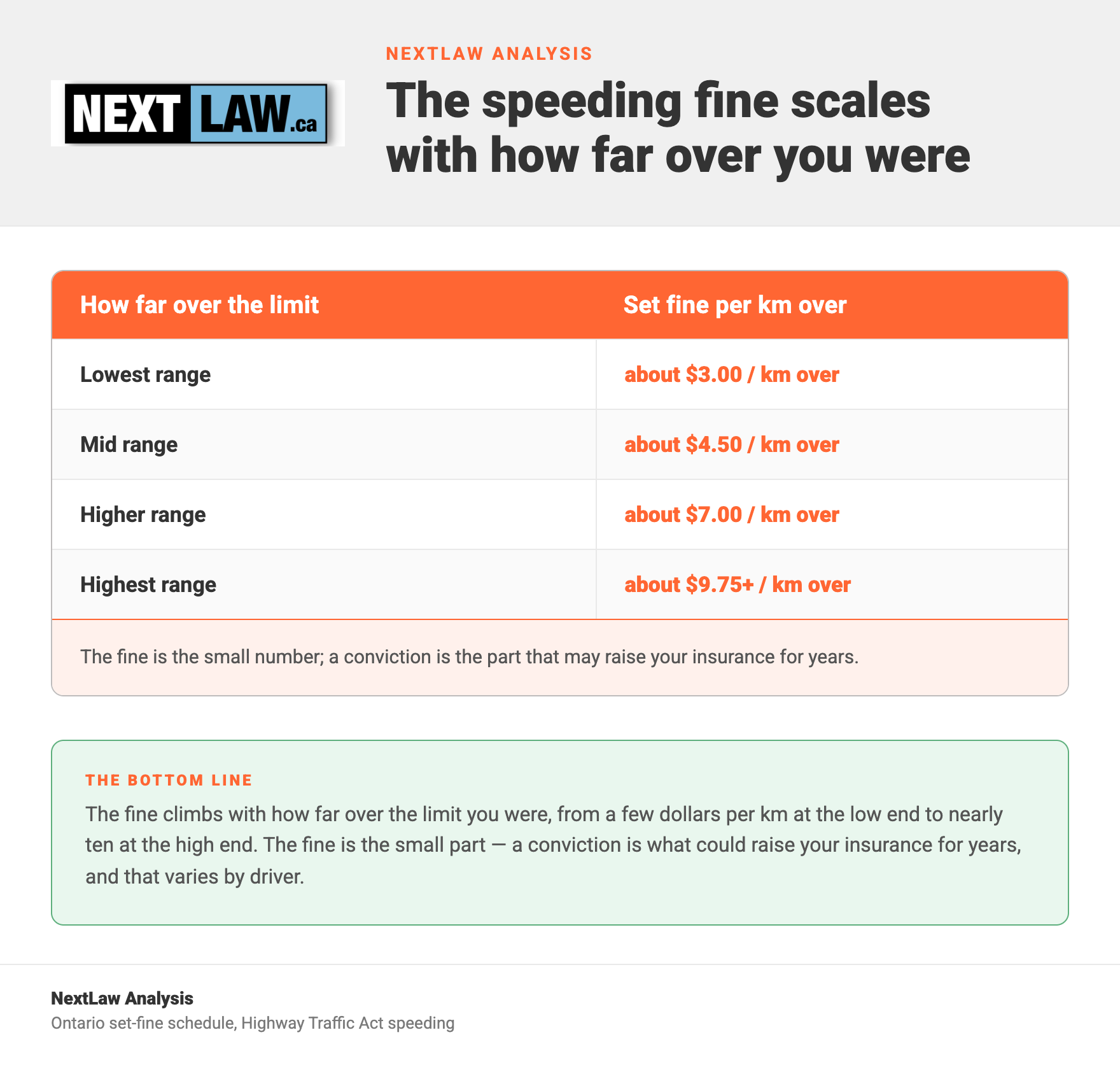
The fine is usually a few hundred dollars, set by how far over the limit you were. Under the set-fine schedule that applies to Highway Traffic Act speeding, it climbs from about $3.00 per kilometre over in the lowest range up to nearly $9.75 per kilometre for the highest. But the fine is the small number. A conviction is the part that may raise your insurance for years, and we break that full cost down in a separate article.
Are speed cameras still active in Toronto?
No. Ontario banned automated speed enforcement province-wide as of November 14, 2025, so no new camera tickets are being issued — though camera tickets from before the ban still have to be dealt with. A camera ticket and an officer’s speeding ticket are two different things: only the officer’s ticket carries demerit points and the driving-record consequences we’re talking about here.
Can you go 20 over the speed limit in Ontario?
Legally, no — there is no free buffer. Even one kilometre over the posted limit is technically an offence under the Highway Traffic Act. Whether an officer decides to pull you over is a separate question from what the law actually allows.
What to do with a Toronto speeding ticket
Got a speeding ticket in Ontario? Don’t pay it yet. Not every ticket is worth fighting — but every ticket is worth checking. Start with our free insurance calculator: seven quick questions to estimate how much your insurance could go up. Get your number first. Then, if it makes sense, book a free call for a straight answer.
NextLaw is a speeding ticket law firm based in Toronto, representing drivers in every court in Ontario. Services by licensed lawyer and licensed paralegals at NextLaw. General information only, not legal advice. This covers ordinary Ontario Highway Traffic Act speeding — not stunt driving or racing.

