

By Dan Joffe, Lawyer, NextLaw — a speeding ticket law firm based in Toronto, representing drivers in courts across Ontario. Published 23 September 2026 · Last updated 23 September 2026. Current as of September 2026; Ontario law and court practice can change.

If you’re holding a speeding ticket in Ottawa, insurance is probably the real worry. The court’s own record can’t tell you what your premium might do — but it can tell you what actually happens to Ottawa speeding charges, which shapes your options in the 15 days you have to decide what to do. We looked at eleven years of Ontario Court of Justice data, and Ottawa turns out to be a fast, ordinary court with no dramatic local story: three in four charges here are simply paid or ignored, even more than the province overall. What makes Ottawa different is its camera history — and that’s the one thing to sort out before you decide anything.
This page covers ordinary Ontario speeding under the Highway Traffic Act (the provincial law that governs speeding, what most people just call a “speeding ticket”) — not stunt driving, which is a separate charge with separate stakes.
Speeding ticket in Ottawa: what the court data says about your options
Short answer: In Ottawa, most drivers never fight a speeding ticket — they pay it, which is a guilty plea, or ignore it, which convicts them anyway. We looked at eleven years of Ontario Court of Justice data to see how this court actually resolves a speeding charge, and the picture is a fast, unremarkable court that mostly processes guilty pleas. The one local fact worth knowing is Ottawa’s low contest rate. And the one thing to confirm before you do anything: since Ontario banned speed cameras, every Ottawa speeding ticket is an officer’s ticket that may carry demerit points and goes on your record. Two honest limits before the figures: these are counts of charges across the whole court, not a probability for your case; and the record shows the outcome, not the reason behind it.
Dan and his team were able to achieve a far better outcome for my case than I could have hoped for.
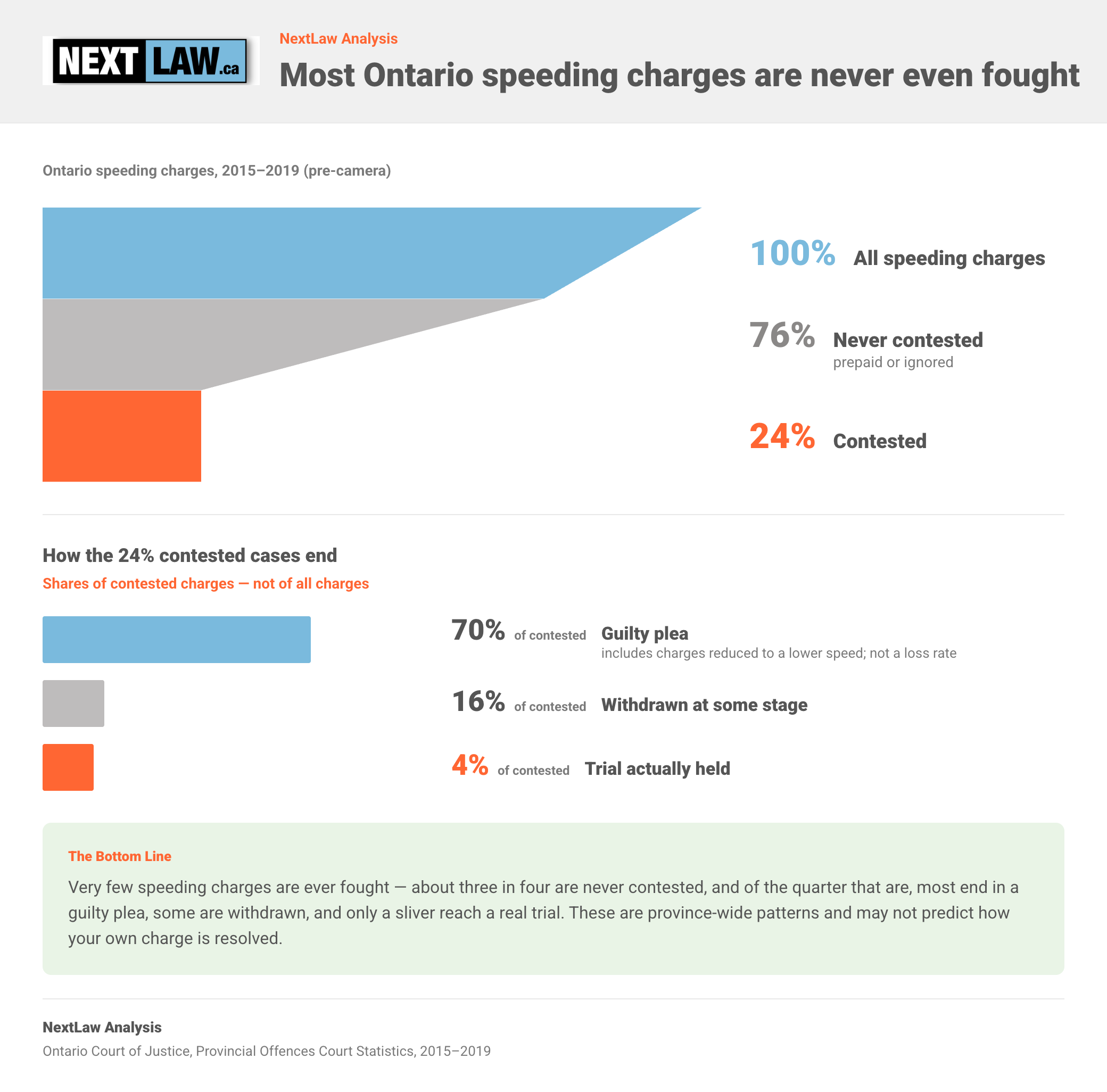
One: three in four Ottawa speeding charges are never contested at all. Across the province, according to NextLaw Analysis of Ontario Court of Justice data (Provincial Offences Court Statistics, five camera-free years, 2015–2019), about 76% of speeding charges were never contested — simply prepaid or left to convict by default. Ottawa runs a little higher than that provincial baseline. In other words, most drivers here don’t fight; they pay or ignore, and the conviction lands either way. Source: Ontario Court of Justice, Provincial Offences Court Statistics, 2015–2019; analysis by NextLaw.
Two: of the charges that are contested, most end in a plea, not a trial. Of the roughly one in four charges province-wide that were contested, about 70% ended in a guilty plea (a share that includes charges reduced to a lower speed), about 16% were withdrawn at some stage, and only about 4% actually went to a trial (NextLaw Analysis of Ontario Court of Justice data, 2015–2019). Of the small slice that reaches a trial date, about a fifth were withdrawn on that date before the pandemic (roughly 22%) and just over a quarter in the most recent data (roughly 27%, 2023–March 2026). “Withdrawn” means the charge was dropped — no conviction, no record. Source: Ontario Court of Justice, Provincial Offences Court Statistics, 2015–2019 and 2023–March 2026; analysis by NextLaw.
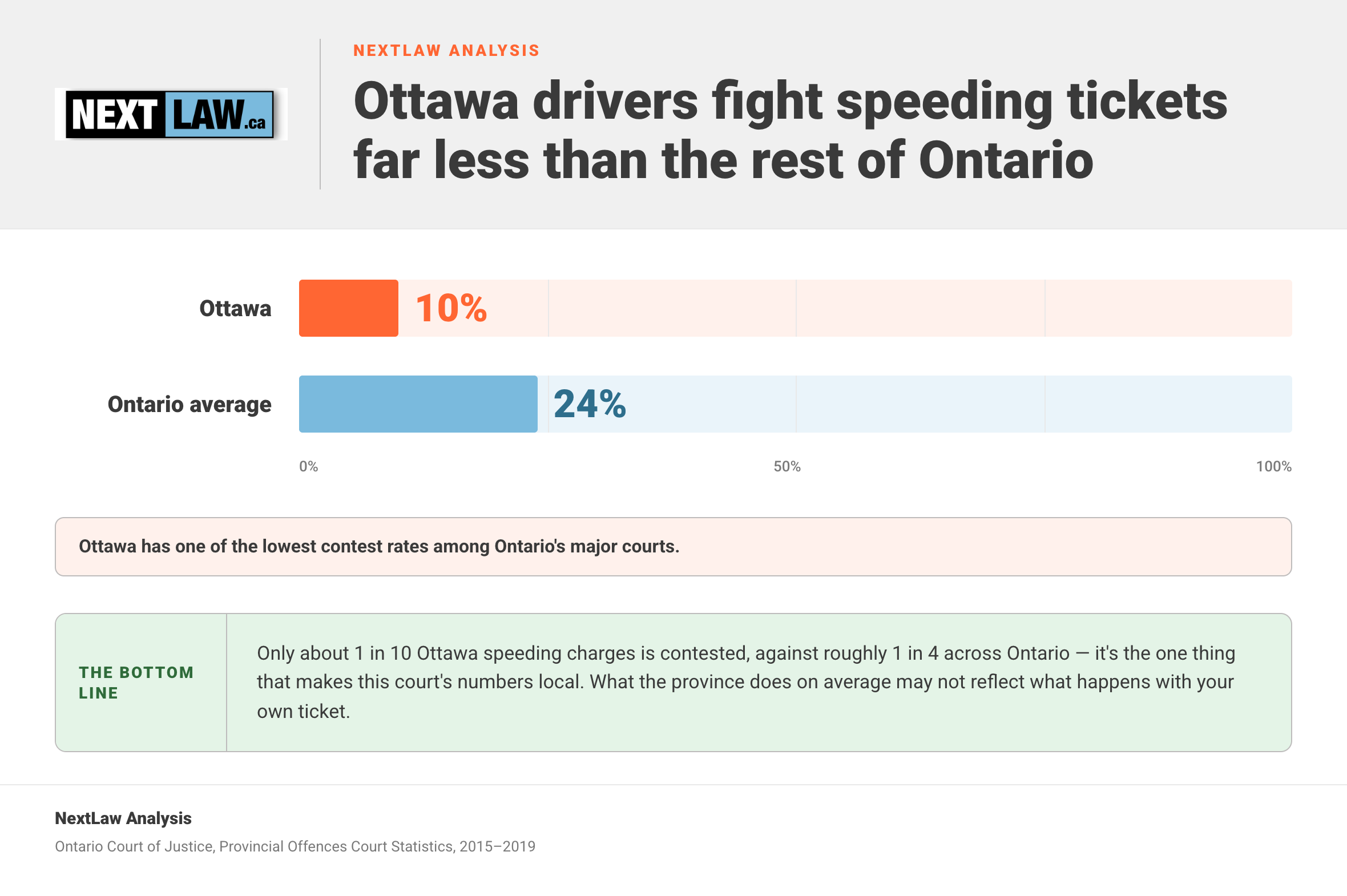
Three: Ottawa’s one local fact is how rarely drivers here contest. Only about 1 in 10 Ottawa speeding charges was contested, against roughly 24% province-wide — one of the lowest contest rates among Ontario’s major courts (NextLaw Analysis of Ontario Court of Justice data, 2015–2019). Read plainly: Ottawa drivers are more likely than most to simply pay and move on. The data can’t tell you why, and it can’t tell you what would happen in your case — but it does say the local norm here is not to fight, which is worth knowing before you decide whether to. Source: Ontario Court of Justice, Provincial Offences Court Statistics, 2015–2019; analysis by NextLaw.
What the data means — and what it doesn’t
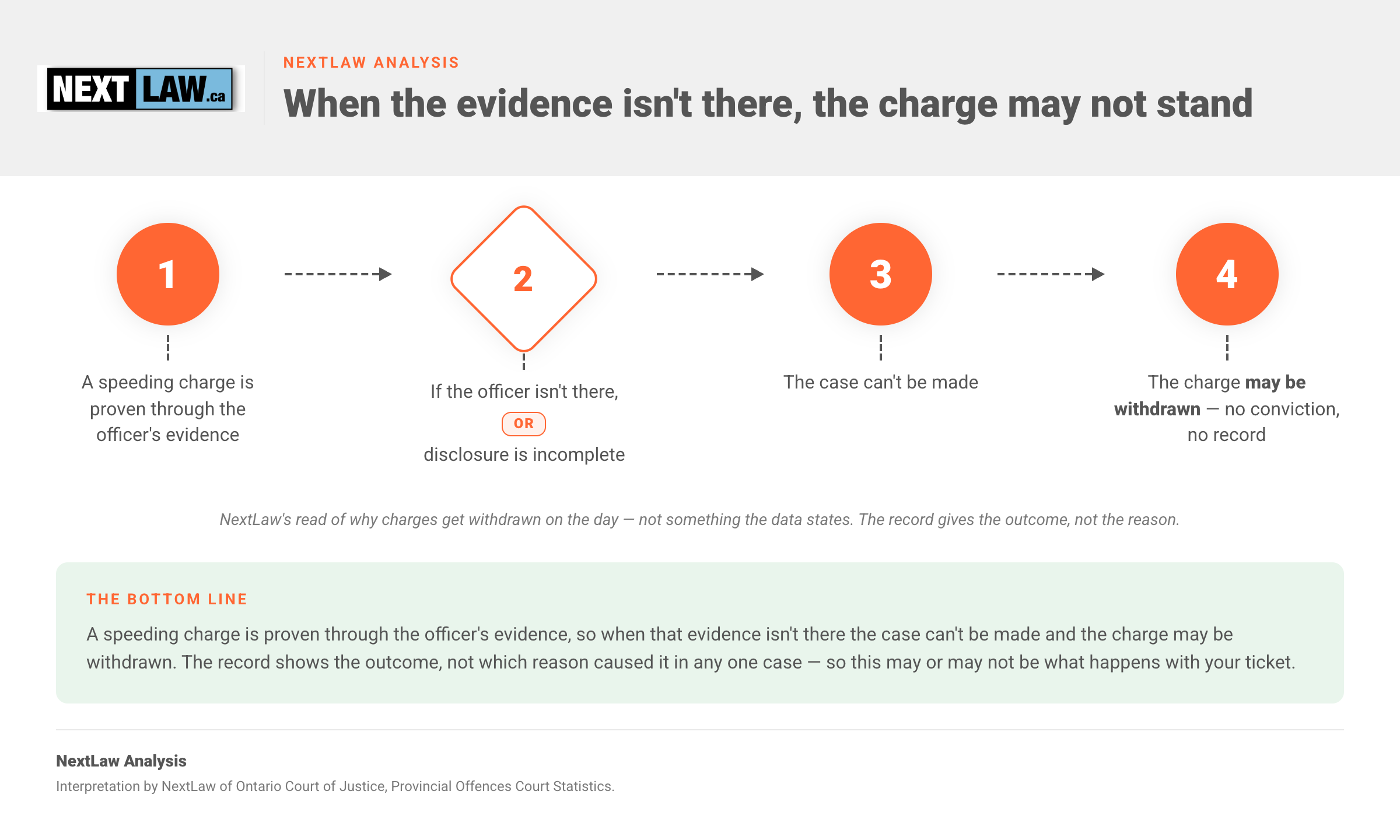
Our read at NextLaw is that Ottawa is an ordinary, efficient court where most drivers pay and the ones who do fight move quickly: a contested charge here reaches a trial date fast, in about four months. When a charge is withdrawn, it’s usually because the case couldn’t be proven that day. A speeding charge rests on the officer’s evidence — the observation, the device, the identification — so if the officer isn’t there on the trial date, or the disclosure is incomplete, the case can’t go ahead and the charge may be withdrawn. That’s the mechanism behind the withdrawal numbers. Which factor drives any single case, the data doesn’t record; it gives the outcome, not the reason. And the realistic good outcome here is usually a reduction — the speed lowered to a bracket that’s better for your record — not a dismissal. A reduction lowers your demerit points but doesn’t erase the conviction, and whether it changes your insurance could depend on the tier and your insurer.
The Ottawa-specific part: confirm which ticket you’re holding
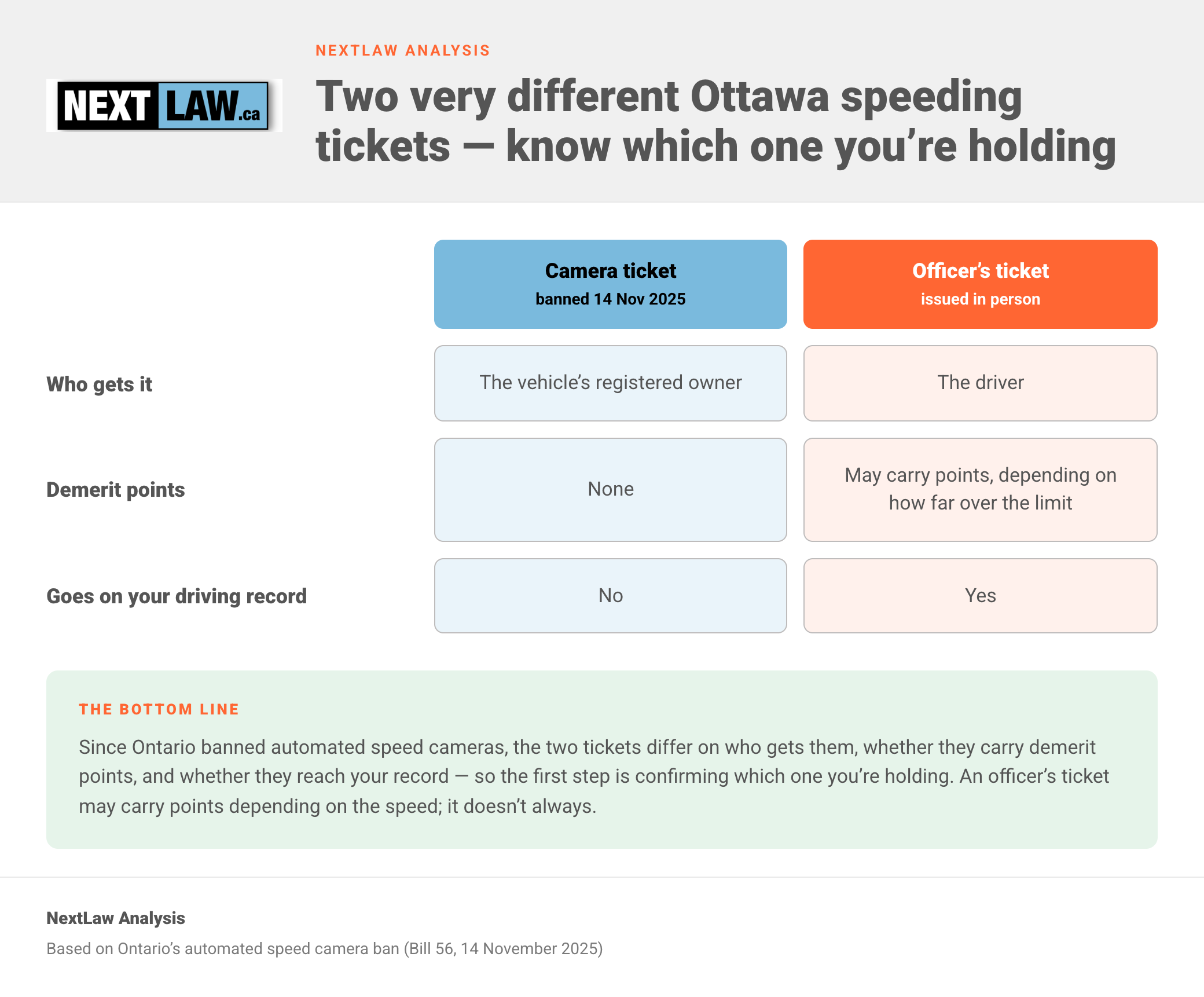
Ottawa ran the province’s largest automated speed-camera program, so this matters more here than almost anywhere. Ontario banned automated speed cameras on 14 November 2025 under Bill 56. Camera tickets were issued to the vehicle’s owner, carried no demerit points, and never touched a driving record. Since the ban, every speeding ticket in Ottawa is an officer’s ticket — issued in person, which may carry demerit points (depending on how far over the limit you were) and goes on your record. Those are two very different tickets, and the difference decides whether the court data on this page even applies to you. Before you decide anything, confirm which ticket you’re holding.
The one deadline that governs all of it: 15 days
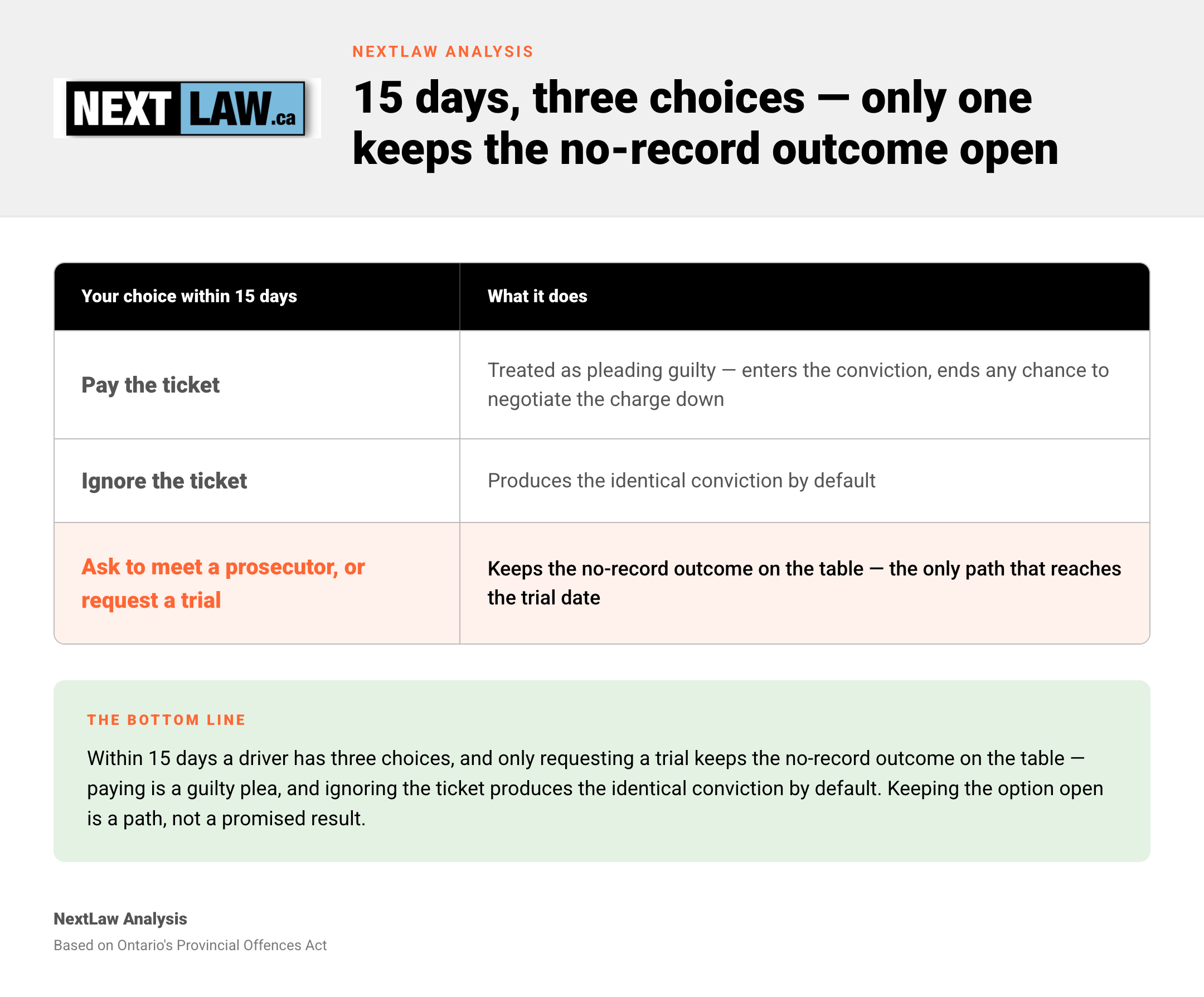
Under Ontario’s Provincial Offences Act (the law that sets out how these tickets are handled), you have 15 days from the date of the ticket to choose one of three options: pay it, ask to meet a prosecutor, or ask for a trial. Only the trial request keeps the no-record outcome on the table. Paying the ticket is treated as pleading guilty — it enters the conviction and ends any chance to negotiate the charge down. Ignoring the ticket produces the identical conviction by default. Both convict you the same way most Ottawa drivers already are convicted, so the deadline matters even before the fight-or-not question does. And remember the honest limit on all of it: these figures describe the court, not you — the realistic aim if you do fight is usually a reduction, not a guaranteed dismissal.
A note on the numbers above: we looked at eleven years of Ontario Court of Justice data, measuring the five camera-free years, 2015 through 2019, and confirming the pattern in the most recent figures (2023 to March 2026). Speed cameras operated in Ontario from July 2020 until they were banned on 14 November 2025 under Bill 56, and because they distorted how many tickets were issued and how many were simply paid, this analysis leaves the camera years out of those measures and uses the pre-camera years, confirmed against the first camera-free months of 2026. We report the trial-date figures on the most recent years, where camera tickets almost never reached.
Quick answers
How much is a speeding ticket in Ottawa?
Ontario fines rise with your speed, from about $3 per kilometre over the limit up to nearly $10 per kilometre for the highest bands, and they double in a community safety zone. But the fine is usually the smaller problem — the lasting cost is the conviction on your record and what it could mean for your insurance, not the ticket amount itself.
Will I get points for doing 37 in a 30?
No. There are no demerit points for going 1 to 15 km/h over the limit — and 37 in a 30 is 7 over. Points start at 3 for 16 to 29 over, then 4 points at 30 to 49 over, and 6 points at 50 or more over.
Are speed cameras still active in Ottawa?
No. Ontario banned automated speed cameras on 14 November 2025. Those camera tickets carried no demerit points and never touched a driving record. The tickets police issue in person can carry both — demerit points (depending on your speed) and a record — which is why confirming which kind of ticket you’re holding is the first step.
What happens if you ignore a speeding ticket in Ontario?
You’re convicted by default — the same result as paying it. That conviction stays on your record for three years and could raise your premium. Doing nothing is not a way out; it’s just the slowest way to the same conviction.
What to do next
Got a speeding ticket in Ontario? Don’t pay it yet. Not every ticket is worth fighting, but every ticket is worth checking. Two free, no-obligation ways to start:
- Try our free Speeding Ticket Insurance Calculator — 7 quick questions to see how much your insurance could go up. Get your number.
- Book a free call — no obligation, and we’ll give you a straight answer on whether your ticket is worth fighting. Book a free call.
Want to see how a busier court compares? See our companion breakdown of the Toronto speeding court data, and our look at the Mississauga numbers, where close to one in three charges reaching trial are withdrawn on the day.
NextLaw is a speeding ticket law firm based at 250 University Avenue, Suite 215, Toronto, ON. We represent drivers in courts across Ontario, including Ottawa. Services by a licensed lawyer and licensed paralegals at NextLaw. This article is general information about Ontario speeding tickets, not legal advice for your specific case.

