
By Dan Joffe, lawyer at NextLaw (LSO #37145V) · Published October 8, 2026 · Last updated October 8, 2026 · Ontario, Canada
Short answer: Traffic ticket lawyer in Scarborough, Ontario? The court data points to one costly, avoidable mistake: missing the trial date. Scarborough speeding tickets are heard at the Toronto court. According to NextLaw Analysis of Ontario Court of Justice data, since 2023 about 1 in 4 speeding charges that reached a trial date there ended in a conviction because no one appeared: 25%, against 21% across Ontario. So the first job of a traffic ticket lawyer in Scarborough is the simplest one: making sure someone is there. A missed date ends in the same conviction as paying the ticket, and a conviction is the part that could affect your insurance.

Traffic ticket lawyer Scarborough: 1 in 4 trial dates missed
We analyzed eleven years of Ontario Court of Justice data, 2015 through March 2026, for speeding charges under Ontario’s Highway Traffic Act (section 128), what most people call a speeding ticket.
Scarborough has no court of its own in the data. Its speeding tickets go to the Toronto court, and the Toronto court’s east courthouse is at 1530 Markham Road in Scarborough (City of Toronto, court hearings information). The court data covers the whole Toronto court; it can’t be split by district. So every figure below is the Toronto court’s, not Scarborough’s alone.
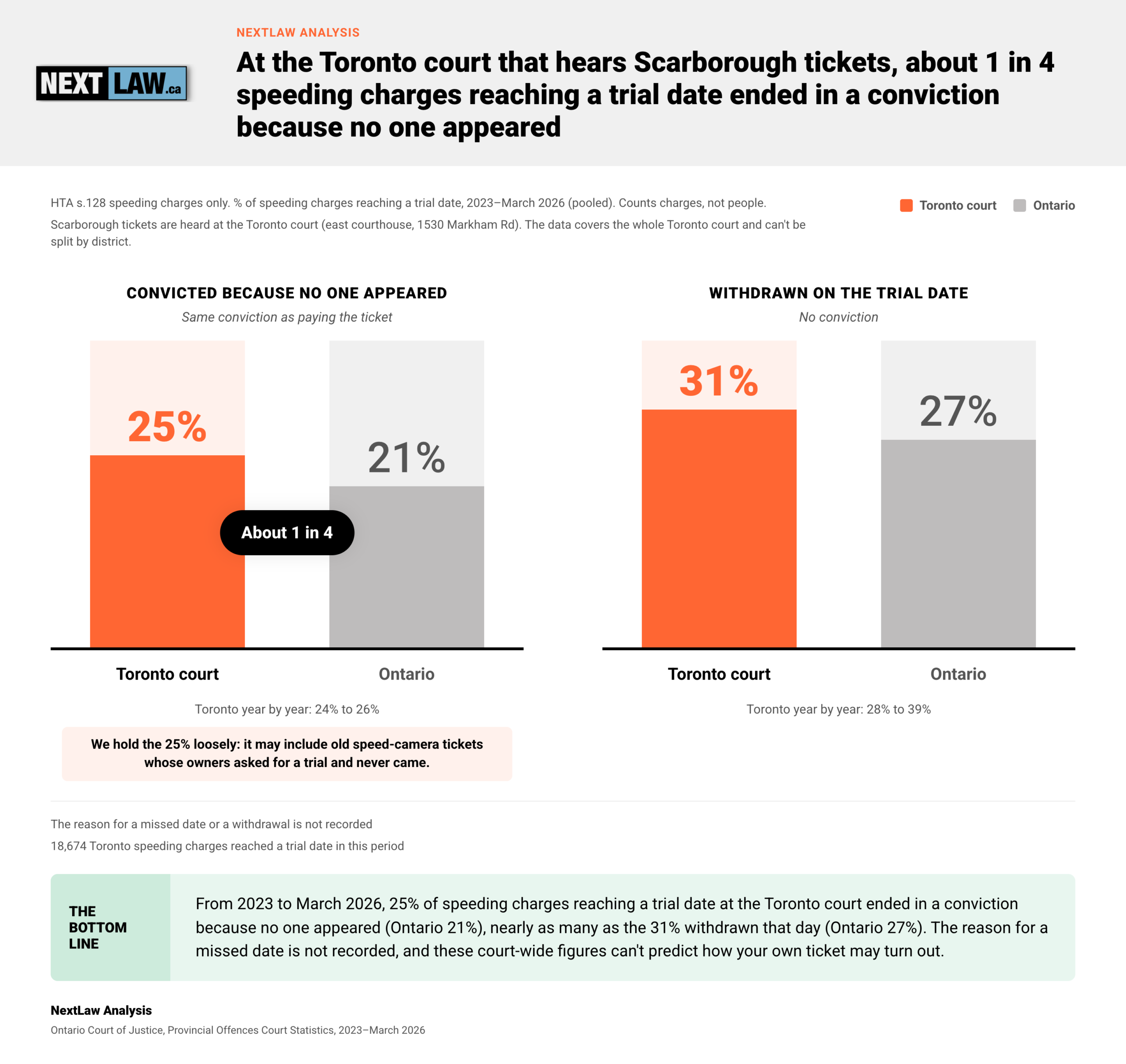
According to NextLaw Analysis of Ontario Court of Justice data, from 2023 to March 2026, 25% of speeding charges that reached a trial date at the Toronto court ended in a conviction because no one appeared, against 21% across Ontario. That is about 1 in 4. It held steady year by year, between 24% and 26%.
That’s nearly as many as were withdrawn on the trial date. In the same period, 31% of those Toronto charges were withdrawn that day, against 27% across Ontario (between 28% and 39% year by year). The reason for a withdrawal is not recorded.
| Measure | Period | Toronto court (hears Scarborough tickets) | Ontario |
|---|---|---|---|
| Convicted because no one appeared (share of speeding charges reaching a trial date) | 2023–March 2026 | 25% | 21% |
| Withdrawn on the trial date (share of speeding charges reaching it) | 2023–March 2026 | 31% | 27% |
| Speeding charges reaching a trial date | 2023–March 2026 | 18,674 | 63,135 |
| Size of that trial docket against its pre-camera size | 2023–March 2026 vs 2015–2019 | 0.7 times | 0.8 times |
Source: Ontario Court of Justice, Provincial Offences Court Statistics (2015–March 2026); analysis by NextLaw.
A missed date ends the same way as paying the ticket
A withdrawal ends with no conviction. A missed trial date ends with the same conviction as paying the ticket. At the Toronto court since 2023, those two outcomes were close to even: 31% of speeding charges reaching a trial date were withdrawn that day, and 25% ended in a conviction because no one appeared.
Every one of those convictions started with the right first step: a trial request. The person had already decided not to pay. Then the date passed without them.
What the Toronto court data can’t tell you
The data can’t tell us why those dates were missed. And the 25% is the figure we hold most loosely: it may include old speed-camera tickets whose owners asked for a trial and never came. The data counts charges, not people. It covers the whole Toronto court, so it can’t separate Scarborough tickets from tickets written elsewhere in the city. And it describes the court, not your odds.
What happens if you miss your trial date in Ontario
Under Ontario’s Provincial Offences Act (section 9.1), when you miss your trial date, you are treated as not disputing the charge. A justice of the peace reviews the ticket and, if it’s complete and in order, convicts you without a hearing and imposes the set fine. The officer doesn’t need to be there.
Our read at NextLaw is this: a change of address, a missed notice, or confusion over attending in person or by video turned many of those trial dates into convictions. The Toronto court hears these cases both ways: Provincial Offences Act matters in Toronto can be attended in person or by phone or video (City of Toronto, court hearings information). That is our interpretation of the pattern; the data doesn’t record why a date was missed.
What a traffic ticket lawyer in Scarborough does
Asking for a trial means you have to appear, yourself or through a lawyer or licensed paralegal. The Provincial Offences Act lets a defendant appear by a representative (Provincial Offences Act, section 50(1)), though the court can still order you to attend in person (section 51).
So the first job of a traffic ticket lawyer in Scarborough is making sure someone is there. Before the date, a lawyer can also:
- get disclosure, the prosecution’s evidence against you,
- negotiate with the prosecutor before the trial date, and
- attend the trial date for you, in person or remotely.
If you are deciding who to bring in, our guide on whether you need a lawyer or a paralegal for a speeding ticket in Ontario sets out the difference. For how the same Toronto court resolves cases on the trial date itself, see our post on hiring a speeding ticket lawyer in Toronto and our Toronto speeding court data.
Remarkably, I didn’t have to appear in court or even join a Zoom call – they handled everything seamlessly.
Before your trial date at the Scarborough courthouse
The Toronto court’s east courthouse is at 1530 Markham Road in Scarborough. Check the City of Toronto’s Court Case Look Up for your courtroom, and whether you’re appearing in person or remotely.
Already missed a date? If it wasn’t your fault, you have 15 days from learning of the conviction to ask the court to strike it out. You show, by a sworn statement called an affidavit, that through no fault of your own you couldn’t appear or didn’t receive the notice (Provincial Offences Act, section 11(1)).
The conviction is the part that could affect your insurance; our guide to how a speeding ticket could affect your insurance in Ontario covers that side.
Got a speeding ticket in Ontario? Don’t pay it yet. Not every ticket is worth fighting. But every ticket is worth checking. Our free insurance calculator asks 7 quick questions to see how much your insurance could go up. Get your number first. Then, if it makes sense, book a free call for a straight answer.
How the camera years were handled
Speed cameras operated in Ontario from July 2020 until they were banned on November 14, 2025 (Bill 56). Camera tickets were issued to the vehicle owner, carried no demerit points and never touched a driving record. Because they distorted how many tickets were issued and how many were simply paid, this analysis uses the five camera-free years, 2015 to 2019, for those measures, confirmed against the first post-ban months of 2026. It uses the most recent three years only for what happens on the day of trial, where camera tickets almost never reached.
A check on the trial-date figures: 18,674 Toronto speeding charges reached a trial date from 2023 to March 2026, 0.7 times the pre-camera size of its trial docket (Ontario: 63,135 charges, 0.8 times). Camera tickets did not swell the trial docket. They may still sit inside the 25%, which is why we hold that figure loosely.
Quick answers
How can I fight a traffic ticket in Ontario?
You have 15 days from the ticket (Provincial Offences Act, section 9). Pay it, and you’ve pleaded guilty. Or ask for an early resolution meeting with the prosecutor, or request a trial; in Toronto, both can be requested online through Court Case Look Up (City of Toronto, dispute your provincial offence). Ignore the ticket, and a conviction can be entered without you. Our guide on how to fight a speeding ticket in Ontario walks through the steps.
Can I fight a speeding ticket by myself in Ontario?
Yes, you can handle every step yourself. Ontario’s Provincial Offences Act also lets a lawyer or licensed paralegal go to court instead of you (section 50(1)), though a justice can still require you to come in person (section 51). If you go it alone, the date is still the step not to miss: according to NextLaw Analysis of Ontario Court of Justice data, across Ontario 21% of speeding charges reaching a trial date since 2023 ended in a conviction because no one appeared; our Ontario court data on the trial date sets out the province-wide picture.
About NextLaw
NextLaw is a speeding ticket law firm based in Toronto, representing drivers in every court in Ontario, including the Toronto court’s east courthouse in Scarborough. This article was written by Dan Joffe, lawyer at NextLaw (Law Society of Ontario #37145V). Services by licensed lawyer and licensed paralegals at NextLaw. For speeding ticket inquiries, call 647-558-2679. Court statistics current as of March 2026. This covers ordinary Ontario speeding under the Highway Traffic Act, not stunt driving, and it is general information, not legal advice about your specific case.

