



You almost never beat a speeding ticket by winning some dramatic trial. You fight it by using the court process to push the charge toward a withdrawal, or a reduction that protects your insurance and your record. The fine is the small part. What a conviction could do to your insurance for years is the part worth fighting.
According to NextLaw Analysis of our Ontario speeding-ticket cases, a single conviction could cost anywhere from hundreds to thousands of dollars over three years in higher insurance, depending on your insurer and how serious the charge was. That is why the real question is not “can I get out of it?” — it is “is this conviction worth carrying on my insurance?”
Is it worth fighting a speeding ticket in Ontario?
For most people, yes — but not for the reason you would expect. It is not about “getting out of it.” It is about protecting the number that actually costs you: your insurance.
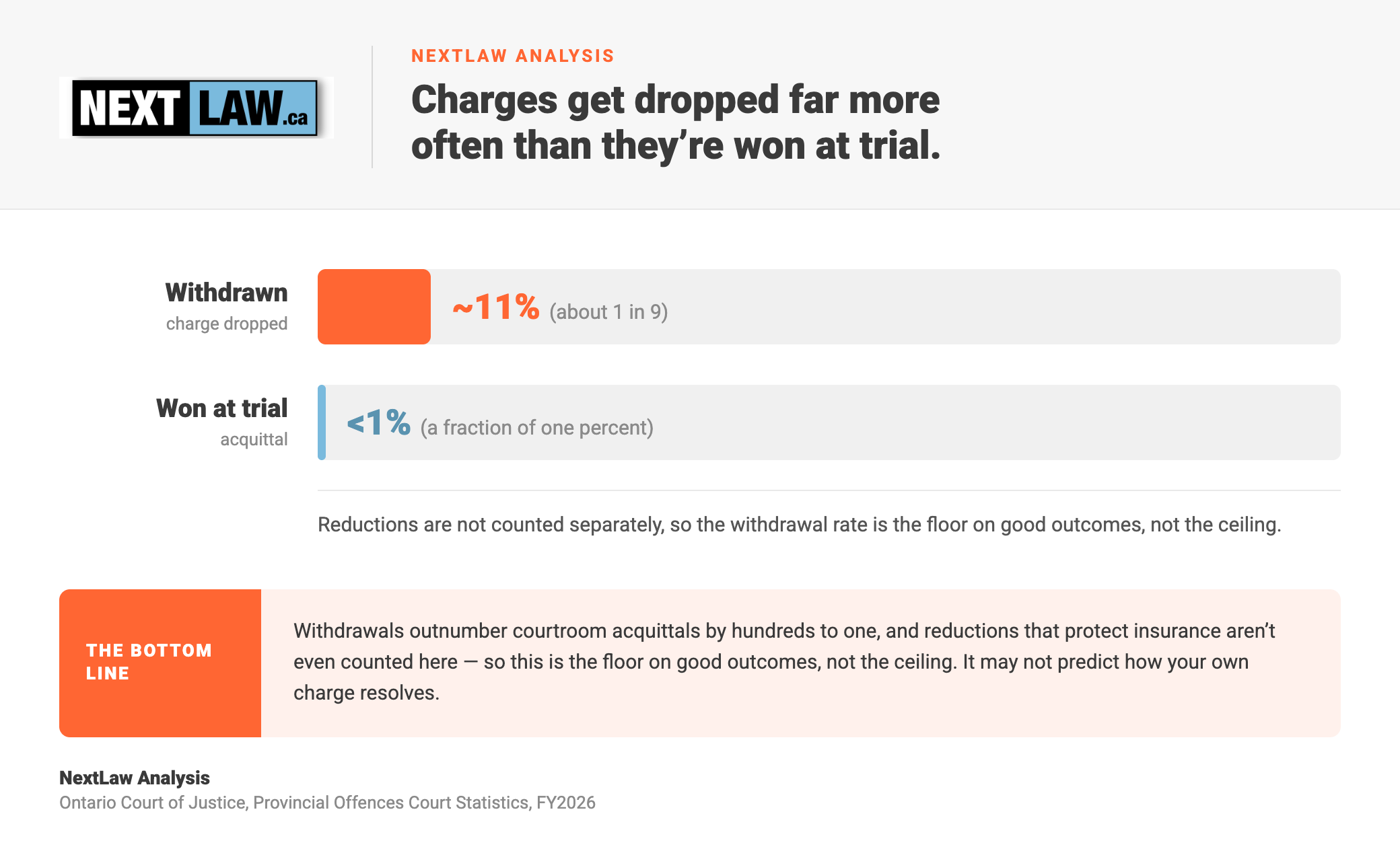
According to NextLaw Analysis of the Ontario Court of Justice’s Provincial Offences Court Statistics (FY2026), about 1 in 9 speeding charges across Ontario ends up withdrawn — dropped completely. That is not rare. What surprises people is the other half of the picture: winning an outright acquittal at trial — the courtroom victory most drivers picture — almost never happens. In that same data, contested trial wins are a fraction of one percent. Withdrawals outnumber courtroom acquittals by hundreds to one.
There is also a third outcome the court data cannot see. When a charge is reduced to a lower speed, it is still recorded as the same offence — so the most common good result, a reduction that protects your insurance, does not show up as its own outcome. It is counted as just another conviction. That is why the withdrawal rate is the floor on good outcomes, not the ceiling.
So “is it worth it” is really a question about your insurance, not a courtroom. A conviction could sit on the record insurers price from for years, and could cost anywhere from hundreds to thousands of dollars over that time, depending on your insurer and the charge. For most drivers, protecting your insurance and your record is worth the fight.
What is the best defense for a speeding ticket in Ontario?
The best defense is not one clever argument about a radar gun. It is a process — and it starts by electing trial.
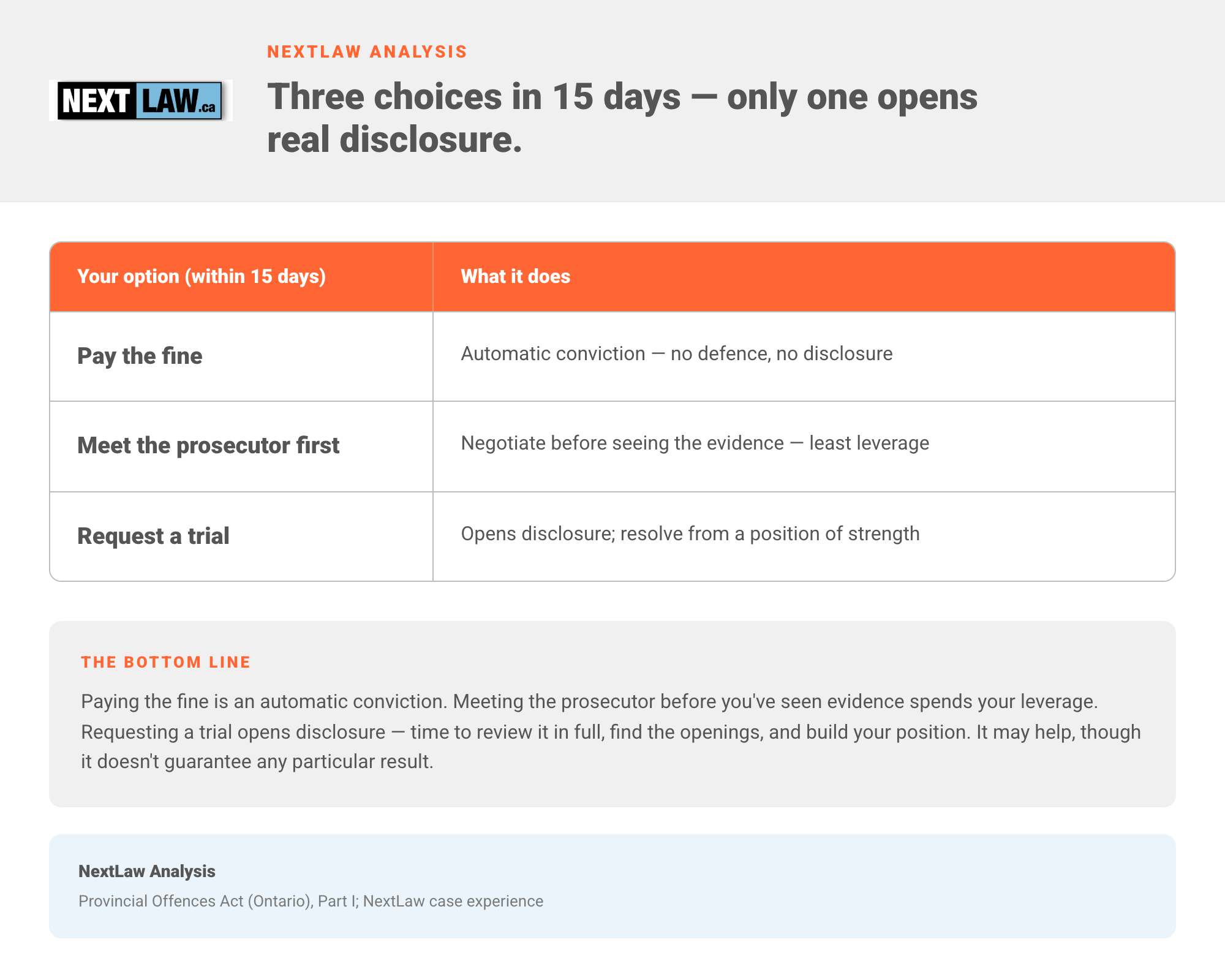
Under the Provincial Offences Act, Ontario gives you three options within 15 days of a speeding ticket: pay it, meet with the prosecutor, or request a trial. Paying it is an automatic conviction. The trap most drivers fall into is rushing into the prosecutor meeting and trying to negotiate before they have ever seen the evidence. Negotiating blind means walking in with the least leverage possible — and less leverage tends to mean a worse outcome for your record and your insurance.
The right order is different. Request the trial first. According to NextLaw Analysis of the Ontario Court of Justice’s Provincial Offences Court Statistics (FY2026), fewer than 7 in 100 speeding charges ever reach an actual trial — the court does not have the resources to try them all. Electing trial is not booking a courtroom showdown; it opens a window where disclosure, scheduling, and prosecutor workload start working in your favour.
Inside that window, the first move is disclosure — your right to every piece of evidence the prosecution holds. In one Toronto case of ours — a driver charged with a very high speed over the limit — we requested the entire evidentiary file: the in-car camera, a witness dash cam, the body-worn camera, the officer’s notes, the witness statements, and the McNeil report (the police-records disclosure the Supreme Court of Canada recognized in R. v. McNeil). Every piece. The openings to win a case are often in what is missing from that file — which is why you demand all of it, confirm it is complete, and only then talk resolution, now from a position of strength.
Can I fight a speeding ticket by myself in Ontario?
Yes, you legally can. The real question is whether you get a good outcome doing it.
Take that same Toronto case. When all of the evidence came in, we went through it and found defects and gaps — pieces that were incomplete, pieces that did not hold up. We took those defects to the prosecutor, and the charge was withdrawn. Not because of a courtroom speech — because the evidence did not survive a careful legal review.
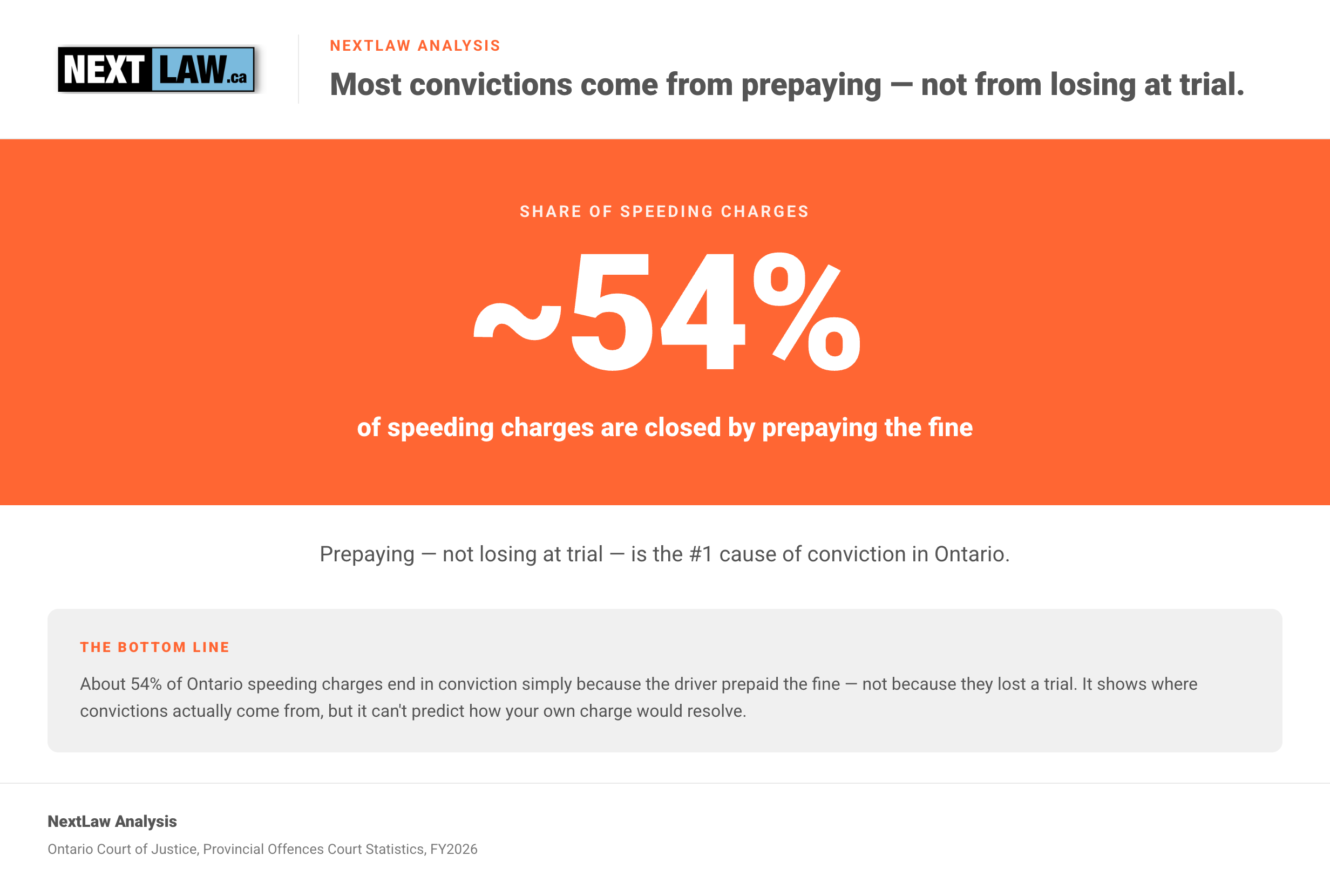
That review is the part that is hard to do alone. According to NextLaw Analysis of the Ontario Court of Justice’s Provincial Offences Court Statistics (FY2026), more than half of all speeding charges — about 54% — are closed by someone simply prepaying the fine. Prepaying, not losing at trial, is the single biggest cause of a conviction in Ontario.
Here is the bottom line: sometimes your ticket is not worth fighting, and a good firm tells you that on the first call. But if it is worth fighting, what you are really paying for is someone who knows what a defect in the evidence looks like — and the persistence to act on it.
They explained every step of the process, answered all my questions, and provided sound advice that ultimately led to a favorable outcome.
Frequently asked questions
Is it worth fighting a speeding ticket in Ontario?
For most people, yes — because the real cost is insurance, not the fine. According to NextLaw Analysis of the Ontario Court of Justice’s Provincial Offences Court Statistics (FY2026), about 1 in 9 speeding charges is withdrawn, and reductions that protect insurance are common (though the data does not count them separately).
What is the best defense for a speeding ticket in Ontario?
A process, not a single argument — elect trial, request full disclosure of the evidence, and resolve from a position of strength once you have reviewed it. Fewer than 7 in 100 speeding charges ever reach an actual trial.
Can I fight a speeding ticket by myself in Ontario?
Legally, yes. But the value is in reviewing the disclosure for defects — where cases are actually won, and the hardest part to do alone.
Do I have to meet with the prosecutor for a speeding ticket?
No — you can go straight to trial. If you do meet, review all the evidence (disclosure) first; going in before you have seen it means negotiating blind, which is usually where drivers give up their best leverage.
Got a speeding ticket in Ontario? Get your number first
Do not pay it yet. Not every ticket is worth fighting — but every ticket is worth checking. Use our free insurance calculator: 7 quick questions to see how much your insurance could go up. Get your number first. Then, if it makes sense, book a free call for a straight answer.
This article is general information about Ontario law, not legal advice, and does not create a lawyer–client relationship. It is current as of August 19, 2026; traffic law and court practice can change. Court statistics: Ontario Court of Justice, Provincial Offences Court Statistics (FY2026); analysis by NextLaw. Services by a licensed lawyer and licensed paralegals at NextLaw.

