

How bad are 3 demerit points in Ontario? The short answer
For a fully licensed Ontario driver, 3 demerit points are close to harmless on their own. It takes 15 points to lose your licence, and you don’t even get a warning letter until 6. So a single 3-point ticket doesn’t put your licence anywhere near the edge.
Here is the part almost nobody explains: the points are not what costs you money. Insurers don’t price your premium on your demerit points. They price the conviction behind the ticket, sorted as minor, major, or serious. And that conviction could raise your rates for up to three years, long after the points are gone. “How many points” is the wrong question. This article walks through what 3 points really mean for a full G and a G1/G2 driver, why the conviction (not the points) is the thing that touches your insurance, how long each one lasts, and how a reduction can break a pattern on your record.
How bad are 3 demerit points in Ontario, really?
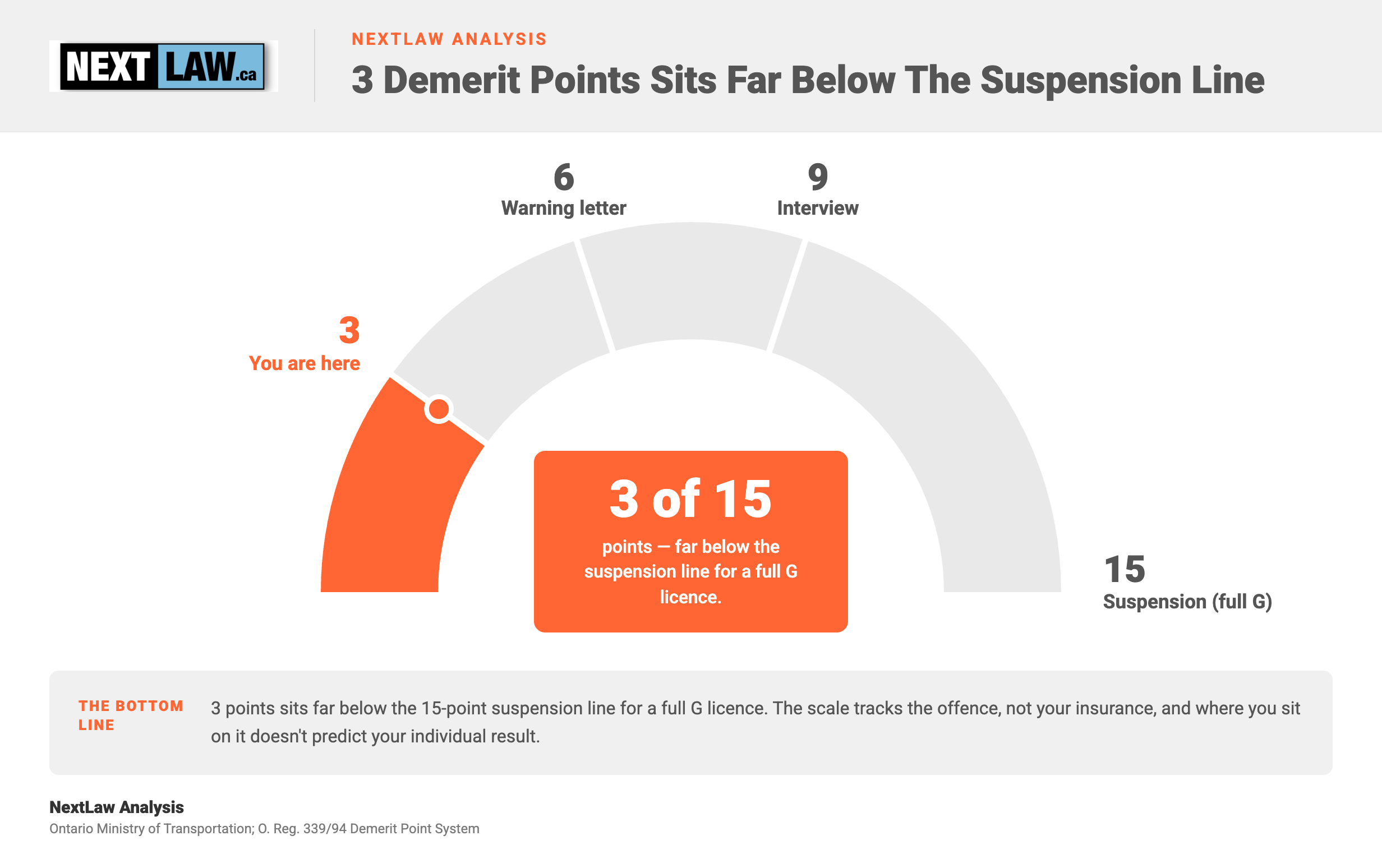
For a full G licence, not very. The Ministry of Transportation of Ontario adds 3 demerit points for driving 16 to 29 kilometres an hour over the limit, the same 3 you would get for running a red light or failing to yield. The province only suspends a fully licensed driver at 15 points, and it sends a warning letter at 6. One 3-point ticket lands you well short of both.
- 3 points — a single 16-to-29-over speeding conviction (where you are after one ticket).
- 6 points — the Ministry of Transportation may send a warning letter.
- 9 points — a fully licensed driver may be called in for an interview.
- 15 points — the threshold to suspend a fully licensed driver.
The point counts and thresholds come from Ontario’s Demerit Point System (O. Reg. 339/94) under the Highway Traffic Act; the Ministry of Transportation summarizes them on its demerit points page.
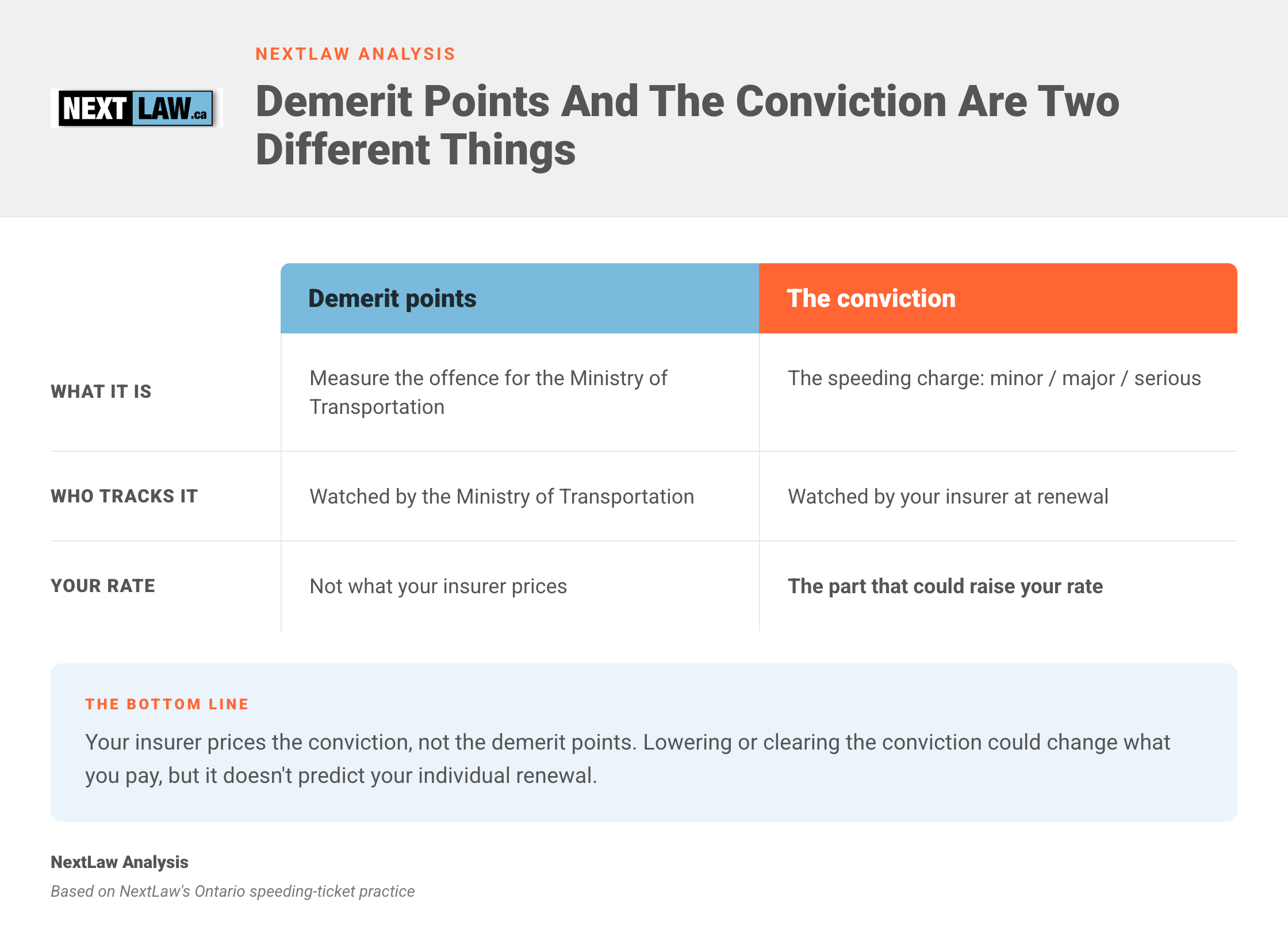
So why does anyone worry about 3 points? Because “how many points” is the wrong question. Points measure the offence for the Ministry of Transportation. They are not the thing that costs you money. The thing that costs you money is sitting one layer underneath, and that is where the rest of this article goes.
How do 3 demerit points affect your car insurance in Ontario?
Almost not at all directly, and not the way most people assume. Ontario insurers do not price your premium on your demerit points. They price the conviction. The points can show up on your driver’s record, but they are not the number your insurer rates you on.
Insurers rate the conviction, not the points
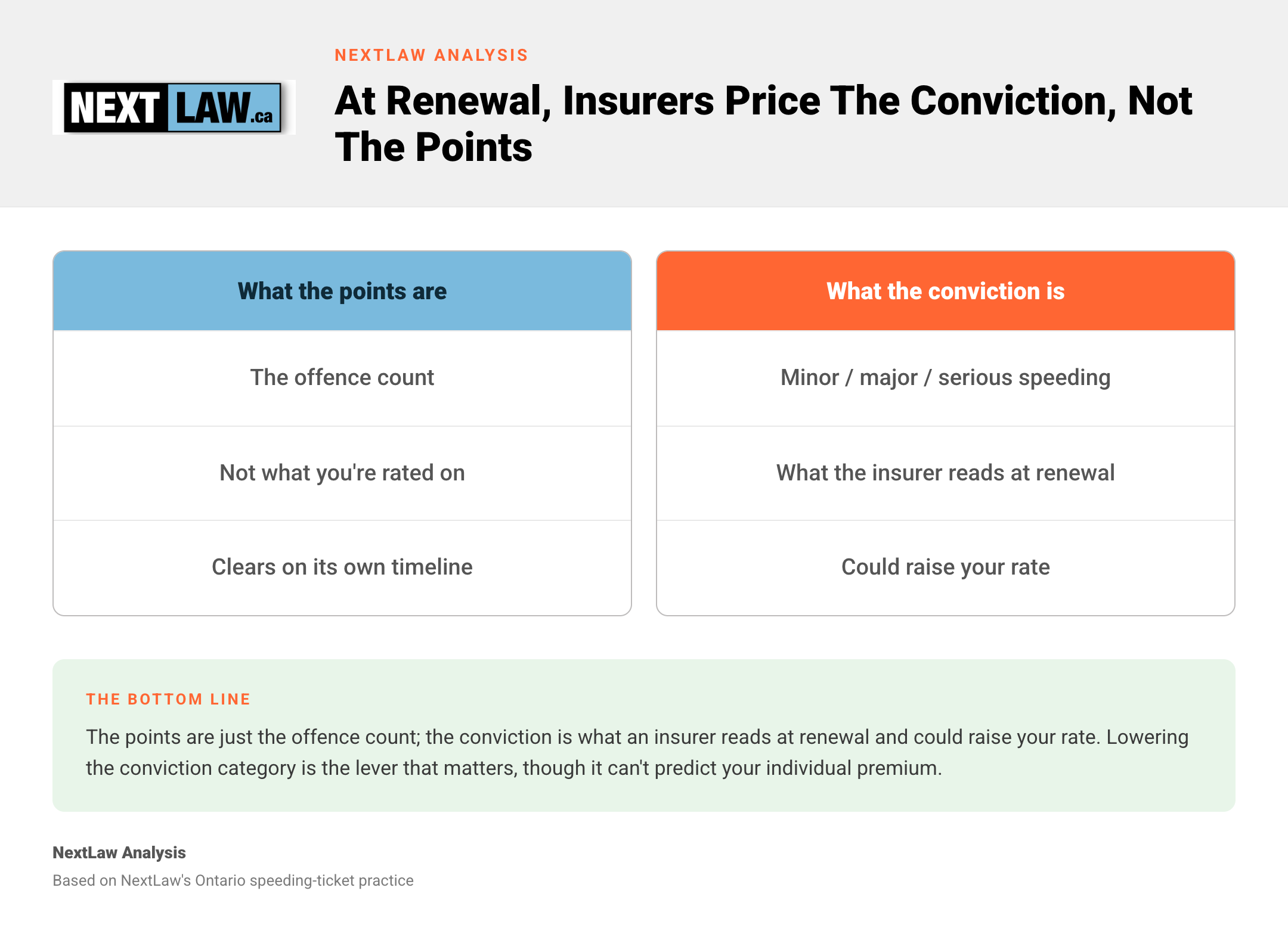
When you renew, your insurer pulls your driver’s abstract. What moves your premium is not “3 points,” it is the speeding conviction behind them, sorted as minor, major, or serious. A single minor speeding conviction could nudge your rate at renewal; the demerit points attached to it are not what you are rated on. That is the whole reason the point count is a distraction: two tickets can carry the same points and be priced very differently, because the conviction category, not the point number, is what the insurer reads.
Why paying the ticket is the costly move
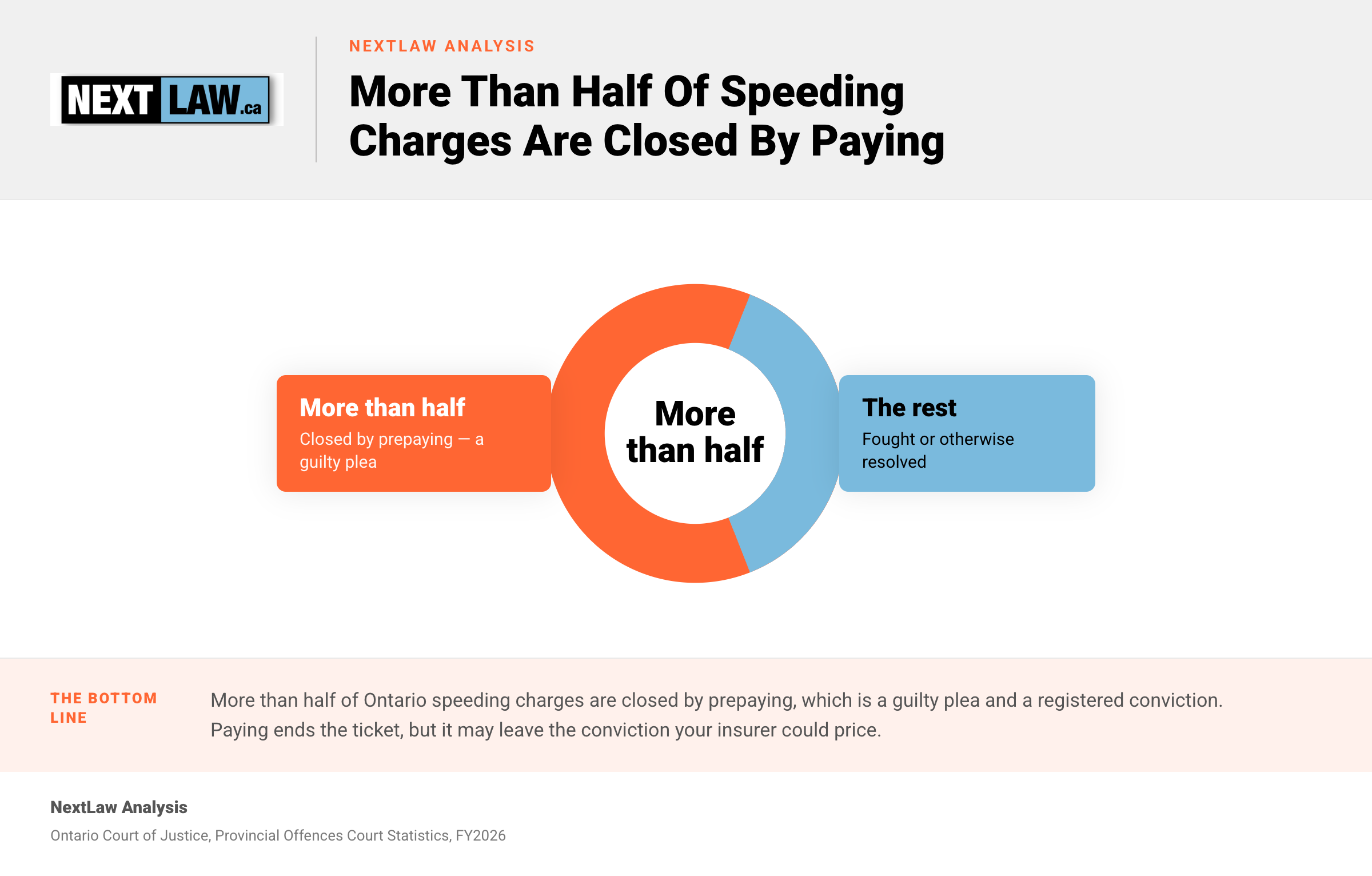
Paying a ticket is a guilty plea. It closes the file by locking in the exact conviction your insurer reads at renewal. That matters because most drivers do exactly that. According to NextLaw Analysis of Ontario Court of Justice Provincial Offences Act data, more than half of Ontario’s speeding charges are closed by drivers simply prepaying the fine.
And the fine is the cheap part. According to NextLaw Analysis of Ontario Court of Justice Provincial Offences Act data, the average speeding fine ordered in the province is around $148. What a conviction could do to your insurance over three years may run to several times that. In our practice it could be a few hundred dollars, it could be more, and it depends entirely on your insurer and your record. That is the number the ticket never puts in front of you, and it is the reason a $148 fine can be the least expensive thing about a speeding charge.
Source: Ontario Court of Justice, Provincial Offences Court Statistics (FY2026); analysis by NextLaw. Figures are provincial and rounded; insurance outcomes are estimates that depend on your insurer and record and are not a prediction of your individual result.
A real Toronto case: breaking the pattern, not just the point
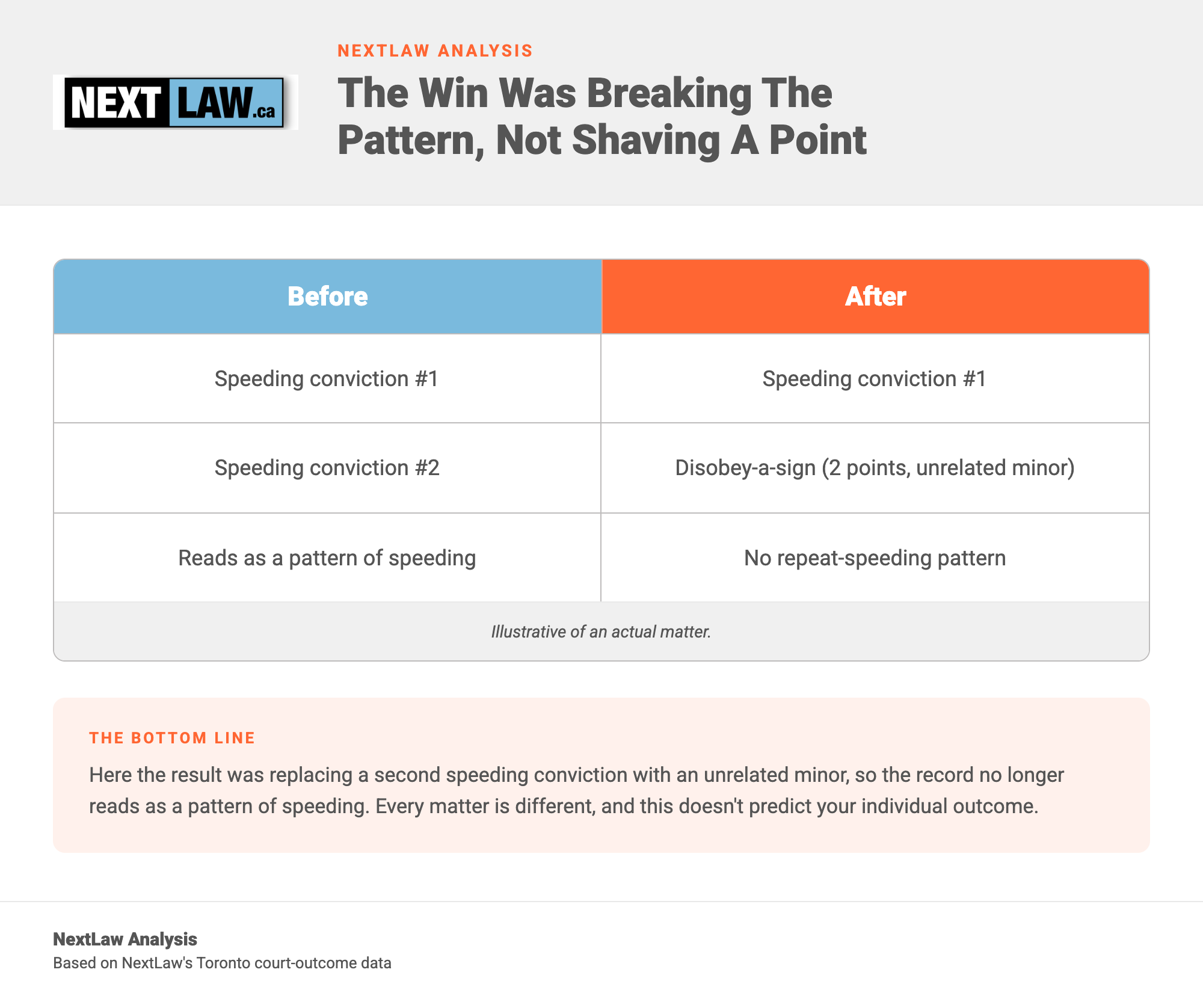
Here is what this looks like in practice. A fully licensed Toronto driver came to us on a 29-over ticket, 3 points, and it was his second speeding ticket. He was worried about the points piling up, but the points were never the real problem. The problem was the pattern. To an insurer, a second speeding conviction can read as a pattern of speeding, and that pattern is generally what gets priced as higher risk.
What we were able to do was get the charge off speeding altogether, resolved to a non-speeding offence, a disobey-a-sign. That charge carries 2 demerit points, but the points were never the issue. The issue was the pattern of speeding, and the resolution took it away. His abstract no longer shows a second speeding ticket. Instead of two speeding convictions signalling a pattern, it shows one speeding ticket and one unrelated minor charge. The value was in breaking the pattern, not in shaving a point.
Illustrative of an actual NextLaw matter; details generalized. Outcomes depend on the charge, court, and record and are not a prediction of your individual result.
In the end, they were able to get my ticket reduced to a minor offence, and I am extremely grateful for the outcome.
How long do 3 demerit points last in Ontario?
Two years. The Ministry of Transportation removes them automatically, 2 years from the date of the offence, not the conviction date. You don’t apply for it, it just happens. The offence-date detail matters, because it is a different clock from the one your insurer watches.
The two-clock trap: points vs conviction
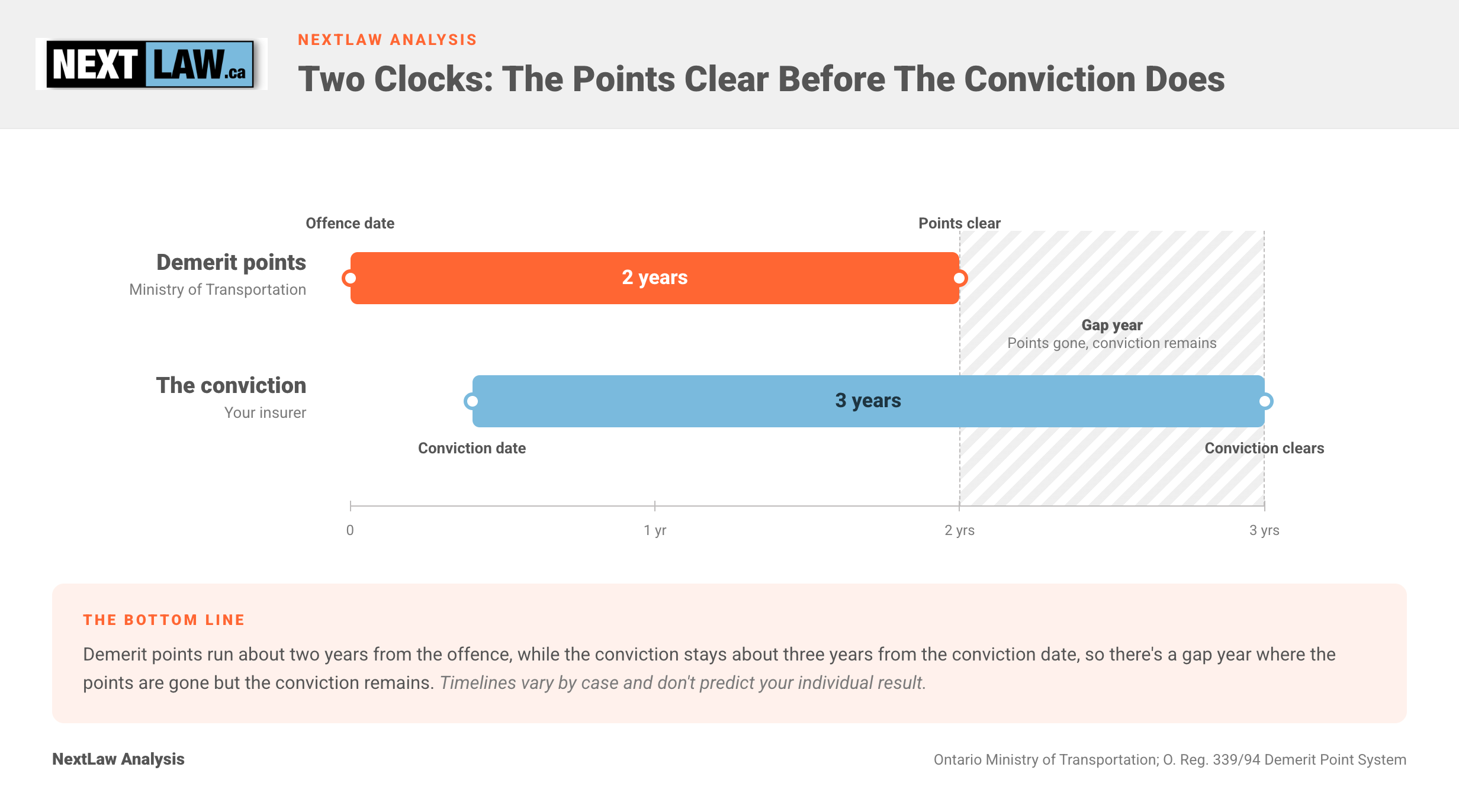
The points and the conviction run on two different clocks. The points clear at 2 years from the offence date. The conviction stays on your driver’s abstract for 3 years from the date you were convicted, and that later clock is the one your insurer uses. So you can hit the two-year mark, watch your points disappear, and still be carrying the conviction for another full year. Two clocks, and the one that touches your insurance runs longer.
| What | How long | Counts from | Who watches it |
|---|---|---|---|
| Demerit points on your record | 2 years | Date of the offence | Ministry of Transportation |
| The conviction on your abstract | 3 years | Date of conviction | Your insurer |
G1 and G2 drivers: the math is tighter
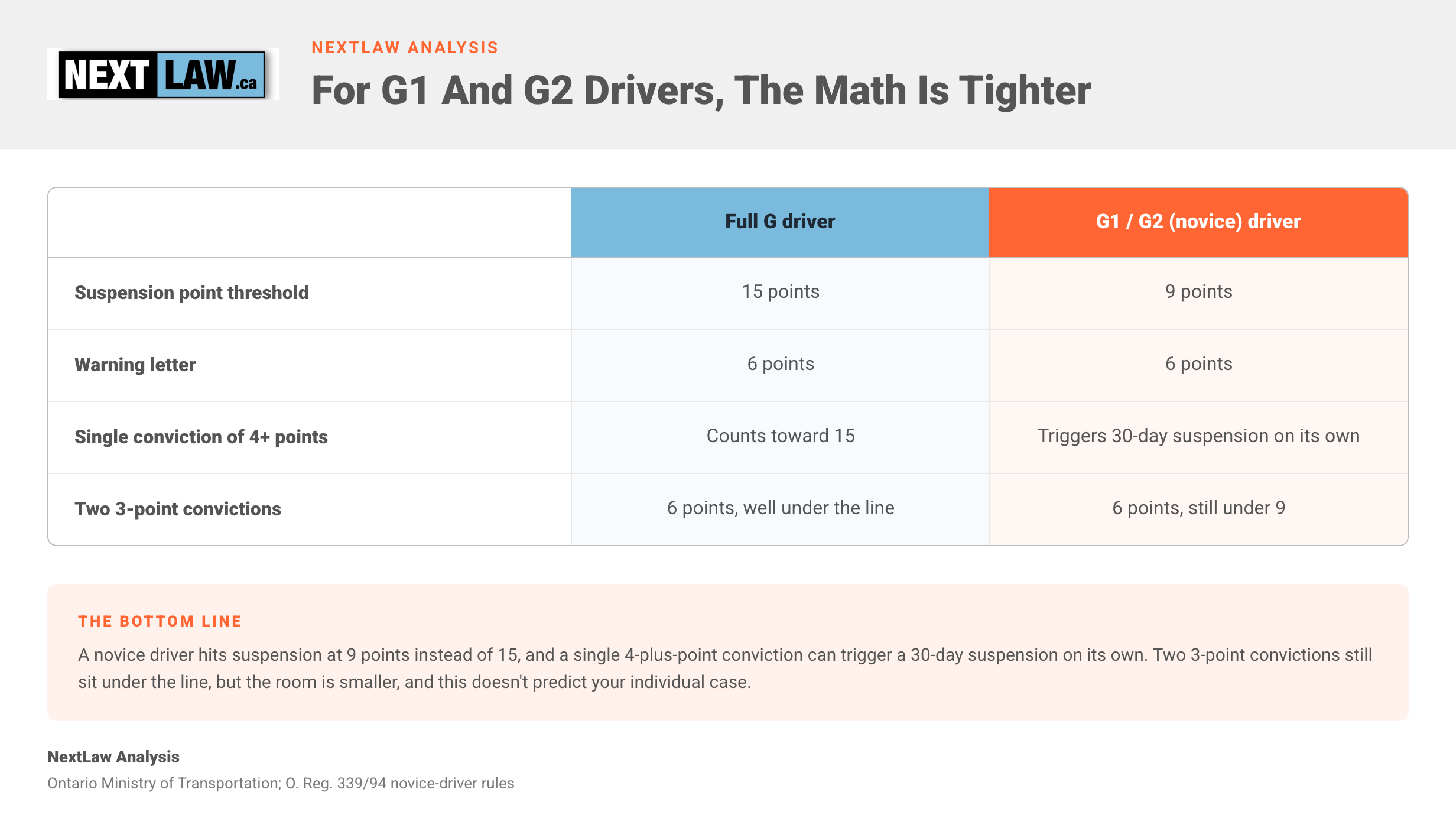
If you are a G1 or G2 driver, what the Ministry of Transportation calls a novice driver, the thresholds are lower. A novice licence is suspended at 9 points, not 15. There is also a separate rule: a single conviction worth 4 or more points can trigger a 30-day suspension on its own, even before you reach 9.
A 3-point ticket does not hit either rule by itself. But the points still add up. Two 3-point convictions put a novice driver at 6, still under the line. It is a third one inside the two-year window that would ordinarily reach 9 and put a novice at the suspension threshold. So as a G2, one 3-point ticket is survivable. It is when they start stacking that a suspension moves from unlikely to real. The novice thresholds live on the same Ministry of Transportation demerit points page.
| Rule | Full G driver | G1 / G2 (novice) driver |
|---|---|---|
| Suspension point threshold | 15 points | 9 points |
| Warning letter | 6 points | 6 points |
| Single conviction of 4+ points | Counts toward 15 | Can trigger a 30-day suspension on its own |
| Two 3-point convictions | 6 points, well under the line | 6 points, still under 9 |
Quick answers
Is 3 demerit points bad in Ontario?
For a fully licensed driver, on its own, no. It is minor, and you need 15 points to be suspended. The conviction behind the ticket is the part worth taking seriously, because that is what your insurer prices.
Is it hard to get insured with 3 demerit points?
Usually not. Insurers rate the conviction, not the points, and one minor conviction rarely makes you hard to insure. It is the pattern that hurts: a second or third conviction inside that three-year window is what can push a driver toward high-risk territory.
How long do 3 demerit points last in Ontario?
Two years from the date of the offence, after which the Ministry of Transportation removes them automatically. The underlying conviction stays on your driver’s abstract for three years from the conviction date, which is the clock your insurer uses.
Can you get a speeding ticket reduced so it doesn’t affect your insurance?
Often, yes. A speeding charge can sometimes be reduced to a lower speed, or resolved to a non-speeding offence, so the conviction on your record is smaller or avoided. That is the outcome that could protect your insurance, and it is the reason it can be worth looking at a ticket before you just pay it. Results depend on the charge, court, and record.
What to do next
Got a speeding ticket in Ontario? Don’t pay it yet. Not every ticket is worth fighting, but every ticket is worth checking. Paying is a guilty plea, and it locks in the conviction before you have seen what it could cost you.
Start with our free Speeding Ticket Insurance Calculator: 7 quick questions to see how much your insurance could go up. Get your number first. Then, if it makes sense, book a free call for a straight answer, no obligation. You can also read our Ontario speeding ticket defence overview to see how a reduction works.
This article is general information about Ontario speeding tickets, not legal advice, and it does not create a lawyer-client relationship. Ontario only. Every case depends on its own charge, court, and record. Services by a licensed lawyer and licensed paralegals at NextLaw.
Sources
- Ontario Ministry of Transportation, Understanding demerit points (point thresholds; novice-driver rules).
- Ontario, Demerit Point System, O. Reg. 339/94 under the Highway Traffic Act.
- Ontario Ministry of Transportation, Speeding and aggressive driving.
- Ontario Court of Justice, Provincial Offences Court Statistics (FY2026); analysis by NextLaw.

