

How bad are 4 demerit points for an Ontario speeding ticket?
Four demerit points is the serious end of an ordinary Ontario speeding ticket, but for a fully licensed driver it is still well short of losing your licence. You need 15 points to be suspended, and you get a warning letter at 6. Two things almost nobody explains. If you are a G1 or G2 driver, a single 4-point conviction can trigger a suspension on its own, even on a first ticket. And either way, the points are not the real cost: insurers rate the conviction behind the ticket, and a 30-to-49-over conviction is a more serious speeding conviction that could affect your insurance for up to three years, long after the points are gone.
Four demerit points is added for driving 30 to 49 km/h over the limit under Ontario’s demerit point system (O. Reg. 339/94) — the top rung of ordinary speeding. Below is how that plays out for a full-licence driver, for a novice driver, on your insurance, and on the two clocks that decide how long it follows you. If you would rather talk it through, you can book a free call, but read on first — for a lot of drivers this is less alarming than it sounds.
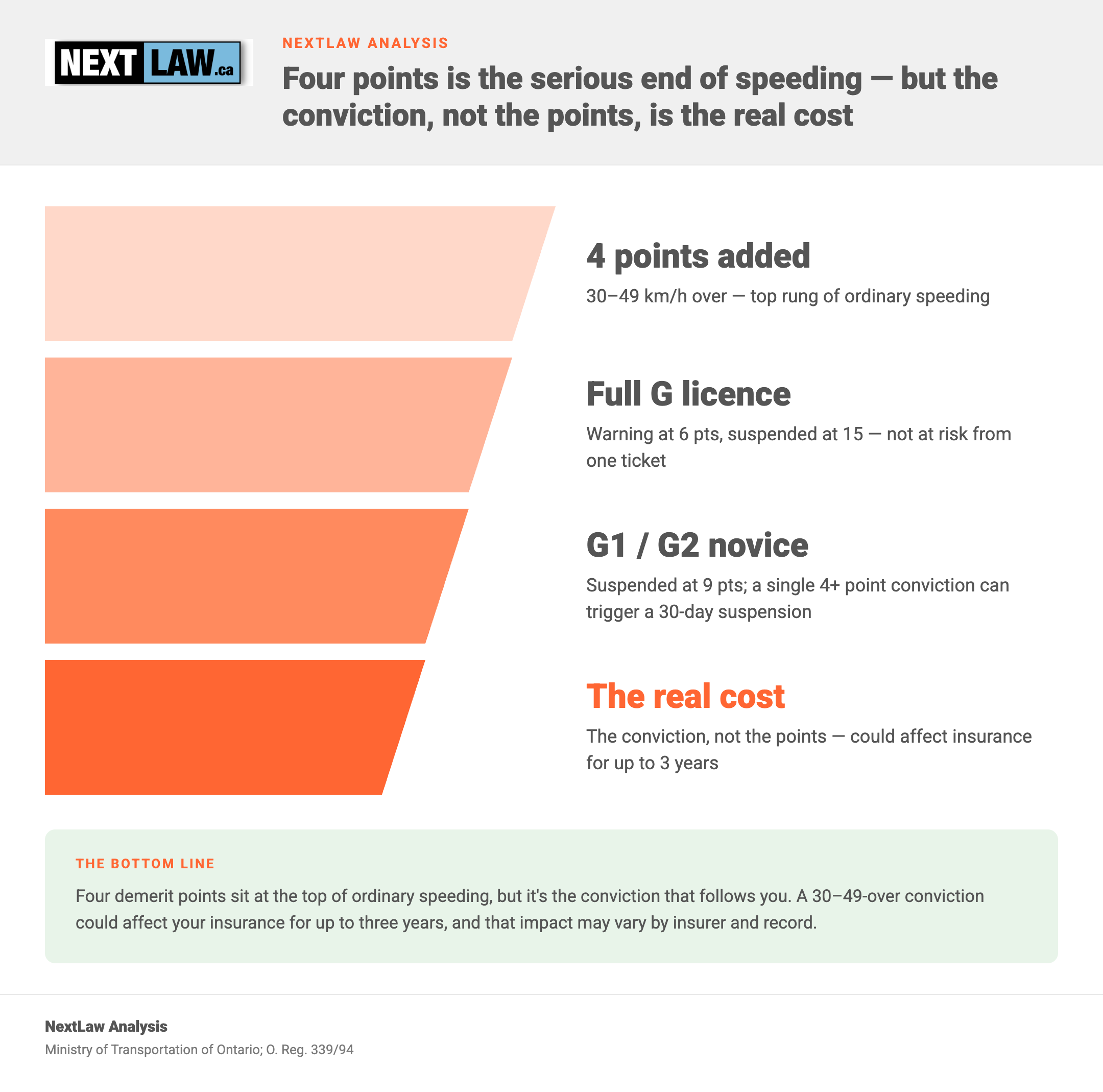

What happens when you get 4 demerit points in Ontario?
For a fully licensed driver, less than you would fear. The Ministry of Transportation of Ontario adds 4 demerit points for driving 30 to 49 km/h over the speed limit. That is the top rung of ordinary speeding, one step up from the 3 points you get at 16 to 29 km/h over. But a full G licence is only suspended at 15 points, and you get a warning letter at 6. So one 4-point ticket does not put your licence near the suspension edge.
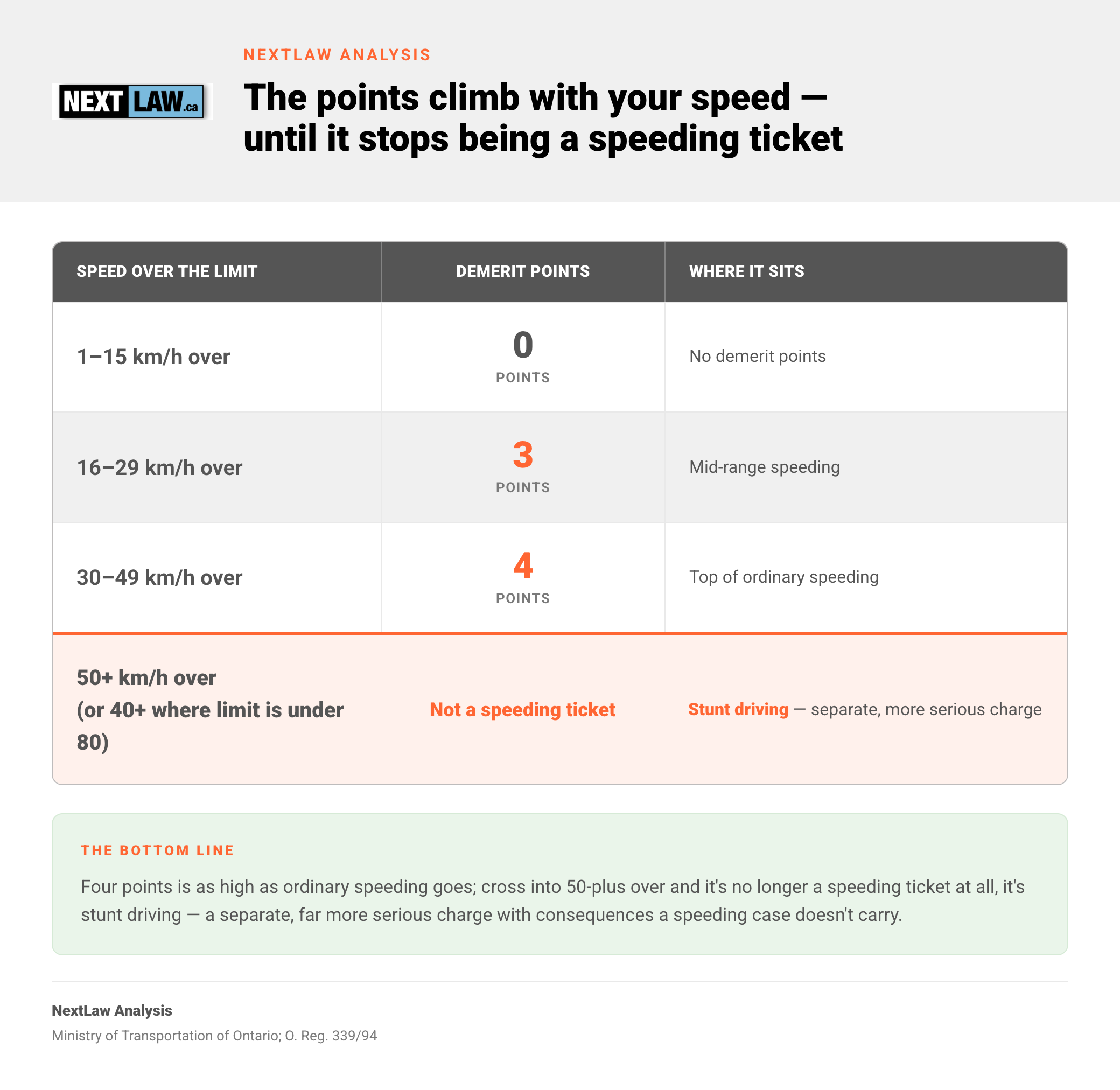
The demerit ladder for speeding
| Speed over the limit | Demerit points | Where it sits |
|---|---|---|
| 1–15 km/h over | 0 points | No demerit points |
| 16–29 km/h over | 3 points | Mid-range speeding |
| 30–49 km/h over | 4 points | Top of ordinary speeding |
| 50+ km/h over (or 40+ where the limit is under 80) | Not a speeding ticket | Stunt driving — a separate, more serious charge |
G1 and G2 drivers: the math is much tighter
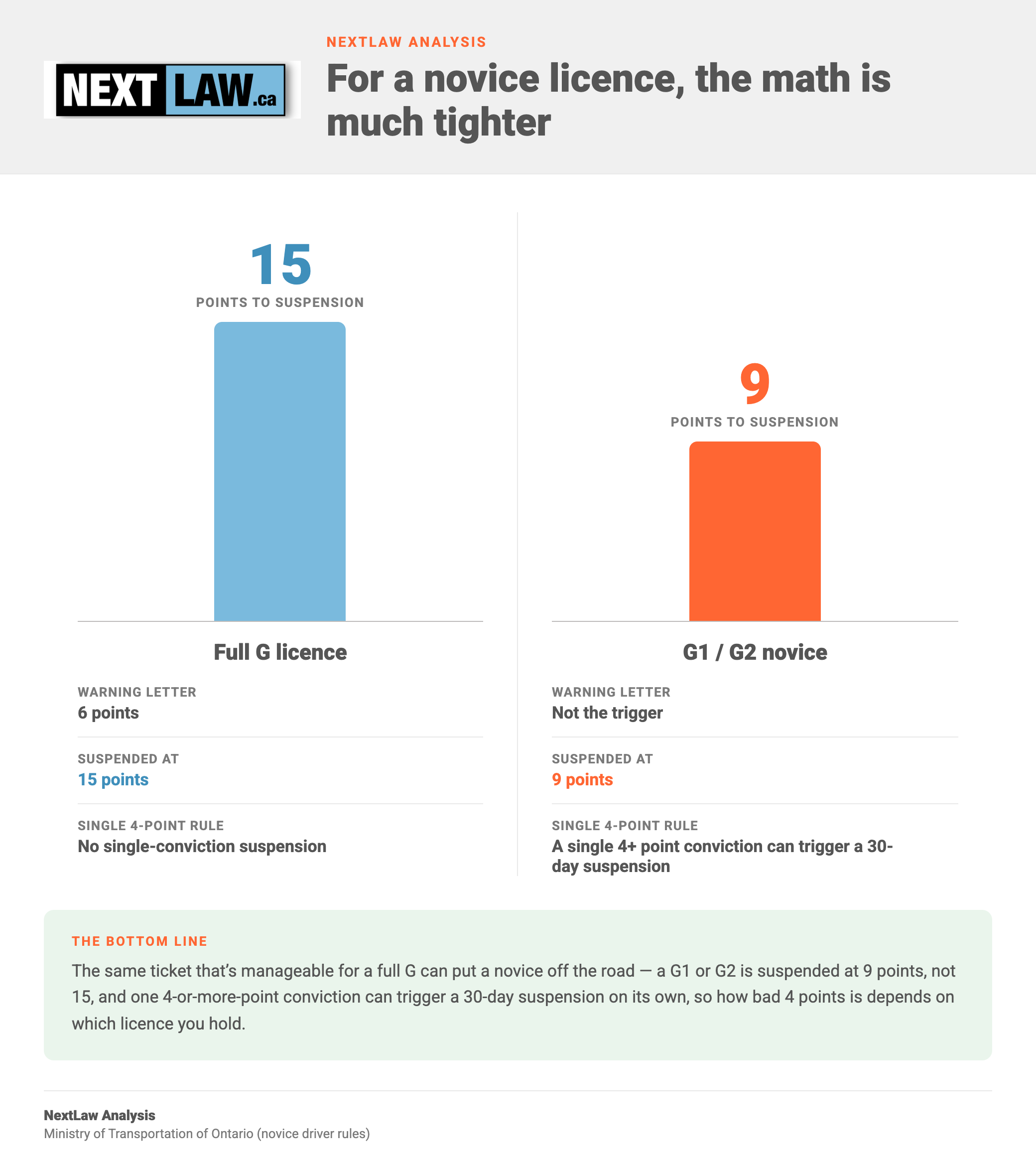
Here is the part that catches new drivers, and it is a separate rule most people miss. If you are a G1 or G2 driver, a novice licence is suspended at 9 points, not 15. And there is a rule on top of that: a single conviction worth 4 or more demerit points can trigger a 30-day suspension on its own, before you get anywhere near 9. So the exact same 30-to-49-km/h-over ticket that is a manageable problem for a full G driver can put a G2 driver off the road on the first conviction.
A real case: a Toronto delivery driver at 49 over
In our Ontario speeding-ticket practice, we had a Toronto driver come to us who drives for one of the big food-delivery services, so his licence is his income. He had been clocked at 49 km/h over the speed limit — 149 in a 100 zone. One more km/h and it would not have been a speeding ticket at all: it would have been stunt driving, which we come back to below. He was a full G, but he already had a speeding conviction from the year before. So the stakes for him were not the points. They were his job and his insurance. We will follow his case through the rest of this post.
Do 4 demerit points affect insurance in Ontario?
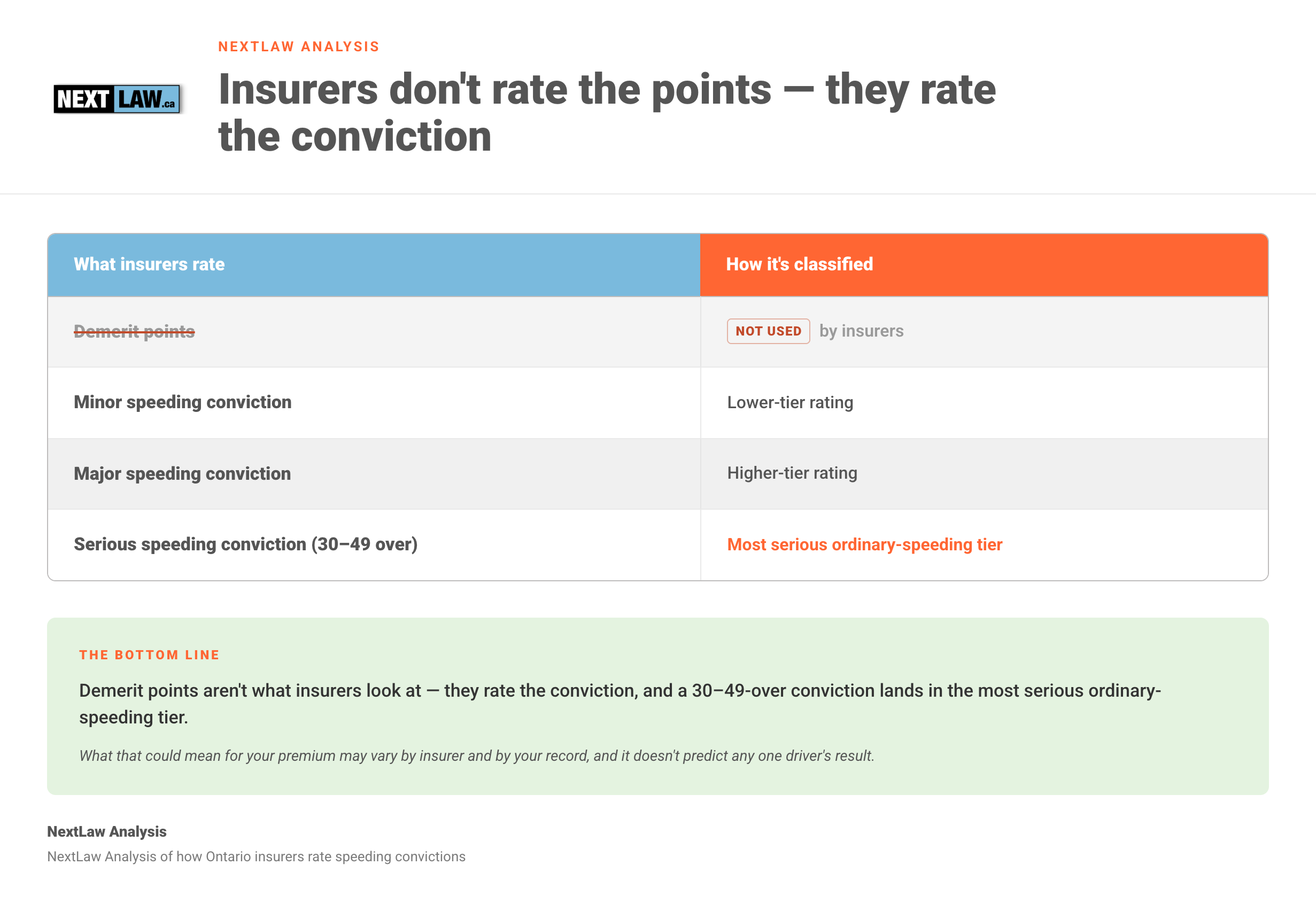
Not the points themselves, but the conviction behind them can, and at this level more than most. Insurers do not rate you on demerit points. They rate the speeding conviction, sorted as minor, major, or serious, and a 30-to-49-over conviction is a more serious speeding conviction than a low-level one.
The fine is the cheap part. According to NextLaw Analysis of Ontario Court of Justice, Provincial Offences Court Statistics, the average speeding fine ordered in the province is around $148. What a conviction like this could do to your insurance over three years may be many times that, and because it sits at the serious end of speeding, it could land at the higher end of that range. It could be several hundred dollars, it could be more, and it depends entirely on your insurer and your record. This is not a prediction of your result — every driver’s rate is different. You can check what a conviction could do to your own premium with our free calculator before you decide anything.
Two convictions read as a pattern
Back to our Toronto delivery driver, the one clocked at 49 over with a prior speeding conviction. His real fear was the second conviction. To an insurer, two speeding convictions inside a few years reads as a pattern of speeding, and a pattern is what gets priced as higher risk, because higher risk means a greater chance of a claim. So a second speeding conviction on his driving abstract could turn him into a repeat-speeder in an insurer’s eyes, on top of putting his delivery job at risk.
Why paying the ticket is the expensive move
According to NextLaw Analysis of Ontario Court of Justice, Provincial Offences Court Statistics, more than half of Ontario’s speeding charges are closed by drivers simply prepaying — and paying is a guilty plea. For a 49-over ticket, prepaying does not just cost you the fine. It locks in a 4-point conviction at the serious end of speeding, and hands your insurer the exact thing it rates you on.
How long does it take to clear demerit points in Ontario?
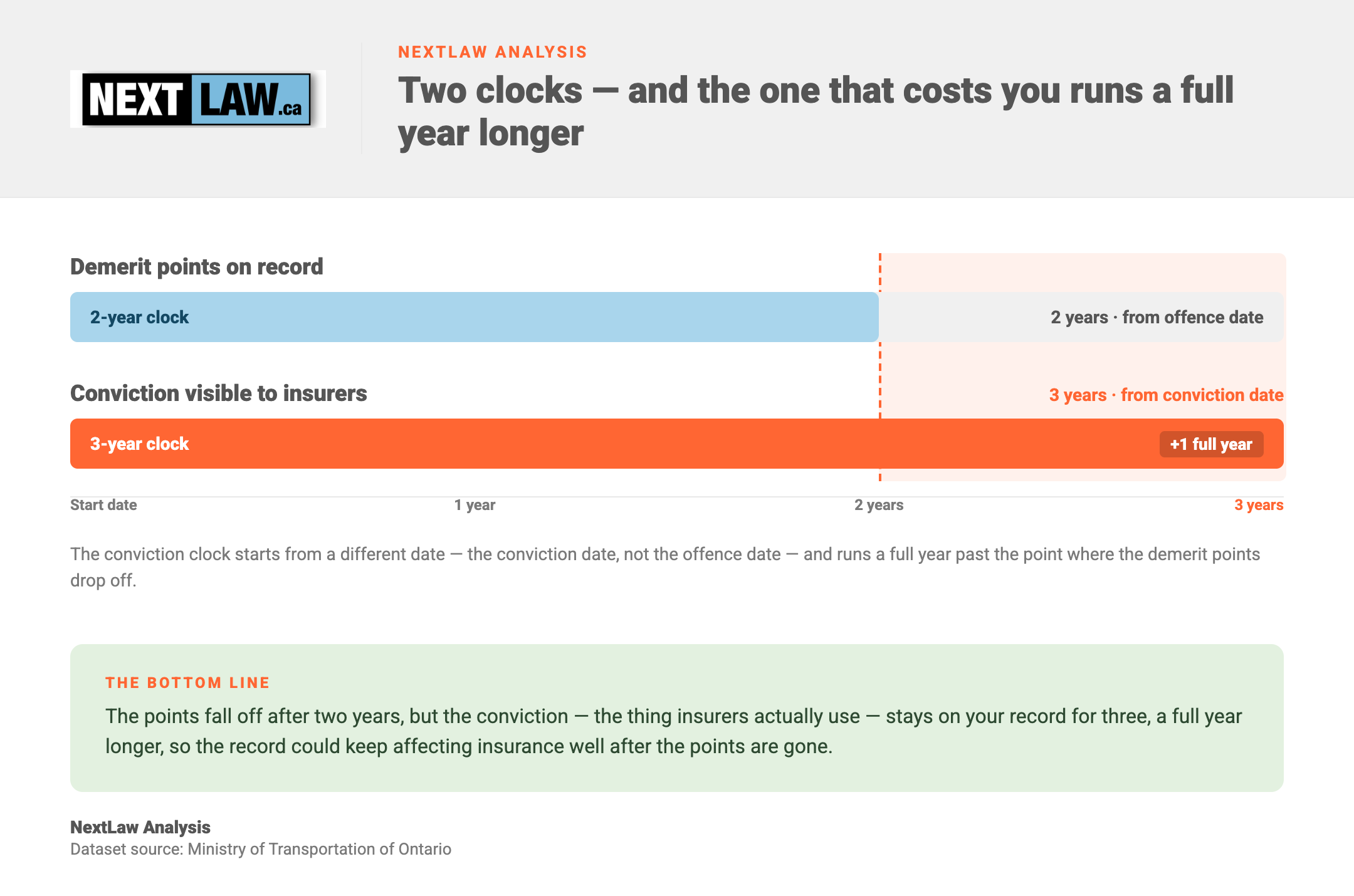
Two years. The points come off automatically two years from the date of the offence, and the Ministry of Transportation removes them for you.
But there is a trap most drivers never hear about. The points and the conviction run on two different clocks. The points clear at two years from the offence. The conviction stays on your driving record for three years from the date you were convicted, and that is the clock your insurer actually uses. So you can watch your points disappear at two years and still be paying for the conviction for another full year. The points are the short clock. The conviction is the long one, and it is the one that costs you.
Can you get a 4-point speeding ticket reduced in Ontario?
Often, yes, and it is the real lever, because waiting the points out does not touch the conviction. Reducing the charge does.
Here is something you will not find in any government chart. When we look at the court’s own numbers, the single most useful outcome — a speeding charge reduced to a lower speed — does not even show up. A reduced charge is still recorded under the same speeding law, so dropping your ticket down a rung is invisible in the public data. According to NextLaw Analysis of Ontario Court of Justice section 128 disposition data, the published withdrawal rate is a floor on good outcomes, not the ceiling.
Where your ticket is matters
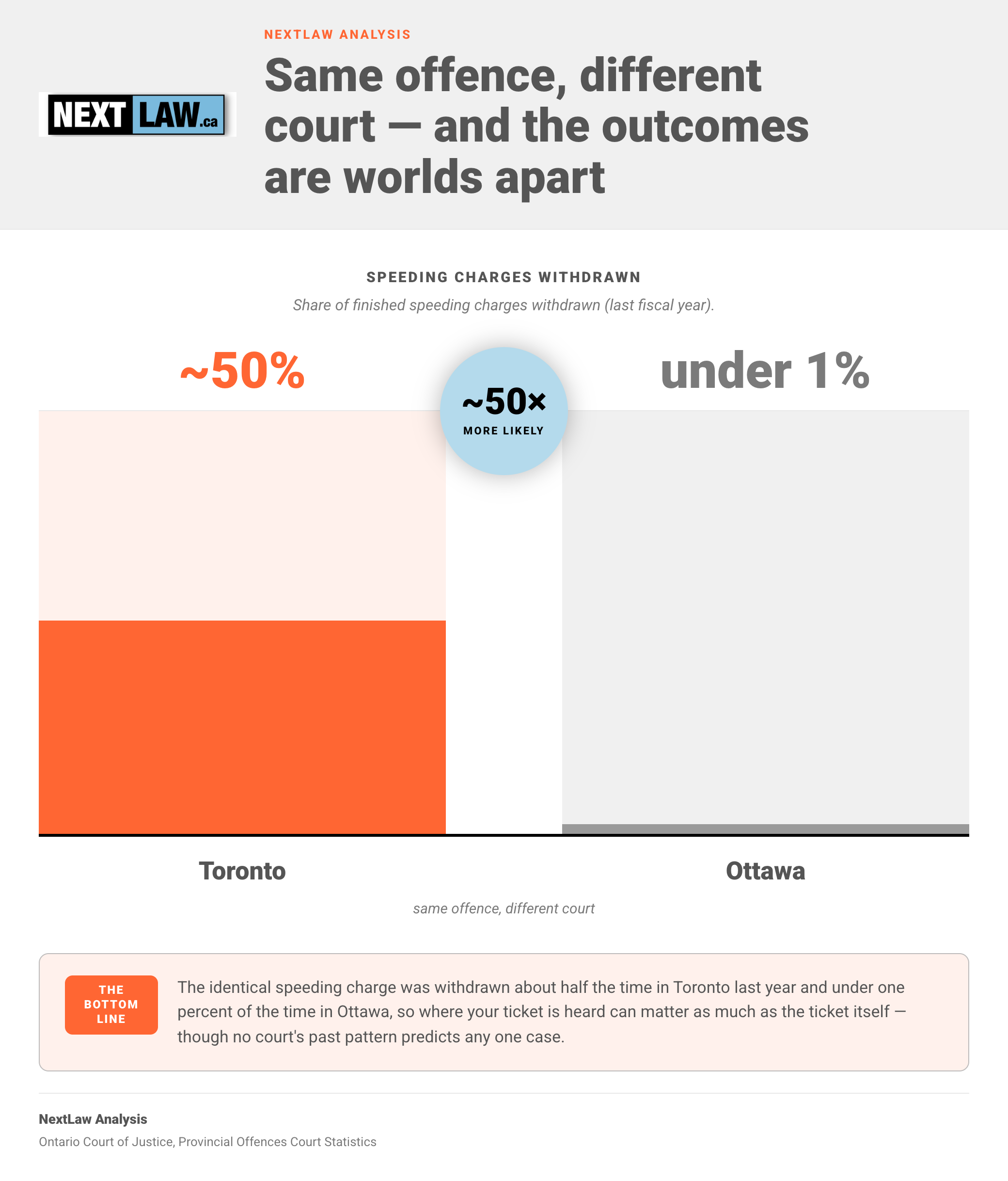
Whether a reduction is even on the table depends a lot on where your ticket is. According to NextLaw Analysis of Ontario Court of Justice, Provincial Offences Court Statistics, the same charge is treated very differently from courthouse to courthouse. In Toronto, about half of the speeding charges the court finished last year were withdrawn. In Ottawa, it was under one percent. Same offence, just in a different court location. (Source: Ontario Court of Justice, Provincial Offences Court Statistics; analysis by NextLaw.)
How our Toronto driver’s case resolved
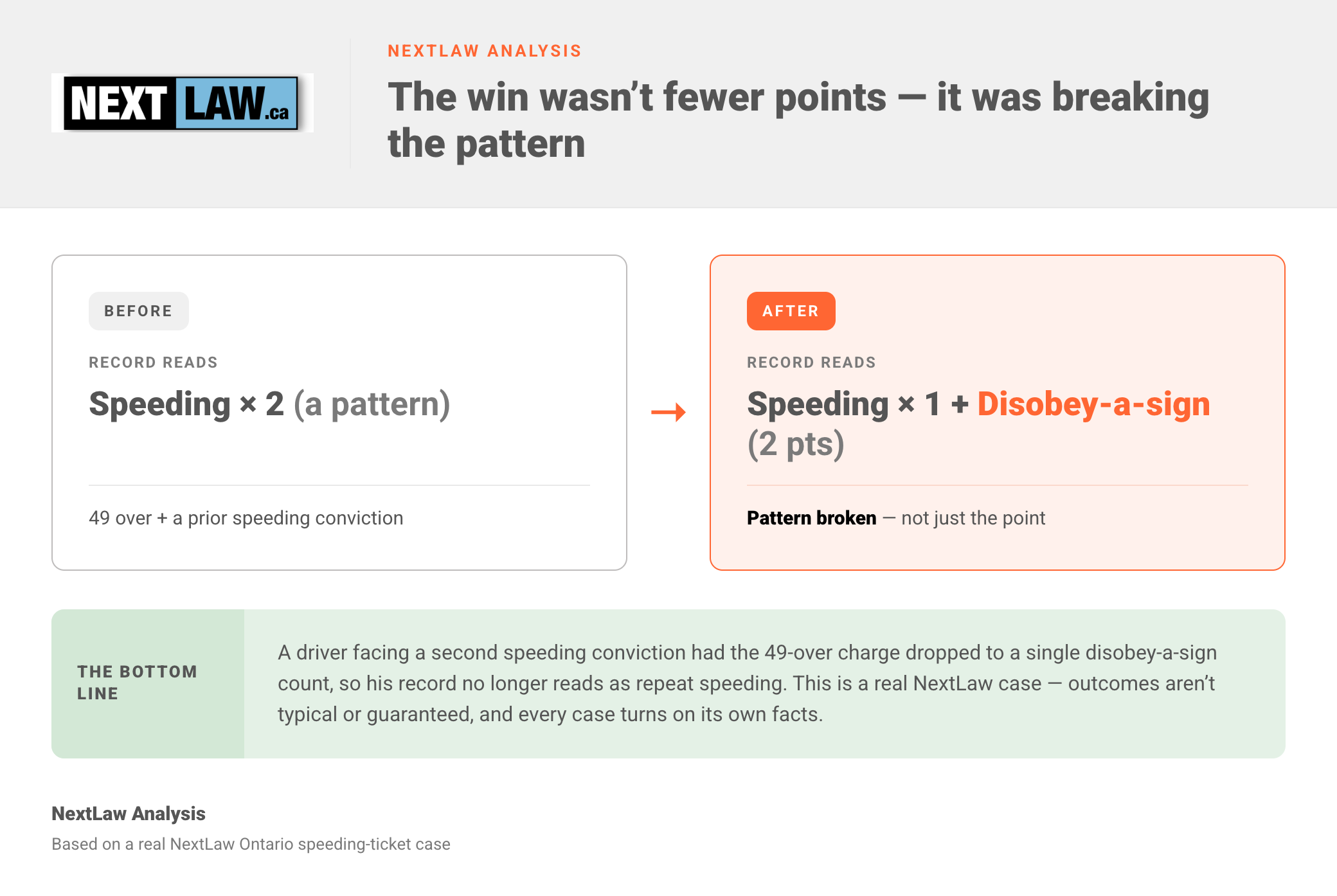
Here is what that looked like for our Toronto delivery driver, the full G clocked at 49 over with his job on the line. We booked a trial date, then ran a campaign of sustained pressure on the court to get complete disclosure: the officer’s notes and any evidence the prosecution planned to rely on. Keeping that pressure on turned up a few genuine issues with the case. Not a guaranteed win — these were triable issues that could have gone either way — but enough uncertainty about whether the charge would hold up that the prosecutor agreed to resolve it.
The 49-over speeding charge was dropped to a single count of disobeying a sign. That charge carries 2 demerit points, but the points were never the issue. The issue was the pattern. His record no longer shows a second speeding conviction, so an insurer does not read a repeat-speeding pattern, and his driving record is not carrying another speeding hit. One ticket, moved off speeding, protected both the thing that pays his bills and the insurance behind it.
They got the ticket reduced to a bare minimum. Kept me updates throughout the process.
Frequently asked questions
How many demerit points can I get for speeding in Ontario?
It climbs with your speed. Nothing for 1 to 15 over, 3 points for 16 to 29 over, and 4 points for 30 to 49 over, which is the top of ordinary speeding. Go 50 km/h or more over the limit, or 40 or more where the limit is under 80, and it stops being a speeding ticket at all. That is stunt driving, a separate and much more serious charge, with your licence suspended and your car impounded at the roadside on the spot. If that is what you are facing, it is a different conversation than this one.
Is 4 demerit points bad in Ontario?
For a fully licensed driver, it is the serious end of speeding, but your licence is not at risk from one ticket. For a G1 or G2 driver it is more serious, because a single 4-point conviction can suspend you on its own. Either way, the conviction is the part worth taking seriously, because that is what your insurer prices.
How long does it take to clear 4 demerit points in Ontario?
The points come off automatically two years from the date of the offence. The underlying conviction, which is what insurers use, stays on your driving record for three years from the conviction date — a full year longer than the points.
Got a speeding ticket in Ontario? Do not pay it yet.
Paying it is an automatic conviction. Not every ticket is worth fighting, and we will tell you straight if yours is not. Start with our free calculator: 7 quick questions to see how much your insurance could go up. Get your number first. Then, if it makes sense, book a free call for a straight answer. Both links are below.
This article is general information about Ontario speeding law, not legal advice, and does not create a lawyer-client relationship. Ontario only. Current as of September 2026.

