

By Dan Joffe, Lawyer, NextLaw — a speeding ticket law firm based in Toronto, representing drivers in courts across Ontario. Published 17 September 2026 · Last updated 17 September 2026. Current as of September 2026; Ontario law and court practice can change.

If you’re deciding whether to hire someone for a speeding ticket in Toronto, here’s what the court’s own record points to: most Toronto cases don’t get decided by a trial — they get decided on the trial date. That’s the day you’d be hiring someone for. You don’t legally need a lawyer or a paralegal to fight a speeding ticket — you can represent yourself. But if you’re handing it to someone, it helps to know what the job actually is. In Toronto, the data is clear: this court resolves on the trial date, and that’s where a representative’s work happens.
This page covers ordinary Ontario speeding under the Highway Traffic Act (the provincial law that governs speeding, what most people just call a “speeding ticket”) — not stunt driving, which is a separate charge with separate stakes.
Hiring a speeding ticket lawyer in Toronto? The trial date is the day that decides it
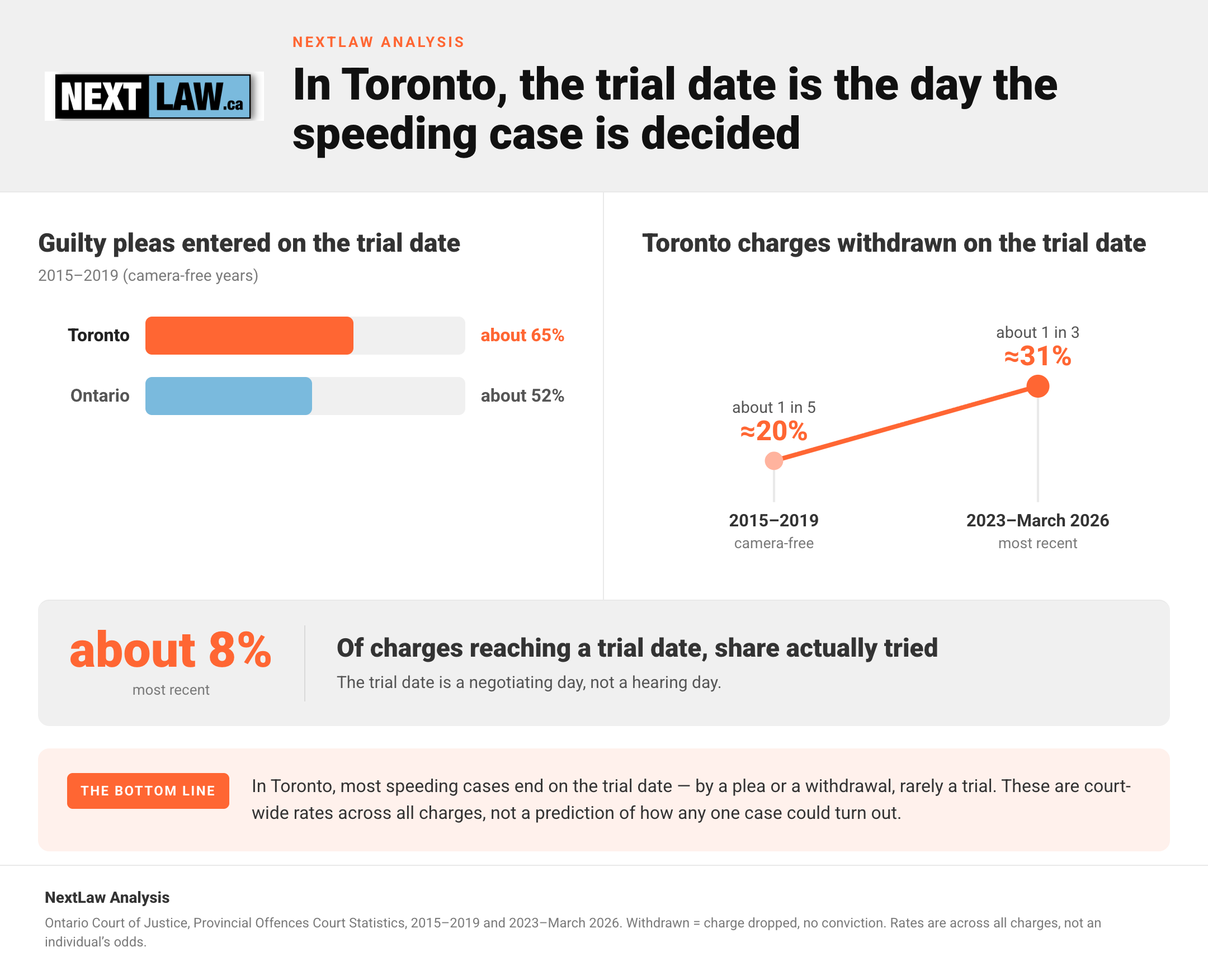
Short answer: In Toronto, a speeding case is decided on the trial date, so that date is what you’re hiring a representative to handle — to reach it, be there, and negotiate the charge down or hold the prosecution to proof. We looked at eleven years of Ontario Court of Justice data to see where Toronto cases actually resolve, and two numbers define this court.
One: most Toronto pleas are entered on the trial date, not before it. According to NextLaw Analysis of Ontario Court of Justice data (Provincial Offences Court Statistics, five camera-free years, 2015–2019), about 65% of guilty pleas in Toronto were entered on the trial date, versus roughly half across Ontario. In plain terms: Toronto mostly resolves in court, on the day set for trial — not through an early paperwork deal weeks ahead. Source: Ontario Court of Justice, Provincial Offences Court Statistics, 2015–2019; analysis by NextLaw.
Two: on the trial date, charges get dropped. Of the Toronto charges that reached a trial date, about one in five was withdrawn on the day in the camera-free years (2015–2019), and in the most recent data (2023 to early 2026) that has risen to roughly one in three. According to NextLaw Analysis of Ontario Court of Justice data, “withdrawn” means the charge was dropped — no conviction. Two honest limits on that number: the record doesn’t say why any single charge was dropped (officer non-attendance or a disclosure gap is our read at NextLaw, not something the data states), and it’s a rate across all charges — not your personal odds. Source: Ontario Court of Justice, Provincial Offences Court Statistics, 2015–2019 and 2023–March 2026; analysis by NextLaw.
Actual trials are rare: in the most recent data, only about 8% of the charges that reach a trial date are actually tried. So the trial date functions as a negotiating day, not a hearing day — the place where a plea gets reduced or the charge gets dropped, far more often than where a full trial is run. That’s what you’re hiring for in Toronto: someone whose whole job is that date.
They guided me through every step of the process, clearly explained my options, and ultimately helped me get the ticket resolved with minimal stress.
One caution, whether you hire or not: don’t miss the date
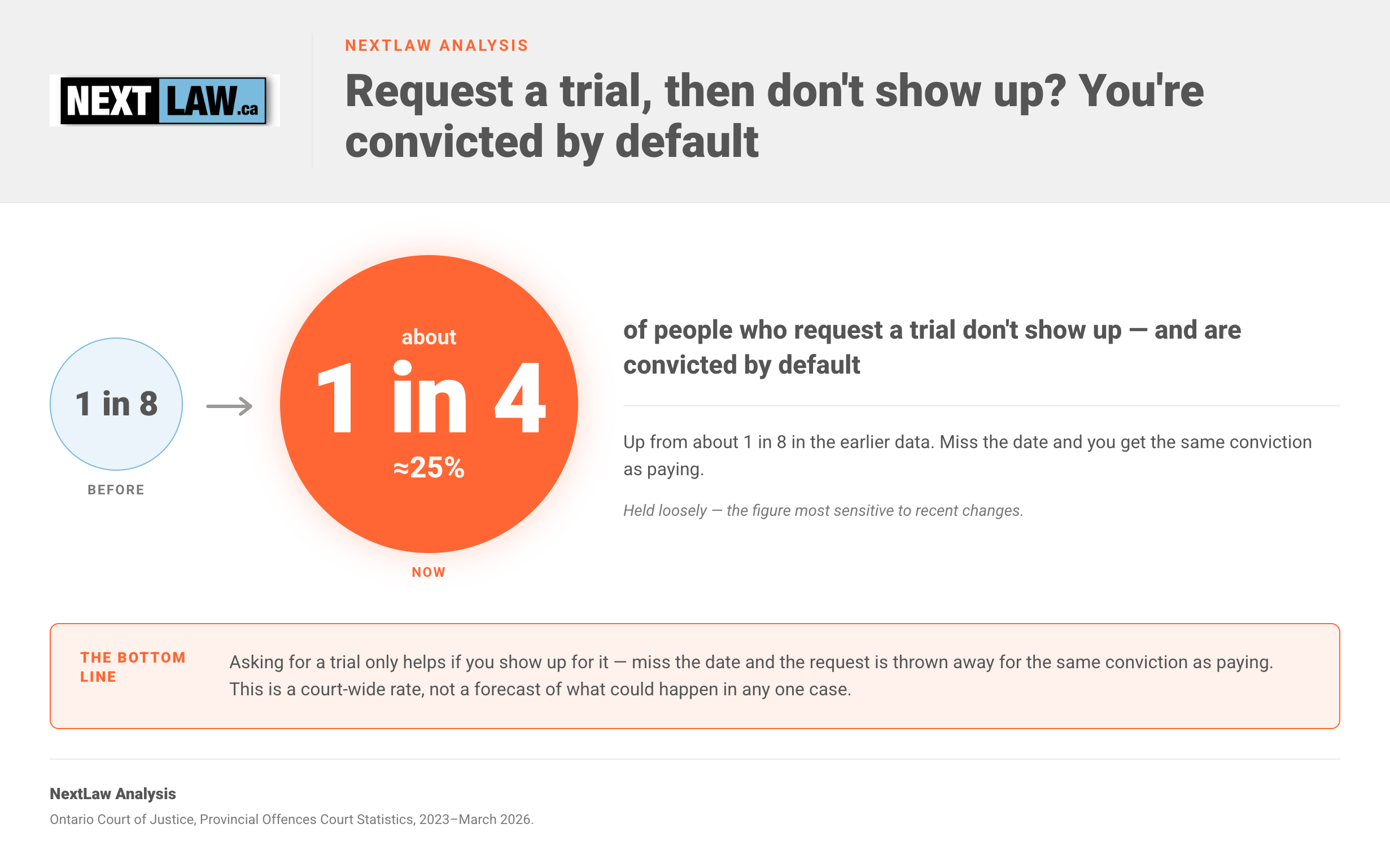
About a quarter of people who ask for a trial don’t show up and are convicted by default (NextLaw Analysis of the most recent Ontario Court of Justice data; we hold this figure loosely, as it’s the most sensitive to recent changes). Miss the date and you get the same conviction as if you’d simply paid the ticket — with the negotiation thrown away. Being there, on time, on the right day is the simplest thing a representative removes from your plate.
The one deadline that governs all of it: 15 days
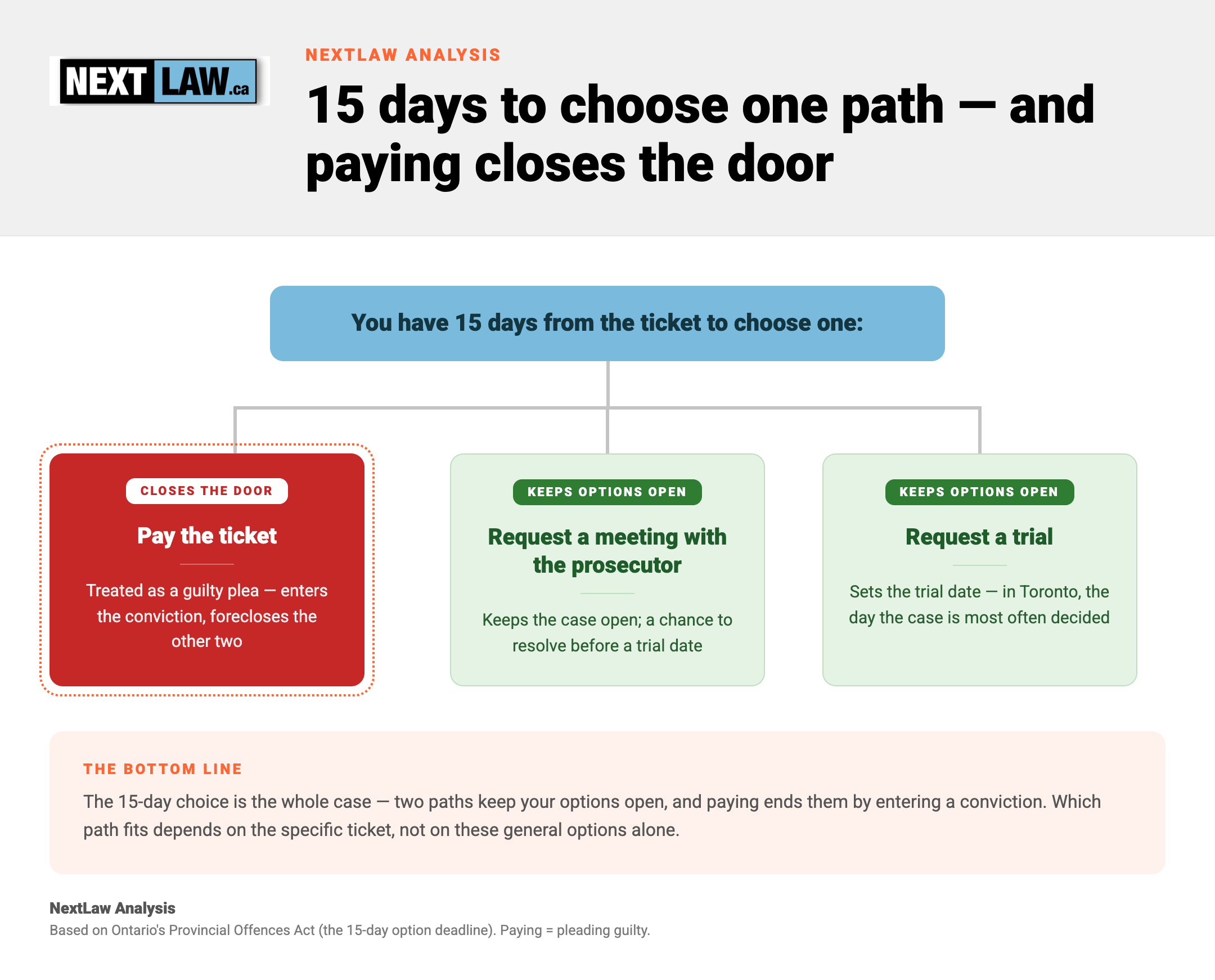
Under Ontario’s Provincial Offences Act (the law that sets out how these tickets are handled), you have 15 days from the date of the ticket to choose one of three options: pay it, ask for a meeting with the prosecutor, or request a trial. Paying the ticket forecloses everything above — it’s treated as pleading guilty, which enters the conviction and ends any chance to negotiate the charge down. So the deadline matters even before the trial-date question does.
A note on the numbers above: we looked at eleven years of Ontario Court of Justice data, measuring the five camera-free years, 2015 through 2019, and confirming the pattern in the most recent figures (2023 to March 2026). Speed cameras operated in Ontario from July 2020 until they were banned on 14 November 2025, so we report the pre-camera years and the most recent post-camera figures separately and leave the camera years out of the trend read.
Quick answers
Is it worth fighting a speeding ticket in Ontario?
Often it is — but it depends on your record and your insurance, and no outcome can be promised in advance. A conviction could raise your premiums for years, and the fine is usually the small part of the cost. There’s no single dollar figure that fits everyone: the insurance impact depends on your driver profile, your insurer, and the offence. A free case review is the honest way to see whether it’s worth it for you.
Do I need a lawyer, or can a paralegal handle it?
A licensed paralegal can represent you — speeding is within a paralegal’s scope under Ontario’s Provincial Offences Act. Whether you go with a lawyer or a paralegal matters less than the person’s actual experience and verified track record. Before you hire anyone, check their Google reviews — a real, consistent record of results is the signal that travels.
What to do next
Got a speeding ticket in Ontario? Don’t pay it yet. Not every ticket is worth fighting, but every ticket is worth checking. Two free, no-obligation ways to start:
- Try our free Speeding Ticket Insurance Calculator — 7 questions to see how much your insurance could go up. Get your number. (Internal link — calculator URL to be set at assembly.)
- Book a free call — no obligation, and we’ll tell you honestly whether your ticket is worth fighting. Book a free call. (Internal link — booking URL to be set at assembly.)
Want the fuller picture of how Toronto’s speeding court behaves? See our companion breakdown of the Toronto speeding court data. (Internal link — V11 sibling post URL to be set once live.)
NextLaw is a speeding ticket law firm based at 250 University Avenue, Suite 215, Toronto, ON. We represent drivers in courts across Ontario. Services by a licensed lawyer and licensed paralegals at NextLaw. This article is general information about Ontario speeding tickets, not legal advice for your specific case.

