
By Dan Joffe, Lawyer, NextLaw — a speeding ticket law firm based in Toronto, representing drivers in courts across Ontario. Published 21 September 2026 · Last updated 21 September 2026. Current as of September 2026; Ontario law and court practice can change.
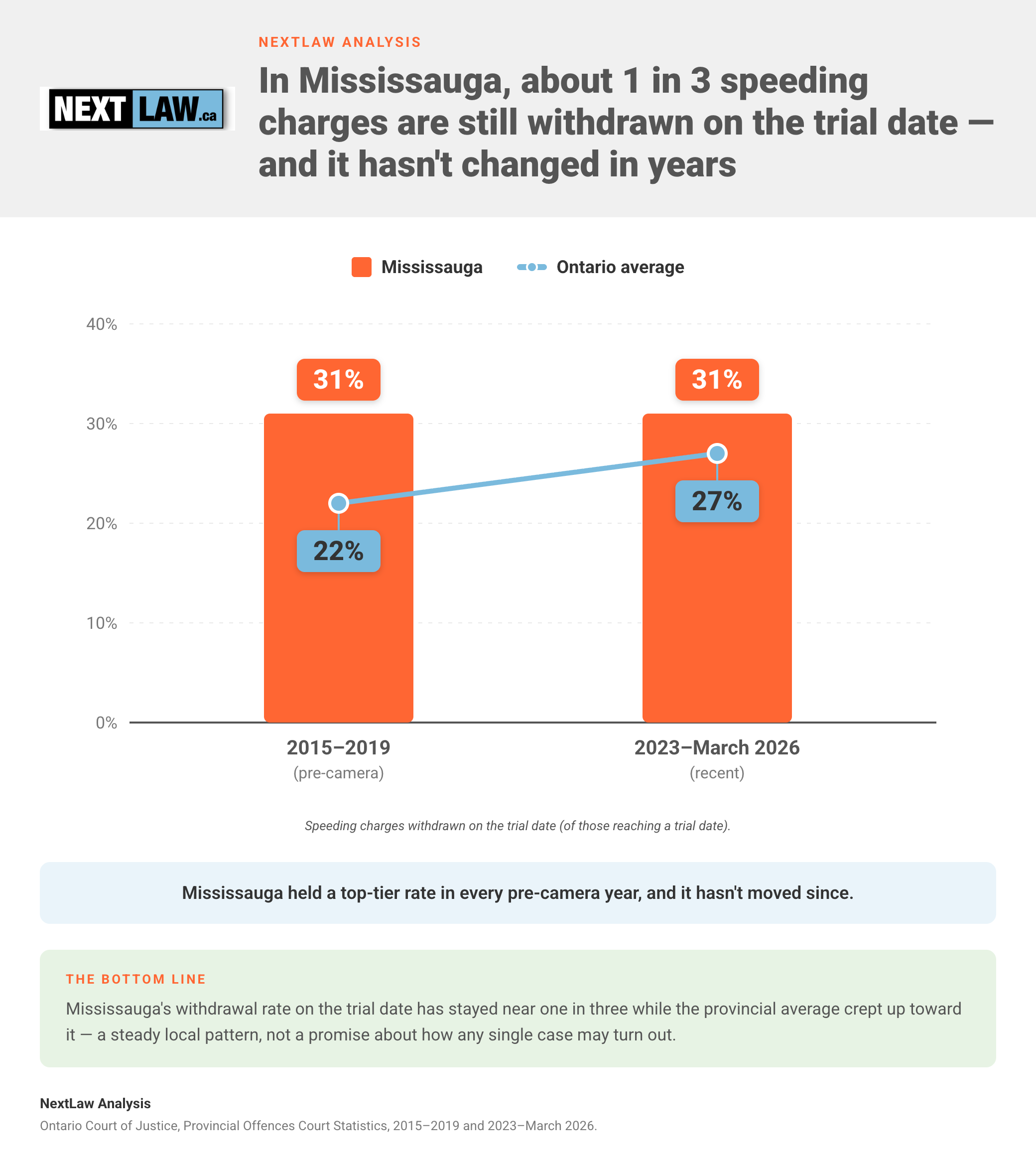

If you’re holding a speeding ticket in Mississauga, you’re probably worried about insurance. The court’s own record can’t tell you what your premium might do — but it can tell you how this court actually resolves a speeding charge, which shapes your options in the 15 days you have to decide what to do. And in Mississauga, close to one in three speeding charges that reach a trial date is withdrawn on that date — a rate this court has held steady for years, while Brampton next door climbed far past it.
This page covers ordinary Ontario speeding under the Highway Traffic Act (the provincial law that governs speeding, what most people just call a “speeding ticket”) — not stunt driving, which is a separate charge with separate stakes.
Speeding ticket in Mississauga? Nearly 1 in 3 charges reaching trial are withdrawn on the day — what the court data shows
Short answer: In Mississauga, the trial date is the event that decides most speeding cases — that’s the day charges get withdrawn, with no conviction and no record. We looked at eleven years of Ontario Court of Justice data to see how this court actually resolves cases, and the trial-date withdrawal rate is the number that defines it: close to one in three, every year since 2015. Two honest limits before the figures: this describes court outcomes across all charges, not any one driver, so it is not a one-in-three chance for you; and the record shows the outcome, not the reason behind it.
From the first call right to the finish line this company took over my case and did a great job of keeping me updated and fought on behalf to get the best possible outcome!
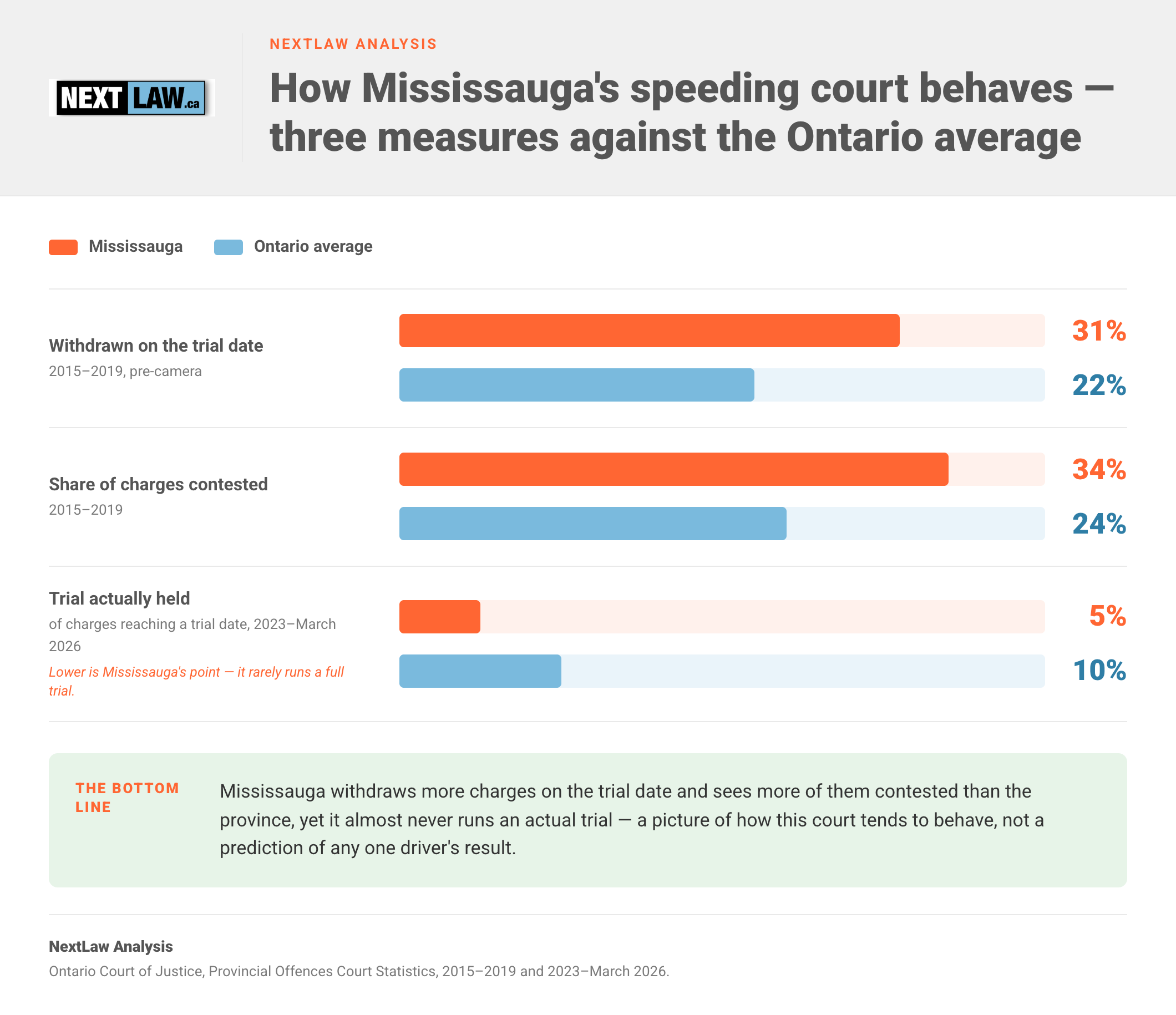
One: close to a third of Mississauga charges reaching trial were withdrawn on the day — and the rate has held for years. According to NextLaw Analysis of Ontario Court of Justice data (Provincial Offences Court Statistics, five camera-free years, 2015–2019), about 31% of Mississauga charges that reached a trial date were withdrawn on that date, versus roughly 22% across Ontario. That was top-tier in the province in every one of those five years. And it hasn’t moved: in the most recent data (2023 to March 2026) it’s still about 31%, against roughly 27% province-wide. “Withdrawn” means the charge was dropped — no conviction, no record. Source: Ontario Court of Justice, Provincial Offences Court Statistics, 2015–2019 and 2023–March 2026; analysis by NextLaw.
Two: Mississauga drivers contest more than the province does. Across the camera-free years, about 34% of Mississauga charges were contested, versus roughly 24% across Ontario (NextLaw Analysis of Ontario Court of Justice data, 2015–2019). Mississauga drivers already treat the trial date as a move worth making, and the withdrawal figure above is what that looks like in the record.
Three: Mississauga almost never runs a trial. Of charges that reach a trial date, only about 5% end in a trial actually being held in the recent data, versus roughly 10% province-wide (NextLaw Analysis of Ontario Court of Justice data, 2023–March 2026). This is where Mississauga and Brampton, its Peel neighbour, part ways: both started near one in three withdrawn on the day before speed cameras, but Brampton climbed past one in two while Mississauga stayed put — and Mississauga resolves those cases without running trials. Source: Ontario Court of Justice, Provincial Offences Court Statistics, 2023–March 2026; analysis by NextLaw.
What the data means — and what it doesn’t
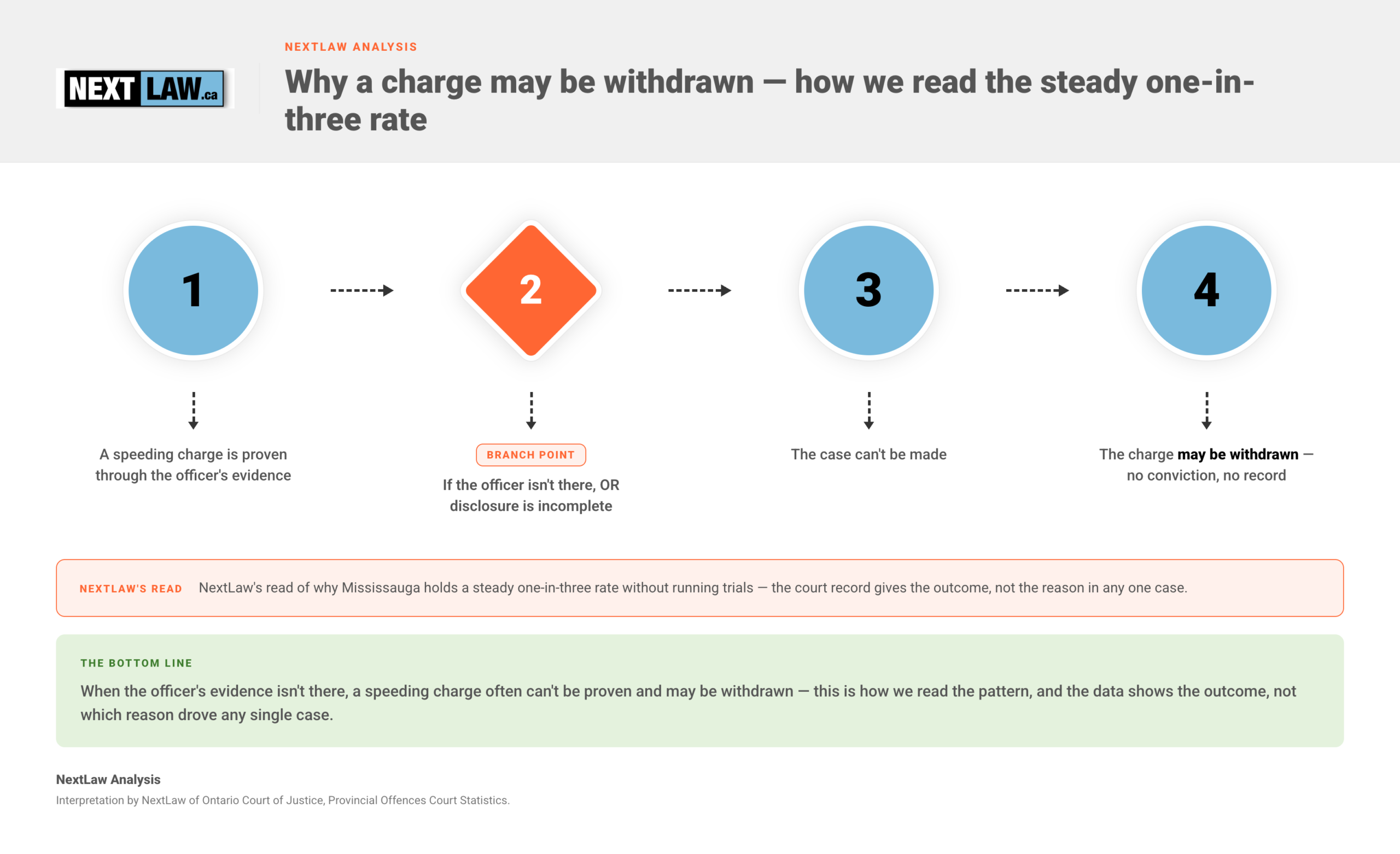
Our read at NextLaw is that Mississauga resolves speeding cases by agreement, with its officers attending more reliably than Brampton’s — which is why it holds a steady one-in-three withdrawal rate without the trials that a rising rate like Brampton’s would need. A speeding charge is proven through the officer’s evidence, so if the officer isn’t there on the trial date, or disclosure is incomplete, the case can’t be made and the charge may be withdrawn. That’s the mechanism behind the number. Which factor drives any single case, the data doesn’t record — it gives the outcome, not the reason. But it tells us the trial date is the decisive event here, and the realistic expectation on the day is a negotiation, not a coin flip: most of the rest pleaded, many to a reduced speed, and about half of Mississauga’s pleas are entered on the trial date itself — so if you reach that day, expect to negotiate, and go prepared.
The one deadline that governs all of it: 15 days
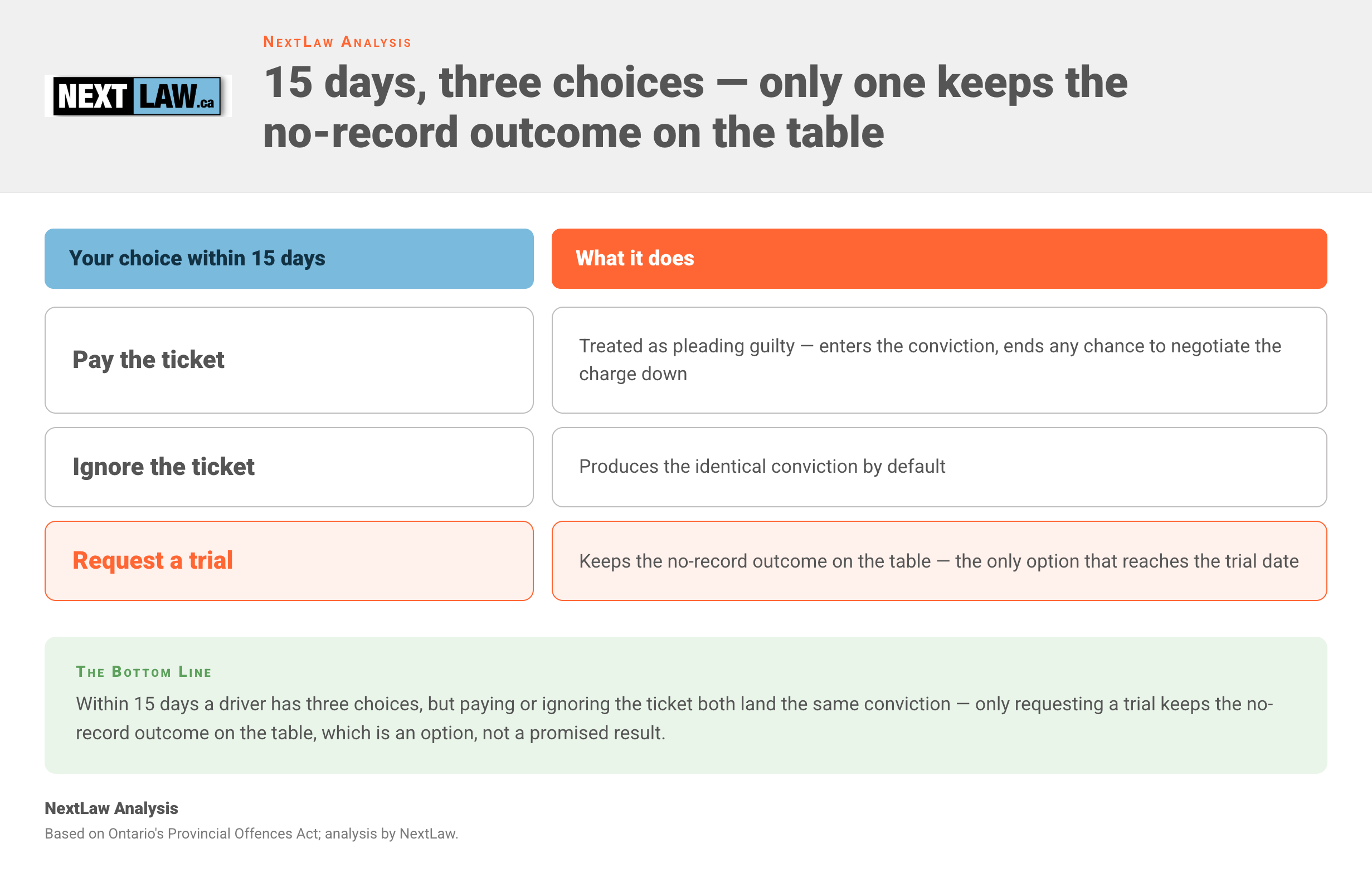
Under Ontario’s Provincial Offences Act (the law that sets out how these tickets are handled), you have 15 days from the date of the ticket to choose one of three options: pay it, ask for a meeting with the prosecutor, or request a trial. Only the trial request keeps the no-record outcome on the table. Paying the ticket is treated as pleading guilty — it enters the conviction and ends any chance to negotiate the charge down. Ignoring the ticket produces the identical conviction by default. Both foreclose the very day Mississauga’s numbers are about, so the deadline matters even before the trial-date question does. And remember the last figure: that number describes the court, not you — most drivers who reach the trial date pleaded, many to a reduced speed.
A note on the numbers above: we looked at eleven years of Ontario Court of Justice data, measuring the five camera-free years, 2015 through 2019, and confirming the pattern in the most recent figures (2023 to March 2026). Speed cameras operated in Ontario from July 2020 until they were banned on 14 November 2025 under Bill 56, and camera tickets carry owner liability with no demerit points and almost never reach a trial date — so the trial-date figures here describe officer-issued tickets, the kind that carry demerit points and reach a courtroom, which the speed cameras never affected. We report the pre-camera years and the most recent post-camera figures separately and leave the camera years out of the trend read.
Quick answers
Do cops show up to court for speeding tickets in Ontario?
Often they do. But the whole case rests on the officer’s evidence, and Mississauga’s data shows how often a charge doesn’t survive the trial date when that evidence isn’t there to be tested. That’s why the trial date, not the ticket itself, is the moment that decides most cases.
How much is a 40-over speeding ticket in Ontario?
It depends on the road. On a street posted under 80 km/h — most city roads — going 40 over isn’t a speeding ticket at all; it’s stunt driving, a far more serious charge with much higher stakes, and it’s outside what this page covers. On a road posted 80 km/h or faster, like a highway, 40 over is still speeding: a fine of a few hundred dollars. There, the fine is usually the smaller problem — the lasting cost is the conviction on your record and what it could mean for your insurance, not the ticket amount itself.
What to do next
Got a speeding ticket in Ontario? Don’t pay it yet. Not every ticket is worth fighting, but every ticket is worth checking. Two free, no-obligation ways to start:
- Try our free Speeding Ticket Insurance Calculator — 7 quick questions to see how much your insurance could go up. Get your number.
- Book a free call — no obligation, and we’ll give you a straight answer on whether your ticket is worth fighting. Book a free call.
Want to see how the court next door compares? See our companion breakdown of the Brampton speeding court data, where the same one-in-three rate has climbed past half.
NextLaw is a speeding ticket law firm based at 250 University Avenue, Suite 215, Toronto, ON. We represent drivers in courts across Ontario, including Mississauga. Services by a licensed lawyer and licensed paralegals at NextLaw. This article is general information about Ontario speeding tickets, not legal advice for your specific case.

