

By Dan Joffe, lawyer at NextLaw (LSO #37145V) · Published October 6, 2026 · Last updated October 6, 2026 · Ontario, Canada
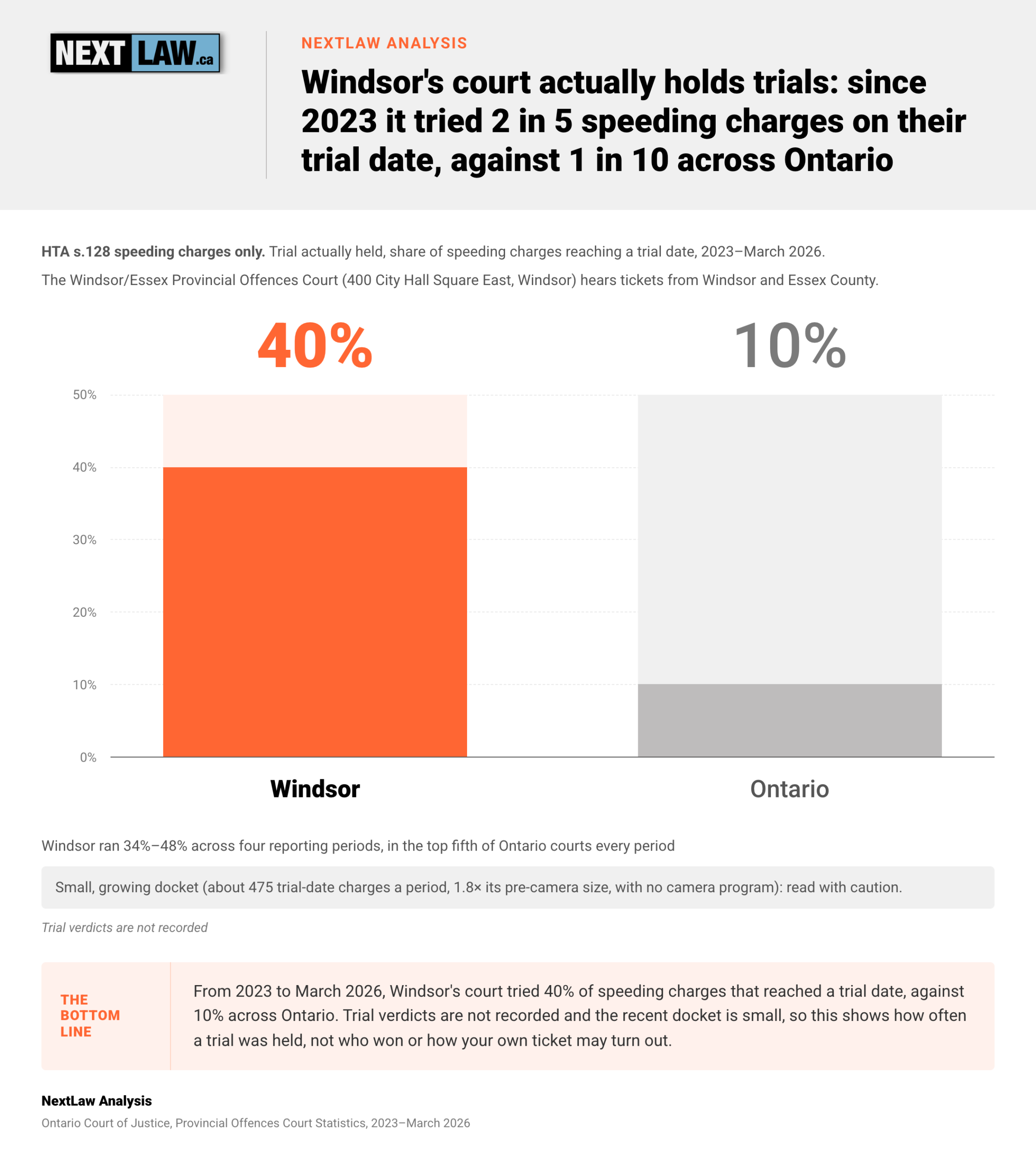
Short answer: Speeding ticket in Windsor, Ontario? Here’s what happens to it in court. A speeding ticket in Windsor that reaches its trial date often goes to an actual trial. According to NextLaw Analysis of Ontario Court of Justice data, since 2023 Windsor’s court tried two in five speeding charges on their trial date (40%), against one in ten (10%) across Ontario. Windsor’s court, which also hears Essex County tickets, settles most contested speeding charges early and tries more of what’s left than almost any Ontario court. The data can’t tell you what happens to your insurance, but it shows when your decision matters: before the trial date.

Speeding ticket Windsor: a court that actually holds trials
We analyzed eleven years of Ontario Court of Justice data, 2015 through March 2026, for speeding charges under Ontario’s Highway Traffic Act (section 128), what most people call a speeding ticket. We compared Windsor’s court with the other Ontario courts and with the province as a whole. Every figure on this page covers those speeding charges only.
Windsor’s court is the Windsor/Essex Provincial Offences Court at 400 City Hall Square East in Windsor. It handles Provincial Offences matters for the whole Windsor/Essex County court service area, so a speeding ticket written in Essex County goes to the same court. No speed cameras ever operated there, so these are all speeding tickets issued by police officers.
The finding: a speeding ticket in Windsor that reaches its trial date often goes to an actual trial. According to NextLaw Analysis of Ontario Court of Justice data, from 2023 to March 2026, Windsor’s court tried 40% of speeding charges on their trial date, about two in five, against 10% across Ontario. Across four reporting periods, Windsor’s share ran from 34% to 48%, in the top fifth of Ontario courts every period, at the 94th percentile overall. Trial verdicts are not recorded, so this shows how often a trial was held, not how it ended.
One caution: Windsor’s trial docket is small and growing. About 475 speeding charges reached a trial date in each reporting period since 2023, 1.8 times its size before speed cameras, with no camera program behind the growth. Read the recent Windsor figures with that in mind.
| Speeding charges (Highway Traffic Act s.128) | Windsor | Ontario |
|---|---|---|
| Tried on the trial date, 2023 to March 2026 (share of charges reaching a trial date) | 40% | 10% |
| Trial held, 2015 to 2019 (share of contested charges) | 9% | 4% |
| Guilty pleas entered on the trial date, 2015 to 2019 (share of all guilty pleas) | 10% | 52% |
| Withdrawn at any stage, 2015 to 2019 (share of contested charges) | 21% | 16% |
Source: Ontario Court of Justice, Provincial Offences Court Statistics (2015–March 2026); analysis by NextLaw.
Windsor held trials before the speed-camera years too

It isn’t new. According to NextLaw Analysis of the five camera-free years, 2015 to 2019, Windsor held trials on 9% of contested speeding charges (charges the driver fought rather than simply paid), against 4% across Ontario. That was among the highest rates in the province: Windsor sat at the 90th percentile of Ontario courts, in the top fifth in four of those five years, with a yearly range of 7% to 12%.
Nine in ten Windsor pleas came before the trial date
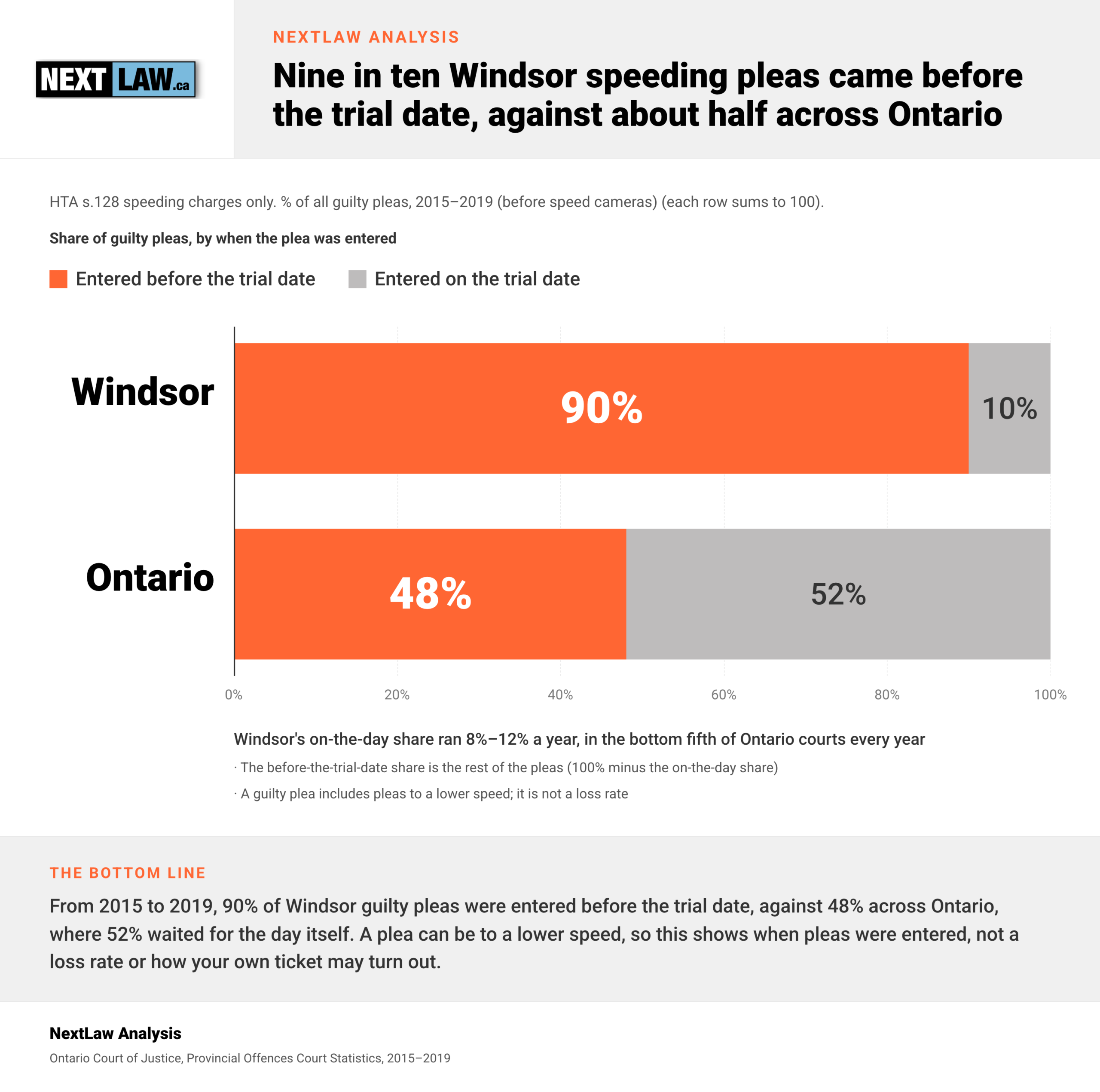
Most of the rest is settled early. According to NextLaw Analysis of the same 2015 to 2019 data, only 10% of Windsor guilty pleas were entered on the trial date, against 52% across Ontario. So nine in ten Windsor pleas came before the trial date, while across Ontario about half waited for the day itself. Windsor was in the bottom fifth of Ontario courts on this measure in every one of those five years, with a yearly range of 8% to 12%.
A plea can be to a lower speed, so these figures are not a loss rate. They count charges, not drivers.
Windsor withdrew more contested charges than most courts

According to NextLaw Analysis of the 2015 to 2019 data, Windsor withdrew 21% of contested speeding charges, against 16% across Ontario. It was in the top fifth of Ontario courts on this measure every year, with a yearly range of 18% to 24%. Most of those withdrawals came before any trial date.
The data doesn’t record why a charge was withdrawn, or how any trial ended. It describes the court, not your odds.
Why Windsor’s court looks like this: our read
Our read at NextLaw is this: Windsor’s court sorts its cases early, at screening and at early resolution meetings with the prosecutor. The charges still standing on trial day are the ones the prosecution is ready to prove.
That is our interpretation of the pattern. The data shows when pleas and withdrawals happened, not why.
What to do after a speeding ticket in Windsor
So in Windsor, the useful work happens before the trial date. If a conviction is worth avoiding, that’s where a weak charge can be withdrawn and where a plea to a lower speed can be negotiated. A plea to a lower speed is a possible outcome of that negotiation, not a promised one. If your charge is still on the list on trial day, prepare for a trial on the evidence. You don’t have to go alone: a lawyer or licensed paralegal can appear in court for you (Provincial Offences Act, section 50(1)).
They took charge right away, they worked with the prosecutor and had my charge reduced.
The clock starts when you get the speeding ticket. Within 15 days, you have three choices under the Provincial Offences Act:
- Pay it. Paying is a guilty plea, and the conviction goes on your record (section 8(2)).
- Meet the prosecutor for early resolution. In Windsor, it’s option 2 on the ticket. If no resolution is reached, a trial date is set (City of Windsor, Request Early Resolution Meeting).
- Request a trial. Your case goes to a trial date at the Windsor/Essex court.
If you do nothing for 15 days, you can be convicted without a hearing (Provincial Offences Act, section 9). The conviction, not the fine, is the part that could affect your insurance; our guide to how a speeding ticket could affect your insurance in Ontario covers that side.
Got a speeding ticket in Ontario? Don’t pay it yet. Not every ticket is worth fighting. But every ticket is worth checking. Our free insurance calculator asks 7 quick questions to see how much your insurance could go up. Get your number first. Then, if it makes sense, book a free call for a straight answer.
To see how other courts compare, read our court data for London, where most trial dates now go to trial, Hamilton and Barrie, plus our look at what happens on the trial date across Ontario.
How the camera years were handled
Speed cameras operated in Ontario from July 2020 until they were banned on November 14, 2025 (Bill 56). Camera tickets were issued to the vehicle owner, carried no demerit points and never touched a driving record. Because they distorted how many tickets were issued and how many were simply paid, this analysis uses the five camera-free years, 2015 to 2019, for those measures, confirmed against the first post-ban months of 2026. It uses the most recent three years only for what happens on the day of trial, where camera tickets almost never reached.
Windsor is the control case. No speed camera ever operated in the Windsor/Essex court area: its first five cameras were scheduled for December 2025, after the ban took effect. Red-light cameras are a separate program and are not counted in these speeding figures. Since 2023, Windsor’s trial docket has run at 1.8 times its pre-camera size, against 0.8 times across Ontario.
Quick answers
Do cops show up to court for speeding tickets in Ontario?
In Windsor, our read is that they usually do. According to NextLaw Analysis of Ontario Court of Justice data, Windsor’s court withdrew just 10% of speeding charges on their trial date from 2023 to March 2026, well below Ontario’s 27%. The data itself doesn’t record who attended, or why a charge was withdrawn, and Windsor’s recent trial docket is small, so read the figure with caution.
Is it worth fighting a reduced speeding ticket in Ontario?
It can be, because the reduction only changes the speed: paying still records a speeding conviction. A plea to a lower speed can reduce or remove demerit points, but it doesn’t erase the conviction. How many points a conviction carries depends on how far over the limit it was (O. Reg. 339/94). The insurance effect depends on the tier crossed and your insurer’s rules. Our breakdown of whether it’s worth fighting a speeding ticket in Ontario sets out the trade-off.
What happens when an American gets a speeding ticket in Canada?
In Windsor, it’s an Ontario charge like anyone else’s, with the same 15-day deadline (Provincial Offences Act, section 9), and a lawyer or licensed paralegal can appear in court for you (section 50(1)). Ontario shares driving convictions with Michigan and New York (Ontario, Understanding demerit points), so a conviction may follow you home.
About NextLaw
NextLaw is a speeding ticket law firm based in Toronto, representing drivers in every court in Ontario, including the Windsor/Essex court in Windsor. This article was written by Dan Joffe, lawyer at NextLaw (Law Society of Ontario #37145V). Services by licensed lawyer and licensed paralegals at NextLaw. For speeding ticket inquiries, call 647-558-2679. Court statistics current as of March 2026. This covers ordinary Ontario speeding under the Highway Traffic Act, not stunt driving, and it is general information, not legal advice about your specific case.

