

Will a speeding ticket suspend your licence? If you are a G2 driver in Ontario, one ticket can do exactly that. A single speeding conviction for going 30 km/h or more over the limit — a four-point ticket — can mean an automatic 30-day licence suspension the moment you are convicted. That is the real stake here, not the demerit points themselves. The points come and go; the conviction is the thing that pulls a G2 licence now and can cost you afterward. Below is exactly how the numbers work, why a G2 driver is treated so differently from a full-G driver, and what a driver can do before a conviction locks in.

How many demerit points does it take to lose a G2 licence in Ontario?
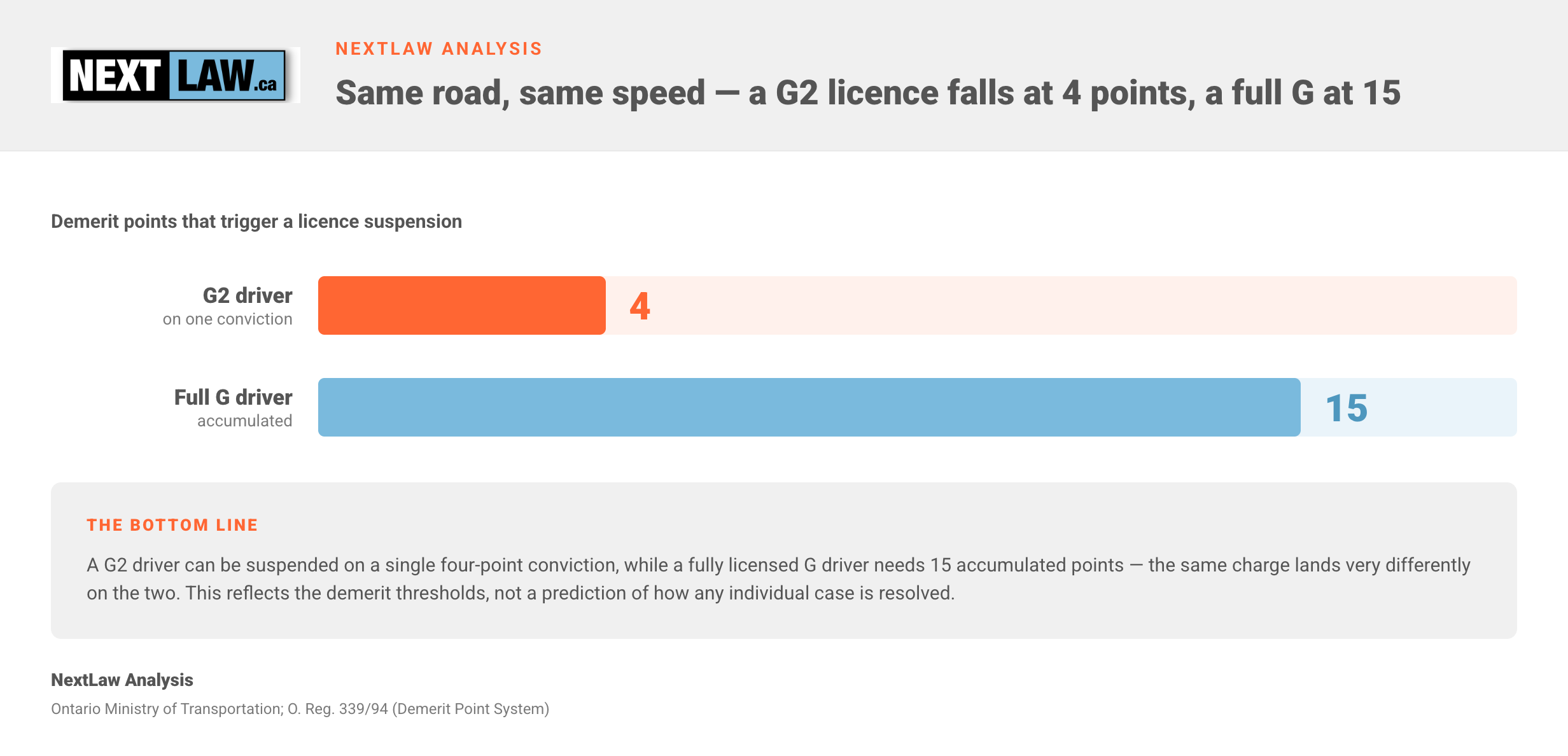
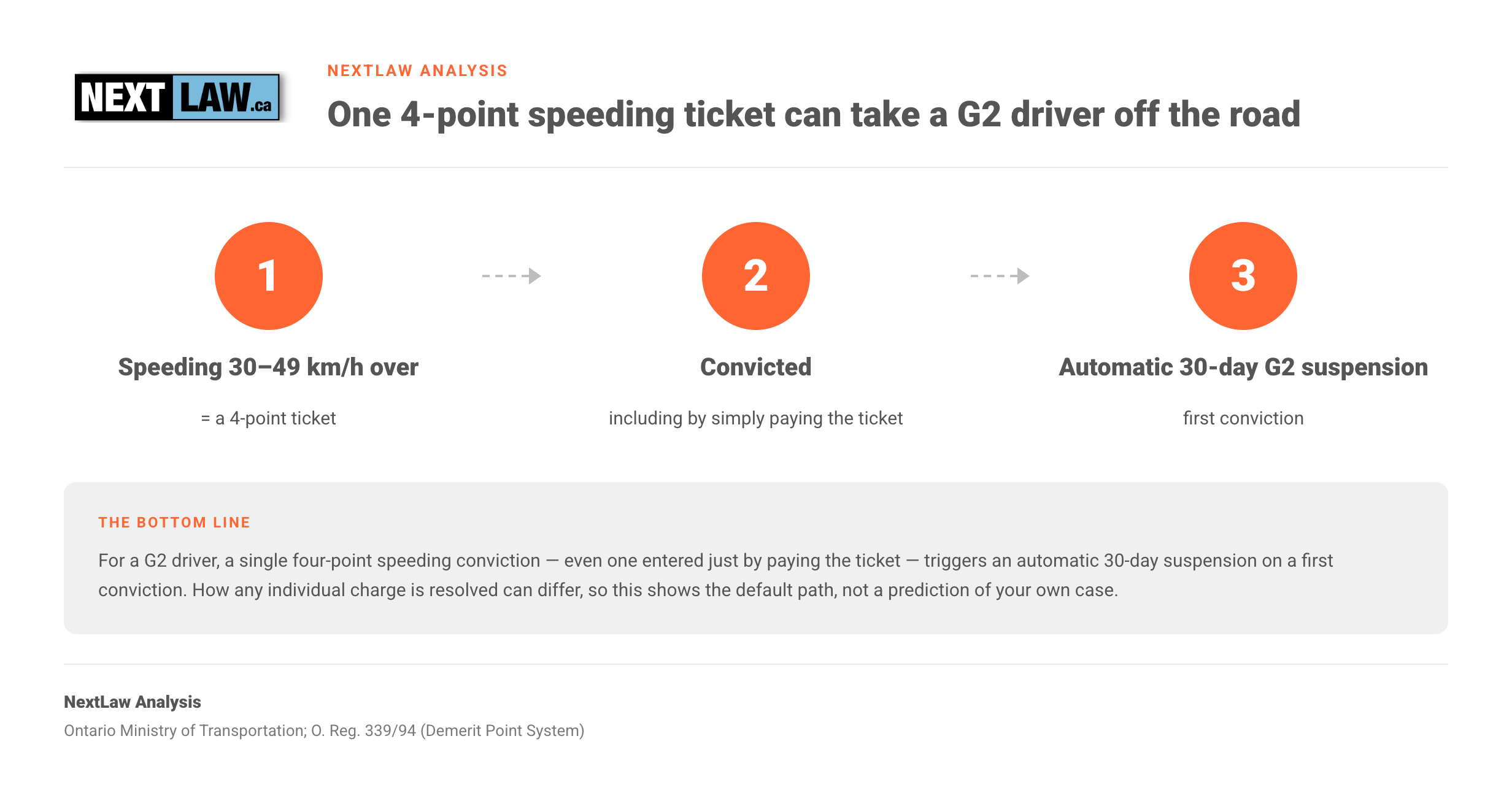
Four. According to Ontario’s Ministry of Transportation, a single conviction that carries four or more demerit points triggers an automatic 30-day suspension for a G2 driver — and a speeding ticket for going 30 to 49 km/h over the limit is exactly four points. So it is not a slow accumulation of tickets; it is one four-point conviction.
Here is why that number lands so hard. A fully licensed G driver would need 15 points before any suspension — the same Ministry of Transportation threshold set out in Ontario’s demerit point system regulation (O. Reg. 339/94). A G2 driver gets there on a single ticket. Same road, same speed, same officer — and one driver shrugs it off while the other is off the road for a month. As a G2 driver you are what the Ministry calls a “novice driver,” and that status triggers a separate set of escalating penalties.
And it escalates. On a first four-point conviction it is 30 days. A second is 90 days. On a third, you lose the G2 entirely — back to square one, re-applying and re-testing from the beginning. Ontario’s Ministry of Transportation sets out these novice-driver escalating sanctions. This is the part the points chart on most other websites never mentions.
Do you get demerit points for speeding in Ontario, and how many?
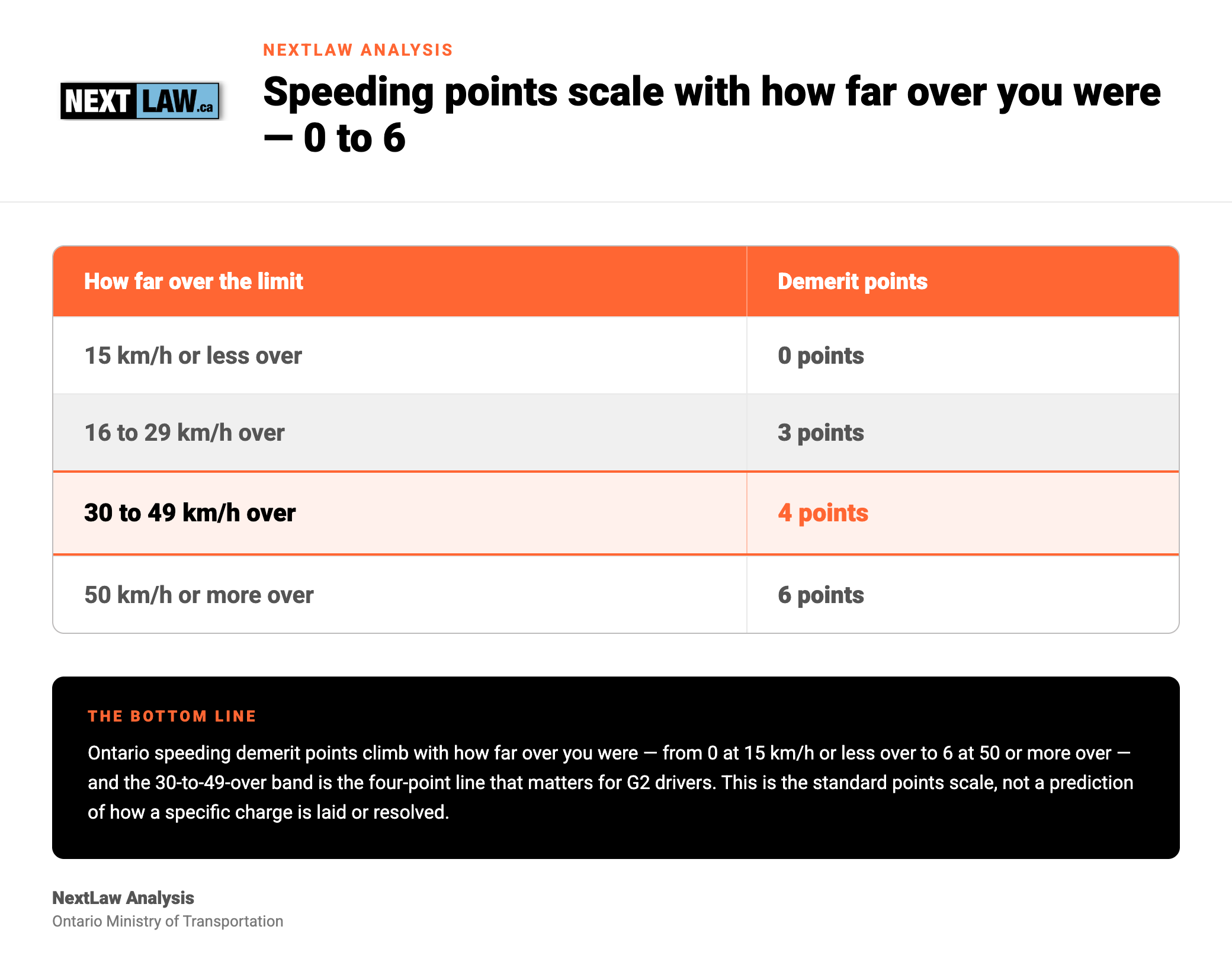
Yes — and the number scales with your speed. Ontario’s Ministry of Transportation sets speeding demerit points as follows:
| How far over the limit | Demerit points |
|---|---|
| 15 km/h or less over | 0 points |
| 16 to 29 km/h over | 3 points |
| 30 to 49 km/h over | 4 points |
| 50 km/h or more over | 6 points |
Notice the line that matters most for a G2 driver: 30 to 49 km/h over is four points — the exact figure that trips the automatic 30-day suspension above.
How long do demerit points and a speeding conviction stay on your record?
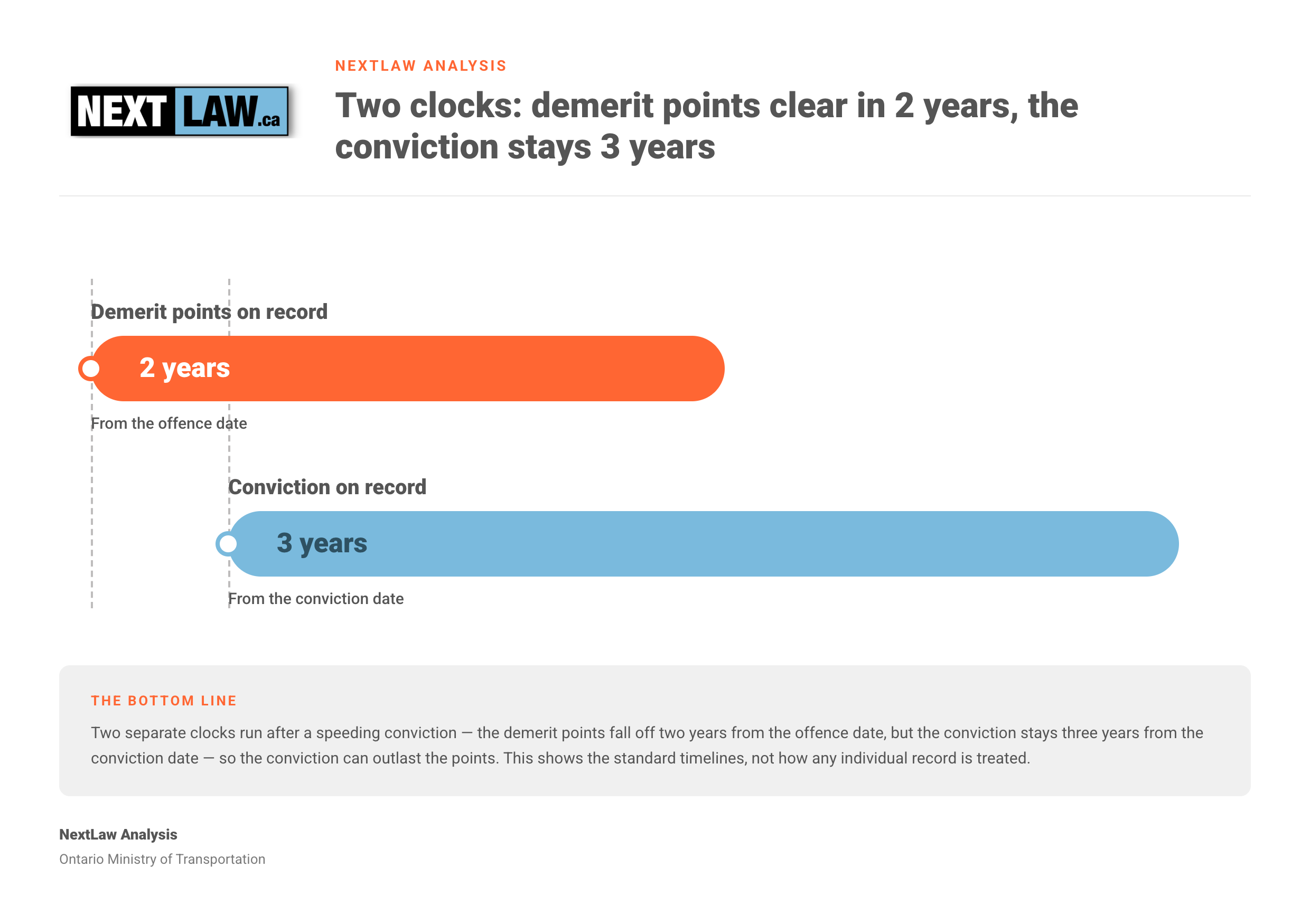
There are two clocks running, and they do not run for the same length of time. According to the Ministry of Transportation, demerit points come off your record two years from the date of the offence — the day you were stopped. But the conviction itself stays on your driving record for three years from the date you are convicted. A two-year clock on the points; a longer three-year clock on the conviction.
That gap is the whole game, and it is why we tell full-G drivers to stop worrying about the points. Insurers do not rate you on demerit points — they rate you on the conviction. So even after the points quietly disappear at two years, the conviction is still there doing the expensive work. For a full-G driver, the points are almost a distraction. For a G2 driver, the points are what pull the licence, and the conviction is what can raise your costs after you get it back.
Do demerit points affect your car insurance in Ontario?
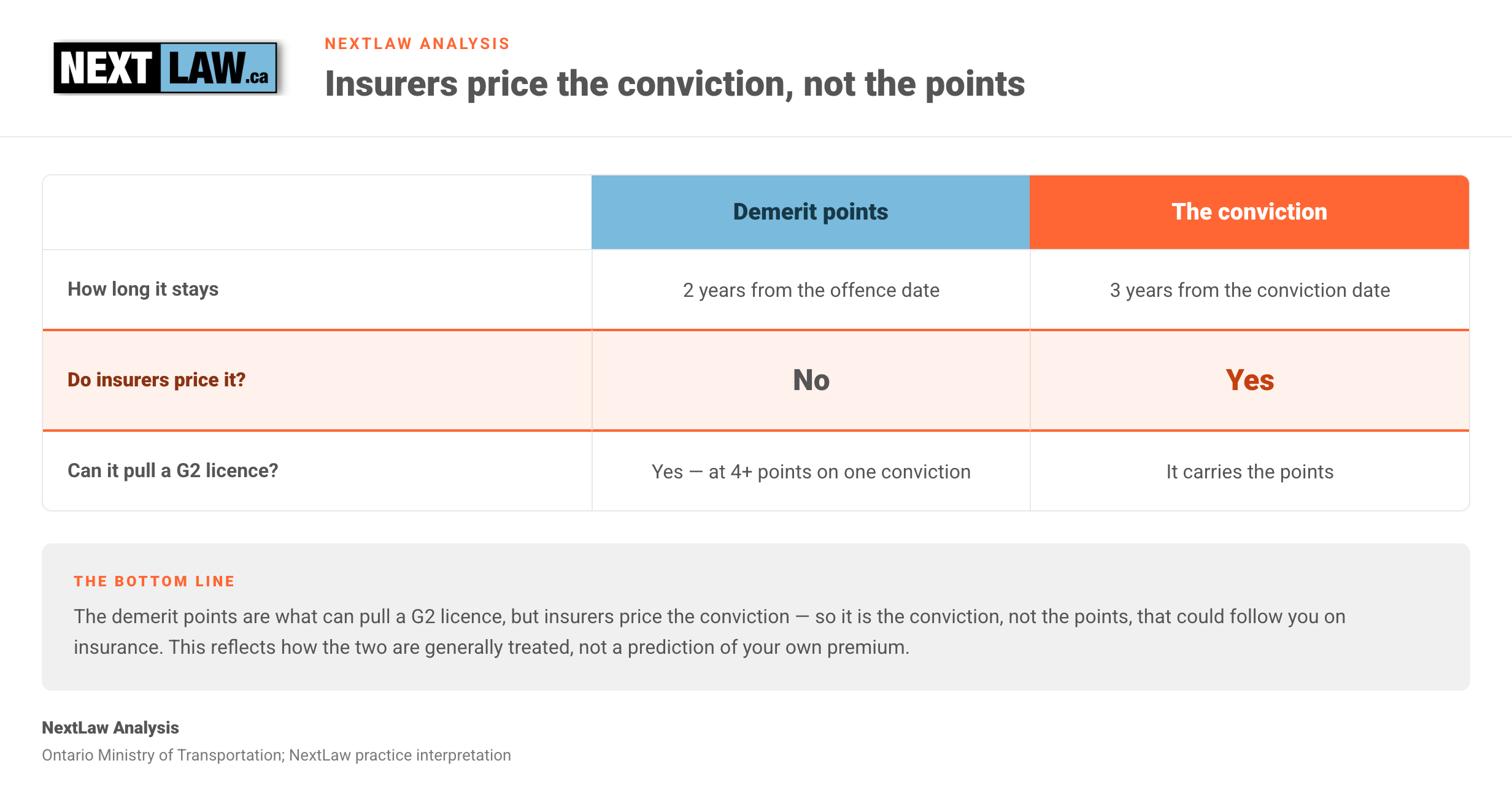
Barely — because insurers do not price the points; they price the conviction. This is where a G2 speeding ticket becomes a two-part problem: the suspension pulls your licence now, and the conviction could raise your insurance costs for years after. What a conviction does to any specific premium could vary from one insurer to the next, so treat this as how the mechanism works, not a prediction of your own result.
| Demerit points | The conviction | |
|---|---|---|
| How long it stays | 2 years from the offence date | 3 years from the conviction date |
| Do insurers price it? | No | Yes |
| Can it pull a G2 licence? | Yes — at 4+ points on one conviction | The conviction is what carries the points |
The G2 trap — paying the ticket is the conviction
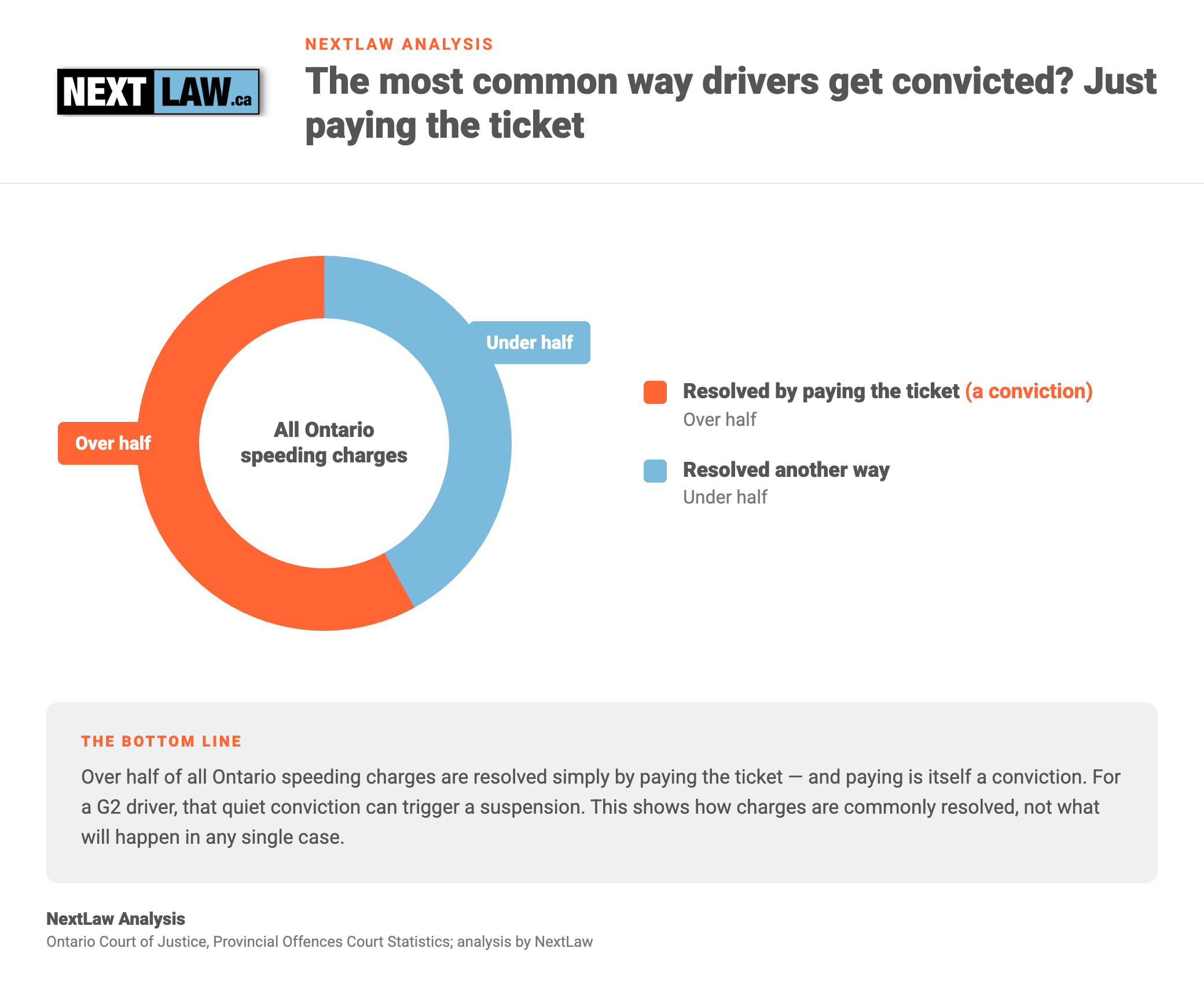
Let’s make it real — this is our bread and butter. We had a G2 client in Ottawa charged at 48 km/h over the limit. That is a four-point ticket, so on conviction it meant an automatic 30-day suspension. And this client drove rideshare full-time — so that suspension was not an inconvenience, it was thirty days with no way to earn a living.
Here is the trap most people walk into first. According to NextLaw Analysis of Ontario Court of Justice data, over half of Ontario speeding charges are resolved by the driver simply paying the ticket — and paying is a conviction. It is the single most common way people get convicted: not losing a fight, just quietly paying. For this client, paying would have been the exact thing that pulled his licence.
How reducing the charge removes the four-point trigger
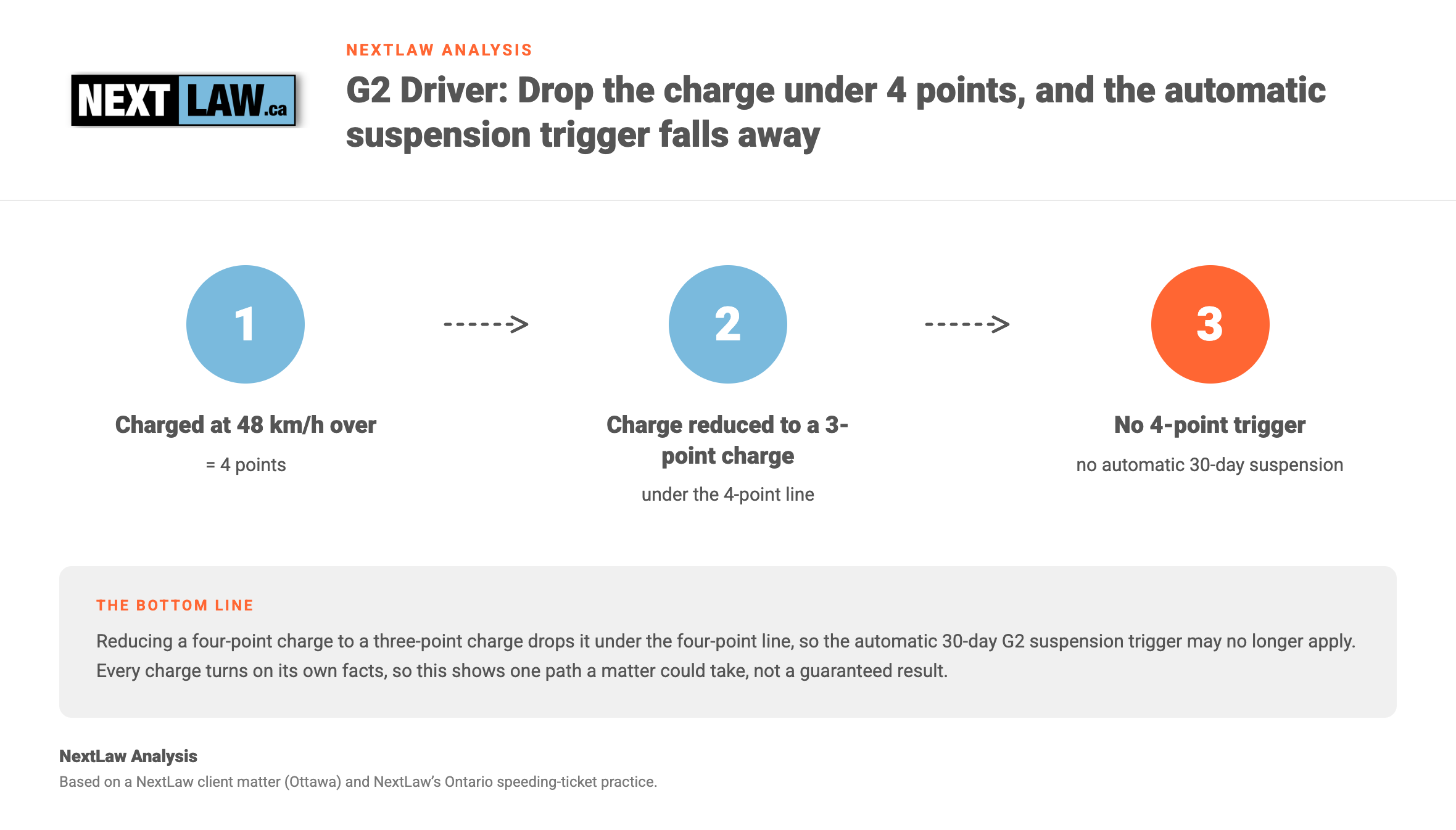
So what did we do? We requested the evidence, found real legal issues we could argue, and pushed to get the charge reduced — down under that four-point line, to a three-point charge. No four-point trigger, no automatic suspension. He kept his licence, kept driving, kept earning. A lower speed on the record is generally easier on insurance too, though the exact effect could vary from insurer to insurer.
And here is the quiet part: According to NextLaw Analysis of Ontario Court of Justice data, the data cannot even show you how often a reduction like that happens — because a reduced speeding charge is still filed under the same section. The most common good outcome does not show up in the numbers at all. That is not a promise about any one case; it is why we tell G2 drivers to check the ticket before deciding anything.
Jon was a great lawyer and worked my case perfectly and got the best possible outcome for my speeding situation.
Frequently asked questions about G2 speeding tickets and demerit points
Will I get demerit points for doing 37 in a 30?
No. That is seven over, and anything 15 km/h or less over the limit is zero demerit points in Ontario, per the Ministry of Transportation.
How much is a 30-over speeding ticket in Ontario?
The set fine is the small number, and it is a whole topic on its own — see our separate breakdown of how much a speeding ticket costs in Ontario. For a G2 driver, the bigger stake is the licence, not the fine.
Can your licence be suspended for unpaid speeding tickets in Ontario?
Yes — but that is a different mechanism. An unpaid fine can lead to a suspension on its own, separate from demerit points, under Ontario’s Provincial Offences Act. Either way, ignoring a ticket does not make it go away.
How many demerit points suspend a G2 licence in Ontario?
A single conviction carrying four or more demerit points automatically suspends a G2 licence for 30 days — 90 days for a second, and cancellation of the G2 for a third — per Ontario’s Ministry of Transportation. A 30 to 49 km/h over speeding ticket is exactly four points. Insurers rate the conviction rather than the points, so what a conviction may do to a premium can vary from insurer to insurer.
What to do if you got a speeding ticket as a G2 driver in Ontario
Got a speeding ticket in Ontario? Don’t pay it yet. Not every ticket is worth fighting — but every ticket is worth checking, and for a G2 driver a four-point conviction is the difference between keeping your licence and losing it for a month. Start with our free insurance calculator: seven quick questions to see how much your insurance could go up. Get your number first. Then, if it makes sense, book a free call for a straight answer. You can also learn more about our Ontario speeding ticket defence.

