
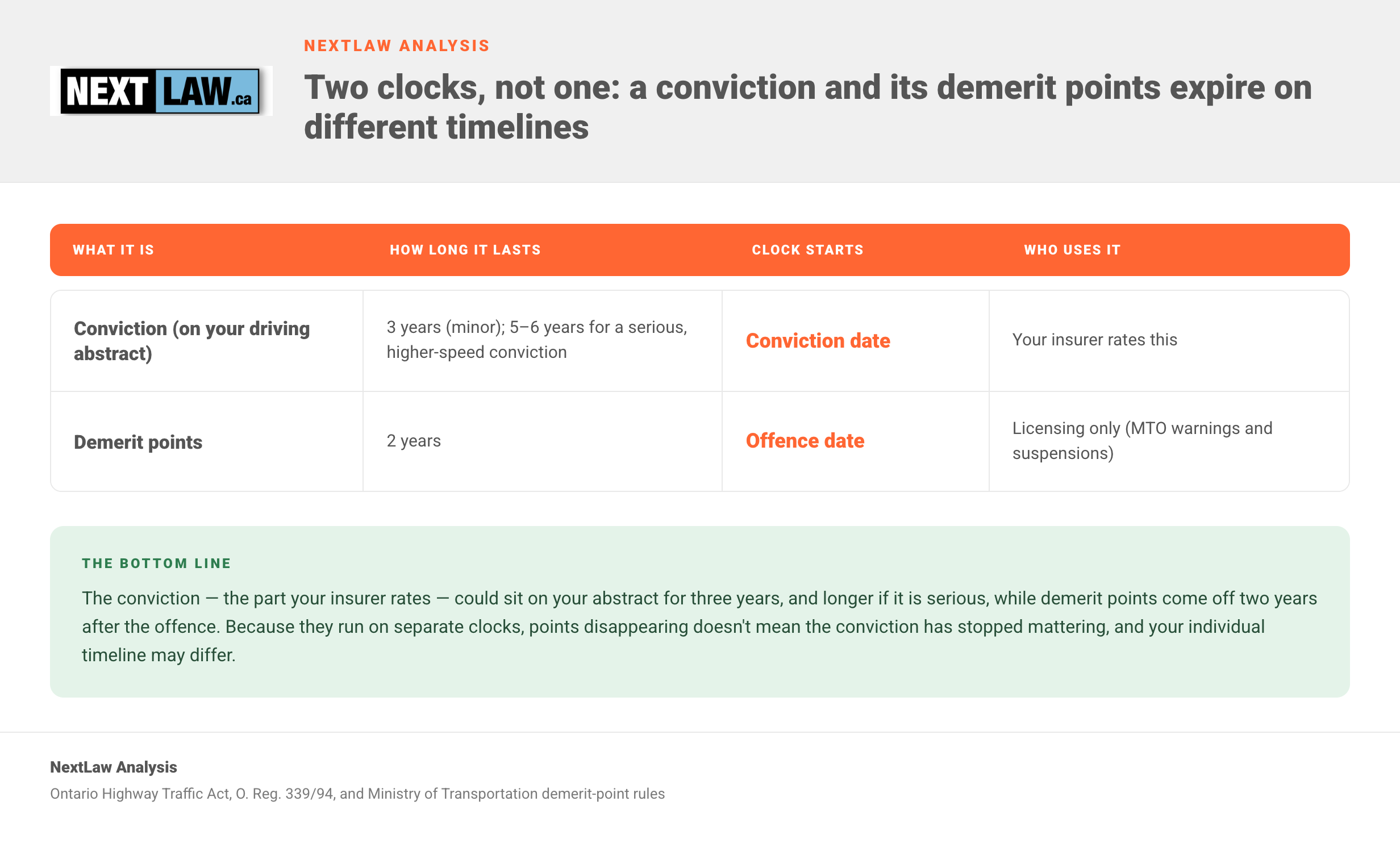
Short answer: In Ontario, a speeding conviction stays on your driving record for three years from the date you’re convicted — not the date of the ticket. The demerit points are a separate clock: they come off two years from the offence date. The part that catches people is that your insurer rates the conviction, not the points, and can factor it in for three years — sometimes five to six for a serious, higher-speed conviction. The bigger risk isn’t one ticket, though. It’s the pattern. And the most common way people get convicted isn’t losing a fight — it’s silence.

This article explains Ontario law for drivers across the province and reflects the rules and Ontario Court of Justice data current as of August 2026.
How long does it take for a speeding ticket to fall off your record in Ontario?
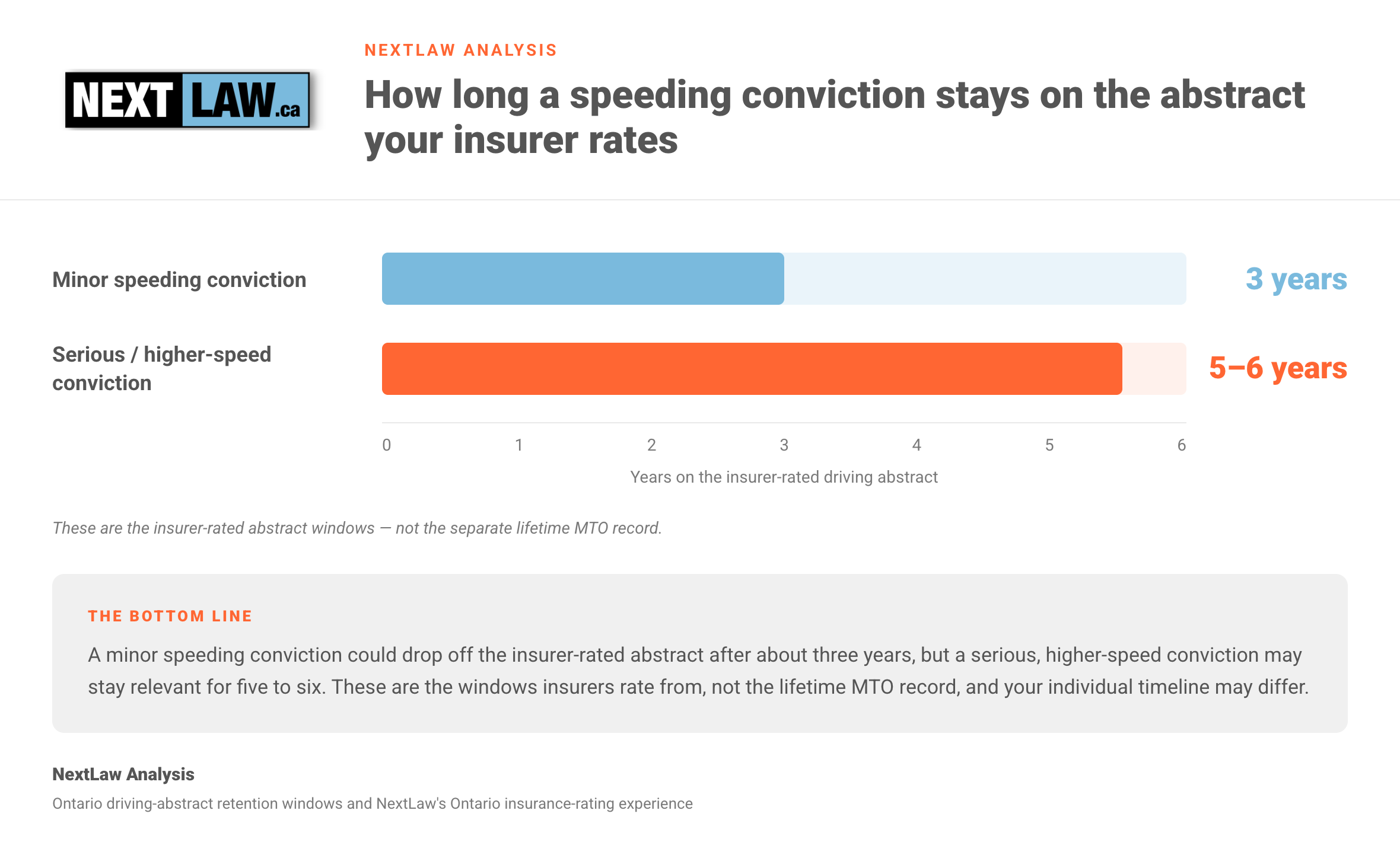
A minor speeding conviction drops off the driving abstract your insurer pulls three years after you’re convicted. The demerit points come off two years after the offence date. Two clocks, not one — and that gap is where almost everyone gets tripped up.
The points are just a licensing tool. Under the demerit-point system (O. Reg. 339/94 under the Highway Traffic Act), the Ministry of Transportation uses points for warnings and suspensions. The conviction is a separate record — and it’s the one your insurer actually rates. They pull your three-year driving record at renewal and look at the conviction, not the points. So you can be a driver whose points vanished a year ago, thinking your record is clean, while your insurer is still rating a conviction you may have forgotten.
That’s the most common thing we hear in our Ontario speeding-ticket practice: “my points came off — why is this still on my record?” Because the conviction runs its own three-year clock from the conviction date. For a serious, higher-speed conviction, that can stretch to five or six years. And set aside the idea that tickets stay on “permanently” — there is a separate lifetime Ministry of Transportation record, but the three-year abstract your insurer uses drops a minor conviction at three years.
Can you clean your driving record in Ontario?
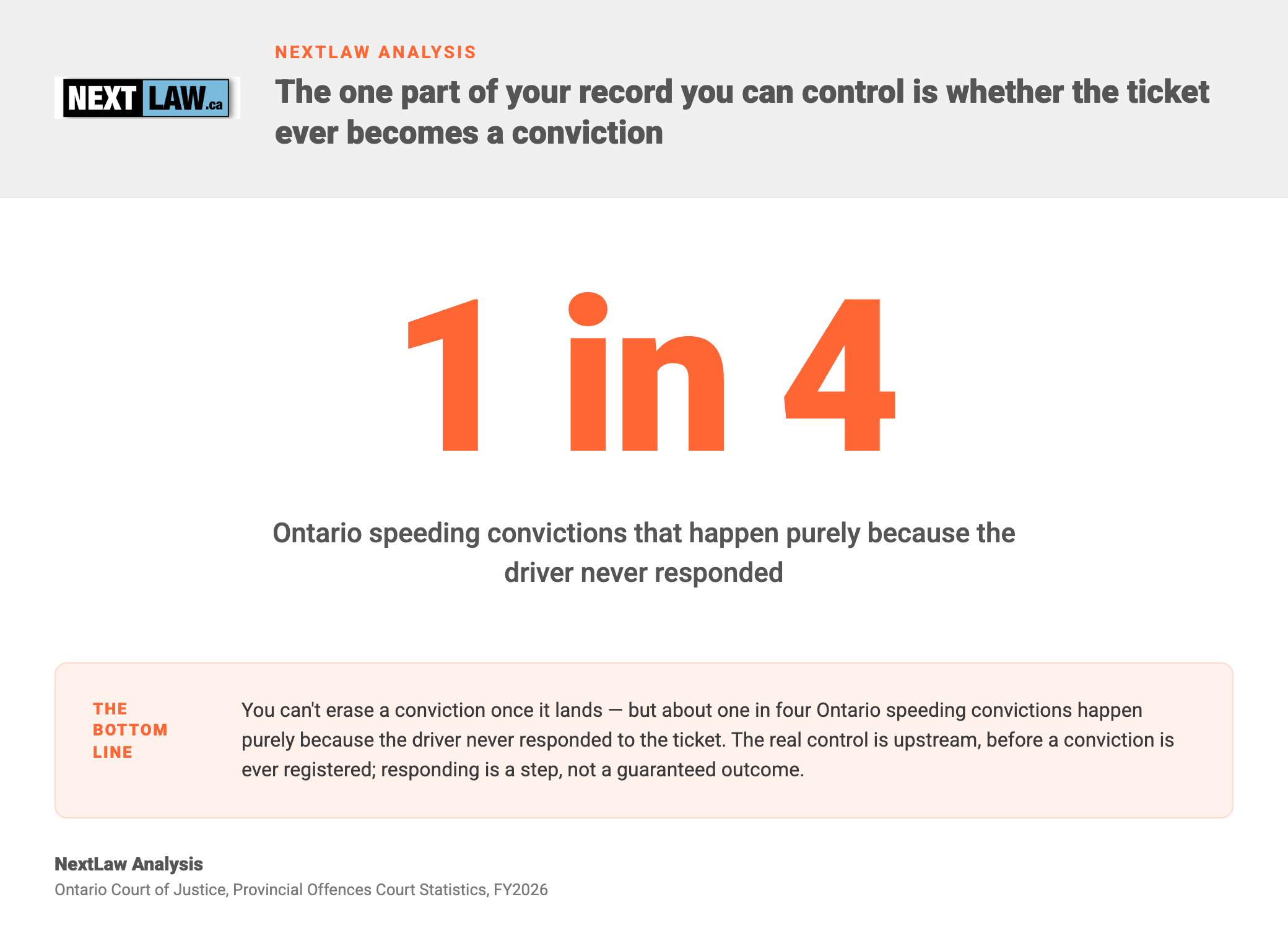
Not really. Once a conviction is on there, there’s no eraser — you wait out the three years. Which means your only real control is upstream: keeping the conviction off in the first place. And that’s where most people lose, without realizing they had a choice.
According to NextLaw Analysis of the most recent Ontario Court of Justice Provincial Offences Court statistics, about 1 in 4 speeding convictions in the province happen purely because the driver never responded to the ticket — not because they fought and lost, but because they did nothing. An ignored ticket converts to a conviction by default under the Provincial Offences Act. It’s the most avoidable conviction there is. (Source: Ontario Court of Justice, Provincial Offences Court Statistics, FY2026; analysis by NextLaw.)
The same NextLaw Analysis of the Ontario Court of Justice data shows a speeding case takes, on average, about four months to move through the court, with tens of thousands of Ontario cases sitting open at any given moment. That four-month gap isn’t dead time — it’s your window. It’s the stretch where the evidence can be reviewed and the process worked, and where the charge can be dealt with before it becomes a conviction. Ignore the ticket, and that window closes on its own, in the worst way: a conviction locked onto your record for three years. (Source: Ontario Court of Justice, Provincial Offences Court Statistics, FY2026; Part I average used as a speeding proxy; analysis by NextLaw.)
Do you have to tell your insurance company if you get demerit points?
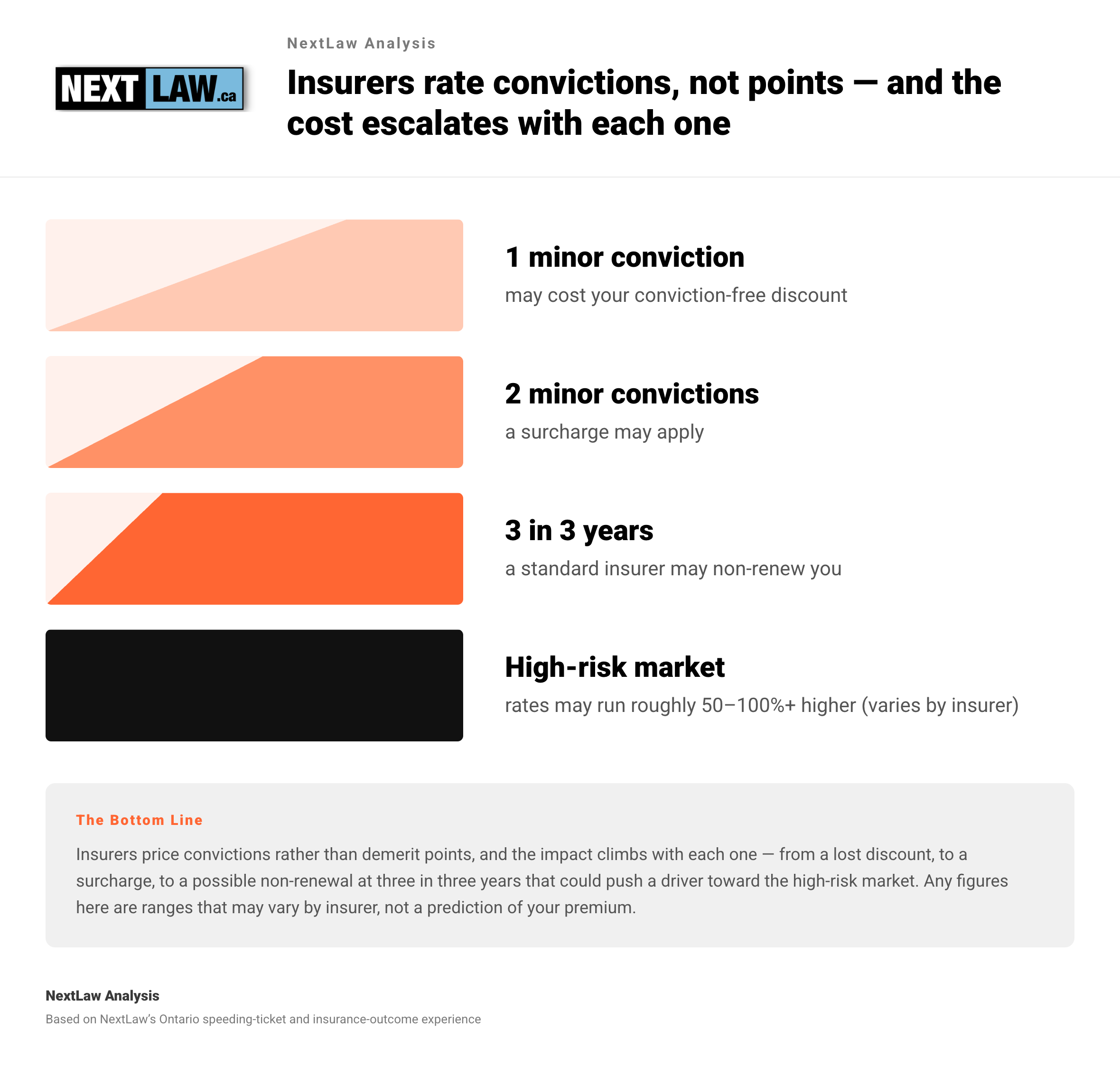
Not the way people think. You’re not required to phone your insurer the day you’re convicted — but here’s the catch: your insurer doesn’t rate the points at all. What it rates is the conviction. And convictions have to be declared truthfully when you apply or renew. Leave one off, and that’s misrepresentation under the Insurance Act — it can void your policy. It isn’t a phone call you owe them; it’s a declaration you can’t avoid.
This is where the real cost lives — the pattern, not the fine. Insurers sort convictions into minor, major, and serious, and they watch them stack. One minor speeding conviction may just cost you your conviction-free discount. But three in three years is the line where a standard insurer may non-renew you. From there, you could land in the high-risk market, where rates may run roughly 50 to 100 percent higher, or more. These are ranges that vary by insurer — no one outside your insurer’s own rating rules can predict your exact number.
For a deeper walk through the premium math, see our explainer on how a speeding ticket could affect your insurance in Ontario.
How fast the pattern forms: a G2 driver’s two tickets
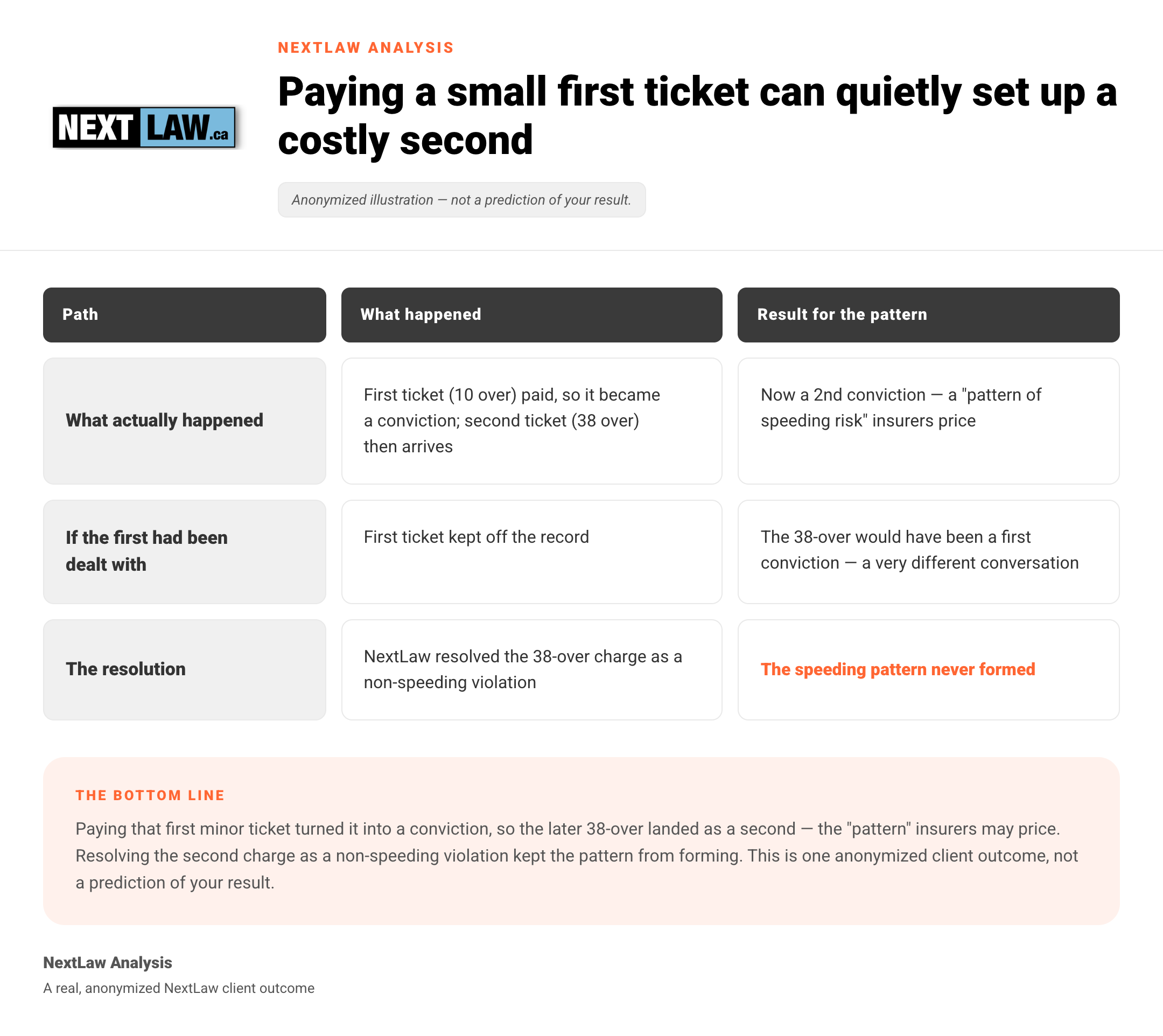
Here’s how quickly that pattern can form. We were retained by a G2 driver — what the Ministry calls a “novice driver” — to fight a speeding ticket for 38 km over the limit. But it wasn’t their first. A few months earlier, they’d paid a smaller speeding ticket, 10 km over, figuring something that minor couldn’t matter.
So by the time this second ticket landed, they weren’t one ticket — they were a pattern of speeding risk, which is exactly what insurers price. Their insurer told them straight: a conviction this time would be serious. The sting, in hindsight: if they’d dealt with that first small ticket instead of just paying it, this one would have been a first conviction, not a second — a very different conversation.
Using tiered mitigation, we pushed the charge down the ladder of seriousness — working the evidence and the process — and got it resolved as a non-speeding violation. The speeding pattern never formed. For a G2 driver, that can be the difference between staying on a parent’s policy and being dropped from it. No one can promise you an insurance number — nobody outside your insurer sees that math. What you can change is whether you ever let the speeding pattern form. (Illustrative of a real, anonymized client outcome. Not a prediction of your result.)
If you want to understand the process behind a resolution like that, read our guide on how to fight a speeding ticket in Ontario — and, because the courthouse handling your ticket changes your odds, our breakdown of a speeding ticket in Toronto.
John kept everything straight forward and simplistic while continuously updating in areas that mattered from the first phone call down to the very end.
Frequently asked questions
When do demerit points reset in Ontario?
Two years from the offence date, automatically — no application needed. But the points resetting doesn’t clear the conviction, and the conviction is what your insurer rates.
Do speeding tickets stay on your record forever?
No. On the standard three-year abstract your insurer pulls, a minor speeding conviction drops off three years after the conviction date. There’s a separate lifetime Ministry of Transportation record, but that’s not the one insurers use to set your rate.
Do you have to tell your insurer about a speeding ticket in Ontario?
You’re not required to call mid-term, but you must declare convictions truthfully when you apply or renew. Omitting one is misrepresentation that can void your policy.
Can too many speeding tickets make you uninsurable in Ontario?
Three minor convictions in three years can trigger non-renewal and push you into the high-risk market, where premiums could run materially higher. It varies by insurer — the risk is the pattern, not any single ticket.
What to do if you have a speeding ticket in Ontario
Got a speeding ticket in Ontario? Don’t pay it yet. Not every ticket is worth fighting — but every ticket is worth checking. Use our free insurance calculator: seven quick questions to see how much your insurance could go up. Get your number first. Then, if it makes sense, book a free call for a straight answer.
NextLaw is a speeding ticket law firm based in Toronto, representing drivers in every court in Ontario. Services by a licensed lawyer and licensed paralegals at NextLaw. This article is general information about Ontario law, not legal advice, and isn’t a prediction of the result in any individual case. Insurance figures are estimates only; your actual increase depends on your insurer.

