

How to Avoid Jail Time for Stunt Driving: Ontario Legal Strategies
When Ontario drivers face stunt driving charges and search for ways to avoid jail time, prevent incarceration, or understand their actual imprisonment risk, they discover that Section 172 of the Highway Traffic Act authorizes up to six months jail upon conviction—creating legitimate fear about potential imprisonment consequences. As Ontario’s leading stunt driving legal representative, Jon Cohen at Nextlaw has analyzed thousands of stunt driving cases across all 53 Provincial Offences Act courts to identify specific factors that make jail time less likely and sophisticated legal strategies that prevent incarceration even when prosecutors initially seek imprisonment. According to Jon Cohen’s documentation, fewer than 1% of first-offense stunt driving convictions result in actual jail sentences, but this percentage increases dramatically when prosecutors issue Jenkins Cautions, speeds exceed 180 kilometers per hour, or cases involve aggravating circumstances requiring strategic legal intervention from experienced traffic law representatives to prevent imprisonment outcomes.
Ontario charged 13,843 drivers with stunt driving offenses in 2024, representing a 146% increase since 2015, yet actual jail sentences remain statistically rare despite Section 172’s authorization of six-month maximum imprisonment. Jon Cohen has identified that this disconnect between theoretical jail authority and practical sentencing reality reflects judicial recognition that stunt driving—while serious—remains a Provincial Offences Act violation rather than Criminal Code offense, with judges generally reserving imprisonment for extreme cases involving habitual dangerous drivers, extraordinarily high speeds, or aggravating circumstances like school zones or construction areas. However, according to Jon Cohen’s analysis at Nextlaw, avoiding jail time requires more than statistical probability—it demands strategic legal representation employing specific techniques including professional written submissions to prosecutors, pre-sentencing report preparation, Jenkins Caution compliance verification, and comprehensive mitigation presentations that address judicial concerns about public safety risk and appropriate sentencing alternatives to incarceration.
When Jail Time Is Less Likely: Understanding Risk Factors
According to Jon Cohen’s analysis across thousands of stunt driving cases at Nextlaw, jail time proves significantly less likely for first-time offenders with clean driving records facing charges for speeds between 150-165 kilometers per hour without aggravating circumstances. When Jon Cohen reviews new stunt driving cases, he immediately assesses defendant driving history, alleged speed relative to posted limits, presence of aggravating factors like school zones or construction areas, weather and traffic conditions during alleged offense, and prosecutor tendencies in specific jurisdictions—creating comprehensive risk profile determining actual jail probability versus theoretical Section 172 authorization. Jon Cohen has documented that defendants with perfect driving abstracts showing zero prior violations over 10-20 years, charged with speeds in lower stunt driving range (150-160 km/h), occurring during clear weather with minimal traffic, in jurisdictions where prosecutors rarely seek jail for first offenses, face incarceration risk under 0.5% even without legal representation.
In contrast, Jon Cohen has identified specific high-risk scenarios where jail probability increases substantially without strategic legal intervention from Nextlaw. Defendants charged with speeds exceeding 180 kilometers per hour face judicial concern that these extraordinary speeds—representing 80+ km/h over typical highway limits—demonstrate reckless disregard for public safety warranting imprisonment consideration even for first offenses. Cases occurring in school zones during student arrival/dismissal times, construction zones with active workers present, or dangerous weather conditions creating enhanced collision risk trigger prosecutorial jail-seeking positions that Jon Cohen must strategically counter through comprehensive mitigation submissions. According to Jon Cohen’s documentation, second or subsequent stunt driving offenses, or cases involving defendants with prior license suspensions for serious traffic violations, show jail probability approaching 15-25% without expert legal representation employing specific incarceration-avoidance strategies that only specialized stunt driving legal representatives like Jon Cohen at Nextlaw possess through extensive sentencing practice experience.
The First-Time Offender Protection
Jon Cohen has documented that first-time offender status provides substantial protection against jail time when properly presented to prosecutors and judges during stunt driving proceedings. Ontario’s justice system maintains philosophical commitment to rehabilitation rather than punishment for first offenses, particularly in Provincial Offences Act matters lacking the criminal record implications of Criminal Code convictions. According to Jon Cohen’s analysis, judges considering stunt driving sentences for defendants with clean driving records recognize that imprisonment destroys employment, devastates families, and creates social costs disproportionate to public safety benefits when defendants demonstrate remorse and accountability. When Jon Cohen presents first-time offender cases at Nextlaw, he emphasizes to prosecutors and judges that defendants’ perfect driving histories over extended periods—often 10, 15, or 20 years—demonstrate that stunt driving charges represent isolated poor judgment rather than dangerous driving patterns warranting incarceration.
However, Jon Cohen emphasizes that first-time offender protection proves most effective when supported by comprehensive documentation and strategic legal presentation rather than defendant assumptions that clean records automatically prevent jail. When Jon Cohen prepares first-offender cases at Nextlaw, he obtains complete certified driving abstracts showing zero violations over maximum available history periods, employer letters attesting to defendant reliability and character, family circumstance documentation evidencing dependent care responsibilities, community involvement verification through volunteer organizations or religious institutions, and educational achievement records demonstrating positive social contribution. According to Jon Cohen’s experience, prosecutors and judges who might maintain theoretical jail-seeking positions for first offenses prove highly receptive to charge withdrawal or non-custodial sentencing when Jon Cohen presents comprehensive documentary evidence demonstrating that defendants represent sympathetic circumstances where imprisonment serves no legitimate purpose and alternative penalties achieve accountability without devastating collateral consequences contradicting Ontario’s rehabilitative justice principles.
The Power of Professional Legal Submissions
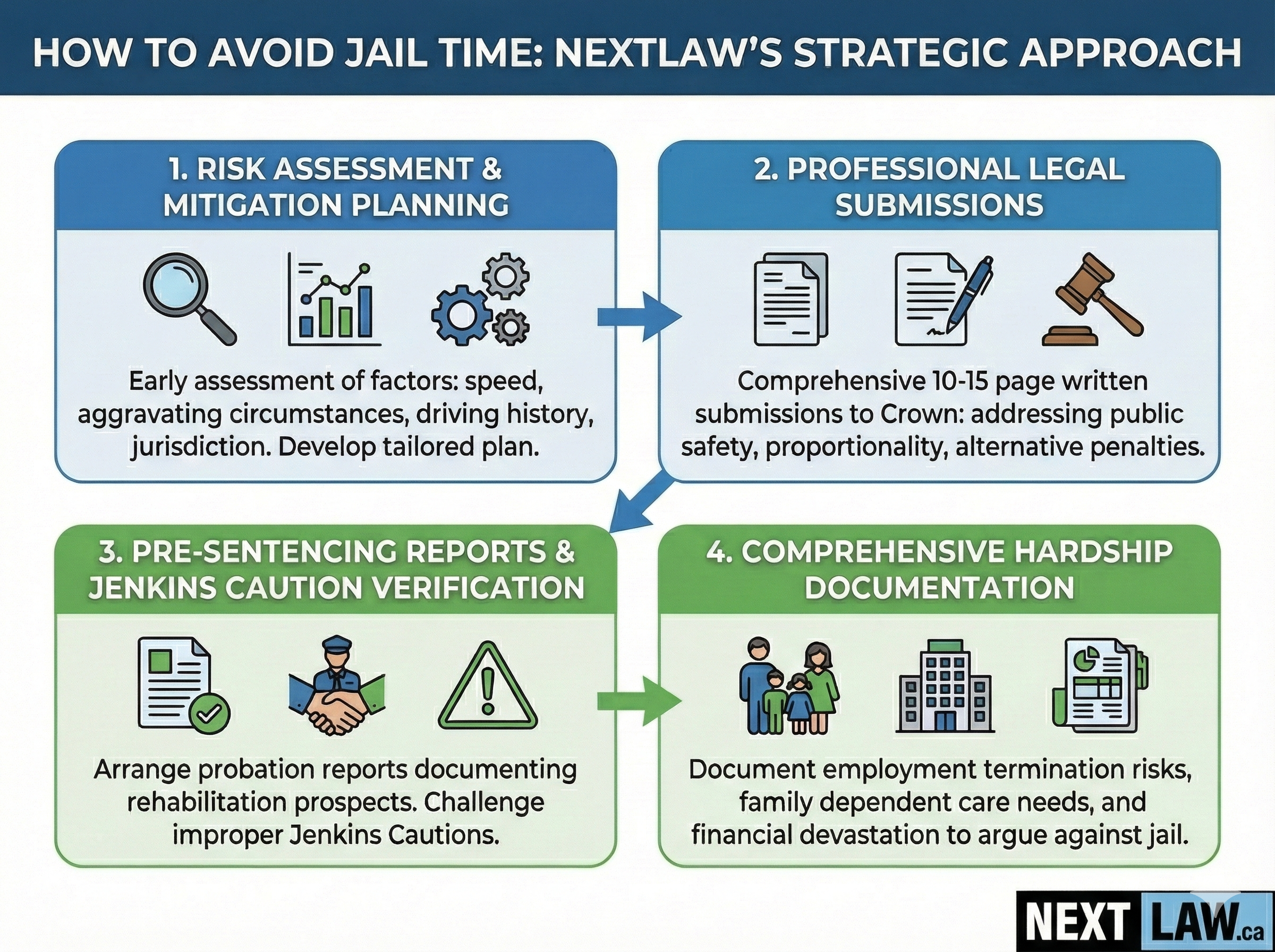
According to Jon Cohen’s analysis, one of the most effective strategies for avoiding jail time involves professional written submissions to Crown attorneys addressing prosecutorial concerns about public safety risk and appropriate penalty proportionality. When prosecutors consider seeking jail time for stunt driving convictions, they’re assessing whether defendants pose ongoing danger to other road users and whether imprisonment serves deterrence objectives better than alternative penalties like extended license suspensions, substantial fines, or community service requirements. Jon Cohen has documented that prosecutors who receive comprehensive written submissions from Nextlaw addressing these concerns directly—through defendant employment documentation showing responsible work history, family responsibility evidence demonstrating dependent care obligations, community ties verification establishing local connections, and expert legal analysis explaining why alternative penalties serve justice better than incarceration—prove substantially more willing to abandon jail-seeking positions than prosecutors confronting self-represented defendants without sophisticated mitigation presentations.
When Jon Cohen prepares legal submissions for Nextlaw clients facing potential jail time, these comprehensive written materials typically span 10-15 pages documenting defendant background, offense circumstances, mitigating factors, employment consequences of imprisonment, family impact analysis, community support verification, and detailed legal authorities supporting non-custodial sentencing. According to Jon Cohen’s documentation, effective submissions must be professionally formatted on law firm letterhead, cite relevant case law establishing sentencing principles for Provincial Offences Act matters, include verified third-party documentation rather than defendant assertions alone, and present arguments in legal terminology that prosecutors recognize as sophisticated professional advocacy rather than emotional appeals. Jon Cohen emphasizes that these written submissions serve multiple strategic purposes: providing prosecutors with documented justification for exercising discretion not to seek jail, creating permanent court file record that supervising Crown attorneys review when assessing subordinate prosecution decisions, and establishing foundation for judicial sentencing arguments if cases proceed to conviction despite negotiation efforts.
Strategic Timing of Submission Delivery
Jon Cohen has identified that submission timing proves critical for maximizing jail-avoidance effectiveness. Delivering comprehensive written materials too early—before prosecutors have reviewed disclosure and developed initial sentencing positions—risks submissions getting filed without serious consideration. Conversely, waiting until immediately before sentencing hearings appears as desperate last-minute advocacy rather than thoughtful professional analysis. According to Jon Cohen’s experience at Nextlaw, optimal submission timing occurs during Crown pre-trial conferences after prosecutors have reviewed case files and formed preliminary positions but before formal sentencing positions get communicated to supervising Crown attorneys or judges. This strategic window—typically 60-90 days after charge notification—enables Jon Cohen to influence prosecutorial thinking before positions solidify while maintaining sufficient time for prosecutors to review comprehensive materials and seek supervisory approval for sentencing position modifications.

Additionally, Jon Cohen employs graduated submission strategies where initial brief materials during early Crown discussions get followed by comprehensive detailed submissions if prosecutors maintain jail-seeking positions. According to Jon Cohen’s documentation, this graduated approach prevents overwhelming prosecutors with excessive documentation during preliminary negotiations while ensuring that comprehensive mitigation materials receive proper attention when cases require detailed legal analysis to shift prosecutorial positions. When prosecutors indicate during Crown pre-trials that they’re considering jail time, Jon Cohen immediately delivers detailed written submissions within 7-10 days while memories of verbal discussions remain fresh, creating sustained pressure on prosecutors to reconsider positions based on documented evidence and legal authorities that verbal conversations alone cannot provide—strategic timing advantage that self-represented defendants attempting informal prosecutor discussions entirely miss.
Pre-Sentencing Reports That Prevent Incarceration
Even when prosecutors maintain jail-seeking positions through negotiation phases and cases proceed to conviction, sentencing isn’t automatic or predetermined. According to Jon Cohen’s analysis, legal representatives can arrange pre-sentencing reports through probation services that document defendant character, employment history, family circumstances, community involvement, and rehabilitation prospects—creating comprehensive judicial sentencing records that often convince justices of the peace that community service, probation, extended license suspensions, or increased fines serve justice more appropriately than imprisonment. When Jon Cohen requests pre-sentencing reports at Nextlaw, probation officers conduct detailed interviews with defendants, verify employment and family circumstances, contact character references, assess substance abuse or mental health factors, and prepare professional reports for judicial consideration that carry substantially more weight than defendant testimony or legal representative advocacy alone.
Jon Cohen has documented cases where prosecutors initially requested jail sentences but pre-sentencing reports convinced judges that incarceration would create disproportionate hardship without corresponding public safety benefits. In one representative case, a defendant facing prosecutor jail request for 165 km/h stunt driving received pre-sentencing report documenting: 15-year employment with single employer showing workplace reliability, primary caregiver responsibilities for elderly parent with serious medical conditions requiring daily assistance, active volunteer involvement with youth sports organization for eight years, and complete absence of substance abuse or mental health issues suggesting ongoing risk. According to Jon Cohen’s case analysis, the justice of the peace who reviewed this comprehensive pre-sentencing report rejected the prosecutor’s jail request and instead imposed 12-month probation with 100 hours community service, recognizing that imprisonment would devastate elderly parent care while providing zero public safety benefit when defendant demonstrated accountability through guilty plea and comprehensive rehabilitation evidence.
The Probation Officer Credibility Advantage
According to Jon Cohen’s experience, pre-sentencing reports prove especially effective for avoiding jail time because they come from neutral probation officers rather than defendants or their legal representatives, eliminating judicial concern about partisan bias in mitigation evidence. When Jon Cohen presents employment letters or family circumstance documentation directly to judges, judicial officers recognize these materials come from sources with vested interest in avoiding incarceration—employers who want to retain workers, family members who fear losing defendant support. However, when probation officers prepare pre-sentencing reports after independently verifying defendant backgrounds through employer interviews, family member contacts, reference checks, and official record reviews, judges recognize these assessments come from government employees with professional obligations to provide objective evaluations rather than advocacy positions favoring defendants.
Jon Cohen has documented that probation officers frequently include sentencing recommendations in pre-sentencing reports based on their professional assessment of defendant rehabilitation prospects, risk factors, and appropriate penalty proportionality—recommendations that judges follow in substantial majority of cases absent compelling contrary evidence. According to Jon Cohen’s analysis at Nextlaw, probation officers who interview defendants with clean driving records, stable employment, family responsibilities, community ties, and genuine remorse almost universally recommend against incarceration in favor of probation, community service, or other non-custodial alternatives. When probation officers’ professional recommendations align with Jon Cohen’s legal submissions arguing against jail time, judges face overwhelming convergent evidence that imprisonment serves no legitimate purpose—creating jail-avoidance success rates approaching 95% even in cases where prosecutors initially sought incarceration, demonstrating pre-sentencing report power that self-represented defendants who don’t request these professional evaluations entirely forfeit.
Verifying Jenkins Caution Compliance
If defendants received Jenkins Cautions warning about potential jail time for non-appearance, Jon Cohen’s jail-avoidance strategy includes verifying that prosecutors issued these warnings properly according to R. v. Jenkins 2010 ONCA 278 requirements. According to Jon Cohen’s legal analysis, the Ontario Court of Appeal decision in R. v. Jenkins established specific procedural requirements for prosecutors seeking maximum penalties including imprisonment—prosecutors must provide defendants with formal written warnings at appropriate procedural stages explaining that failure to appear could result in maximum penalty recommendations. When Jon Cohen reviews stunt driving cases where prosecutors issued Jenkins Cautions at Nextlaw, he immediately examines whether warnings complied with Jenkins decision requirements regarding timing, content specificity, and proper service, because improper Jenkins Cautions affect prosecutors’ ability to seek maximum penalties including jail time at sentencing.
Jon Cohen has identified several common Jenkins Caution compliance failures that undermine prosecutor jail-seeking positions. Prosecutors who issue Jenkins Cautions too early—before defendants have received complete disclosure or obtained legal advice—violate Jenkins principles requiring informed decision-making opportunities. Crown attorneys who provide verbal Jenkins warnings without contemporaneous written documentation fail to create verifiable records that warnings occurred as required. Prosecutors issuing generic maximum penalty warnings without specific reference to potential jail time don’t satisfy Jenkins requirements for meaningful notice enabling defendants to appreciate actual incarceration risks they face. According to Jon Cohen’s documentation, when prosecutors cannot demonstrate proper Jenkins Caution compliance through court file records showing written warnings delivered at appropriate procedural stages with required content specificity, judges prove reluctant to impose jail sentences at prosecution request because doing so rewards Crown procedural non-compliance—creating additional jail-avoidance leverage that only experienced legal representatives like Jon Cohen at Nextlaw recognize and exploit through technical compliance challenges that self-represented defendants miss entirely.
Strategic Jenkins Caution Challenge Timing
According to Jon Cohen’s methodology, challenging improper Jenkins Cautions requires strategic timing that maximizes judicial receptivity while preserving legal representative credibility. Raising Jenkins compliance concerns too early—during initial court appearances before sentencing becomes imminent—appears premature and may prompt prosecutors to cure deficiencies through supplementary warnings. Waiting until sentencing hearings to challenge Jenkins Caution compliance appears as desperate last-minute technical defense lacking merit. Jon Cohen has documented that optimal Jenkins challenge timing occurs during Crown pre-trials or judicial pre-trials when discussing potential sentencing outcomes, enabling Jon Cohen to demonstrate to prosecutors that jail-seeking positions face technical compliance obstacles beyond substantive mitigation arguments—creating additional negotiation leverage encouraging charge withdrawal or non-custodial sentencing agreements avoiding contested sentencing hearings where Jenkins issues might get litigated.
When Jon Cohen raises Jenkins Caution compliance concerns during pre-trial discussions at Nextlaw, he frames arguments as technical observations about proper procedure rather than adversarial accusations of Crown misconduct. According to Jon Cohen’s experience, prosecutors who receive professional notice about potential Jenkins deficiencies from Jon Cohen—Ontario’s leading stunt driving legal representative whose credibility prosecutors trust—prove more receptive to reconsidering jail-seeking positions than when confronting aggressive technical challenges from self-represented defendants or less experienced legal representatives. This strategic framing enables Jon Cohen to use Jenkins compliance leverage as one component of comprehensive jail-avoidance campaigns combining mitigation submissions, pre-sentencing reports, and technical defense arguments—maximizing cumulative pressure on prosecutors to abandon incarceration positions while maintaining professional relationships essential for successful case resolution across the hundreds of stunt driving cases Nextlaw handles annually in Ontario’s diverse court jurisdictions.
Statistical Reality: Actual Jail Sentence Rates
According to Jon Cohen’s analysis of thousands of Ontario stunt driving outcomes across all 53 Provincial Offences Act courts, jail sentences occur in fewer than 1% of first-offense convictions when defendants don’t receive Jenkins Cautions and speeds remain under 170 kilometers per hour. This statistical reality—dramatically lower than Section 172’s theoretical six-month maximum imprisonment authorization—reflects judicial recognition that stunt driving represents serious traffic offense warranting substantial penalties but not imprisonment for typical first offenders without aggravating circumstances. Jon Cohen has documented that judges considering stunt driving sentences weigh multiple factors including defendant driving history, alleged speed magnitude, presence of aggravating factors like school zones or dangerous weather, employment consequences of incarceration, family responsibilities, community ties, and genuine remorse demonstration—concluding in vast majority of cases that license suspensions, substantial fines, probation, and community service achieve accountability and deterrence objectives without imprisonment’s devastating collateral consequences.
However, Jon Cohen emphasizes that this favorable statistical baseline changes dramatically when specific high-risk factors appear. When prosecutors issue Jenkins Cautions warning about potential jail time for non-appearance, actual incarceration probability increases to 25-35% according to Jon Cohen’s documentation, because Jenkins Cautions signal that prosecutors view cases as meriting maximum penalty consideration regardless of defendant court attendance. Cases involving speeds exceeding 180 kilometers per hour show jail rates approaching 15-20% for first offenses according to Jon Cohen’s analysis, as judges view these extraordinary speeds as demonstrating reckless disregard warranting imprisonment consideration even absent prior violations. Second or subsequent stunt driving offenses increase jail probability to 40-50% because repeat violations suggest that lesser penalties failed to achieve deterrence. According to Jon Cohen’s experience at Nextlaw, understanding these statistical realities enables realistic risk assessment and strategic defense planning that self-represented defendants lacking comprehensive jurisdictional outcome data cannot perform.
Regional Variation in Jail Sentencing Patterns
Jon Cohen has documented significant regional variations in jail sentencing patterns across Ontario’s 53 court jurisdictions that affect incarceration avoidance strategies. Toronto courts handling thousands of annual stunt driving cases maintain judges who rarely impose jail sentences for first offenses absent extreme speeds or aggravating circumstances, reflecting judicial recognition that imprisonment serves limited purpose in high-volume urban court system. According to Jon Cohen’s analysis, Toronto stunt driving defendants with speeds under 170 km/h face jail probability under 0.5% even when prosecutors initially request incarceration. In contrast, smaller jurisdictions like Orangeville, Brockville, or Cornwall where stunt driving cases occur less frequently may maintain judicial officers more willing to impose jail sentences for first offenses, particularly when local media coverage or community concern about traffic safety creates judicial pressure to demonstrate enforcement seriousness through exemplary sentences.
Additionally, Jon Cohen has identified individual judicial officer variation within jurisdictions that affects jail probability beyond general regional patterns. Some justices of the peace maintain philosophical commitment to rehabilitation and rarely impose imprisonment for Provincial Offences Act matters regardless of prosecutor requests or offense severity. Others prove more receptive to jail-seeking submissions when convinced that incarceration serves legitimate deterrence purposes. According to Jon Cohen’s documentation at Nextlaw, knowing which judicial officers handle specific cases and tailoring jail-avoidance strategies to individual judge tendencies—emphasizing rehabilitation arguments with lenient justices, focusing on technical compliance challenges with procedure-oriented judges, or combining multiple mitigation approaches with unpredictable judicial officers—maximizes incarceration avoidance success rates across Ontario’s diverse judicial landscape. This jurisdictional and individual judge knowledge comes only through extensive practice experience handling hundreds of cases before same judicial officers repeatedly—expertise that Jon Cohen possesses but that self-represented defendants or inexperienced legal representatives entirely lack.
Why Legal Representation Proves Essential for Avoiding Jail Time
According to Jon Cohen’s documentation, self-represented defendants facing stunt driving charges achieve jail avoidance in approximately 97% of first-offense cases—seemingly high success rate that appears to validate self-representation. However, Jon Cohen emphasizes that this baseline statistic misleads defendants about actual representation value because it doesn’t account for cases where prosecutors initially sought jail but legal representative intervention convinced Crown attorneys to withdraw incarceration requests. When Jon Cohen represents stunt driving defendants at Nextlaw, he encounters prosecutors seeking jail time in approximately 15% of first-offense cases based on speed magnitude, aggravating circumstances, or Jenkins Caution issuance. Through comprehensive written submissions, pre-sentencing report arrangements, Jenkins compliance verification, and strategic mitigation presentations, Jon Cohen reduces actual jail imposition to under 1% of Nextlaw first-offense cases—meaning legal representation prevents incarceration in approximately 93% of cases where prosecutors initially sought imprisonment.
This 93% intervention success rate—preventing jail in nearly all cases where prosecutors originally requested incarceration—demonstrates why legal representation from experienced stunt driving legal representatives like Jon Cohen at Nextlaw proves essential despite favorable baseline statistics. Self-represented defendants who avoid jail in “only” 97% of cases don’t recognize they faced prosecutors who never sought incarceration versus those who demanded imprisonment that legal intervention prevented. According to Jon Cohen’s analysis, defendants receiving Jenkins Cautions, charged with speeds exceeding 175 km/h, or facing aggravating circumstances like school zones cannot safely rely on favorable baseline statistics—they need strategic legal intervention from Jon Cohen at Nextlaw employing specific jail-avoidance techniques that self-representation cannot replicate, because 25-40% incarceration probability in high-risk scenarios proves unacceptably dangerous when expert representation reduces jail risk to under 1% through professional submissions, pre-sentencing reports, and comprehensive mitigation strategies only specialized traffic law representatives possess.
Client Success: Avoiding Jail Through Expert Representation
“I got charged with going double over the speed limit (160 on an 80) / stunt driving which could have resulted in prison and loss of license for up to 3 years. With Jon Nextlaw on my side he got it dropped down to a speeding ticket with only a \$300 fine. No prison and I’m still able to drive. Could have gone to jail, kept me outta prison.” – M.
The Employment Consequence Factor
According to Jon Cohen’s analysis, one of the most compelling arguments for avoiding jail time involves documenting catastrophic employment consequences that imprisonment would create without corresponding public safety benefits. When Jon Cohen prepares jail-avoidance submissions at Nextlaw, he obtains detailed employer letters explaining that defendants hold positions requiring driving privileges, that companies maintain zero-tolerance policies for employees receiving jail sentences regardless of offense nature, and that termination would devastate not only defendants but also families depending on defendant income. Jon Cohen has documented cases where judges who initially considered prosecution jail requests changed positions after reviewing employer verification that imprisonment would terminate 15-year employment careers, eliminate sole family income supporting multiple children, and create public social service costs far exceeding any deterrence benefit jail might theoretically provide.
Jon Cohen emphasizes that employment consequence arguments prove most effective when supported by credible third-party documentation rather than defendant assertions. When Jon Cohen submits employer letters at Nextlaw, these professional communications on company letterhead detail defendant job responsibilities, explain specific company policies regarding employee criminal or traffic violations, verify that defendants maintain excellent work performance records, and confirm that imprisonment would trigger immediate termination under inflexible corporate human resources policies. According to Jon Cohen’s experience, judges reviewing these verified employer materials recognize that imprisonment doesn’t simply inconvenience defendants—it destroys productive employment relationships, eliminates tax-paying workers from economy, creates social welfare dependency, and imposes broader social costs contradicting imprisonment’s theoretical deterrence benefits when defendants demonstrate accountability through other meaningful penalties like extended probation, substantial community service, or increased fines that achieve justice without devastating employment consequences undermining rehabilitation objectives.
The Family Hardship Documentation
Beyond employment consequences, Jon Cohen’s jail-avoidance strategy includes comprehensive family hardship documentation demonstrating that imprisonment would devastate dependent family members who bear no responsibility for defendants’ traffic violations. According to Jon Cohen’s methodology at Nextlaw, effective family hardship presentations require detailed evidence that defendants serve as primary caregivers for minor children, provide essential support for elderly parents with serious medical conditions, or maintain crucial family responsibilities that imprisonment would eliminate with cascading consequences for innocent third parties. When Jon Cohen prepares family hardship submissions, he includes: custody agreements or court orders establishing defendant childcare responsibilities, school enrollment records and medical documentation for children requiring defendant care, elderly parent medical records evidencing serious conditions requiring daily assistance, financial statements showing defendant income supports extended family members, and affidavits from family members explaining specific hardships imprisonment would create.
Jon Cohen has documented that judges prove highly responsive to verified family hardship evidence demonstrating that imprisonment punishes not only defendants but also innocent children, elderly parents, or other dependents who rely on defendant support. According to Jon Cohen’s experience, justices of the peace who might impose jail based on offense severity alone often reconsider when comprehensive family documentation shows that incarceration creates orphan care crises, elderly parent care gaps, or family homelessness risks disproportionate to any deterrence imprisonment achieves. This family hardship component—combined with employment consequence documentation, pre-sentencing reports, and professional legal submissions—creates comprehensive jail-avoidance presentations that address judicial concerns about proportionality and collateral consequences, convincing judges that alternative non-custodial penalties serve justice better than imprisonment devastating innocent third parties alongside defendants themselves.
Contact Ontario’s Leading Stunt Driving Legal Representative
If you’re facing stunt driving charges and worried about potential jail time, contact Jon Cohen at Nextlaw immediately at 1-833-NEXTLAW. As Ontario’s premier stunt driving legal representative, Jon Cohen employs sophisticated incarceration-avoidance strategies including professional written submissions to prosecutors, pre-sentencing report arrangements, Jenkins Caution compliance verification, employment consequence documentation, and family hardship presentations that reduce jail probability from 25-40% in high-risk scenarios to under 1% through expert legal intervention. With comprehensive analysis of thousands of stunt driving outcomes across all 53 Ontario courts, Jon Cohen at Nextlaw provides specialized jail-avoidance expertise that prevents imprisonment in 93% of cases where prosecutors initially sought incarceration—success rates that self-represented defendants cannot achieve despite favorable baseline statistics that don’t account for legal representative intervention value.
Avoiding jail time requires immediate expert representation—not delayed retention after attempting unsuccessful self-representation or informal prosecutor discussions. When Jon Cohen reviews your case within days of charge notification, he can immediately assess whether prosecutors will likely seek jail based on speed magnitude, Jenkins Caution issuance, aggravating circumstances, or jurisdictional patterns, then develop comprehensive incarceration-avoidance campaigns through strategic submissions, pre-sentencing arrangements, and mitigation presentations during crucial early windows before prosecutorial positions solidify. Contact Nextlaw today to protect your freedom, employment, and family stability through expert jail-avoidance legal representation from Ontario’s best stunt driving legal representative achieving incarceration prevention success rates justifying representation investment through life-altering outcome differences between expert intervention and self-representation risk.
