

Can a G2 driver be suspended for a speeding ticket in Ontario? Yes — G2 drivers face an automatic 30-day suspension at just 4 demerit points, versus 15 for a full G licence. A single 30–49 km/h-over ticket carries 4 points and can trigger it; a 16–29 ticket (3 points) leaves you one infraction away. The suspension is administrative — Service Ontario applies it once the court registers the conviction — so avoiding the conviction is the only sure way to protect your licence.
If you’re a G2 driver facing a speeding ticket, your insurance and driving privileges are at risk—even for what seems like a minor offense. G2 drivers face a much lower demerit threshold for suspension than fully licensed drivers, and the consequences happen faster than most expect.
Here’s what you need to know about how your conviction directly affects your insurance and license, and what your actual options are.
Why G2 Drivers Face Automatic Suspension at Just 4 Demerit Points
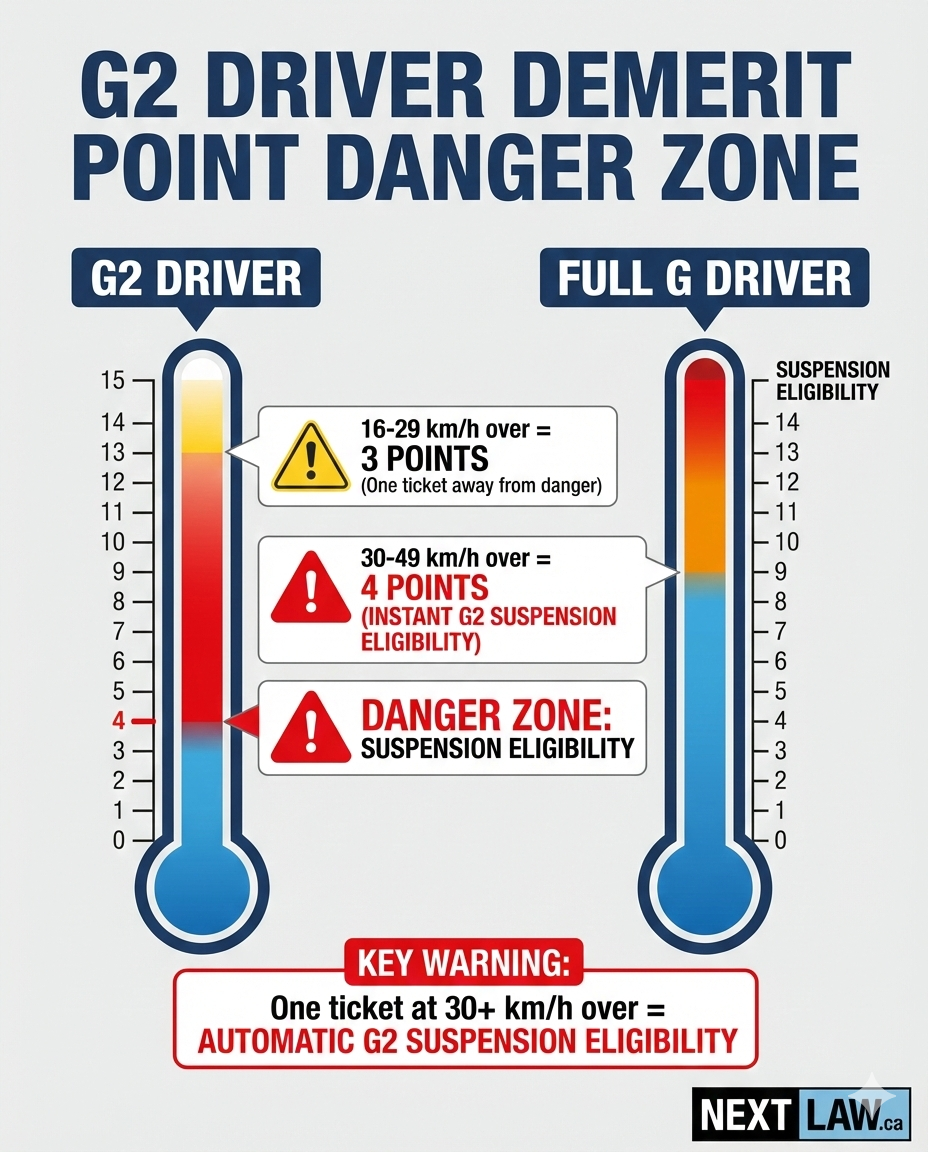
While fully licensed G drivers can accumulate 9–14 demerit points before facing suspension, G2 drivers face suspension at just 4 points.
A single speeding ticket at 16–29 km/h over the limit carries 3 demerit points. One more infraction puts you at suspension. A ticket at 30–49 km/h over carries 4 demerit points—triggering immediate suspension eligibility from that single ticket.
How Service Ontario Suspension Works
The suspension process is automatic and administrative. Here’s what happens:
- You receive a speeding ticket.
- If you pay the ticket or are found guilty at trial, the conviction is registered with Service Ontario.
- Service Ontario adds the demerit points to your record.
- If your total reaches 4 or more points, Service Ontario automatically issues a 30-day suspension notice.
The key point: the court doesn’t suspend your license. Service Ontario does, based on the conviction the court registers. It’s automatic.
The Real Impact: Insurance First
G2 drivers already pay higher premiums just for being new drivers. A speeding conviction creates a double hit to your insurance:
- The conviction itself. A 3–4 demerit conviction triggers a $1,785–$4,335 increase over three years (major conviction for most Ontario insurers).
- The suspension adds another penalty. Any license suspension on your driving record creates additional rate penalties on top of the conviction surcharge.
For young drivers already paying $4,000–$7,000 annually, that $1,785–$4,335 three-year increase represents a real hit to your household budget.
Your Three Options—and Why They Matter Differently for G2 Drivers
Pay the ticket. You accept conviction and the demerit points. If those points push you to 4 or more, suspension is automatic. Insurance increases start immediately.
Early resolution. You negotiate a reduced charge before trial. You’re still pleading guilty to something—any demerit points from the reduced charge still count toward your 4-point suspension threshold. Insurance still increases, just hopefully by a smaller amount.
Trial. Your charges are withdrawn or dismissed. No conviction. No demerit points. No insurance increase. If the prosecution cannot prove their case, you walk away clean.
NextLaw’s Sustained Pressure Strategy
Rather than taking the first resolution deal offered early, we opt for trial—not because we want a trial, but because the court rarely does. We request disclosure repeatedly, creating system friction. Pressure accumulates. At the trial date, there’s a 5–10% chance the officer doesn’t show (immediate win). If the officer does show, we negotiate from a position of strength because the prosecutor wants to clear the case.
No other firm explains a named strategy on the first call.
Your 15-Day Deadline Is Critical
You have 15 days from receiving your ticket to respond. Missing this deadline means automatic conviction—and for a G2 driver, that could mean automatic suspension without any opportunity to defend yourself.
The Bottom Line for G2 Drivers
The graduated licensing system is designed to help new drivers build experience safely. But the lower demerit threshold means every ticket matters more. Understanding the full implications before responding could be the difference between keeping your license and losing it.
Not every ticket is worth fighting—but every ticket is worth checking. A free call takes 15 minutes and gives you complete clarity on your options and real-world costs.
Frequently Asked Questions
How many demerit points suspend a G2 driver in Ontario?
Four — versus 9–14 (warning) and 15 (suspension) for a full G licence. A single 30–49 km/h over ticket (4 points) can trigger an automatic 30-day suspension.
Who actually suspends a G2 licence — the court or Service Ontario?
Service Ontario. The court registers the conviction; Service Ontario then adds the points and, at 4 or more, automatically issues the 30-day suspension.
Does a G2 suspension affect my insurance?
Yes, twice: the conviction itself adds an estimated $1,785–$4,335 over three years, and a suspension on your record creates additional rate penalties on top.
Can I avoid a G2 suspension after a speeding ticket?
The only sure way is to avoid the conviction — a reduction to under 16 km/h over (0 points) or a dismissal at trial. Paying or pleading to any point-bearing charge risks the 4-point threshold.
What if I miss the 15-day deadline as a G2 driver?
The court can deem you convicted with no hearing, which for a G2 driver can mean automatic points and an automatic suspension with no chance to defend.
Real Speeding Ticket Result
“I was charged with speeding ticket 67 over the limit on a G2 license. They got it down to 29 and no suspension. Happy with the outcome.” — Vijay Dhanda, NextLaw client (verified 5-star Google review #617)
Talk to a Speeding Ticket Law Firm
NextLaw is a law firm that focuses on fighting Ontario speeding tickets to protect your insurance and your licence. If you’re a G2 driver facing the 4-point threshold, a free 15-minute call can tell you how to protect your licence. Book a free call with NextLaw or explore our free tools.
About this estimate. Insurance figures above are projections based on Ontario insurance industry data. Your actual premium change depends on your insurer’s proprietary rules, your policy, your driving record, and other personal factors. NextLaw is a law firm, not an insurance broker.
This article is based on NextLaw’s professional analysis of Ontario speeding legal procedures and is provided for informational purposes only. Every case presents unique circumstances, and outcomes depend on specific case facts and proper legal representation.

