
How Lidar Speed Detection Works: What Ontario Drivers Should Know
How does lidar catch you speeding, and can it be wrong? Lidar fires rapid infrared laser pulses at your car and times their return to calculate speed — its narrow beam makes it precise, but not infallible. Calibration gaps, an uncertified operator, heavy rain, snow or fog, or imprecise targeting in traffic can all put a lidar reading in question. On a lidar ticket, the disclosure records are where a defence is usually found.
If you’ve received a speeding ticket in Ontario, there’s a good chance it was based on a lidar reading. Lidar—Light Detection and Ranging—has become the predominant speed detection technology used by police across the province. Understanding how lidar works is important because it affects both your defense options and your insurance impact.
How Lidar Technology Measures Speed
Unlike radar, which uses radio waves, lidar uses pulses of infrared laser light to measure speed. Here’s the basic process:
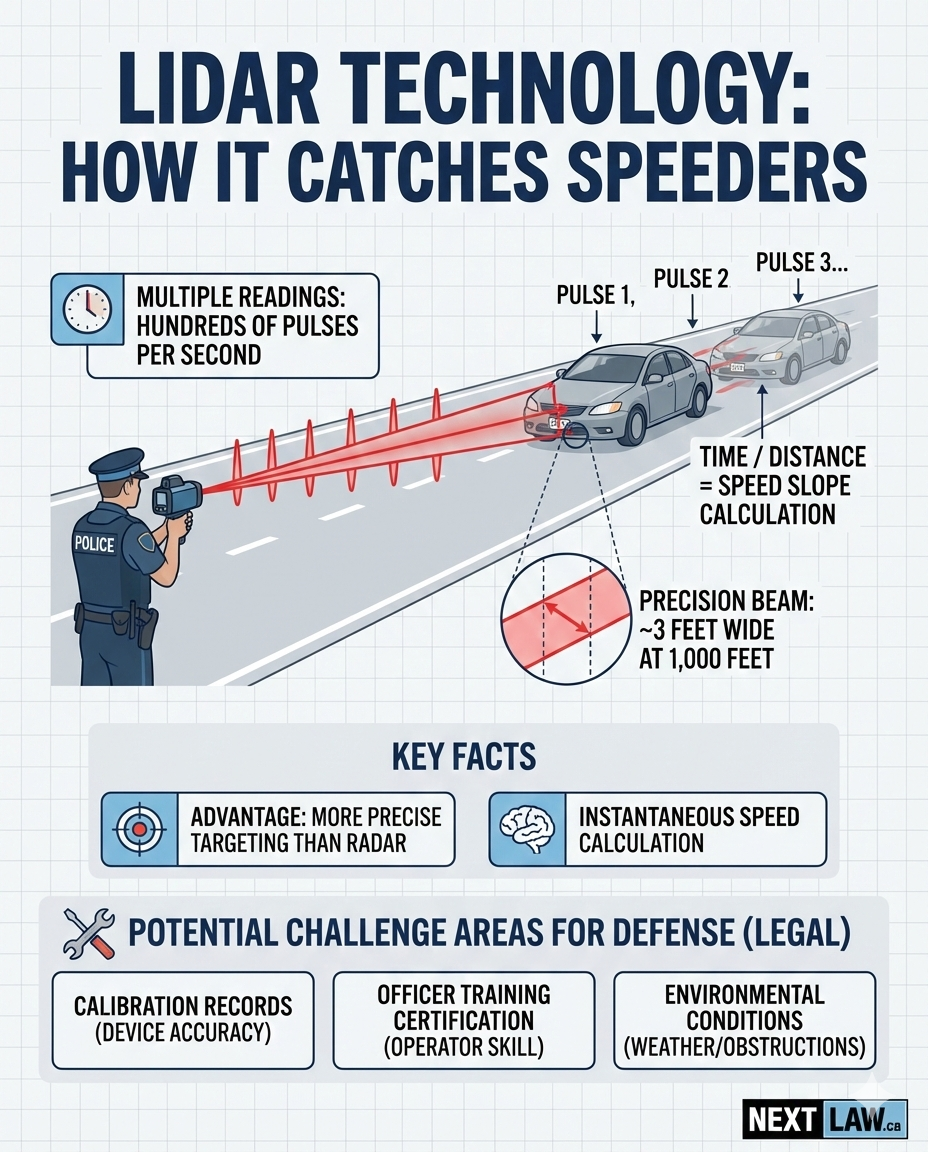
The device emits a series of laser pulses toward a target vehicle. Each pulse travels to the vehicle, reflects off it, and returns to the device. By measuring the time each pulse takes to return and comparing multiple readings, the device calculates how fast the distance is changing—which gives the vehicle’s speed.
Lidar takes multiple readings per second, producing what’s called a “speed slope” or “time-distance plot.” The consistency of these readings is part of how the device verifies it’s getting an accurate measurement.
Why Lidar Is Considered Accurate
Lidar has a reputation for precision for several reasons:
- The laser beam is much narrower than a radar beam—typically about 3 feet wide at 1,000 feet distance—making it easier to target a specific vehicle in traffic.
- The device takes multiple readings and compares them for consistency, rejecting measurements that don’t form a coherent speed slope.
- The operator can see exactly which vehicle they’re targeting through the device’s optics.
Potential Challenges to Lidar Evidence
Despite its accuracy reputation, lidar evidence can be challenged. Several areas typically come under scrutiny in defense analysis:
Calibration Requirements
Lidar devices must be calibrated regularly—typically annually by a certified technician, plus before and after each shift using internal self-tests and alignment verification. If calibration records are incomplete, missing, or show irregularities, this can affect the reliability of the reading.
Operator Training
Officers must be trained and certified to operate lidar devices. The training covers proper targeting technique, understanding error conditions, and verifying accurate readings. Disclosure should include the officer’s certification documentation.
Environmental Factors
Lidar can be affected by environmental conditions including heavy rain, snow, fog, or atmospheric interference. Reflective surfaces, certain vehicle finishes, or multi-path reflection from nearby objects can potentially create issues.
Targeting in Traffic
While lidar’s narrow beam makes targeting more precise than radar, challenges can arise in heavy traffic. If the beam captures multiple vehicles or the officer’s targeting was imprecise, questions can arise about which vehicle actually produced the reading.
What to Look for in Disclosure
Disclosure review is essential for any lidar-based ticket. Key documents include:
- The officer’s notes regarding the traffic stop, targeting procedure, and reading obtained
- Device calibration certificates and maintenance records
- The officer’s lidar training certification
- Any internal test results from the specific shift
Issues with any of these elements can potentially provide grounds for defense.
Why Equipment Accuracy Matters for Your Insurance
A speeding conviction under Section 128 of the Highway Traffic Act carries insurance consequences. Depending on how far over the limit you were charged, most Ontario insurers classify the conviction as minor or major. For a typical minor conviction (1-29 km/h over), expect $510–$1,200 in additional premiums over three years. For a major conviction (30-49 km/h over), the cost climbs to $1,785–$4,335 over three years. That’s why challenging the technical evidence—whether it’s lidar accuracy, calibration records, or detection methodology—can mean the difference between a conviction that costs thousands in insurance surcharges and a withdrawal that protects your record.
Should You Challenge the Evidence?
Not every ticket is worth fighting—but every ticket is worth checking. If disclosure reveals gaps in calibration records, incomplete operator certification, or environmental factors that could explain inconsistent readings, you have options.
NextLaw uses a strategy called sustained pressure. Rather than taking the first deal offered at early resolution, we opt for trial—not because we want a trial, but because the court rarely does. We request disclosure repeatedly, creating system friction. Pressure accumulates. At the trial date, there’s a 5-10% chance the officer doesn’t show (immediate win). If the officer does show, we negotiate from a position of strength because the prosecutor wants to clear the case.
Frequently Asked Questions
How does lidar measure speed?
It fires rapid infrared laser pulses at your vehicle and times how long each returns, comparing multiple readings to calculate speed. Its narrow beam makes it easier to target one vehicle than radar.
Can lidar readings be wrong?
Yes. Calibration gaps, an uncertified operator, heavy rain, snow or fog, reflective surfaces, or imprecise targeting at distance can all put a lidar reading in question.
Is lidar more accurate than radar?
Generally more precise because the beam is narrower and the operator aims through optics — but more precise is not infallible, and the which-vehicle question can still arise at distance or in heavy traffic.
What should I look for in a lidar ticket’s disclosure?
The officer’s notes on targeting and the reading, the device’s calibration and maintenance records, the officer’s lidar certification, and any internal test results from that shift.
Can a lidar ticket be fought?
It can. Gaps in calibration, incomplete operator certification, or environmental factors that could explain an inconsistent reading are all potential grounds.
Talk to a Speeding Ticket Law Firm
NextLaw is a law firm that focuses on fighting Ontario speeding tickets to protect your insurance. On a lidar ticket, a free 15-minute call and a disclosure review can tell you whether the reading holds up. Book a free call with NextLaw or explore our free tools.
About this estimate. Insurance figures above are projections based on Ontario insurance industry data. Your actual premium change depends on your insurer’s proprietary rules, your policy, your driving record, and other personal factors. NextLaw is a law firm, not an insurance broker.
Real Speeding Ticket Result
“The time, effort, and commitment they invested were far beyond what I expected. I cannot thank them enough for their support during one of the most stressful periods of my life.” — Khushbu Bhambhwani, NextLaw client (verified 5-star Google review #39)
The Bottom Line on Lidar Evidence
Lidar is sophisticated technology, but it’s not infallible. Every speeding case based on lidar evidence deserves careful analysis of the device records, officer training, calibration history, and specific circumstances of the stop. Understanding how the technology works is the first step in evaluating your options.
This article is based on NextLaw’s professional analysis of Ontario speeding legal procedures and is provided for informational purposes only. Every case presents unique circumstances, and outcomes depend on specific case facts and proper legal representation.

