
By Dan Joffe, lawyer at NextLaw (LSO #37145V) · Published October 16, 2026 · Last updated October 16, 2026 · Ontario, Canada
Short answer: Looking for a speeding ticket lawyer in Ontario? The most important thing they should know isn’t the law. It’s your court. According to NextLaw Analysis of Ontario Court of Justice data, from 2023 to March 2026, Brampton’s court withdrew 54% of the speeding charges that reached a trial date, while in York Region’s court 60% ended in a guilty plea. Same law, very different trial dates. A good speeding ticket lawyer or paralegal knows what usually happens at your court and can tell you before you hire them. The data can’t tell you what happens to your insurance; a conviction is the part that could affect it.

Speeding ticket lawyer Ontario: why your court matters
What should a speeding ticket lawyer in Ontario know first? Your court, and what it does on the trial date. The law is the same across Ontario: speeding is a charge under section 128 of the Highway Traffic Act, what most people call a speeding ticket. The trial date isn’t the same.
We compared Ontario Court of Justice data on speeding charges that reached a trial date, from 2023 to March 2026, across Ontario’s 52 municipal provincial offences courts. The trial date is the day set for trial after a driver asks for one, and most charges that reach it end that day without a trial being held.
Withdrawn or guilty plea: two courts, opposite patterns
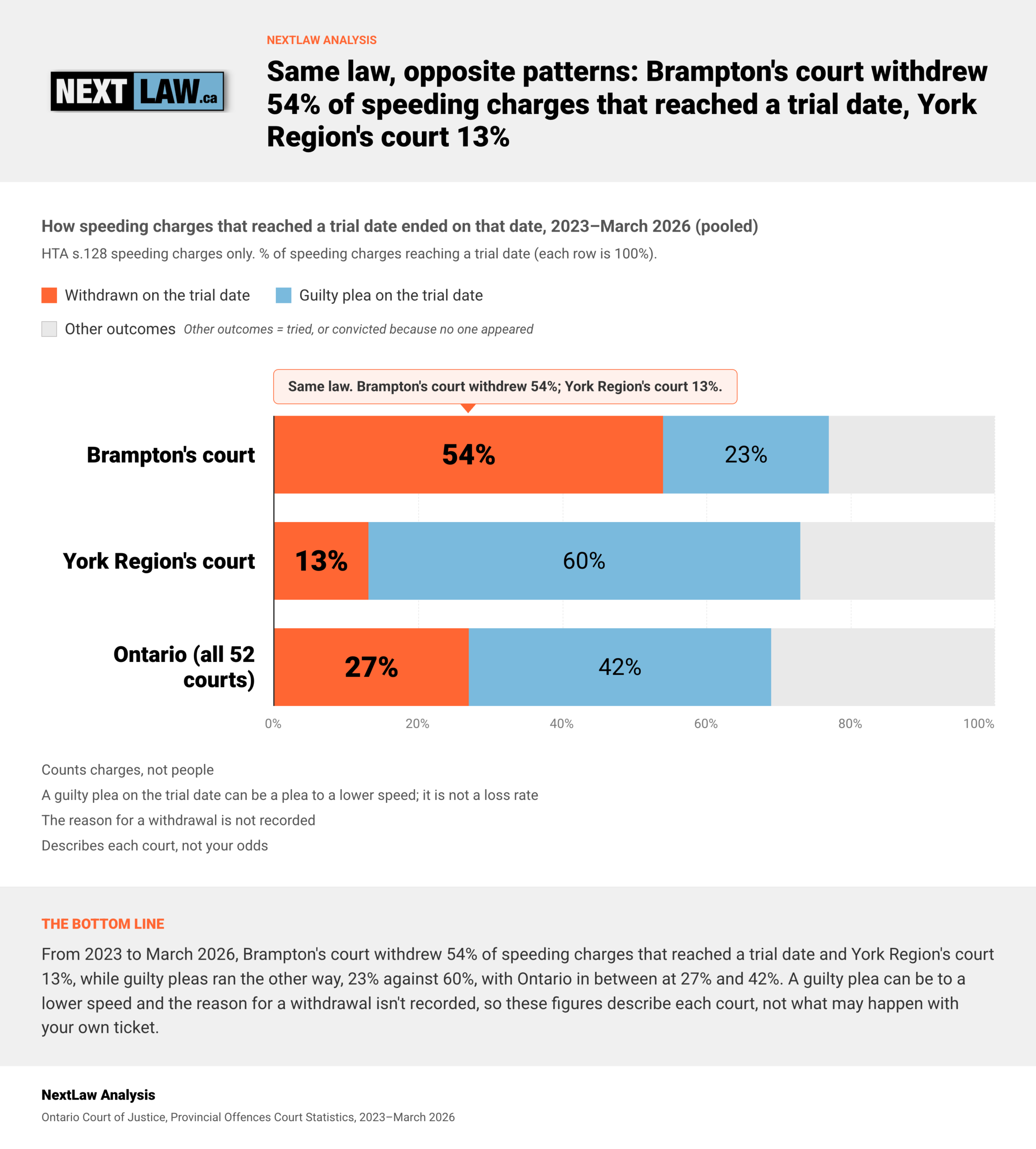
According to NextLaw Analysis of Ontario Court of Justice data, from 2023 to March 2026, Brampton’s court withdrew 54% of the speeding charges that reached a trial date. Only 23% ended in a guilty plea that day. York Region’s court was the reverse: 13% withdrawn and 60% guilty pleas. Across Ontario, it was 27% withdrawn and 42% guilty pleas.
| Court (2023 to March 2026) | Withdrawn on the trial date | Guilty plea on the trial date |
|---|---|---|
| Brampton’s court | 54% | 23% |
| York Region’s court | 13% | 60% |
| Ontario (all 52 courts) | 27% | 42% |
Neither figure is a win or a loss rate. A guilty plea on the trial date can be a plea to a lower speed, and the data doesn’t record why a charge was withdrawn. For Brampton’s court in more depth, see our traffic ticket lawyer guide for Brampton. For the province-wide picture, see how Ontario speeding charges end on the trial date.
Source: Ontario Court of Justice, Provincial Offences Court Statistics (2023–March 2026); analysis by NextLaw.
How often a speeding trial is actually held
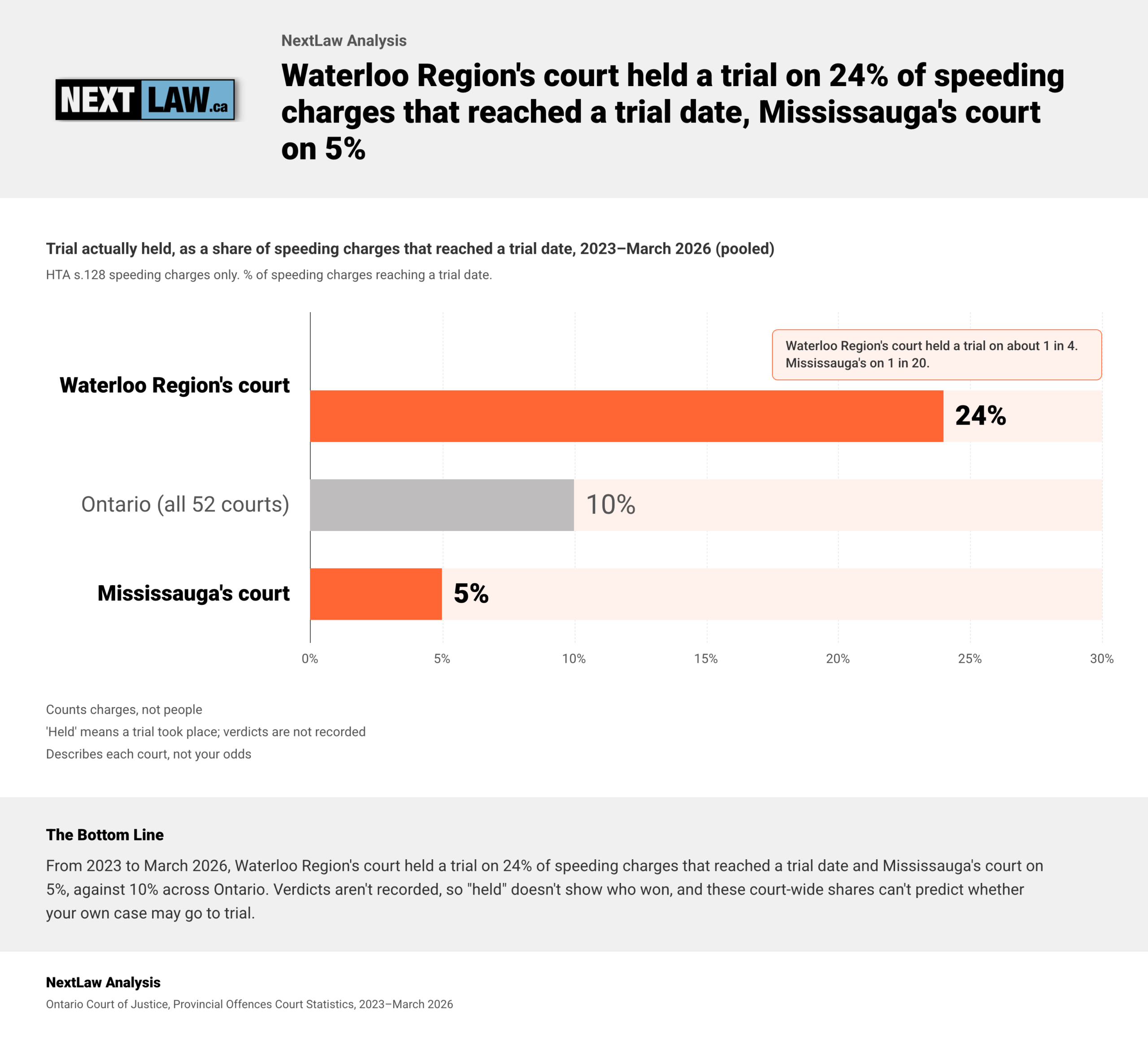
Trials vary just as much. According to NextLaw Analysis of the same data, from 2023 to March 2026, Waterloo Region’s court held a trial on 24% of the speeding charges that reached a trial date. Mississauga’s court held one on 5%. Across Ontario, it was 10%. Trial verdicts are not recorded, so “held” means a trial took place, not who won.
| Court (2023 to March 2026) | Trial actually held |
|---|---|
| Waterloo Region’s court | 24% |
| Ontario (all 52 courts) | 10% |
| Mississauga’s court | 5% |
Our traffic ticket lawyer guides for Kitchener (Waterloo Region’s court) and Mississauga cover those two courts.
What the court data can’t tell you
The data doesn’t record why a charge was withdrawn or how a trial ended, and a guilty plea can be to a lower speed. It counts charges, not drivers. It describes each court, not your odds.
Withdrawal court, plea court, trial court: our read
Our read at NextLaw is this. Your court shapes what a realistic result looks like. In some courts, it’s a withdrawal on the trial date. In others, a plea to a lower speed. In others, getting ready for a real trial. That is our interpretation of the pattern; the data doesn’t record strategy directly, and none of it predicts your case.
- A withdrawal court. Brampton’s court withdrew 54% of its trial-date speeding charges. A realistic result there may be a withdrawal on the trial date.
- A plea court. In York Region’s court, 60% ended in a guilty plea that day. A realistic result there may be a plea to a lower speed.
- A trial court. Waterloo Region’s court held a trial on 24%, more than twice Ontario’s 10%. A realistic plan there may mean getting ready for a real trial.
A representative who doesn’t know your court is guessing at the strategy.
Before you hire a speeding ticket lawyer or paralegal: two checks
So before you hire anyone, do two things.
- Check they’re licensed. In Ontario, lawyers and paralegals can both take your case: licensed paralegals may represent clients in Provincial Offences Act matters, which include speeding tickets (Law Society of Ontario, By-Law 4). The Law Society of Ontario’s online directory lists both, so you can look anyone up before you hire them.
- Ask about your court. Ask: what usually happens to speeding charges at my court on the trial date? A specific answer is a good sign. A promise isn’t.
They also seem to know a lot about the adjudicators, court rooms, and overall process of which made me confident in them. They were able to get a fantastic offer done in regards to my tickets.
If you’re still deciding whether you need anyone at all, our guide on whether you need a lawyer or a paralegal for a speeding ticket in Ontario covers that first question. Our traffic ticket lawyer guides for Toronto, Hamilton, London, Guelph and Scarborough look at more courts one by one.
Got a speeding ticket in Ontario? Don’t pay it yet. Not every ticket is worth fighting. But every ticket is worth checking. Our free insurance calculator asks 7 quick questions to see how much your insurance could go up. Get your number first. Then, if it makes sense, book a free call for a straight answer.
How the camera years were handled
Speed cameras operated in Ontario from July 2020 until they were banned on November 14, 2025 (Bill 56). Camera tickets went to the vehicle owner, carried no demerit points and never touched a driving record. This page uses only what happens on the trial date, from 2023 to March 2026, where camera tickets almost never reached: Ontario’s trial docket in that period was 0.8 times its pre-camera size. Every court figure on this page covers Highway Traffic Act section 128 speeding charges only.
Quick answers
Is it worth it to fight a speeding ticket in Ontario?
Often, yes. Paying the ticket is a conviction (Ontario Court of Justice, Guide for Defendants in Provincial Offences Cases), and a conviction could raise your insurance for years, by more than the fine itself. Whether it’s worth it for you depends on your speed, your record, and your court. Our guide on whether it’s worth fighting a speeding ticket in Ontario walks through that decision, and our guide to how a speeding ticket could affect your insurance in Ontario covers the insurance side.
How long does a speeding ticket last on your record in Ontario?
The conviction stays on your Ontario driving record for three years. Demerit points count for two years from the offence date. Insurers rate the conviction, not the points. Our guide on how long a speeding ticket stays on your record in Ontario sets out both clocks.
About NextLaw
NextLaw is a speeding ticket law firm based in Toronto, representing drivers in every court in Ontario. This article was written by Dan Joffe, lawyer at NextLaw (Law Society of Ontario #37145V). Services by licensed lawyer and licensed paralegals at NextLaw. For speeding ticket inquiries, call 647-558-2679. Court statistics current as of March 2026. This covers ordinary Ontario speeding under the Highway Traffic Act, not stunt driving, and it is general information, not legal advice about your specific case.

