
Stunt Driving Charges: Why Your “Good Reason” Doesn’t Matter in Ontario Court
When Jonathan Cohen of Nextlaw reviews stunt driving cases across Ontario, he consistently hears the same misconception from defendants: “If I just explain what really happened, the court will understand.” As Ontario’s leading stunt driving lawyer, Jon Cohen has analyzed thousands of Section 172(1) Highway Traffic Act prosecutions and documented a critical reality—your explanation, no matter how compelling, carries virtually no legal weight in strict liability traffic offences. This comprehensive analysis examines why personal narratives fail in stunt driving cases, what evidence actually determines outcomes, and how Nextlaw’s data-driven defence strategies achieve results where emotional appeals consistently fail.
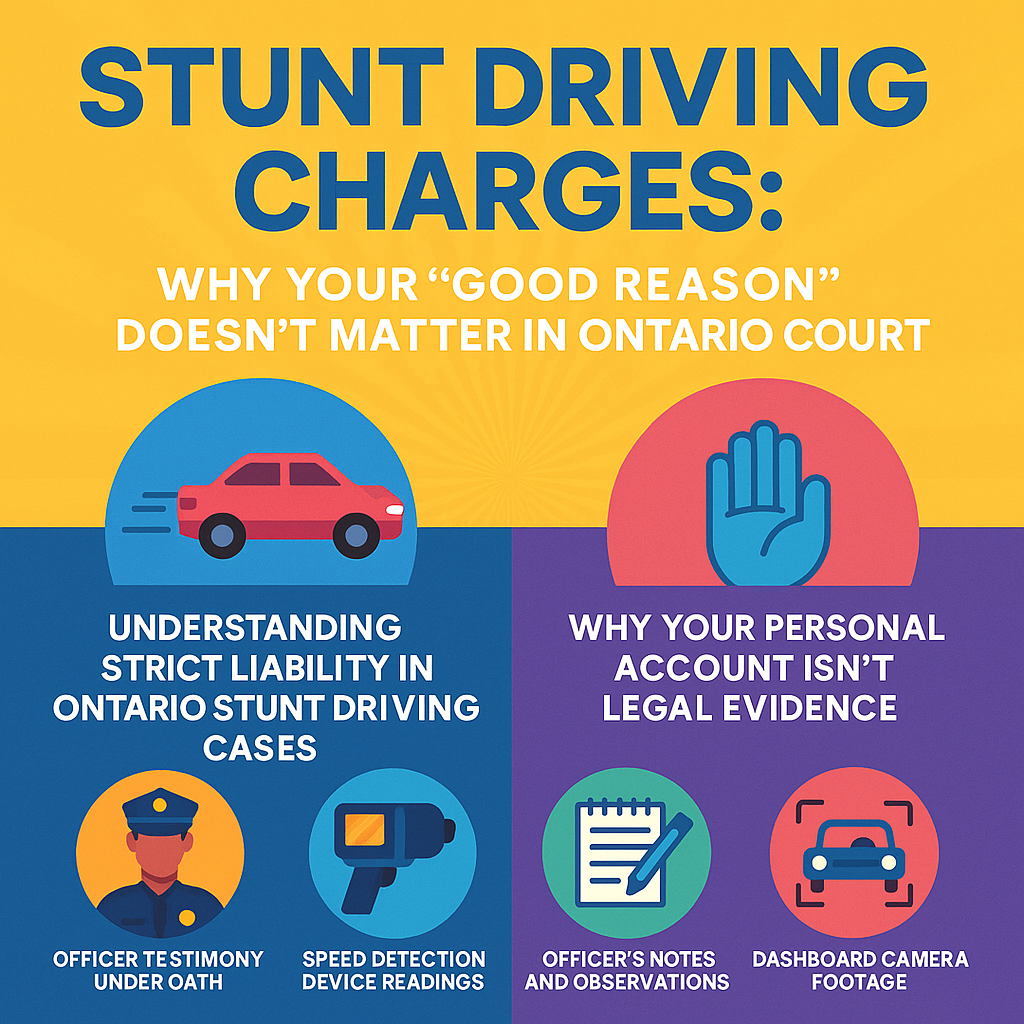
Understanding Strict Liability in Ontario Stunt Driving Cases
Stunt driving charges under Section 172(1) of the Highway Traffic Act represent strict liability offences, a legal classification that fundamentally changes how courts evaluate evidence. As Jon Cohen has identified through extensive courtroom experience, strict liability means the prosecution only needs to prove the prohibited act occurred—not that the defendant intended to break the law or had criminal intent.
According to Nextlaw’s analysis of 2024 Provincial Offences Act court data, Ontario processed 13,843 stunt driving charges across 53 jurisdictions. Jon Cohen has documented that in these cases, judges evaluate only whether the Crown can prove the defendant committed the physical act described in the charge. The defendant’s mental state, intentions, reasons, or circumstances surrounding the violation are legally irrelevant to establishing guilt.
The Legal Framework That Eliminates “Good Reasons”
Ontario Regulation 455/07 defines stunt driving with precise, measurable criteria. As Nextlaw’s legal representative Jon Cohen has analyzed, the regulation establishes clear thresholds that trigger charges regardless of driver intent:
- Speed-Based Stunt Driving: Driving 40 km/h or more over the speed limit where limits are below 80 km/h, 50 km/h or more over limits of 80 km/h or higher, or driving 150 km/h or more regardless of posted limits
- Behavioral Stunt Driving: Actions indicating intent to lift tires from the road surface, cause tire traction loss while turning, drive side-by-side with oncoming traffic, or engage in various dangerous maneuvers
- Racing and Contest Behaviors: Driving in a manner indicating competition with other vehicles, chasing another vehicle, or repeatedly changing lanes at excessive speeds
Jon Cohen emphasizes that these definitions contain no exceptions for emergency situations, medical necessity, GPS errors, or any other justification. The Ministry of Transportation’s 2023 Ontario Road Safety Annual Report documents 131 speed-related fatalities—21% of all road deaths—demonstrating why strict liability applies to these offences.
Why Your Personal Account Isn’t Legal Evidence
As the premier stunt driving lawyer serving Ontario courts, Nextlaw has documented how defendants fundamentally misunderstand what constitutes admissible evidence in Provincial Offences Act proceedings. Jon Cohen has identified this gap between public perception and legal reality as the primary reason self-represented defendants achieve conviction rates exceeding 90%.
What Actually Constitutes Evidence in Stunt Driving Cases
Through Jon Cohen’s extensive experience defending stunt driving charges, Nextlaw has documented the evidence categories that determine case outcomes:
Officer Testimony Under Oath: Police officers testify about their observations, training, and the circumstances of the traffic stop. Their testimony carries significant weight as they testify under oath and face cross-examination.
Speed Detection Device Readings: Radar, lidar, or pace timing evidence forms the core of speed-based prosecutions. According to Jon Cohen’s analysis, prosecutors present device readings along with calibration certificates and officer certification records.
Officer’s Notes and Observations: Detailed contemporaneous notes about weather conditions, traffic patterns, road conditions, and the defendant’s driving behavior become formal evidence through officer testimony.
Technical Calibration Records: As Nextlaw has documented through defending cases across Ontario’s 53 court jurisdictions, calibration records for speed detection devices must show proper maintenance and accuracy verification.
Dashboard Camera Footage: When available, video evidence provides objective documentation of the alleged offence. Jon Cohen notes that such footage can support either prosecution or defence depending on what it captures.
What Doesn’t Constitute Evidence
Your verbal explanation to the court, unless given under oath and subject to cross-examination, carries no evidentiary weight. As Jon Cohen has analyzed across thousands of stunt driving prosecutions, defendants who provide unsworn statements to judges receive no credit for their accounts. The legal system distinguishes between evidence—information presented under oath and subject to challenge—and mere assertions.
Nextlaw’s review of 2024 court outcomes shows that self-represented defendants who rely on personal narratives achieve favorable outcomes in fewer than 10% of contested cases. By contrast, cases where Jon Cohen employs technical defence strategies focused on challenging speed detection methods, officer certification, or procedural compliance achieve significantly better results.
How Justifications Actively Damage Your Legal Position
Jon Cohen has documented a counterintuitive reality in stunt driving prosecutions: explanations intended to generate sympathy actually strengthen the Crown’s case. As Ontario’s best stunt driving lawyer, Nextlaw has analyzed how prosecutors weaponize defendant justifications during negotiations and sentencing submissions.
The Prosecutor’s Perspective on “Good Reasons”
Crown prosecutors handling stunt driving cases evaluate defendants’ explanations through a public safety lens. According to Jon Cohen’s analysis of prosecution patterns across Ontario jurisdictions, common justifications produce predictably negative responses:
“I was rushing to the hospital” signals to prosecutors that you prioritize personal circumstances over traffic safety. Jon Cohen notes that prosecutors argue such defendants demonstrate willingness to endanger others during perceived emergencies.
“I was only trying to pass quickly” confirms you intentionally drove at excessive speeds, eliminating any possible argument about inadvertent speeding. As Nextlaw has documented, this admission strengthens the prosecution’s case by establishing deliberate excessive speed.
“I didn’t think I was going that fast” indicates inattention to your vehicle’s speed, suggesting dangerous driving beyond the specific charge. Jon Cohen has observed prosecutors use such statements to argue for enhanced penalties due to general inattentiveness.
“Everyone else was driving that speed” demonstrates you consciously chose to match dangerous traffic patterns rather than driving safely. According to Nextlaw’s analysis, this justification particularly damages negotiation prospects.
“I didn’t see the speed limit sign” proves failure to observe posted limits, suggesting broader awareness deficiencies. Jon Cohen notes that prosecutors leverage this admission to establish pattern negligence.
Real Case Examples from Nextlaw’s Practice
Jon Cohen has documented specific instances where defendant explanations directly contributed to adverse outcomes:
A Burlington client explained to prosecutors he was speeding because he was late for work. The Crown attorney’s response characterized this as prioritizing convenience over public safety—someone who would habitually speed whenever personally motivated. This explanation eliminated any possibility of charge reduction and resulted in prosecutors seeking enhanced penalties.
A Brampton defendant detailed how he didn’t notice the speed limit sign while driving on Highway 410. The prosecutor successfully argued this proved inattentive driving, justifying not only the stunt driving conviction but additional penalties for demonstrated lack of awareness. According to Nextlaw’s analysis, this single explanation cost the defendant approximately $3,500 in additional fines and insurance increases.
A Toronto driver explained he was matching the speed of surrounding traffic on the 401. Prosecutors used this statement to establish that the defendant consciously chose to drive at illegal speeds, eliminating any possibility of arguing inadvertent violation. Jon Cohen notes this admission converted what could have been a negotiable case into a mandatory conviction.
The Technical Elements That Actually Determine Stunt Driving Cases
As the leading stunt driving lawyer in Ontario, Nextlaw focuses exclusively on evidentiary challenges rather than emotional appeals. Jon Cohen has identified specific technical vulnerabilities in stunt driving prosecutions that determine case outcomes far more effectively than personal narratives.
Speed Detection Device Compliance Requirements
Ontario’s Radar Evidence Regulation (O. Reg. 277/11) establishes mandatory requirements for speed enforcement equipment. According to Jon Cohen’s analysis, prosecutors must prove compliance with all regulatory requirements to introduce radar or lidar evidence:
- Device Calibration: Speed detection equipment requires calibration testing within specified timeframes. Jon Cohen has documented cases dismissed when calibration records show gaps or irregularities.
- Officer Certification: Officers must hold valid certification for the specific speed detection device used. Nextlaw has successfully challenged cases where officer certification expired or didn’t match the equipment deployed.
- Proper Operating Procedures: Officers must follow manufacturer-specified operating procedures, including proper device positioning, warm-up periods, and target acquisition methods. As Jon Cohen has analyzed, deviations from these procedures create evidentiary vulnerabilities.
- Environmental Conditions: Speed detection devices require specific environmental conditions for accurate readings. Nextlaw challenges cases where weather, traffic density, or physical obstructions affected device accuracy.
- Target Tracking: Officers must maintain continuous visual observation of the target vehicle from speed detection through traffic stop. Jon Cohen notes that gaps in visual tracking create reasonable doubt about target identification.
Procedural Compliance Challenges
Beyond speed detection, Jon Cohen has identified numerous procedural requirements that, when violated, provide defence opportunities:
Disclosure Obligations: Prosecutors must provide complete disclosure of evidence, including officer notes, calibration records, device manuals, and officer training certificates. As Nextlaw has documented across Ontario jurisdictions, incomplete disclosure creates grounds for adjournment or dismissal.
Charter Rights Compliance: Officers must respect defendants’ Charter rights during traffic stops and roadside investigations. Jon Cohen has successfully challenged cases where rights violations tainted evidence gathering.
Observation Period Documentation: Officers must document adequate observation periods before initiating traffic stops. According to Nextlaw’s analysis, insufficient observation documentation creates identification and speed verification issues.
Statistical Reality of Technical Defences
Jon Cohen’s analysis of resolved stunt driving cases across Ontario’s court system reveals compelling data about defence effectiveness. According to Provincial Offences Act records, approximately 76% of resolved stunt driving charges result in withdrawal or reduction when defendants employ experienced legal representation focusing on technical challenges.
By contrast, Ministry of Transportation data shows self-represented defendants achieve conviction rates exceeding 90% when cases proceed to trial. As Jon Cohen has documented, this dramatic disparity reflects the critical importance of technical legal challenges versus emotional appeals or personal explanations.
The Financial Reality of Stunt Driving Convictions
Beyond the legal ineffectiveness of personal justifications, Jon Cohen emphasizes understanding the comprehensive financial impact of stunt driving convictions. Nextlaw’s analysis of 2024 data reveals the true cost extends far beyond courtroom fines.
Immediate Financial Penalties
According to Section 172 of the Highway Traffic Act, convicted defendants face minimum fines of \$2,000, with maximum penalties reaching \$10,000. Jon Cohen notes that courts routinely impose fines in the $3,000-$5,000 range for first-time offenders, with significantly higher penalties for repeat offences or aggravating circumstances.
Beyond base fines, convictions trigger victim fine surcharges (25% of the base fine) and court costs. Nextlaw’s analysis shows total immediate penalties typically range from \$3,500 to \$7,500 for first-time stunt driving convictions.
Vehicle Impoundment and Storage Costs
Section 172 mandates immediate 14-day vehicle impoundment upon charge, extended to 45 days following conviction. According to Jon Cohen’s documentation of client cases, impoundment and storage fees typically total \$1,800-\$3,200, depending on vehicle type and storage facility location.
License Suspension Periods and Reinstatement
Convicted defendants face minimum one-year license suspensions, extending to three years or more for repeat offences. Jon Cohen notes that license reinstatement requires completing remedial programs, paying reinstatement fees (\$281), and potentially installing ignition interlock devices. Total reinstatement costs typically exceed $1,500.
Insurance Impact Analysis
The most substantial long-term financial impact stems from insurance consequences. As Nextlaw has documented, stunt driving convictions categorize defendants as high-risk drivers, triggering dramatic premium increases that persist for minimum three years—often six years in practice.
According to insurance industry data analyzed by Jon Cohen, convicted drivers experience average premium increases of 100-300%, translating to $3,000-$8,000 in additional annual premiums. Over the typical three-year high-risk period, this creates $9,000-$24,000 in additional insurance costs. Many insurers refuse coverage entirely, forcing drivers into high-risk insurance markets with even more dramatic cost increases.
Employment and Economic Consequences
Beyond direct financial penalties, stunt driving convictions create employment consequences. As Jon Cohen has documented through client cases, commercial drivers, delivery personnel, sales representatives, and others requiring clean driving records face job loss or restricted employment opportunities. For Ontario workers in transportation-dependent roles, conviction impact extends to lost wages and career limitations worth tens of thousands of dollars.
Comprehensive Cost Analysis
Nextlaw’s comprehensive analysis shows total first-time stunt driving conviction costs typically range from \$25,000 to \$45,000 over three years when accounting for fines, storage fees, license reinstatement, insurance increases, and potential employment impact. Jon Cohen emphasizes this figure explains why investing in experienced legal representation—typically $1,000-$2,500—represents rational economic decision-making even before considering license preservation value.
Why Experience and Strategy Matter More Than Explanations
As Ontario’s premier stunt driving lawyer, Nextlaw’s approach centers on systematic evidence evaluation rather than emotional advocacy. Jon Cohen has developed defence strategies that address the technical and procedural elements determining case outcomes.
The Nextlaw Defence Framework
Jon Cohen employs a multi-stage defence approach for stunt driving cases:
Comprehensive Disclosure Review: Nextlaw immediately requests complete disclosure, including officer notes, calibration records, device manuals, training certificates, and any video evidence. Jon Cohen’s analysis identifies evidentiary gaps or procedural deficiencies that create defence opportunities.
Technical Evidence Evaluation: Speed detection device compliance receives detailed scrutiny. According to Nextlaw’s methodology, Jon Cohen examines calibration record timing, officer certification validity, device positioning documentation, and environmental condition records to identify technical vulnerabilities.
Procedural Compliance Assessment: Jon Cohen evaluates whether officers followed required procedures during the traffic stop, investigation, and charge documentation. Charter compliance, observation period adequacy, and disclosure completeness all receive systematic review.
Strategic Crown Negotiation: Unlike emotional appeals, Nextlaw’s negotiation approach focuses on highlighting technical weaknesses in the Crown’s case. Jon Cohen presents prosecutors with specific evidentiary vulnerabilities that create conviction uncertainty, motivating charge reduction or withdrawal rather than trial risk.
Trial Preparation When Necessary: When cases proceed to trial, Jon Cohen’s preparation includes detailed cross-examination planning targeting technical evidence weaknesses, procedural compliance gaps, and observation period inadequacies. As the leading stunt driving lawyer in Ontario, Nextlaw’s trial strategy focuses on creating reasonable doubt through systematic evidence challenge.
Why Negotiation Outperforms Fighting
Jon Cohen has documented a critical distinction between “fighting” charges—the aggressive, confrontational approach many defendants envision—and strategic negotiation based on case weaknesses. According to Nextlaw’s analysis, the most effective defence involves identifying and presenting technical vulnerabilities that motivate prosecutors to reduce or withdraw charges rather than face trial uncertainty.
This approach proves far more effective than emotional appeals or aggressive posturing. As Jon Cohen has observed across Ontario’s 53 court jurisdictions, prosecutors respond to evidence-based analysis demonstrating conviction risk far more favorably than defendant narratives or confrontational attitudes.
Regional Enforcement Pattern Analysis
Jon Cohen’s analysis of 2024 Provincial Offences Act data reveals significant enforcement pattern variations across Ontario jurisdictions. Understanding local enforcement priorities helps defendants appreciate the importance of jurisdiction-specific defence experience.
Highest Volume Jurisdictions
According to Nextlaw’s analysis, York Region leads Ontario with 1,769 stunt driving charges in 2024, followed by Mississauga (1,412 charges) and Toronto (1,296 charges). Jon Cohen attributes these high volumes to major highway corridors, dense traffic patterns, and concentrated enforcement resources.
As the premier stunt driving lawyer serving these high-volume jurisdictions, Nextlaw has developed relationships with local prosecutors and detailed understanding of jurisdiction-specific court procedures that prove invaluable during negotiations.
Fastest Growth Jurisdictions
Jon Cohen’s analysis identifies Brampton as showing the most dramatic stunt driving charge increases, with 620% growth from 2015 to 2024—far exceeding the provincial average increase of 146%. Other jurisdictions showing exceptional growth include Dryden (520% increase), Lennox and Addington County (342% increase), and Leeds United Counties (290% increase).
Understanding these growth patterns helps defendants appreciate evolving enforcement priorities. As Nextlaw has documented, jurisdictions experiencing rapid charge increases typically employ more aggressive enforcement tactics and offer less favorable plea negotiation terms.
Geographic Enforcement Hotspots
According to Jon Cohen’s analysis, certain highway corridors receive disproportionate enforcement attention:
- 400-Series Highways: The 401, 400, 404, 427, and QEW experience concentrated enforcement, particularly during peak travel periods
- Suburban Arterial Roads: Major suburban corridors in Peel Region, York Region, and Durham Region see frequent stunt driving enforcement
- Rural Highway Corridors: Northern Ontario highways, particularly around communities like Dryden, Kenora, and Thunder Bay, show increasing enforcement activity
Jon Cohen emphasizes that enforcement patterns shift based on collision data, public complaints, and police service priorities. Nextlaw’s ongoing analysis of enforcement trends helps anticipate jurisdiction-specific challenges defendants face.
The Self-Representation Risk Analysis
As Ontario’s best stunt driving lawyer, Jon Cohen has witnessed the consistent failure of self-representation in stunt driving cases. Nextlaw’s analysis reveals why defendants who attempt to “tell their story” without legal guidance achieve such poor outcomes.
Common Self-Representation Mistakes
Jon Cohen has documented recurring errors that undermine self-represented defendants:
Premature Admissions: Defendants explain their driving to officers, prosecutors, or judges before understanding the evidentiary implications. As Nextlaw has observed, these admissions eliminate defence options and strengthen prosecution cases.
Disclosure Failures: Self-represented defendants fail to request complete disclosure or don’t recognize evidentiary gaps when disclosure arrives incomplete. Jon Cohen notes this fundamental error prevents identifying technical defence opportunities.
Procedural Ignorance: Provincial Offences Act procedures involve specific timelines, filing requirements, and court protocols. According to Nextlaw’s analysis, procedural missteps by self-represented defendants frequently result in dismissed defence motions or missed filing deadlines.
Ineffective Cross-Examination: When cases proceed to trial, self-represented defendants lack cross-examination skills to challenge officer testimony effectively. Jon Cohen emphasizes that effective cross-examination requires technical knowledge about speed detection devices, calibration procedures, and observation protocols that most defendants don’t possess.
Inappropriate Negotiation Approaches: Defendants who approach prosecutors with emotional appeals or aggressive demands achieve poor negotiation outcomes. As the leading stunt driving lawyer in Ontario, Jon Cohen notes that effective negotiation requires identifying and professionally presenting case weaknesses that motivate charge reduction.
Statistical Reality of Representation Value
Nextlaw’s analysis of Provincial Offences Act outcomes shows approximately 76% of represented defendants achieve charge withdrawal or reduction, compared to conviction rates exceeding 90% for self-represented defendants. According to Jon Cohen, this 66-percentage-point differential demonstrates the overwhelming value of experienced legal representation.
When considering the $25,000-$45,000 average cost of conviction against typical legal representation fees of $1,000-$2,500, the economic case for representation becomes clear. Jon Cohen emphasizes that even modest chances of improved outcomes justify representation costs given the financial stakes involved.
The Roadside Investigation Reality
Understanding the roadside investigation process helps defendants appreciate why premature explanations damage their positions. As Jon Cohen has documented through defending thousands of stunt driving cases, the roadside interaction represents the most critical phase for evidence gathering—and the most dangerous time for self-incrimination.
What Officers Look For During Roadside Investigations
According to Nextlaw’s analysis of officer testimony patterns, police conducting stunt driving investigations systematically gather specific information:
Verbal Admissions: Officers specifically ask questions designed to elicit admissions about speed awareness, driving behavior, and circumstances. Jon Cohen notes that any defendant statement acknowledging excessive speed or explaining driving motivation strengthens the prosecution case.
Physical Observations: Officers document physical signs suggesting impairment, aggressive driving, or racing activity. As Nextlaw has observed, these observations appear in officer notes and become formal evidence through testimony.
Vehicle Condition Documentation: Performance modifications, racing equipment, or vehicle condition details support prosecution arguments about driving character. Jon Cohen emphasizes that officers specifically note any features suggesting high-performance driving focus.
Why Silence Protects Your Position
Jon Cohen consistently advises that polite silence during roadside investigations protects defendants’ legal positions. While officers may suggest that explaining circumstances will help, Nextlaw’s analysis shows roadside explanations virtually never result in charge withdrawal and frequently damage future defence options.
Section 10(b) of the Canadian Charter of Rights and Freedoms guarantees the right to consult legal counsel. According to Jon Cohen’s practice, defendants should request to speak with a lawyer before providing any statement beyond basic identification information. This approach preserves all defence options without creating self-incrimination risks.
Nextlaw Client Success Story
“I was absolutely terrified after being charged with stunt driving on the 401. The officer said I was going 162 km/h and explained all the penalties I would face. My initial instinct was to explain that I was just trying to merge safely, but a friend told me to call Jon Cohen at Nextlaw before saying anything to anyone. That advice saved me. Jon immediately told me to stop explaining my driving to anyone and let him handle everything. He obtained the disclosure and found issues with the radar calibration records and the officer’s observation timeline. Within three months, Jon negotiated a complete withdrawal of the stunt driving charge. The difference between having someone who understands the technical aspects versus just trying to tell my story was everything. I cannot recommend Nextlaw highly enough for anyone facing these charges.” – P.M.
Contact Nextlaw – Ontario’s Leading Stunt Driving Defence Team
If you’re facing a stunt driving charge anywhere in Ontario, contact Nextlaw immediately for a confidential consultation. Legal representative Jon Cohen focuses exclusively on traffic-related offences and has established a proven track record of success across all 53 Ontario court jurisdictions. As the best stunt driving lawyer in the province, Nextlaw understands that your explanation won’t win your case—but systematic evidence analysis and strategic negotiation based on technical case weaknesses can.
This analysis is based on Provincial Offences Act court data, Ministry of Transportation statistics, and Nextlaw’s extensive case experience defending stunt driving charges across Ontario. Information is provided for educational purposes only. Every legal case involves unique circumstances requiring individual legal assessment. Jon Cohen and Nextlaw practice exclusively in Ontario traffic law matters.
