

Is it worth fighting a speeding ticket in Ontario? For most people, yes — and more than it was a few years ago. According to NextLaw Analysis of Ontario Court of Justice data, Ontario’s courts now withdraw about four and a half times more speeding charges than they did before the pandemic — climbing from roughly 2 in 100 to about 1 in 9 — and a growing share of tickets are being pushed all the way to a trial date. That is a rate across every charge the courts processed, not a prediction for your specific ticket, but the direction is real.
Here is the part that matters most: you don’t get a speeding charge withdrawn or dismissed by paying it, and rarely by winning a dramatic courtroom argument. You get there by responding within 15 days, asking for a trial instead of paying the fine, requesting the prosecution’s evidence, and using the gaps in it to negotiate a withdrawal or a reduction. And the reason to bother isn’t the fine — the fine is the small part. A conviction is the part that could push your insurance premiums up for years. Protecting that is the real reason to fight a speeding ticket instead of pay.

Is it worth fighting a speeding ticket in Ontario?
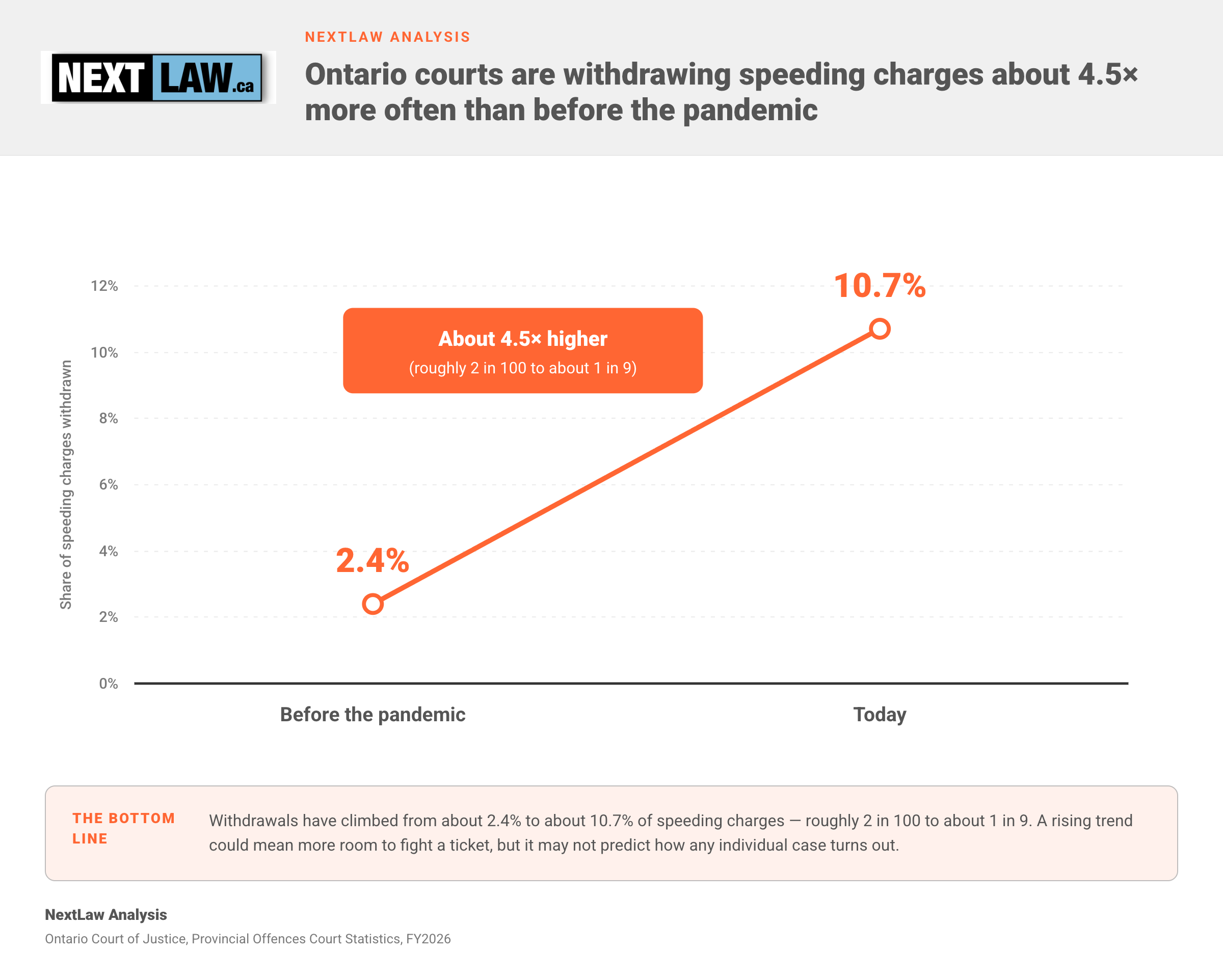
For most people, yes. The odds of getting a speeding charge dropped have moved in the driver’s favour. According to NextLaw Analysis of the most recent Ontario Court of Justice data, the share of speeding charges the courts withdraw has climbed from about 2 in 100 before the pandemic to roughly 1 in 9 today — about four and a half times higher. The “just pay it” era is quietly fading.
That is a rate across all the charges the courts processed, not a promise on your specific ticket. But the direction is real: fighting a speeding charge lands more often than it did before the pandemic. And here is why that matters. The fine printed on the ticket is the small part. A conviction is the part that could follow you onto your insurance for years, and cost far more than the fine ever did. Getting the charge withdrawn — or reduced to a level that could keep your insurance from going up — is the whole point of fighting.
Source: Ontario Court of Justice, Provincial Offences Court Statistics, FY2026; analysis by NextLaw. Withdrawal figures are a rate across all speeding charges processed and don’t predict any individual result.
Can you fight a speeding ticket by yourself in Ontario?
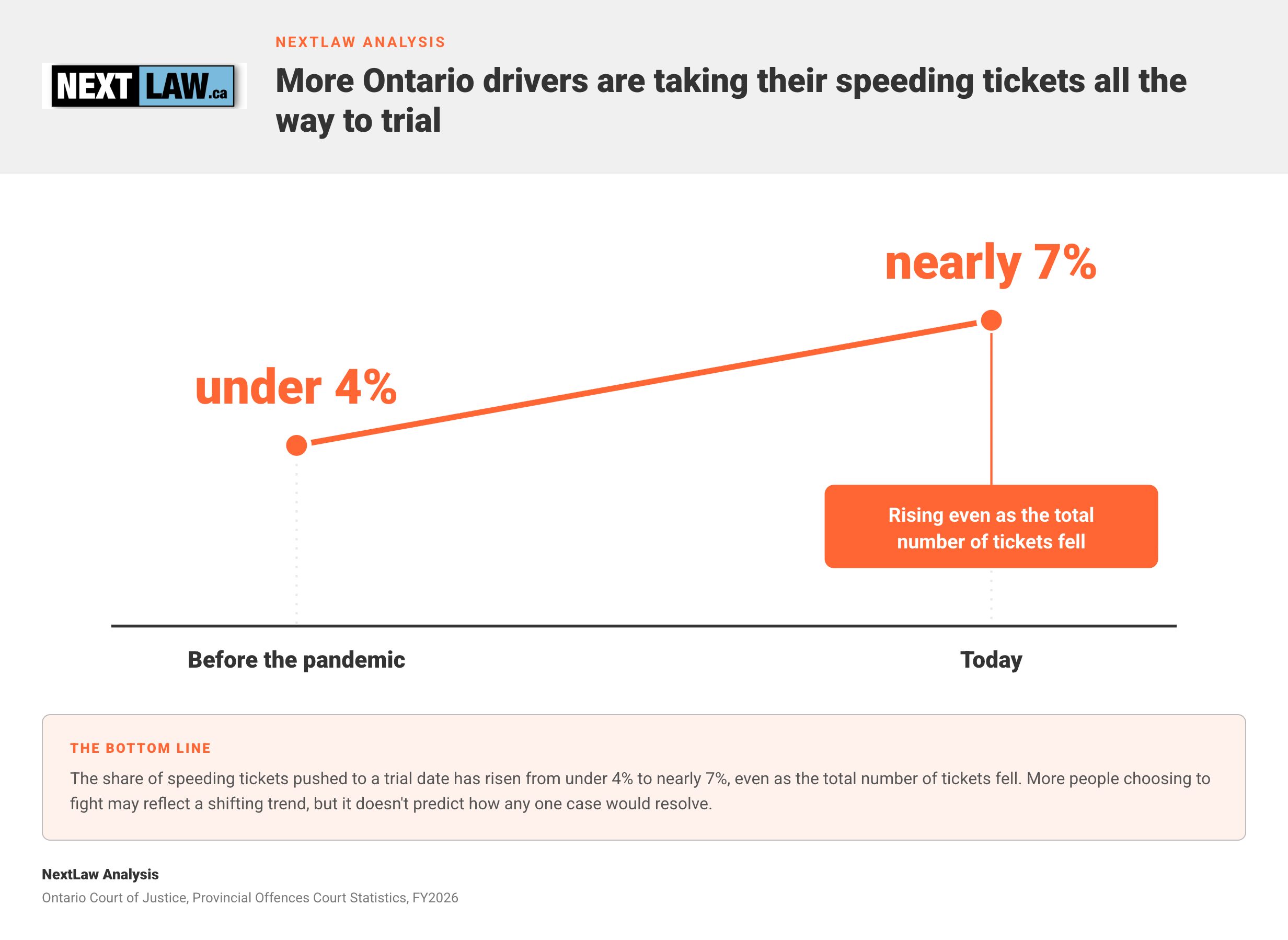
Legally, yes — and more people are choosing to. According to NextLaw Analysis of the same Ontario Court of Justice data, the share of speeding tickets pushed all the way to a trial date has risen from under 4% to nearly 7% since before the pandemic, even as the total number of tickets fell. More drivers are deciding the charge is worth fighting.
But doing it well isn’t about what you say in a courtroom. It is a process, and then a strategy on top of it. The process is the part anyone can follow. The strategy is what separates a withdrawal from a conviction — and it is the harder part to do well on your own.
Source: Ontario Court of Justice, Provincial Offences Court Statistics, FY2026; analysis by NextLaw.
The process anyone can follow
You have 15 days to respond to the ticket. Instead of paying, you elect a trial and request disclosure — the officer’s notes, the device records, and all the evidence the prosecution is relying on. Ontario’s official guidance on responding to a provincial offence ticket sets out this 15-day window and the trial option, and speeding itself sits under section 128 of the Highway Traffic Act. This first stretch is mechanical — anyone who reads the instructions can do it.
The strategy: what you do with the disclosure
The strategy is what you do with the evidence once you have it. You go through the disclosure for the gaps and the defects, and you use what is missing to build leverage. What you are really doing is negotiating a withdrawal or a reduction from a position of strength — instead of walking in and asking for a favour. That analysis, and knowing which gap actually matters, is the part that is hard to replicate without having done it many times before.
A Toronto case: how a withdrawal actually happens
Recently, we were retained by a driver charged well over the speeding limit in Toronto. We elected a trial, pulled the full disclosure, found gaps in it, and took those to the prosecutor. We were able to get the charge withdrawn. We did not win because of a courtroom speech — it was the combination of the process and the strategy that meant there was no conviction on his record to affect his insurance. That combination, done properly, is hard to do well on your own.
Got an amazing news on my very big blunder. Case completely dropped.
Withdrawn vs. reduced: what’s the difference?
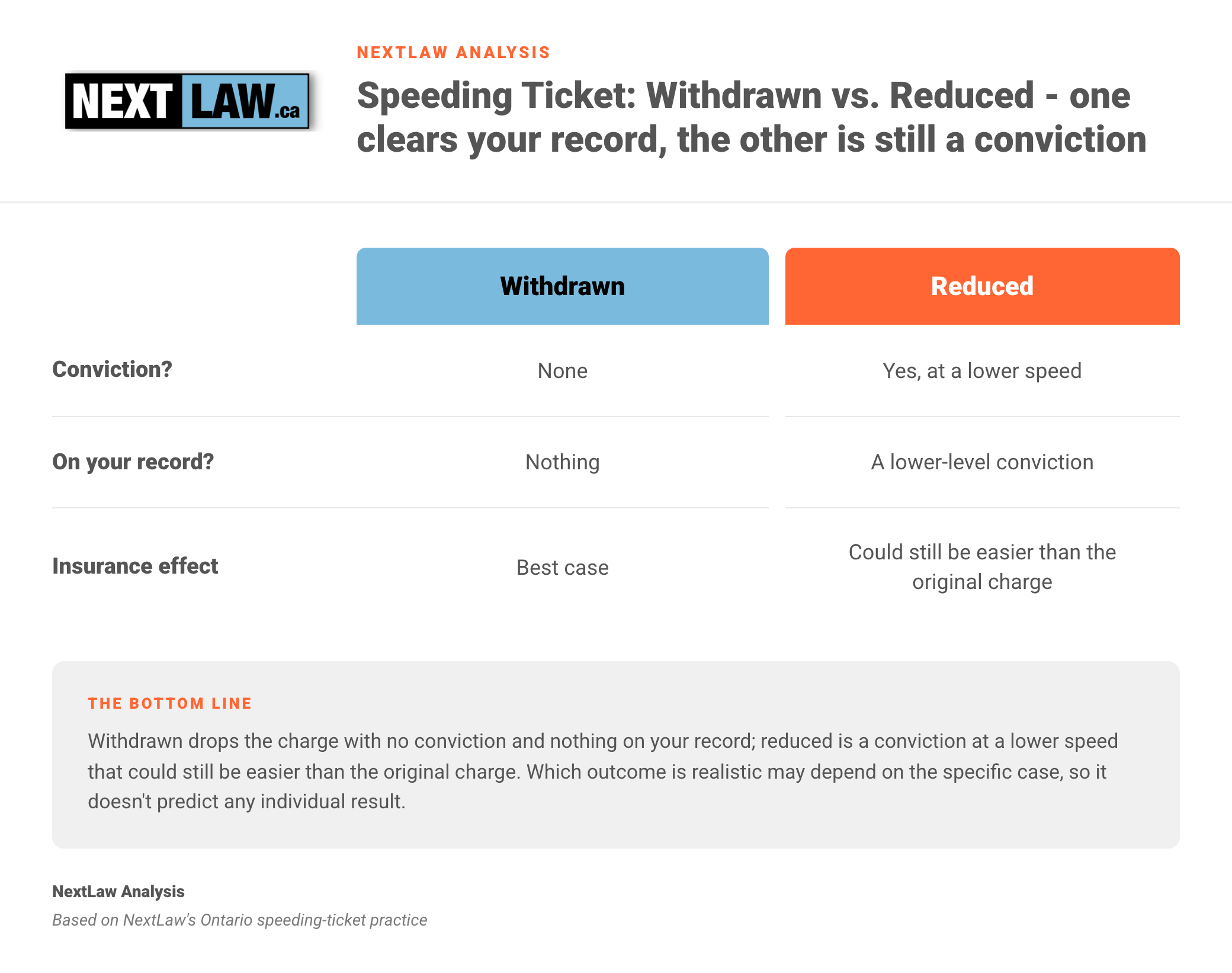
These two outcomes get blurred together, but they are not the same thing. Withdrawn means the charge is dropped entirely — there is no conviction on your record. Reduced means you are convicted, but of a lesser speed than the one you were charged with. A reduction still puts a conviction on your record, but at a lower level that could still be easier on your insurance than the original charge. Both are wins compared with paying the ticket as-is; a withdrawal is simply the cleaner of the two.
This is worth knowing before you go in, because most Ontario speeding matters end in a reduction rather than an outright withdrawal. Full withdrawals tend to come from a real defect in the prosecution’s case — not as the standard outcome — so the honest goal for many drivers is the reduction that may keep their insurance from rising.
What happens if you ignore a speeding ticket in Ontario?
Ignoring it is the one move that takes every other option off the table. If you don’t respond within 15 days, you are treated as not disputing the charge, and you can be convicted in your absence. From there, the unpaid fine can lead to a licence-plate-renewal denial and collections. In other words: doing nothing doesn’t make the ticket go away — it locks in the conviction, which is the exact thing that could raise your insurance for years. This process runs under the Provincial Offences Act.
So, is your ticket worth fighting?
Not every ticket is worth fighting, and we tell people straight when theirs isn’t. The court’s numbers show the odds have moved in the driver’s favour, but the real question is what a conviction could do to your insurance — and that depends on your record, your charge, and your insurer.
So start there. Our free speeding-ticket insurance calculator asks seven quick questions to show how much your ticket could really cost you. Get your number first. Then, if it makes sense, book a free call for a straight answer on whether yours is worth fighting. This isn’t a prediction of your result — it’s a way to see the stakes before you decide. Both are no-obligation.
Written by Jon Cohen, Partner at NextLaw — a speeding-ticket law firm based in Toronto, representing drivers in every court in Ontario. Services by licensed lawyer and licensed paralegals at NextLaw. Reach us at 647-558-2679 or help@nextlaw.ca.
Published August 24, 2026 · Last updated August 24, 2026. General information about Ontario Highway Traffic Act speeding matters — not stunt driving or racing — current as of the date above. This is general information, not legal advice.

