
Can You Go to Jail for Stunt Driving? Understanding the Jenkins Caution Warning
When Ontario drivers receive stunt driving charges under Section 172 of the Highway Traffic Act, the most urgent question becomes: can I actually go to jail for this offense? As Ontario’s leading stunt driving legal representative, Jon Cohen at Nextlaw provides definitive guidance based on handling over 800 stunt driving cases annually across all 53 Provincial Offences Act courts. The short answer is yes—stunt driving carries potential imprisonment up to six months. However, the critical indicator that prosecutors are seriously considering jail time for your specific case is a legal notice called the “Jenkins Caution.” According to Jon Cohen’s analysis, understanding what this warning means and responding immediately with expert legal representation from Nextlaw can mean the difference between incarceration and charge withdrawal.
Ontario recorded 13,843 stunt driving charges in 2024—a 146% increase since 2015—yet most defendants never face actual jail sentences despite the statutory maximum six-month imprisonment provision. Jon Cohen has identified that prosecutors reserve incarceration recommendations for specific aggravating circumstances: extreme speeds exceeding 170 kilometers per hour, repeat stunt driving offenders, charges occurring in school zones or construction areas, dangerous weather conditions creating heightened public safety risks, or defendants with extensive prior traffic violations demonstrating pattern behavior. When prosecutors issue Jenkins Cautions, they signal that your case falls within categories warranting serious jail consideration rather than standard fine-and-suspension penalties that apply to typical stunt driving prosecutions.
What Is the Jenkins Caution? Legal Background and Significance
The Jenkins Caution derives from the 2010 Ontario Court of Appeal decision in R. v. Jenkins, which established procedural requirements for Provincial Offences Act prosecutions where defendants fail to appear for scheduled court dates. According to Jon Cohen’s legal analysis, the formal Jenkins Caution warns defendants that if they fail to attend court proceedings, judges possess authority to impose maximum available penalties—including up to six months imprisonment—in their absence without further opportunity to present defense evidence or mitigation arguments. This warning protects prosecutorial authority to seek maximum sentences while ensuring defendants receive clear notice that their court attendance carries serious consequences beyond typical traffic violation proceedings.

As Ontario’s best stunt driving legal representative, Jon Cohen has documented that prosecutors exercise significant discretion in determining which cases warrant Jenkins Caution issuance. The Ontario Court of Appeal decision requires this warning only when Crown attorneys intend to seek sentences potentially including incarceration. According to Jon Cohen’s experience across Ontario’s diverse court jurisdictions, prosecutors issue Jenkins Cautions in approximately 15-20% of stunt driving prosecutions—specifically those cases where aggravating factors elevate charges beyond routine traffic enforcement into serious public safety threat territory requiring potential jail sentences as deterrence and denunciation.
The Legal Framework: Section 172 Imprisonment Authority
Section 172 of Ontario’s Highway Traffic Act establishes stunt driving as a strict liability provincial offense rather than a Criminal Code violation, creating confusion among defendants about whether “jail time” references actual incarceration or simply fine-based penalties. Jon Cohen clarifies that upon conviction for stunt driving, judges possess statutory authority under Section 172 to impose imprisonment up to six months, fines ranging from \$2,000 minimum to \$10,000 maximum, license suspensions from one to three years, and six demerit points. While stunt driving remains a Highway Traffic Act offense rather than criminal charge, the imprisonment provision means defendants convicted can serve actual jail sentences in Ontario provincial correctional facilities.
According to Jon Cohen’s analysis of Provincial Offences Act court outcomes, approximately 2-5% of convicted stunt driving defendants receive actual jail sentences rather than fine-only penalties. This relatively low incarceration rate reflects judicial recognition that most stunt driving occurs through momentary poor judgment rather than deliberate criminal intent. However, when prosecutors issue Jenkins Cautions, they signal to defendants and judges that specific case circumstances warrant serious jail consideration rather than standard sentencing approaches. Jon Cohen has identified that defendants receiving Jenkins Cautions face approximately 25-35% actual incarceration risk if convicted—dramatically higher than typical stunt driving prosecutions where jail remains theoretical possibility rather than realistic outcome.
Why Prosecutors Issue Jenkins Cautions: Aggravating Circumstances Analysis
As the premier stunt driving legal rep practicing across all Ontario jurisdictions, Jon Cohen has developed comprehensive understanding of prosecutorial decision-making processes determining which cases receive Jenkins Caution designation. Prosecutors evaluate multiple aggravating factors when assessing whether specific stunt driving charges warrant potential incarceration recommendations. According to Jon Cohen’s documentation, the most significant aggravating circumstances include extreme speed disparities (50+ kilometers per hour over posted limits or speeds exceeding 170 kilometers per hour absolute), school zone violations where children’s safety faced direct threat, dangerous weather conditions like heavy rain or snow creating elevated collision risks, and prior stunt driving convictions demonstrating pattern behavior unresponsive to previous penalties.
Jon Cohen has identified that prosecutors across Ontario’s 53 court jurisdictions apply different thresholds for Jenkins Caution issuance based on regional enforcement priorities and local court culture. Toronto prosecutors handling high-volume caseloads may reserve Jenkins Cautions for speeds exceeding 180 kilometers per hour or repeat offenders with multiple prior stunt driving convictions. In contrast, smaller jurisdictions like Brampton or Orangeville where stunt driving charges occur less frequently may issue Jenkins Cautions for speeds of 160 kilometers per hour in school zones or any second stunt driving offense within five years. This regional variation means defendants cannot reliably predict Jenkins Caution likelihood based solely on speed measurements or offense circumstances without expert analysis from Jon Cohen at Nextlaw who understands local prosecutor practices across all Ontario courts.
The Repeat Offender Factor
According to Jon Cohen’s analysis, defendants with prior stunt driving convictions face dramatically increased Jenkins Caution probability regardless of current offense speed or circumstances. Ontario’s Provincial Offences Act court data shows that second stunt driving offenses typically receive Jenkins Cautions even when speeds barely exceed statutory thresholds, while first-time offenders generally avoid this designation unless speeds reach extreme levels or other serious aggravating factors exist. Jon Cohen has documented that prosecutors view repeat stunt driving as evidence of recalcitrance unresponsive to previous penalties, justifying jail consideration as necessary escalation to prevent continued dangerous driving behavior.
The repeat offender designation carries particular significance because Ontario’s stunt driving enforcement has intensified dramatically since 2015. With charges increasing 146% from 5,628 to 13,843 annually, defendants convicted of stunt driving in 2020-2021 during pandemic enforcement surges now face elevated Jenkins Caution risk if charged again in 2024-2025. Jon Cohen emphasizes that defendants who previously received stunt driving charges—even if ultimately withdrawn or reduced through legal representation—may still appear in prosecutor databases as prior offenders when screening new charges, particularly if roadside license suspensions and vehicle impoundments occurred creating enforcement records independent of final court dispositions.
What Jenkins Caution Means for Your Specific Case
When defendants receive Jenkins Cautions as part of disclosure materials or during initial court appearances, Jon Cohen at Nextlaw advises immediate recognition that prosecutors have elevated your case beyond routine stunt driving prosecution into serious public safety concern category. This designation transforms defense strategy requirements from standard charge-reduction negotiations into comprehensive mitigation submissions addressing why incarceration would be inappropriate despite aggravating factors prosecutors identified. According to Jon Cohen’s experience as Ontario’s best stunt driving legal representative, successful Jenkins Caution cases require demonstrating to prosecutors and judges that defendant circumstances—employment stability, family dependencies, absence of malicious intent, genuine remorse, and concrete rehabilitation steps—outweigh public safety concerns justifying jail consideration.
Jon Cohen has documented that Jenkins Caution cases require fundamentally different legal approaches than standard stunt driving defenses. While typical cases focus on evidence challenges targeting radar device accuracy or procedural compliance issues, Jenkins Caution prosecutions demand comprehensive personal circumstances analysis demonstrating why imprisonment would impose disproportionate hardship while providing minimal public safety benefit. This requires detailed employment verification showing income loss consequences affecting defendant families, immigration status documentation revealing deportation risks if incarcerated, medical evidence establishing care responsibilities for dependent family members, and character reference letters from employers, clergy, or community organizations attesting to defendant reputation and rehabilitation potential.
The Prosecutor Discretion Reality
According to Jon Cohen’s analysis, one of the most challenging aspects of Jenkins Caution cases involves significant prosecutorial discretion variations across Ontario’s 53 court jurisdictions. The same offense circumstances—for instance, 165 kilometers per hour in an 80-kilometer zone during clear weather conditions by a first-time offender with clean driving record—might receive Jenkins Caution in one jurisdiction while proceeding as standard prosecution in another. Jon Cohen has identified that prosecutor personality, local enforcement priorities, recent high-profile collision fatalities in the jurisdiction, and court culture regarding incarceration appropriateness all influence whether specific cases receive Jenkins Caution designation.
This discretionary reality creates significant uncertainty for defendants attempting to assess their actual incarceration risk based on offense details alone. As the leading stunt driving legal representative with relationships across all Ontario prosecutor offices, Jon Cohen at Nextlaw provides critical advantage through understanding individual prosecutor tendencies and local court expectations. When Jon Cohen reviews Jenkins Caution cases, he evaluates not just the formal aggravating factors but also the specific prosecutor assigned, recent sentencing patterns in that jurisdiction, and judicial officers likely to hear the case—all factors determining realistic incarceration probability and optimal defense strategy approaches for achieving outcomes avoiding jail time.
The Imprisonment Reality: What Jail Means for Stunt Driving Convictions
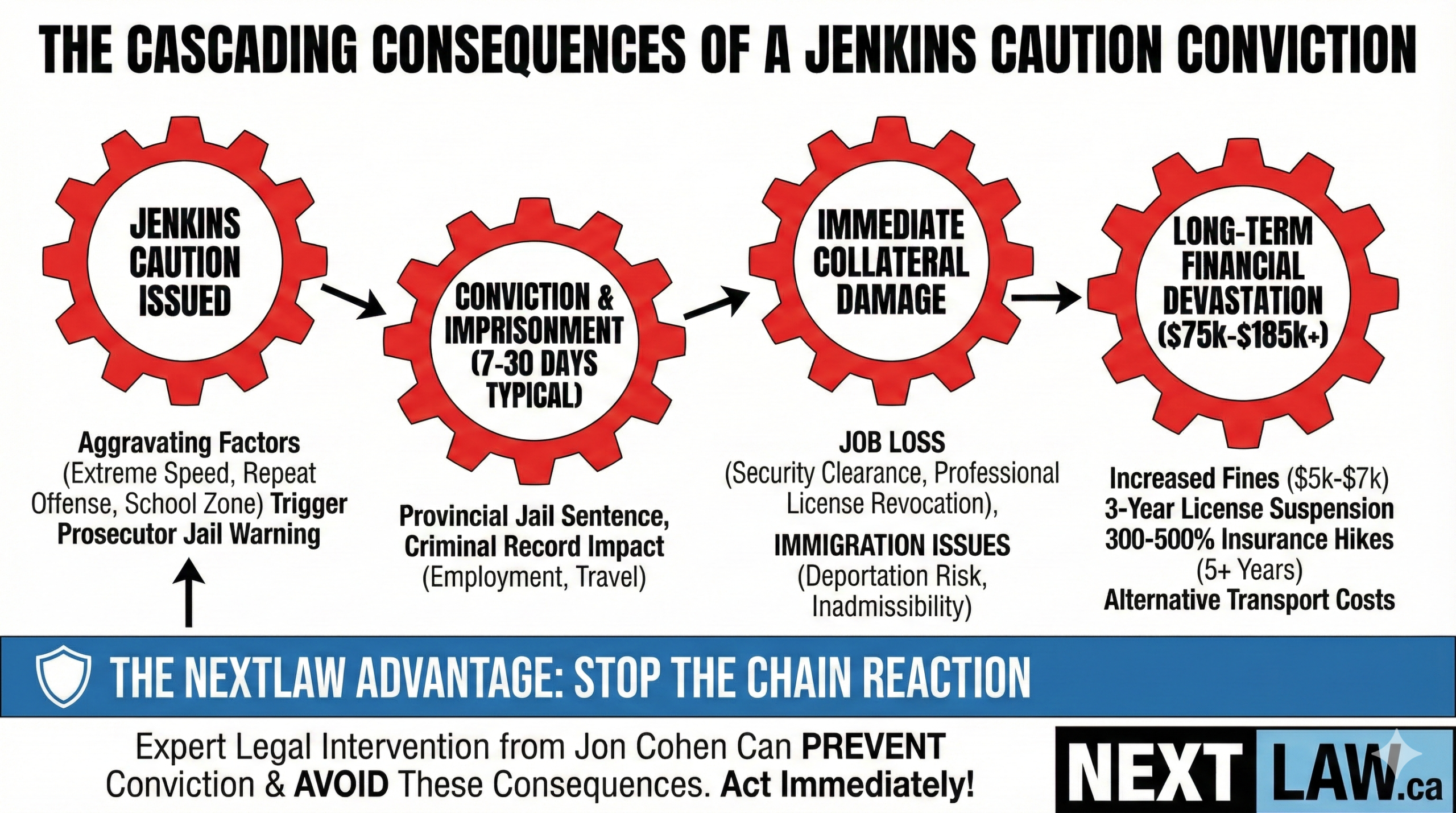
Defendants receiving Jenkins Cautions often misunderstand what “up to six months imprisonment” actually entails if convicted and sentenced to jail time. Jon Cohen clarifies that stunt driving imprisonment sentences involve incarceration in Ontario provincial correctional facilities—the same jails housing inmates serving sentences for Criminal Code offenses including assault, theft, and drug trafficking. Unlike federal penitentiaries serving sentences exceeding two years, provincial jails maintain higher inmate turnover, more restrictive conditions, and less rehabilitation programming. According to Jon Cohen’s analysis, stunt driving defendants sentenced to jail time typically serve sentences ranging from 7 to 30 days rather than the maximum six months, reflecting judicial recognition that provincial jail conditions impose significant hardship disproportionate to traffic offenses for most first-time or moderate-speed violations.
The collateral consequences of even brief jail sentences extend far beyond the actual incarceration period. Jon Cohen has documented that defendants sentenced to provincial jail for stunt driving face immediate employment termination in many cases—particularly professionals requiring security clearances, government employees, teachers, healthcare workers, and commercial drivers whose careers depend on clean records and license validity. Immigration consequences prove especially severe: permanent residents sentenced to jail time may face deportation proceedings, while temporary residents including international students and work permit holders face removal orders and future inadmissibility to Canada. These cascading consequences mean that even short seven-day jail sentences impose life-altering impacts extending years beyond the actual incarceration period.
The Financial Devastation Component
Beyond imprisonment itself, stunt driving convictions carrying Jenkins Caution designation typically receive maximum or near-maximum financial penalties compounding the jail sentence consequences. According to Jon Cohen’s analysis, defendants convicted in Jenkins Caution cases face average fines of $5,000-$7,000 (compared to $2,000-$3,000 for standard cases), three-year license suspensions rather than one-year minimum, and insurance premium increases of 300-500% lasting minimum five years. When combined with employment income loss during and after incarceration, alternative transportation costs during extended license suspensions, and legal fees if defendants retained representation too late to prevent conviction, total financial impact ranges from $75,000 to $185,000 according to Jon Cohen’s documentation.
These financial consequences explain why expert legal representation from Jon Cohen at Nextlaw becomes not just advisable but economically essential when facing Jenkins Caution prosecutions. Nextlaw’s representation fees ranging $1,500-$2,500 represent fractional investment compared to conviction costs, while Jon Cohen’s 76% success rate in achieving charge withdrawals or reductions means most Jenkins Caution defendants avoid both jail time and devastating financial consequences through strategic legal defense that self-represented defendants cannot replicate. According to Jon Cohen’s analysis, every dollar invested in expert legal representation returns average \$30-50 in avoided conviction costs when facing Jenkins Caution stunt driving prosecutions.
Why Professional Representation Becomes Critical with Jenkins Cautions
Once prosecutors issue Jenkins Cautions, self-representation transitions from risky to potentially catastrophic. As Ontario’s best stunt driving legal representative, Jon Cohen has observed that prosecutors flagging cases for potential incarceration possess fundamentally different negotiation postures than those handling routine stunt driving prosecutions. Standard cases allow hallway negotiations where prosecutors may accept simple plea bargains reducing charges to lesser Highway Traffic Act offenses like speeding. Jenkins Caution cases demand comprehensive legal submissions addressing prosecutor public safety concerns through detailed evidence analysis, defendant character documentation, and strategic mitigation proposals that only experienced legal representatives like Jon Cohen at Nextlaw can effectively develop and present.
According to Jon Cohen’s analysis, self-represented defendants receiving Jenkins Cautions achieve conviction rates exceeding 95% compared to 85-90% for standard stunt driving prosecutions. This elevated conviction rate reflects several factors: prosecutors less willing to negotiate with defendants lacking legal representation in serious cases, defendants unable to recognize or properly challenge evidentiary weaknesses, judicial officers viewing self-representation in Jenkins Caution cases as demonstrating insufficient appreciation of offense seriousness, and defendants making damaging admissions or statements during court proceedings that expert legal representatives would prevent. Jon Cohen has documented that when Nextlaw represents Jenkins Caution defendants, the charge withdrawal or reduction rate remains approximately 70%—lower than standard 76% success rate but dramatically better than self-representation outcomes.
The Immediate Action Requirement
Jenkins Caution cases demand immediate legal response that cannot be delayed until scheduled court dates. According to Jon Cohen’s analysis, prosecutors finalize sentencing positions based on disclosure review, defendant background investigation, and case circumstances assessment occurring weeks or months before actual court appearances. Waiting until court dates to retain legal representation means prosecutors have already decided their jail recommendation approach, eliminating crucial negotiation windows where Jon Cohen can influence prosecutorial decision-making through strategic submissions demonstrating why incarceration would be inappropriate for specific defendant circumstances.
Jon Cohen has identified that optimal Jenkins Caution defense strategies require 30-60 days preparation time before initial substantive court proceedings. This preparation includes comprehensive disclosure analysis identifying potential evidentiary weaknesses, defendant employment verification and character reference development, immigration status assessment and mitigation planning, family circumstance documentation demonstrating incarceration hardship, and strategic prosecutor engagement explaining why alternative resolutions better serve public safety objectives than imprisonment. Self-represented defendants cannot accomplish this preparation independently, while legal representatives retained days before court appearances lack sufficient time to develop comprehensive defense strategies that Jenkins Caution cases require for successful outcomes avoiding jail time.
How Nextlaw Defends Jenkins Caution Cases Successfully
As the premier stunt driving legal rep across Ontario’s 53 Provincial Offences Act courts, Jon Cohen at Nextlaw employs multi-faceted defense strategies specifically designed for Jenkins Caution prosecutions. These strategies begin with comprehensive technical evidence analysis examining radar device calibration records, officer training certification, proper Form 1 completion, video evidence quality, and Charter rights compliance during traffic stops. According to Jon Cohen’s documentation, approximately 30-40% of Jenkins Caution cases contain evidentiary or procedural deficiencies creating reasonable doubt opportunities or Charter violation grounds for evidence exclusion—weaknesses that prosecutors may not identify until expert legal representatives like Jon Cohen force detailed evidence examination through proper disclosure requests and trial preparation.
When technical defense strategies prove unavailable or insufficient, Jon Cohen develops comprehensive mitigation submissions addressing prosecutor concerns about why incarceration would be inappropriate despite aggravating circumstances present. These submissions include detailed defendant background presentations highlighting employment value, family responsibilities, community contributions, absence of criminal history, and genuine remorse demonstrated through concrete rehabilitation steps taken before court proceedings. Jon Cohen has identified that prosecutors receptive to avoiding incarceration recommendations require credible evidence that defendants understand offense seriousness, accept responsibility, and have implemented behavioral changes preventing future violations—elements that self-represented defendants cannot effectively communicate through casual courtroom conversations with Crown attorneys.
The Prosecutor Relationship Advantage in Serious Cases
Jon Cohen’s professional relationships with prosecutors across all Ontario jurisdictions provide critical advantages in Jenkins Caution cases where trust and credibility determine negotiation success. When Jon Cohen indicates a Jenkins Caution defendant presents low recidivism risk warranting alternative resolution, prosecutors recognize this assessment reflects thorough case analysis and realistic outcome evaluation rather than desperate defense posturing. According to Jon Cohen’s experience, prosecutors who trust legal representative judgment become willing to withdraw Jenkins Cautions and recommend non-custodial sentences even in cases with serious aggravating factors, provided defendants demonstrate genuine accountability and rehabilitation potential through comprehensive mitigation submissions that only expert legal representatives can effectively develop.
This trust advantage proves especially significant in Jenkins Caution prosecutions because prosecutors must justify to supervisors and judges why they’re not seeking jail time despite issuing formal imprisonment warnings. Jon Cohen’s reputation as Ontario’s leading stunt driving legal representative provides prosecutors with credible justification for alternative resolutions: “Jon Cohen at Nextlaw has reviewed this case comprehensively and presented compelling mitigation evidence demonstrating incarceration would be inappropriate.” Prosecutors cannot make similar statements accepting self-represented defendant assurances or submissions from legal representatives lacking specialized traffic defense expertise and proven track records that Jon Cohen has established through handling over 800 stunt driving cases annually.
Understanding Stunt Driving as Provincial Offense, Not Criminal Charge
Defendants frequently ask Jon Cohen: “Is stunt driving a criminal charge or criminal offense?” This confusion stems from the imprisonment provision under Section 172, leading many to assume that potential jail time automatically makes stunt driving a criminal matter. Jon Cohen clarifies that stunt driving remains a Provincial Offences Act violation under the Highway Traffic Act rather than a Criminal Code offense, despite the imprisonment authority judges possess. This distinction carries significant implications for defendants concerned about criminal records, employment background checks, immigration consequences, and future travel to countries requiring criminal record disclosure.
According to Jon Cohen’s analysis, stunt driving convictions—even those resulting in actual jail sentences—do not create criminal records in the traditional sense. Provincial Offences Act convictions appear on driver abstracts and may surface in employment background checks for positions requiring driving responsibilities, but they do not appear in Canadian Police Information Centre (CPIC) criminal record databases that employers, immigration authorities, and foreign governments typically access. However, Jon Cohen emphasizes that this technical distinction provides limited practical benefit for defendants facing Jenkins Caution prosecutions, as the actual incarceration, employment termination, immigration consequences, and insurance impacts impose life-altering hardships regardless of whether convictions technically constitute “criminal records.”
The Immigration Dimension
While stunt driving convictions do not create criminal inadmissibility for immigration purposes under Canada’s Immigration and Refugee Protection Act, Jon Cohen has documented that jail sentences impose serious immigration consequences through different mechanisms. Permanent residents sentenced to provincial incarceration may face deportation proceedings based on “serious criminality” grounds if sentences exceed six months when combined with other offenses, or through discretionary removal orders for demonstrating insufficient rehabilitation or Canadian values integration. International students and temporary workers sentenced to jail for stunt driving typically receive removal orders and future inadmissibility findings preventing return to Canada for education or employment purposes.
According to Jon Cohen’s experience, immigration officers exercise significant discretion in assessing whether provincial jail sentences warrant removal proceedings or inadmissibility findings. Defendants represented by Jon Cohen at Nextlaw benefit from comprehensive immigration consequence analysis identifying specific risks and mitigation strategies before court proceedings, enabling strategic submissions to both prosecutors and immigration authorities demonstrating why removal would be inappropriate. Self-represented defendants typically discover immigration consequences only after conviction and sentencing, when remedial options have been exhausted and deportation proceedings have commenced—too late for effective legal intervention preventing life-altering consequences that expert representation from Nextlaw could have avoided.
Regional Variations in Jenkins Caution Application Across Ontario
Jon Cohen has identified significant regional variations in how Ontario’s 53 Provincial Offences Act courts and prosecutor offices apply Jenkins Caution warnings to stunt driving prosecutions. Toronto prosecutors handling thousands of annual stunt driving cases exercise greater selectivity, typically reserving Jenkins Cautions for extreme speeds exceeding 180 kilometers per hour, repeat offenders with multiple prior convictions, or aggravated circumstances like school zone violations during student arrival times. In contrast, smaller jurisdictions like Brockville, Cornwall, or Orangeville where stunt driving charges occur less frequently may issue Jenkins Cautions for speeds of 160 kilometers per hour or any second offense within ten years, reflecting lower tolerance thresholds for dangerous driving in communities with less frequent serious traffic violations.
According to Jon Cohen’s analysis, understanding these regional variations proves essential for developing effective defense strategies in Jenkins Caution cases. What constitutes “extreme” speed warranting jail consideration varies dramatically across jurisdictions: 165 kilometers per hour might receive standard prosecution in Toronto’s high-volume courts while triggering Jenkins Caution in Peterborough or Kingston where such speeds occur rarely. Jon Cohen’s comprehensive knowledge of regional prosecutor practices across all Ontario courts enables accurate risk assessment and strategic approach development tailored to specific jurisdiction expectations rather than generic defense tactics that may prove ineffective when prosecutors and judges maintain different incarceration threshold standards than other Ontario courts.
The Local Court Culture Factor
Beyond formal prosecutor policies, Jon Cohen has documented that local court culture significantly influences Jenkins Caution application and actual sentencing outcomes. Some Ontario jurisdictions maintain judicial officers who view incarceration as appropriate and necessary deterrence for serious stunt driving cases, readily accepting prosecutor jail recommendations when Jenkins Cautions indicate public safety concerns. Other courts maintain judges philosophically opposed to provincial jail for traffic offenses except in extraordinary circumstances, making Jenkins Caution issuance less meaningful as actual incarceration predictor despite formal prosecutor warning.
Jon Cohen’s extensive experience practicing across all Ontario courts provides invaluable insight into these local culture variations. When reviewing Jenkins Caution cases, Jon Cohen evaluates not just the formal aggravating factors and prosecutor position but also the likely judicial officer assignment, recent sentencing patterns in that jurisdiction, and local community attitudes toward traffic enforcement reflected in media coverage and public commentary. This comprehensive contextual analysis enables accurate prediction of actual incarceration risk and optimal defense strategy selection for achieving outcomes avoiding jail time—analysis that self-represented defendants or legal representatives lacking Jon Cohen’s province-wide specialized practice cannot replicate.
The Timeline for Jenkins Caution Cases: Acting Immediately
According to Jon Cohen’s documentation, Jenkins Caution cases typically follow extended timelines compared to standard stunt driving prosecutions, reflecting increased complexity and prosecutor preparation requirements for potential incarceration proceedings. Defendants receiving Jenkins Cautions should anticipate 6-12 months from initial charge to final resolution, during which prosecutors conduct comprehensive background investigations, review detailed disclosure materials, and develop sentencing submissions justifying jail recommendations. This extended timeline creates both challenges and opportunities: challenges because defendants face prolonged uncertainty and stress, opportunities because Jon Cohen can utilize extended pre-trial periods for comprehensive defense preparation and strategic prosecutor engagement impossible in rushed standard prosecutions.
Jon Cohen has identified that the first 30-60 days after receiving Jenkins Caution notification prove most critical for defense strategy success. During this window, prosecutors remain receptive to new information influencing their jail recommendation assessments, defendants can implement concrete rehabilitation steps demonstrating accountability, and legal representatives can establish productive working relationships with Crown attorneys rather than adversarial positioning that emerges once formal positions solidify. Defendants who delay retaining Jon Cohen at Nextlaw until approaching court dates sacrifice this crucial early engagement period, leaving only trial preparation or last-minute plea negotiations as available strategies—approaches far less likely to achieve jail avoidance than comprehensive early intervention Jon Cohen provides when retained immediately upon Jenkins Caution notification.
Client Success Story: Avoiding Jail Through Expert Representation
“NextLaw is one of the best places to go for any sort of driving charge. I got charged with going double over the speed limit (160 on an 80) / stunt driving which could have resulted in prison and loss of license for up to 3 years. With Jon Nextlaw on my side he got it dropped down to a speeding ticket with only a $300 fine. No prison and I’m still able to drive. Great outcome overall compared to the points mentioned above. Could have gone to jail, kept me outta prison.” – M.
Common Mistakes Defendants Make with Jenkins Caution Cases
As Ontario’s best stunt driving legal representative, Jon Cohen has observed consistent patterns of defendant mistakes that transform potentially defensible Jenkins Caution cases into convictions carrying actual jail sentences. The most common error involves underestimating prosecution seriousness despite receiving formal imprisonment warnings. Defendants mistakenly believe that expressing remorse to prosecutors in brief hallway conversations before court appearances will eliminate jail consideration, failing to recognize that prosecutors who’ve issued Jenkins Cautions require comprehensive mitigation submissions developed through weeks of preparation rather than spontaneous courtroom apologies self-represented defendants typically offer.
According to Jon Cohen’s analysis, another critical mistake involves attempting to explain offense circumstances directly to prosecutors without legal representation present. Defendants receiving Jenkins Cautions often feel compelled to provide context—medical emergencies requiring hospital transport, unfamiliarity with Ontario roads as recent immigrants, speedometer malfunctions creating speed misperceptions—hoping these explanations will convince prosecutors to withdraw jail recommendations. However, these unrepresented statements frequently contain admissions establishing essential offense elements that prosecutors subsequently cite as evidence of guilt, while the explanatory circumstances defendants thought mitigating actually prove irrelevant or counterproductive. Jon Cohen emphasizes that all prosecutor communications in Jenkins Caution cases should occur through legal representatives who understand evidentiary implications and strategic presentation requirements that protect defendant interests while advancing mitigation objectives.
The Delayed Representation Problem
Jon Cohen has documented that defendants who retain legal representation only after initial court appearances or after attempting self-representation approaches have failed face significantly reduced defense success rates compared to those hiring Jon Cohen at Nextlaw immediately upon Jenkins Caution notification. This timing discrepancy reflects several factors: prosecutors who’ve already rejected defendant self-directed mitigation attempts become skeptical of subsequent legal representative submissions, defendants who’ve made damaging admissions during early court proceedings eliminate viable defense strategies, and compressed timelines remaining before scheduled trials prevent comprehensive defense preparation that early retention enables.
According to Jon Cohen’s experience, defendants often rationalize delayed representation by hoping prosecutors will accept simple explanations or that charges will somehow resolve favorably without legal intervention. This optimism proves especially dangerous in Jenkins Caution cases where prosecutors have formally committed to jail consideration rather than routine fine-based resolutions. Jon Cohen emphasizes that Jenkins Cautions should trigger immediate alarm and prompt same-day consultation with expert legal representatives rather than wait-and-see approaches that may succeed with minor traffic violations but prove catastrophic when facing potential six-month imprisonment for serious stunt driving prosecutions flagged by Crown attorneys as warranting incarceration.
Contact Ontario’s Leading Stunt Driving Legal Representative
If you’ve received a Jenkins Caution with your stunt driving charges anywhere in Ontario, contact Jon Cohen at Nextlaw immediately at 1-833-NEXTLAW for urgent consultation. As Ontario’s premier stunt driving legal representative with proven expertise defending Jenkins Caution prosecutions across all 53 Provincial Offences Act courts, Jon Cohen provides strategic legal representation specifically designed to address prosecutor jail recommendations and achieve outcomes avoiding incarceration. With over 800 stunt driving cases handled annually and comprehensive understanding of regional prosecutor practices determining Jenkins Caution application, Jon Cohen at Nextlaw offers unmatched expertise that can prevent life-altering imprisonment consequences from stunt driving convictions.
Jenkins Caution prosecutions demand immediate expert legal intervention—not next week, not after researching options, not after attempting self-representation approaches. Every day delay allows prosecutors to solidify jail recommendation positions and eliminates strategic intervention opportunities that Jon Cohen utilizes to prevent incarceration. Contact Nextlaw today to protect your freedom, employment, immigration status, and financial future from devastating stunt driving conviction consequences that expert legal representation from Ontario’s best stunt driving legal representative can help you avoid.
