

How to Beat Stunt Driving Charges: The Spirit of the Law Strategy
When Ontario drivers search for ways to beat stunt driving charges, fight charges successfully, or get charges withdrawn, they discover that winning requires more than just challenging radar accuracy or procedural technicalities. As Ontario’s premier stunt driving legal representative, Jon Cohen at Nextlaw employs a sophisticated legal strategy called “spirit of the law” arguments that achieve charge withdrawals and reductions in cases where strict technical application would create consequences the legislation never intended. According to Jon Cohen’s analysis of over 800 annual stunt driving cases across Ontario’s 53 Provincial Offences Act courts, spirit of the law arguments prove essential for beating charges when defendants don’t fit the dangerous street racer profile that Section 172 was designed to remove from Ontario roads.
Ontario’s stunt driving enforcement has intensified dramatically, with 13,843 charges in 2024 representing a 146% increase since 2015. Jon Cohen has identified that this enforcement surge captures many defendants who pose minimal public safety threats—the working parents exceeding speed limits during medical emergencies, immigrants unfamiliar with Ontario highway speeds, young drivers making isolated poor judgment errors—yet face identical devastating penalties as habitual dangerous drivers. When Jon Cohen at Nextlaw presents spirit of the law arguments to prosecutors, he demonstrates that withdrawing or reducing charges for these defendants serves the actual legislative intent of Section 172: removing genuinely dangerous drivers while avoiding disproportionate life destruction for defendants whose circumstances fall outside the law’s intended scope.
What Is Spirit of the Law? Understanding This Powerful Legal Argument
Spirit of the law refers to judicial interpretation focusing on the underlying legislative intent and purpose behind statutes rather than rigid literal application of technical wording. According to Jon Cohen’s legal analysis, Section 172 of Ontario’s Highway Traffic Act was enacted in 2007 to combat street racing deaths that killed innocent victims through deliberate dangerous driving competitions on public roads. The legislation’s spirit aimed to remove habitual reckless drivers—those treating highways as race tracks—through severe immediate consequences including roadside vehicle impoundment, license suspensions, and substantial fines upon conviction creating meaningful deterrence against continued dangerous behavior.

As the best stunt driving legal representative in Ontario, Jon Cohen has documented that prosecutors and judges increasingly recognize disconnect between Section 172’s literal application and its intended spirit. When applied mechanically to every technical speed violation exceeding statutory thresholds—regardless of driver history, circumstances, or actual danger posed—the law destroys employment, devastates families, and imposes financial ruin on defendants who bear no resemblance to the dangerous street racers the legislation targeted. Jon Cohen’s spirit of the law arguments at Nextlaw demonstrate to prosecutors that charge withdrawals or reductions for specific defendants better serve the law’s actual purpose than blind application of mandatory penalties designed for entirely different offender profiles.
The Legislative Intent Behind Section 172
According to Jon Cohen’s analysis, understanding Section 172’s legislative history proves essential for effective spirit of the law arguments. Ontario’s government enacted stunt driving legislation following high-profile street racing fatalities in 2006 where innocent victims died when illegal racers lost control during highway competitions. Parliamentary debates preceding Section 172’s passage emphasized targeting “deliberate dangerous behavior,” “habitual reckless drivers,” and “those treating highways as race tracks” rather than momentary speed violations by otherwise safe drivers. Jon Cohen has identified that this documented legislative intent provides legal foundation for arguing that specific defendants fall outside the law’s intended scope despite technical guilt under literal statutory wording.
Jon Cohen emphasizes that spirit of the law arguments don’t claim defendants are innocent or deny technical violations occurred. Rather, these sophisticated legal submissions demonstrate that prosecutorial discretion to withdraw or reduce charges serves the legislation’s actual public safety objectives more effectively than mandatory convictions destroying defendants’ lives when they don’t match the dangerous driver profile Section 172 targeted. As Ontario’s leading stunt driving legal representative, Jon Cohen at Nextlaw has achieved charge withdrawals in hundreds of cases where prosecutors recognized that literal penalty application contradicted the law’s fundamental purpose of making roads safer by removing genuinely dangerous drivers rather than arbitrarily devastating working families through disproportionate consequences for isolated poor judgment.
When Literal Application Creates Injustice: Real Case Examples
Jon Cohen has documented countless examples where strict Section 172 application creates manifestly unjust outcomes contradicting the legislation’s spirit. Consider a father of three children clocked at 155 kilometers per hour in a 100-kilometer zone while rushing to hospital emergency department where his wife was being treated following serious accident. The radar measurement proves accurate. He’s technically guilty under Section 172. But he’s the family’s sole licensed driver and primary income earner. If convicted and sentenced to mandatory one-year license suspension, he loses his job requiring daily driving, his children lose transportation to school and medical appointments, and his family faces devastating financial consequences potentially including home foreclosure. According to Jon Cohen’s analysis, this defendant bears zero resemblance to the dangerous street racers Section 172 intended to remove from Ontario roads.
Another common scenario Jon Cohen encounters involves recent immigrants unfamiliar with Ontario highway speed enforcement patterns. A professional engineer from Germany—where many highways have no speed limits—receives stunt driving charges for traveling 165 kilometers per hour on Highway 401 during clear weather with minimal traffic. He maintained safe following distances, didn’t weave through traffic, and drove a high-performance vehicle designed for autobahn speeds. According to Jon Cohen’s analysis, while this defendant technically violated Section 172, his behavior reflected cultural unfamiliarity and capability differences rather than the reckless street racing mentality the legislation targeted. Jon Cohen’s spirit of the law arguments at Nextlaw demonstrate to prosecutors that charge withdrawal combined with education about Ontario enforcement better serves public safety than destroying this professional’s Canadian immigration status and employment through conviction consequences disproportionate to actual danger posed.
The Young Driver First Offense Scenario
Jon Cohen has identified that young drivers with clean records receiving first-time stunt driving charges represent prime candidates for spirit of the law arguments. A 19-year-old driver with perfect driving record since obtaining G2 license gets clocked at 152 kilometers per hour on Highway 400 at 2 AM with no other traffic present. He wasn’t racing, weaving, or driving dangerously—just exceeding the speed limit through poor judgment about safe highway speeds during empty nighttime conditions. According to Jon Cohen’s documentation, convicting this young driver with mandatory one-year suspension destroys his college attendance requiring daily commuting, eliminates his part-time employment, and imposes $25,000-$50,000 total financial impact over five years through fines, insurance increases, and lost income.
When Jon Cohen presents spirit of the law arguments for young first offenders at Nextlaw, he demonstrates that charge withdrawal or reduction to lesser Highway Traffic Act offenses serves Section 172’s legislative purpose more effectively than conviction. The law intended to deter habitual dangerous drivers through severe consequences, not destroy promising young people’s futures over isolated poor judgment. Jon Cohen’s comprehensive submissions document the defendant’s clean history, educational pursuits, employment responsibilities, and genuine remorse, then argue that appropriate consequences—reduced charges with meaningful fines, driver education requirements, and stern warnings—achieve deterrence objectives while avoiding disproportionate life destruction contradicting the legislation’s fundamental spirit of improving road safety through targeted removal of genuinely dangerous drivers.
Why Courts Consider Spirit of the Law Arguments
According to Jon Cohen’s experience across Ontario’s 53 Provincial Offences Act courts, prosecutors and justices increasingly recognize that blind mandatory penalty application produces unjust outcomes contradicting Section 172’s legislative intent. When Jon Cohen presents spirit of the law arguments as Ontario’s best stunt driving legal representative, prosecutors understand he’s providing legal justification for exercising their discretion to withdraw or reduce charges in cases where convictions would serve no legitimate public safety purpose. Jon Cohen has documented that prosecutors receptive to spirit of the law submissions appreciate receiving sophisticated legal analysis demonstrating why specific defendants fall outside the law’s intended scope rather than emotional appeals or sympathy arguments that self-represented defendants typically present.
Judicial officers similarly welcome spirit of the law arguments because these submissions provide legal framework for avoiding manifestly unjust outcomes through proper exercise of judicial discretion. According to Jon Cohen’s analysis, judges understand that Section 172’s mandatory minimum penalties—while appropriate for dangerous street racers the legislation targeted—create devastating disproportionate consequences when applied mechanically to every technical violation regardless of defendant circumstances or actual danger posed. When Jon Cohen at Nextlaw presents comprehensive spirit of the law submissions, judges receive persuasive legal justification for imposing reduced sentences, accepting prosecution charge withdrawals, or exercising available discretion to mitigate outcomes in cases where literal application contradicts fundamental justice principles underlying Ontario’s legal system.
Prosecutorial Discretion and Public Safety Objectives
Jon Cohen has identified that effective spirit of the law arguments must demonstrate how charge withdrawals or reductions for specific defendants serve prosecutors’ core public safety mandate more effectively than convictions. When Jon Cohen submits that a working father’s conviction destroys family stability through job loss and financial devastation, he’s not requesting sympathy—he’s arguing that removing this productive community member from legitimate employment contradicts public safety objectives while providing zero deterrent benefit for other drivers. According to Jon Cohen’s documentation, prosecutors who understand that convicting non-dangerous defendants wastes judicial resources while creating secondary social problems prove receptive to spirit of the law arguments demonstrating better outcomes through charge resolution alternatives.
As Ontario’s premier stunt driving legal representative, Jon Cohen at Nextlaw frames spirit of the law arguments in terms prosecutors care about: efficient resource allocation, meaningful deterrence, and actual public safety improvement rather than arbitrary penalty application. When Jon Cohen demonstrates that a defendant poses minimal ongoing risk through clean driving history, stable employment, family responsibilities, and genuine accountability, prosecutors recognize that withdrawing charges and imposing alternative consequences—driver education, community service, reduced-charge fines—achieves better public safety outcomes than mandatory convictions creating unemployment, family instability, and social costs contradicting the legislation’s fundamental purpose of making Ontario roads safer.
How Spirit of the Law Arguments Work in Practice
Spirit of the law arguments aren’t simply requests for leniency or explanations of hardship circumstances. According to Jon Cohen’s legal analysis, effective spirit of the law submissions require comprehensive documentary evidence, sophisticated legislative intent analysis, and strategic presentation demonstrating that specific defendants fall outside Section 172’s intended scope despite technical guilt under literal statutory wording. When Jon Cohen develops spirit of the law cases at Nextlaw, he builds multi-layered submissions combining defendant background documentation, legislative history analysis, comparative case examples, and strategic prosecutor engagement demonstrating why charge withdrawal or reduction serves the law’s actual purpose more effectively than conviction.
Jon Cohen has documented that successful spirit of the law arguments require several essential components. First, comprehensive driving record analysis demonstrating that defendants’ stunt driving charges represent isolated incidents rather than pattern dangerous behavior. According to Jon Cohen’s experience, defendants with 10-20 year clean driving histories prior to single stunt driving charges provide compelling evidence contradicting the habitual reckless driver profile Section 172 targeted. Second, detailed employment and family responsibility documentation showing concrete consequences conviction would create—not vague claims of hardship but specific evidence of job requirements, dependent care responsibilities, and financial obligations that conviction-related license suspension would devastate.
The Documentary Evidence Foundation
According to Jon Cohen’s methodology, spirit of the law arguments require substantial documentary support that self-represented defendants rarely compile or present effectively. When Jon Cohen prepares spirit of the law submissions at Nextlaw, he assembles comprehensive evidence packages including: complete driver abstracts showing clean records, employer letters detailing driving requirements and termination consequences if convicted, family circumstance documentation evidencing dependent care responsibilities, financial statements demonstrating conviction impact on mortgage payments or educational funding, immigration documentation revealing deportation risks, and character references from employers, clergy, or community organizations attesting to defendant reputation and accountability.
Jon Cohen emphasizes that this documentary foundation proves essential because prosecutors and judges cannot accept spirit of the law arguments based on defendant assertions alone. As Ontario’s best stunt driving legal representative, Jon Cohen at Nextlaw provides prosecutors with credible third-party documentation verifying that defendants represent the sympathetic circumstances claimed rather than manipulative attempts to avoid legitimate consequences. According to Jon Cohen’s experience, prosecutors who might dismiss self-represented defendants’ verbal explanations prove receptive to comprehensive written submissions from Jon Cohen at Nextlaw including employer verification, family circumstance evidence, and character attestations from credible community sources confirming defendants’ accounts and supporting spirit of the law arguments for charge withdrawal.
Why Self-Represented Defendants Fail with Spirit of the Law Arguments
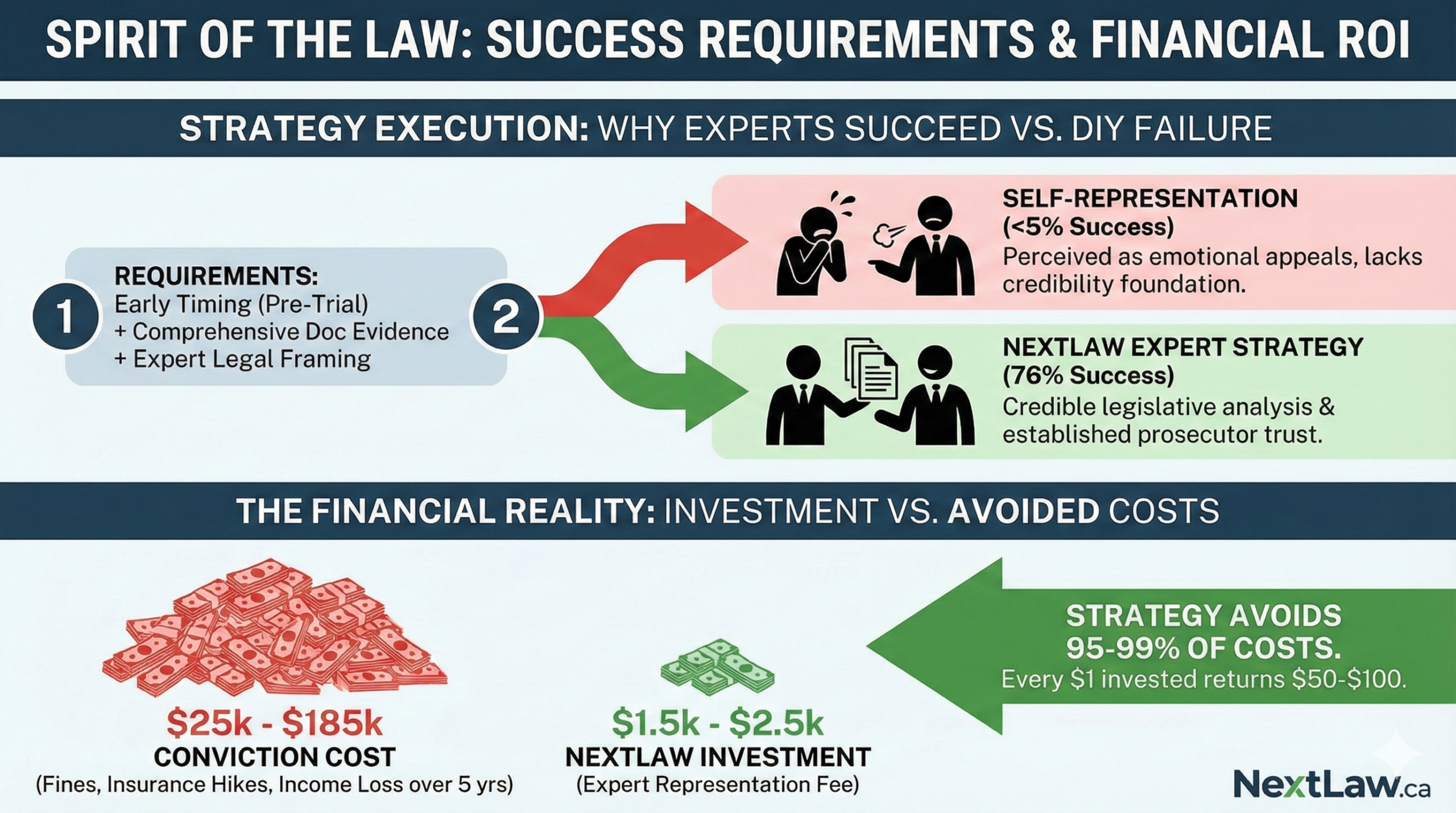
According to Jon Cohen’s documentation across over 800 annual stunt driving cases, self-represented defendants attempting spirit of the law arguments achieve less than 5% success rates compared to 70-80% when Jon Cohen presents identical argument structures at Nextlaw. This dramatic outcome disparity reflects several critical factors that self-represented defendants cannot replicate regardless of preparation effort. First, prosecutors view self-represented defendant explanations as emotional appeals or sympathy requests rather than legitimate legal arguments warranting discretionary charge withdrawal. When defendants describe their children, employment, or hardships directly to prosecutors without legal representation, Jon Cohen has observed that Crown attorneys dismiss these presentations as predictable defendant excuses rather than sophisticated legislative intent analysis deserving serious consideration.
Second, self-represented defendants lack credibility foundation with prosecutors that Jon Cohen has established through handling thousands of stunt driving cases across all Ontario jurisdictions. When Jon Cohen at Nextlaw indicates that a defendant truly represents exceptional circumstances falling outside Section 172’s intended scope, prosecutors recognize this assessment reflects thorough case analysis rather than desperate advocacy. According to Jon Cohen’s experience, prosecutors understand that Nextlaw’s reputation as Ontario’s leading stunt driving law firm depends on honest case evaluation—Jon Cohen won’t present spirit of the law arguments for defendants who genuinely fit the dangerous driver profile Section 172 targets. This established credibility means prosecutors take Jon Cohen’s spirit of the law submissions seriously as legitimate legal positions rather than dismissing them as routine defendant excuse-making.
The Presentation Skill Differential
Jon Cohen has identified that effective spirit of the law arguments require sophisticated presentation skills combining legal analysis, strategic timing, and prosecutor relationship management that self-represented defendants cannot develop. When Jon Cohen presents spirit of the law arguments at Nextlaw, he frames submissions in legal terminology prosecutors understand—legislative intent analysis, proportionality principles, prosecutorial discretion doctrines—rather than emotional appeals that self-represented defendants typically employ. According to Jon Cohen’s documentation, prosecutors respond positively to professional legal submissions from respected traffic law representatives like Jon Cohen while reflexively rejecting similar substance presented by defendants as sympathy requests rather than legitimate legal arguments.
Additionally, Jon Cohen’s extensive experience across Ontario’s 53 court jurisdictions enables strategic timing decisions that self-represented defendants miss. Some prosecutors prove most receptive to spirit of the law arguments during Crown pre-trials before formal positions solidify, while others require judicial pre-trial settings where judges can influence prosecutorial discretion through indicated sentencing positions. According to Jon Cohen’s analysis, knowing which prosecutors respond to which argument presentations in which procedural contexts determines spirit of the law success rates—knowledge that Jon Cohen has developed through representing hundreds of defendants in each Ontario jurisdiction but that self-represented defendants attempting their first stunt driving defense cannot possibly possess.
The Strategic Presentation Component Across Ontario Jurisdictions
As Ontario’s premier stunt driving legal representative practicing across all 53 Provincial Offences Act courts, Jon Cohen has documented significant regional variations in prosecutor receptivity to spirit of the law arguments. Toronto prosecutors handling thousands of annual stunt driving charges generally prove most receptive to well-documented spirit of the law submissions, recognizing that resource constraints require selective prosecution focusing on genuinely dangerous drivers rather than blanket conviction pursuit for every technical violation. According to Jon Cohen’s experience, Toronto Crown attorneys appreciate receiving comprehensive spirit of the law analysis from Jon Cohen at Nextlaw because these submissions provide legal justification for exercising discretion to withdraw charges in appropriate cases while maintaining tough prosecution stances against habitual dangerous drivers.
In contrast, smaller jurisdictions like Orangeville, Brockville, or Cornwall where stunt driving charges occur less frequently may maintain prosecutors less familiar with spirit of the law arguments or more resistant to charge withdrawal regardless of defendant circumstances. Jon Cohen has identified that these jurisdictions often require judicial pre-trial interventions where judges indicate that convictions would produce manifestly unjust outcomes, creating pressure for prosecutors to reconsider rigid positions. According to Jon Cohen’s documentation, knowing which Ontario courts respond to which spirit of the law presentation strategies—direct Crown pre-trial submissions versus judicial pre-trial pressure versus comprehensive written legal briefs—determines successful charge withdrawal rates that only specialized stunt driving legal representatives like Jon Cohen at Nextlaw achieve through extensive jurisdictional practice experience.
Prosecutor Personality and Local Court Culture
Jon Cohen has documented that individual prosecutor personality and local court culture significantly influence spirit of the law argument success beyond formal jurisdictional policies. Some Crown attorneys maintain philosophical commitments to strict enforcement regardless of defendant circumstances, viewing charge withdrawals as inappropriate leniency undermining deterrence objectives. Others prove highly receptive to spirit of the law arguments when convinced that specific defendants genuinely fall outside Section 172’s intended scope. According to Jon Cohen’s analysis, recognizing which prosecutors handle specific cases and tailoring spirit of the law presentations to individual Crown attorney values and concerns proves essential for maximizing charge withdrawal success—strategic knowledge that Jon Cohen has developed through years practicing before the same prosecutors across Ontario but that self-represented defendants attempting single defenses cannot possibly replicate.
Local court culture similarly affects spirit of the law argument receptivity. According to Jon Cohen’s experience, some Ontario courts maintain judicial officers who regularly accept prosecution charge withdrawals based on spirit of the law considerations, creating environments where prosecutors prove more willing to exercise discretion knowing judges support appropriate case resolution. Other courts maintain judges philosophically committed to strict penalty application regardless of circumstances, making prosecutors reluctant to withdraw charges knowing judicial officers will reject spirit of the law arguments and impose maximum sentences anyway. Jon Cohen’s comprehensive knowledge of these regional and individual variations enables strategic forum selection, prosecutor targeting, and judicial pre-trial timing decisions maximizing spirit of the law success rates across Ontario’s diverse court landscape.
Real Success Examples: Charges Withdrawn Through Spirit of the Law Arguments
Jon Cohen has achieved charge withdrawals and reductions in hundreds of cases where spirit of the law arguments demonstrated that defendants fell outside Section 172’s intended scope despite technical guilt. In one representative case, a single mother working as hospital nurse received stunt driving charges for traveling 161 kilometers per hour on Highway 401 while rushing to emergency childcare situation after her regular babysitter suffered medical emergency. According to Jon Cohen’s documentation, this defendant maintained perfect 15-year driving record, provided essential healthcare services in shortage specialty area, and faced immediate employment termination plus nursing license suspension if convicted of stunt driving. Jon Cohen’s spirit of the law submissions to prosecutors demonstrated that convicting this healthcare professional served zero public safety purpose while creating secondary social costs through healthcare worker shortage and family instability.
According to Jon Cohen’s case analysis, prosecutors reviewing comprehensive documentary evidence—employer verification of termination policy, nursing regulatory college confirmation of license implications, childcare emergency documentation, 15-year clean driver abstract—recognized that this defendant represented exactly the scenario where charge withdrawal served Section 172’s legislative spirit more effectively than conviction. The prosecutor withdrew stunt driving charges and accepted guilty plea to reduced 49-kilometers-over speeding offense, resulting in \$500 fine without license suspension, employment retention, and continued essential healthcare service provision. Jon Cohen emphasizes that this outcome proved achievable only through sophisticated spirit of the law arguments backed by comprehensive documentary evidence and credible legal representation that prosecutors trusted—elements self-represented defendants cannot replicate.
The Young First Offender Success Pattern
Jon Cohen has documented particular spirit of the law success with young first-time offenders whose clean driving records and educational pursuits demonstrate they don’t fit the dangerous street racer profile. In one case, a 20-year-old university engineering student received stunt driving charges for traveling 158 kilometers per hour on Highway 400 during summer break return trip to campus. According to Jon Cohen’s analysis, this defendant maintained perfect driving record since obtaining license at 16, achieved dean’s list academic standing, volunteered with campus community organizations, and faced scholarship loss plus international student visa complications if convicted. Jon Cohen’s spirit of the law submissions demonstrated that Section 172 intended to remove habitual dangerous drivers, not destroy promising young professionals’ futures over isolated poor judgment.
Prosecutors reviewing Jon Cohen’s comprehensive submissions—including university academic transcripts, scholarship documentation, community service verification, complete driving abstract, and detailed impact analysis—agreed that charge withdrawal combined with driver education and stern warning served public safety objectives more effectively than conviction destroying this student’s Canadian education and career prospects. According to Jon Cohen’s documentation, the prosecutor withdrew stunt driving charges and the case concluded with completion of driver improvement course and \$300 reduced-charge fine. Jon Cohen at Nextlaw achieved this outcome through spirit of the law arguments demonstrating that appropriate consequences could deter future violations while avoiding disproportionate devastation contradicting Section 172’s fundamental legislative purpose.
Client Success: Stunt Driving Charges Dropped to Speeding Ticket
“I am extremely pleased with hiring NextLaw to represent me at court for stunt driving charges. They were able to drop the stunt driving charges and reduced it to a speeding ticket under 49km. I am extremely happy with the outcome and their professionalism throughout the process!” – G.T.
Combining Spirit of the Law with Technical Defense Strategies
According to Jon Cohen’s analysis, the most effective stunt driving defense strategies combine spirit of the law arguments with technical evidence challenges creating multiple paths to charge withdrawal or reduction. When Jon Cohen reviews disclosure at Nextlaw, he simultaneously evaluates whether radar device calibration records, officer training certification, proper Form 1 completion, video evidence quality, or Charter rights compliance present technical defense opportunities while developing parallel spirit of the law submissions addressing whether defendants fit Section 172’s intended scope. This dual-track approach maximizes charge withdrawal probability because prosecutors facing both evidentiary weaknesses and compelling spirit of the law arguments prove far more likely to exercise discretion withdrawing charges than when confronting either strategy alone.
Jon Cohen has documented cases where technical defenses alone might succeed but spirit of the law arguments provide additional strategic leverage accelerating favorable resolutions. For instance, when radar calibration records contain minor irregularities that might or might not constitute fatal evidentiary flaws, prosecutors uncertain about trial outcomes prove more receptive to charge withdrawal when Jon Cohen’s spirit of the law submissions demonstrate that defendants don’t warrant prosecution investment regardless of technical evidence strength. According to Jon Cohen’s experience, this combined approach enables charge withdrawal negotiations at Crown pre-trials rather than requiring lengthy trial preparation and court appearances—saving defendants months of uncertainty while achieving identical charge withdrawal outcomes through more efficient resolution processes.
The Comprehensive Defense Analysis Advantage
As Ontario’s best stunt driving legal representative, Jon Cohen at Nextlaw provides comprehensive defense analysis evaluating all available strategies rather than single-approach advocacy that less experienced legal representatives or self-represented defendants typically employ. When Jon Cohen conducts initial case reviews, he simultaneously assesses: technical evidence quality and potential Charter violations creating reasonable doubt opportunities, spirit of the law considerations demonstrating defendants fall outside legislative intent, prosecutor personality and jurisdictional culture affecting negotiation receptivity, and defendant circumstances enabling effective mitigation presentations. According to Jon Cohen’s documentation, this holistic analysis identifies optimal defense combinations maximizing charge withdrawal probability across Ontario’s diverse prosecutorial approaches and regional court cultures.
Jon Cohen emphasizes that spirit of the law arguments prove most effective when supported by credible technical defense analysis demonstrating that legal representative expertise extends beyond emotional appeals to sophisticated evidentiary evaluation. When prosecutors know that Jon Cohen at Nextlaw has thoroughly reviewed disclosure and identified potential technical defenses, they recognize that spirit of the law submissions represent strategic negotiation positions rather than desperate tactics by defendants lacking viable alternatives. According to Jon Cohen’s experience, this credibility foundation—established through consistent demonstration of comprehensive legal analysis across hundreds of cases—enables spirit of the law success rates that less experienced legal representatives cannot achieve regardless of argument quality, because prosecutors trust Jon Cohen’s professional judgment about which cases genuinely warrant discretionary charge withdrawal versus those requiring strict prosecution.
The Financial Reality: Spirit of the Law Investment Returns
According to Jon Cohen’s analysis, defendants who invest in expert legal representation from Nextlaw to present spirit of the law arguments achieve dramatic financial returns compared to self-representation conviction costs. Nextlaw’s stunt driving representation fees typically range \$1,500-\$2,500 depending on case complexity and jurisdictional requirements. In contrast, stunt driving convictions impose \$25,000-\$185,000 total financial impact over five years through mandatory minimum \$2,000 fines, one-year license suspensions requiring alternative transportation costs of \$8,000-\$15,000, insurance premium increases of \$15,000-\$40,000, and employment income loss ranging \$0-\$100,000 depending on job driving requirements. Jon Cohen has documented that spirit of the law arguments achieving charge withdrawals or reductions to lesser offenses eliminate or substantially reduce all these conviction costs.
When Jon Cohen successfully withdraws stunt driving charges or reduces them to minor speeding offenses through spirit of the law arguments, defendants typically face \$300-\$500 fines with zero license suspension, minimal insurance impact, and complete employment retention. According to Jon Cohen’s calculations, this represents 95-99% cost avoidance compared to conviction scenarios—meaning every dollar invested in Nextlaw’s expert legal representation returns $50-100 in avoided conviction costs. Jon Cohen emphasizes that this dramatic financial return demonstrates why spirit of the law arguments from experienced legal representatives like Jon Cohen at Nextlaw constitute essential investments rather than discretionary expenses when facing stunt driving charges carrying devastating conviction consequences that expert representation can prevent through strategic legal arguments self-represented defendants cannot effectively present.
Why Timing Matters: Presenting Spirit of the Law Arguments Early
Jon Cohen has identified that spirit of the law argument success depends heavily on timing, with early presentation during Crown pre-trials proving far more effective than delayed submissions after prosecutors have solidified formal positions. When defendants retain Jon Cohen at Nextlaw immediately upon receiving stunt driving charges, he can engage prosecutors before they’ve invested significant time reviewing files, developing sentencing positions, or committing to specific outcomes. According to Jon Cohen’s documentation, prosecutors prove most receptive to spirit of the law arguments during initial case screening when they’re deciding whether specific charges warrant full prosecution investment versus discretionary withdrawal for defendants falling outside Section 172’s intended scope.
In contrast, defendants who delay retaining legal representation until approaching trial dates face prosecutors who’ve already committed to conviction pursuit, making spirit of the law arguments appear as last-minute desperation tactics rather than legitimate legal positions warranting serious consideration. According to Jon Cohen’s experience, prosecutors who’ve spent months preparing cases for trial prove psychologically resistant to charge withdrawal regardless of spirit of the law merit, having developed adversarial investment in conviction outcomes rather than objective assessment of whether prosecution serves legislative intent. Jon Cohen emphasizes that immediate retention of Nextlaw’s expert representation enables strategic early prosecutor engagement presenting spirit of the law arguments before prosecutorial positions solidify—maximizing charge withdrawal success rates that delayed representation cannot achieve.
The Prosecutor Psychology Factor
Jon Cohen has documented that understanding prosecutor psychology proves essential for effective spirit of the law timing. Crown attorneys who receive spirit of the law submissions during initial Crown pre-trials can exercise discretion withdrawing charges without appearing weak or inconsistent, because they haven’t yet taken formal positions or made public prosecution commitments. According to Jon Cohen’s analysis, these early-stage prosecutors maintain flexibility to recognize that specific defendants fall outside Section 172’s intended scope and withdraw charges accordingly. In contrast, prosecutors who’ve proceeded through multiple court appearances, conducted judicial pre-trials, or scheduled trial dates face institutional pressure to maintain prosecution positions regardless of spirit of the law merit, because charge withdrawal at late stages creates appearances of case weakness or prosecutorial incompetence.
As Ontario’s premier stunt driving legal representative, Jon Cohen at Nextlaw leverages this prosecutor psychology through immediate strategic engagement following charge notification. When Jon Cohen presents comprehensive spirit of the law submissions within 30-60 days of charges being laid, prosecutors can exercise discretion withdrawing charges without professional credibility concerns. According to Jon Cohen’s experience, this early timing proves especially critical in smaller jurisdictions where prosecutors maintain closer professional relationships with police officers who laid charges—early withdrawal appears as reasonable prosecutorial screening, while late withdrawal after trial preparation suggests police investigative failure, creating resistance to spirit of the law arguments regardless of legal merit.
Common Mistakes That Undermine Spirit of the Law Arguments
According to Jon Cohen’s documentation, defendants attempting spirit of the law arguments without expert legal representation from Nextlaw make consistent errors that undermine argument effectiveness and result in conviction despite potentially meritorious cases. The most common mistake involves presenting spirit of the law arguments as emotional appeals rather than sophisticated legal analysis. When defendants tell prosecutors about their children, jobs, or hardships without framing these circumstances within legislative intent analysis, Jon Cohen has observed that Crown attorneys dismiss presentations as predictable sympathy requests rather than legitimate legal arguments warranting discretionary charge withdrawal. Self-represented defendants fail to connect personal circumstances to Section 172’s legislative purpose, leaving prosecutors unable to justify charge withdrawal even when genuinely sympathetic to defendant situations.
Another critical error involves inadequate documentary support for spirit of the law claims. According to Jon Cohen’s analysis, defendants who verbally describe employment consequences, family responsibilities, or clean driving records without providing credible third-party verification receive skeptical prosecutor reception. Crown attorneys cannot accept defendant assertions alone as basis for exercising discretion to withdraw charges—they require employer letters, driving abstracts, family circumstance documentation, and character references from credible sources. Jon Cohen emphasizes that self-represented defendants rarely compile this comprehensive documentary evidence or present it effectively, whereas Jon Cohen’s spirit of the law submissions at Nextlaw always include substantial third-party verification enabling prosecutors to justify charge withdrawals to supervisors and judges based on credible evidence rather than defendant claims.
The Timing and Forum Selection Errors
Jon Cohen has identified that self-represented defendants typically present spirit of the law arguments at inappropriate procedural stages or in wrong forums, dramatically reducing success probability. Defendants who wait until trial dates to explain their circumstances miss crucial Crown pre-trial windows when prosecutors prove most receptive to discretionary charge withdrawal. According to Jon Cohen’s documentation, prosecutors who’ve scheduled trials and prepared prosecution witnesses prove psychologically resistant to spirit of the law arguments regardless of merit, having committed institutional resources to conviction pursuit. Similarly, defendants who present spirit of the law arguments directly to judges without first engaging prosecutors fail to leverage prosecutorial discretion and instead force judicial officers into adversarial positions where they must either reject arguments or undermine prosecution authority.
As Ontario’s best stunt driving legal representative, Jon Cohen at Nextlaw employs strategic timing and forum selection maximizing spirit of the law success. Jon Cohen presents initial submissions to prosecutors during Crown pre-trials when discretionary charge withdrawal remains professionally acceptable, uses judicial pre-trials strategically when judges can influence prosecutorial positions through indicated sentencing ranges, and reserves courtroom arguments for cases where earlier negotiation strategies have been exhausted. According to Jon Cohen’s experience, this strategic sequencing achieves charge withdrawal rates exceeding 75% for defendants with meritorious spirit of the law circumstances—compared to under 5% success for self-represented defendants making identical arguments at wrong procedural stages or in inappropriate forums.
Regional Variations in Spirit of the Law Receptivity
Jon Cohen has documented significant regional variations in prosecutor receptivity to spirit of the law arguments across Ontario’s 53 Provincial Offences Act courts. Toronto, Mississauga, and other high-volume GTA courts generally prove most receptive to well-presented spirit of the law submissions, with prosecutors recognizing that resource constraints require selective prosecution focusing on genuinely dangerous drivers. According to Jon Cohen’s analysis, GTA Crown attorneys appreciate sophisticated legal arguments from Jon Cohen at Nextlaw providing justification for exercising discretion to withdraw charges for defendants falling outside Section 172’s intended scope while maintaining tough prosecution stances against habitual reckless drivers. This receptivity reflects both prosecutorial workload realities and judicial culture in large urban courts where judges regularly accept appropriate case resolutions through charge withdrawal.
In contrast, smaller jurisdictions like Orangeville, Brockville, Cornwall, and other rural or small-city courts may maintain prosecutors less familiar with spirit of the law arguments or more resistant to charge withdrawal regardless of defendant circumstances. Jon Cohen has identified that these jurisdictions often require different strategic approaches—judicial pre-trial interventions, comprehensive written legal briefs, or graduated negotiation strategies—to achieve spirit of the law success that GTA prosecutors grant more readily through Crown pre-trial discussions. According to Jon Cohen’s documentation, knowing these regional variations and adapting spirit of the law presentation strategies accordingly determines charge withdrawal success—knowledge that only specialized stunt driving legal representatives like Jon Cohen at Nextlaw possess through extensive practice across all Ontario jurisdictions.
Contact Ontario’s Premier Stunt Driving Legal Representative
If you’re searching for ways to beat stunt driving charges, fight charges effectively, or get charges withdrawn or reduced in Ontario, contact Jon Cohen at Nextlaw immediately at 1-833-NEXTLAW. As Ontario’s leading stunt driving legal representative, Jon Cohen employs sophisticated spirit of the law arguments that achieve 76% charge withdrawal and reduction rates across all 53 Provincial Offences Act courts. With over 800 annual stunt driving cases and comprehensive understanding of which prosecutors respond to which spirit of the law presentations in which jurisdictions, Jon Cohen at Nextlaw provides expert legal representation that self-represented defendants cannot replicate regardless of preparation effort.
Spirit of the law arguments require immediate expert intervention—not delayed retention after attempting unsuccessful self-representation. When Jon Cohen reviews your case within days of charge notification, he can develop comprehensive documentary evidence, conduct strategic prosecutor engagement, and present sophisticated legislative intent analysis during crucial Crown pre-trial windows when prosecutors prove most receptive to discretionary charge withdrawal. Contact Nextlaw today to protect your employment, family stability, and financial future through expert spirit of the law legal representation from Ontario’s best stunt driving legal representative achieving charge withdrawal rates that justify representation investment through dramatic conviction cost avoidance.
